
LAWC-113 · Lesson 6 of 12 · 22 min
Future interests and perpetuities
▶ Video coming soon A video version of this lesson is on the way.
Clause seven of Margaret Holloway's will reads: 'I leave my shares in the Severn Valley Grain Co-operative to such of my grandchildren as attain the age of twenty-five years, in equal shares.' Margaret died with three grandchildren: Ruth's daughter Emma, who is nineteen, and Colin's two sons, aged eleven and seven. Ruth is forty-eight and Colin forty-five, and either could have more children. Professor Asante asks the class a question that has tormented law students for two centuries: is clause seven valid? The answer depends on the rule against perpetuities, and on whether Ontario's reform of that rule saves the gift.
Present and future interests
A present interest gives its holder the right to possession now. A future interest gives a right to possession that will or may arise later. Future interests are real property rights that exist now, even though the holder cannot yet occupy the land: they can be sold, mortgaged or left by will, and the holder can sue to protect them, as Ruth and Colin could if Walter committed waste.
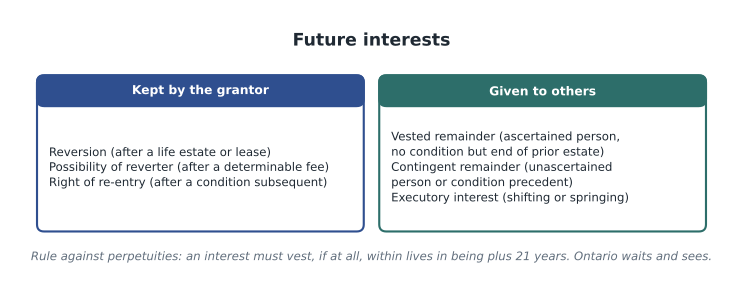
Future interests fall into two groups. The first group consists of interests the grantor keeps. A reversion is what remains with a grantor who gives away a smaller estate than they hold, such as a life estate or a lease; it is always vested. A possibility of reverter follows a determinable fee, and a right of re-entry follows a fee subject to a condition subsequent, as lesson 5 explained. The second group consists of interests given to someone other than the grantor: remainders and executory interests.
Remainders
A remainder is a future interest given to a third party that takes effect in possession when a prior estate, usually a life estate, comes to its natural end. In Margaret's gift of the farm 'to Walter for life, then to Ruth and Colin', Ruth and Colin hold a remainder.
A remainder is vested if it is given to an ascertained person and is not subject to any condition precedent other than the natural end of the prior estate. Ruth and Colin's remainder is vested: they are known, living people, and their interest will take effect in possession as soon as Walter's life estate ends. Lawyers say it is vested in interest now and will vest in possession on Walter's death. If Ruth died before Walter, her share would not disappear; it would pass under her own will or intestacy.
A remainder is contingent if it is given to a person who is not yet born or not yet ascertained, or is subject to a condition precedent. A gift 'to Walter for life, then to the first of Ruth's children to graduate from law school' gives a contingent remainder: nobody has met the condition yet, and nobody may ever meet it. A remainder can also be vested subject to divestment, where it is given to an ascertained person but may be taken away by a later event, or vested subject to open, where it is given to a class, such as 'Ruth's children', some of whom are alive but which may grow as more are born.
Older law had elaborate rules for legal contingent remainders, including the rule that a contingent remainder was destroyed if it had not vested when the prior estate ended. Those rules came from the feudal requirement that someone always be seised of land. Most of them are now of mainly historical interest, especially because most future interests today are created behind a trust, where the trustee holds the legal title and the beneficiaries hold equitable interests.
Executory interests
The common law did not allow a future interest to cut short a prior freehold estate or to spring up in the future without a prior estate to support it. After the Statute of Uses of 1535, and later through wills, such interests became possible. A shifting executory interest cuts short a prior estate in favour of someone else: 'to Colin, but if he stops farming, to Ruth.' A springing executory interest takes effect in the future from the grantor: 'to Emma when she marries.' Executory interests are always subject to the rule against perpetuities.
The rule against perpetuities
The rule against perpetuities limits how far into the future a property owner can control who will take their property. Its classic statement comes from the American scholar John Chipman Gray: 'No interest is good unless it must vest, if at all, not later than twenty-one years after some life in being at the creation of the interest.' The rule grew out of the Duke of Norfolk's Case (1682), in which the courts accepted that some future control was legitimate but drew a line to prevent landowners from tying up land indefinitely.
Several features of the rule cause confusion. It is about vesting, not about how long an interest lasts: a vested remainder that will take effect in possession two hundred years from now is valid, but a contingent remainder that might vest one day too late is void. It applies to contingent interests, executory interests and, at common law, to some interests kept by grantors. The perpetuity period is the lifetime of one or more people alive at the time the interest is created (the measuring lives), plus twenty-one years, plus any period of gestation. And at common law, the rule asked whether there was any possible way, however unlikely, that the interest could vest outside the period. If there was, the interest was void from the start, even if it actually vested soon after.
That last feature produced famous absurdities. In Jee v. Audley (1787), the court presumed that a woman of seventy could still have children, which invalidated a gift that depended on her having no more. The 'fertile octogenarian' became a standard example. The 'unborn widow' example involves a gift to a son's widow for life, then to their children who survive her: the son might marry someone not yet born, so the gift to the children might vest too late. The 'magic gravel pit' involves a gift that takes effect when a gravel pit is worked out: it might take longer than twenty-one years, so the gift failed at common law even though everyone expected the pit to be exhausted in a few years.
Clause seven at common law
Asante walks through clause seven. The gift is to a class, 'such of my grandchildren as attain the age of twenty-five', so it cannot vest in anyone until each grandchild's share is known, which means it must be clear which grandchildren will reach twenty-five. The will speaks from Margaret's death. Her children, Ruth and Colin, are lives in being at her death, and since Margaret is dead, no more children can be born to her. Every grandchild must be a child of Ruth or Colin. But Ruth or Colin could have another child next year, both could die the year after, and that child would reach twenty-five more than twenty-one years after the deaths of all the lives in being. At common law, the whole class gift is void, even though Emma is already nineteen and will very likely reach twenty-five within six years. Arjun Mehta calls this 'the rule punishing the gift for a possibility nobody believes in'.
Ontario's Perpetuities Act
Ontario reformed the rule in 1966. The Perpetuities Act keeps the rule but softens it. Its central reform is wait-and-see: an interest is not void merely because it might vest outside the perpetuity period. Instead, the court waits to see whether it actually vests within the period, and it becomes void only when it becomes clear that it cannot. The Act also identifies which lives count as measuring lives for wait-and-see purposes; if there are none, the period is twenty-one years.
The Act adds several saving devices. It sets presumptions about capacity to have children based on age, ending the fertile octogenarian problem, and allows evidence of actual incapacity. If an interest depends on a person reaching an age over twenty-one and would otherwise fail, the age is reduced to the extent needed to save the gift, but not below twenty-one. If the interest is a class gift and only some members might take too late, the class can be split so that those whose interests can vest in time still take. It addresses the unborn widow problem by treating a gift to a spouse's surviving children as if the spouse were a life in being. And it brings possibilities of reverter and rights of re-entry within the rule: if the event that would end a determinable fee or trigger a right of re-entry does not happen within the perpetuity period, the estate becomes absolute.
Clause seven under the Act
Under wait-and-see, the court does not declare clause seven void today. It waits. If Ruth and Colin have no more children, all three grandchildren were lives in being or born to lives in being, and they will reach twenty-five within the period measured by the lives the Act recognizes, so the gift will be valid. If a later-born grandchild cannot reach twenty-five within the period, the age reduction provision allows the court to reduce the age for that purpose, but not below twenty-one, and class splitting can protect the grandchildren whose shares vest in time. Asante's conclusion is that clause seven is very likely to work under the Act, even though it fails at common law. 'That,' he says, 'is why we still teach the common law rule: so you understand what the Act is fixing.'
The Pike Lake lot again
The perpetuity rules also affect the Pike Lake lot. At common law, a possibility of reverter after a determinable fee was not subject to the rule, so it could take effect centuries later. Under Ontario's Act, the possibility of reverter is subject to the perpetuity period. If the township keeps using the lot as a park for the whole period, its determinable fee becomes absolute, and the Holloway heirs lose their chance to get the lot back. Hannah Kowalczyk asks what the period is for a gift to a township. Asante says that is exactly the question a court would have to decide by applying the Act's rules on measuring lives, and that where no relevant lives can be identified, the period is twenty-one years. A drafter who wants a longer period of protection would need to use a different device, such as a covenant or a conservation easement held by a land trust.
Trusts and their variation
Most long-term future interests today are created behind a trust rather than as legal estates in land. A trustee holds the legal title, and the beneficiaries hold equitable life interests, remainders and contingent interests. Under the rule in Saunders v. Vautier (1841), adult beneficiaries of full capacity who are together entitled to the whole beneficial interest can end the trust and call for the property, whatever the settlor wanted. Where some beneficiaries are minors, unborn or unascertained, Ontario's Variation of Trusts Act allows a court to approve an arrangement varying the trust on their behalf if it benefits them. These tools give later generations a way out of arrangements that no longer make sense, which is one reason some reformers think the rule against perpetuities has outlived its purpose.
Beyond Ontario
Other provinces have reformed or abolished the rule. Manitoba abolished it in 1983, relying on the courts' power to vary trusts to prevent the problems it was designed to address, and some other jurisdictions have followed. Supporters of abolition say the rule creates traps for the unwary and serves little purpose now that most long-term interests are held in trusts that courts can vary. Supporters of the rule say it still protects later generations from the dead hand of earlier ones. Daniel Whitecloud observes that the debate is about the same question the course began with: how much control a person should have over things after they are gone.
Worked problem
Classifying the Holloway future interests
Classify each interest: (a) Ruth and Colin's interest in the farm after Walter's life estate; (b) the Holloway heirs' interest in the Pike Lake lot given to the township "so long as" it is a park; (c) the grandchildren's interest in the co-operative shares under clause seven.
Show solution
- (a) A remainder given to ascertained persons, subject only to the end of the life estate: a vested remainder in fee simple.
- (b) The interest kept after a determinable fee: a possibility of reverter, subject to the perpetuity period under Ontario's Act.
- (c) A class gift conditional on reaching twenty-five: contingent until the class closes and members reach the age.
- Under the common law rule, (c) is void because a later-born grandchild could reach twenty-five too late.
- Under Ontario's Perpetuities Act, wait-and-see, age reduction and class splitting will very likely save (c).
Common mistakes
MistakeThinking the rule limits how long an interest can last.
InsteadThe rule is about vesting: an interest must vest, if at all, within the perpetuity period.
MistakeApplying the common law "what might happen" test in Ontario.
InsteadOntario's Perpetuities Act uses wait-and-see and other saving devices.
MistakeTreating a remainder to a living, named person as contingent.
InsteadA remainder to an ascertained person with no condition other than the end of the prior estate is vested.
MistakeAssuming possibilities of reverter are outside the rule in Ontario.
InsteadThe Act brings possibilities of reverter and rights of re-entry within the perpetuity period.
Practice problems
Work each problem on paper first, then reveal the answer to check.
State the common law rule against perpetuities.
Show answer
No interest is good unless it must vest, if at all, not later than twenty-one years after some life in being at the creation of the interest.
What is the difference between a vested and a contingent remainder?
Show answer
A vested remainder is given to an ascertained person with no condition precedent other than the end of the prior estate; a contingent remainder is given to an unascertained person or is subject to a condition precedent.
What problem does wait-and-see solve?
Show answer
It stops interests from being struck down because of remote possibilities; the court waits to see whether they actually vest in time.
What is the "fertile octogenarian"?
Show answer
The common law presumption that anyone, however old, can have children, which invalidated gifts depending on no more children being born (Jee v. Audley).
What does age reduction do under Ontario's Act?
Show answer
It reduces an age requirement over twenty-one, but not below twenty-one, as far as needed to save the gift.
Summary and key terms
- Future interests are present property rights to future possession: reversions, possibilities of reverter, rights of re-entry, remainders and executory interests.
- Remainders are vested (ascertained person, no condition precedent) or contingent.
- The common law rule requires an interest to vest, if at all, within lives in being plus twenty-one years.
- The common law asked what might happen, producing traps such as the fertile octogenarian and the unborn widow.
- Ontario's Perpetuities Act adds wait-and-see, presumptions on capacity, age reduction, class splitting and treatment of unborn spouses.
- The Act brings possibilities of reverter and rights of re-entry within the rule, so determinable fees can become absolute.
- Remainder
- A future interest in a third party that takes effect when a prior estate ends naturally.
- Vested in interest
- A present right to future possession, held by an ascertained person, not subject to a condition precedent.
- Executory interest
- A future interest that cuts short a prior estate or springs up in the future, permitted by the Statute of Uses and wills.
- Measuring life
- A person alive when an interest is created whose life is used to measure the perpetuity period.
- Wait-and-see
- The statutory approach that judges validity by what actually happens during the perpetuity period.
- Class gift
- A gift to a group defined by a common characteristic, such as grandchildren, whose membership may change.
Lesson quiz · 5 questions
Score 60% or more to complete this lesson.
Create a free account to save your progress, take quizzes and earn a certificate.