
LAWC-112 · Lesson 9 of 12 · 22 min
Occupiers' liability and vicarious liability
▶ Video coming soon A video version of this lesson is on the way.
This lesson covers two ways tort law assigns responsibility beyond the person who directly caused harm. Occupiers' liability makes those who control premises responsible for keeping them reasonably safe. Vicarious liability makes employers responsible for torts committed by their employees in the course of employment, even if the employer did nothing wrong itself. Both are central to the Hallett Arena file.
Professor Bouchard-Ames introduces the last two incidents. Agnes Proulx, seventy-two, arrived for the late game at about 9 p.m. The front steps of the arena were covered with a thin layer of ice where meltwater from a blocked eavestrough had pooled and frozen. Salt had last been spread at 2 p.m. by Northline Snow Services, the city's snow contractor. Proulx slipped, fell and broke her hip. She did not see a lawyer until mid-May, more than three months later. And the guard who held Mason Levesque in lesson 1 was employed by Corwin Patrol Services, which the city hires for event security.
The Occupiers' Liability Act
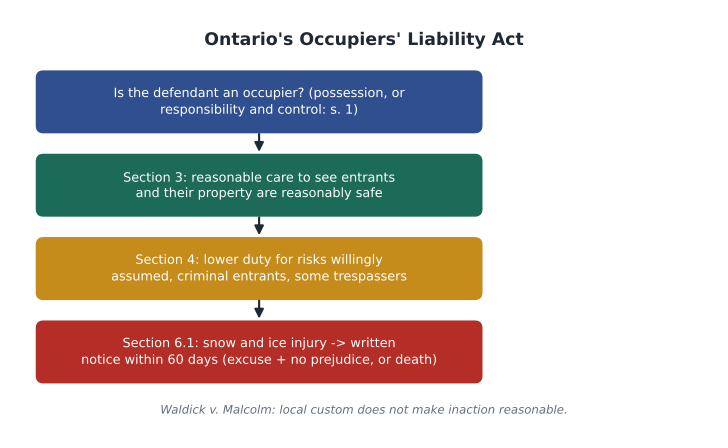
At common law, an occupier's duty depended on the category of the entrant: invitee, licensee or trespasser, with different duties for each. Ontario replaced that system with the Occupiers' Liability Act, RSO 1990, c. O.2. Under section 1, an occupier includes a person in physical possession of premises, or who has responsibility for and control over the condition of the premises, the activities conducted there or the persons allowed to enter. There can be more than one occupier. The city owns and operates Hallett Arena, so it is an occupier. A snow removal contractor with responsibility for the condition of the steps may also be one.
Section 3 sets the general duty: an occupier must take such care as in all the circumstances of the case is reasonable to see that persons entering the premises, and their property, are reasonably safe while on the premises. The duty applies whether the danger arises from the condition of the premises or from activities on them. It is a duty of reasonable care, not a guarantee of safety. In Waldick v. Malcolm, [1991] 2 SCR 456, a visitor slipped on an icy, unsanded driveway at a rural Ontario farmhouse. The occupiers argued that it was local custom not to salt or sand rural driveways. The Supreme Court held them liable: a local custom of not taking precautions does not make inaction reasonable, and the statute requires an objective assessment of what was reasonable in the circumstances.
Reduced duties
Section 4 lowers the duty in certain situations. For risks willingly assumed by the entrant, the occupier owes only a duty not to create a danger with the deliberate intent of doing harm and not to act with reckless disregard of the person's presence. Courts interpret 'willingly assumed' narrowly; mere knowledge of a risk is not enough, and the entrant must have accepted both the physical and legal risk. The same reduced duty applies to persons who enter with the intention of committing a criminal act, to trespassers on certain kinds of premises such as farmland and vacant rural land, and to people using recreational trails and certain other premises for recreational purposes without paying. Section 5 allows an occupier to restrict or modify its duty by express agreement or notice, but the occupier must take reasonable steps to bring the restriction to the entrant's attention, and a restriction cannot bind a third party who did not agree to it.
Snow and ice: section 6.1
Section 6.1 was added by the Occupiers' Liability Amendment Act, 2020 (S.O. 2020, c. 33), in force since January 29, 2021. It applies to claims for personal injury caused by snow or ice on premises. The injured person must serve written notice of the claim, including the date, time and location of the incident, on the occupier, or on a contractor responsible for snow and ice removal, within 60 days after the injury occurred. The notice may be served personally or by registered mail. If notice is served on one of them, that person must give a copy to the other within a reasonable time. Failure to give notice is not a bar if the injured person had a reasonable excuse and the defendant is not prejudiced by the delay, or if the injury resulted in death.
Agnes Proulx's case raises the same issue as the Ingram file students worked on in Legal Research and Writing. She did not serve notice within 60 days. Her lawyer will need evidence of a reasonable excuse, for example that her hip surgery, rehabilitation and the confusion caused by her pain medication prevented her from attending to the matter, and will have to rebut prejudice, for example by showing that the city's own incident report and the security footage preserved the evidence of the steps' condition. Courts interpreting similar notice provisions under the Municipal Act have held that a reasonable excuse must be more than ignorance of the requirement, and that the defendant must point to actual prejudice, though a lengthy delay may raise an inference of prejudice.
If the notice issue is overcome, the merits look favourable. A blocked eavestrough that caused water to pool and freeze on the main entrance is a known hazard. Salting once at 2 p.m. for an evening event, with freezing temperatures, is unlikely to be reasonable care, especially for a busy public building used by older spectators. The city may claim contribution from Northline under the Negligence Act if Northline's contract required more frequent salting or monitoring of the steps. Under section 6 of the Act, an occupier is not liable for damage caused by the negligence of an independent contractor if it took reasonable care in selecting and supervising the contractor, which the city will try to invoke for Northline's work.
Other routes: municipal liability and highways
Claims for falls on public roads and sidewalks are governed by the Municipal Act, 2001, not the Occupiers' Liability Act. Section 44 requires municipalities to keep highways and bridges in a reasonable state of repair, sets a ten-day notice period, protects municipalities from liability for snow and ice on sidewalks unless they were grossly negligent, and allows defences based on minimum maintenance standards. Had Proulx fallen on the city sidewalk in front of the arena rather than on the arena's own steps, her claim would have been much harder.
Vicarious liability
Vicarious liability is strict liability imposed on one person for a tort committed by another because of their relationship. The most important relationship is employment. An employer is vicariously liable for torts committed by employees in the course of their employment, even if the employer was not itself at fault. The doctrine is justified by two policy goals: fair compensation, because the employer introduced the risk and can spread the cost through insurance and prices, and deterrence, because the employer can take steps to reduce the risk.
Employees and independent contractors
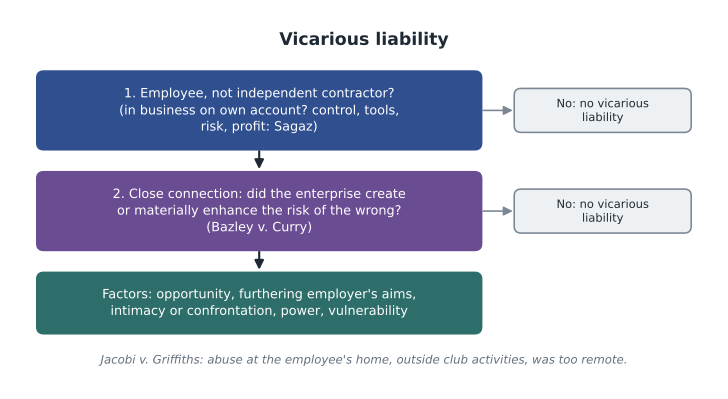
Employers are generally not vicariously liable for independent contractors. In 671122 Ontario Ltd. v. Sagaz Industries Canada Inc., 2001 SCC 59, [2001] 2 SCR 983, a supplier of car seat covers lost its contract with Canadian Tire after a rival company's sales consultant bribed a Canadian Tire employee. The question was whether the rival company was vicariously liable for its consultant. Major J. held that the central question is whether the person was performing the services as a person in business on their own account. Factors include the level of control the employer has over the worker's activities, whether the worker provides their own equipment, whether the worker hires helpers, the degree of financial risk taken by the worker, the worker's investment and management responsibility, and the worker's opportunity for profit. The consultant was an independent contractor, so the rival company was not vicariously liable.
The guard at Hallett Arena was employed by Corwin Patrol Services, not by the city. Corwin Patrol is his employer for vicarious liability purposes. Whether the city is also liable depends on its own conduct as occupier and on any non-delegable duty, a separate doctrine under which some duties, such as a hospital's duty to its patients or a school's duty to pupils in some circumstances, cannot be discharged by hiring a competent contractor.
The close connection test: Bazley v. Curry
The harder question is when a tort is committed in the course of employment. Traditionally, an employee's act was in the course of employment if it was authorized, or an unauthorized mode of doing an authorized act (the Salmond test). Intentional wrongs, such as theft or assault, were difficult to fit within that test. In Bazley v. Curry, [1999] 2 SCR 534, an employee of a non-profit residential care facility for emotionally troubled children sexually abused a child in his care. McLachlin J., for a unanimous Court, held the employer vicariously liable.
The Court explained that vicarious liability is appropriate where there is a significant connection between the creation or enhancement of a risk and the wrong that accrues from it, even if unrelated to the employer's desires. Factors include the opportunity the enterprise gave the employee to abuse power, the extent to which the wrongful act furthered the employer's aims, the extent to which it was related to friction, confrontation or intimacy inherent in the enterprise, the extent of power conferred on the employee in relation to the victim, and the vulnerability of potential victims. The facility's job required intimate, parent-like care, at night, for vulnerable children, so it materially enhanced the risk.
In the companion case Jacobi v. Griffiths, [1999] 2 SCR 570, the Court reached the opposite result by a 4 to 3 majority: a Boys and Girls Club employee who sexually abused children at his home, outside club activities, was too distantly connected to his employment, because the club's activities were group recreation in public settings and did not create the intimacy that led to the abuse. Later cases include K.L.B. v. British Columbia, 2003 SCC 51, holding that the province was not vicariously liable for abuse by foster parents, who were not its employees, and John Doe v. Bennett, 2004 SCC 17, holding a Catholic diocese vicariously liable for abuse by a priest.
Applying the test to the guard
The guard's detention of Mason Levesque was a misguided attempt to do his job, which was to protect the arena's property and keep order. Even under the traditional Salmond test, it was an unauthorized way of doing an authorized act. Under Bazley, the connection is strong: security work places guards in confrontation with members of the public, gives them apparent authority over them, and creates the opportunity to detain and search. Corwin Patrol Services is very likely vicariously liable for the false imprisonment and the trespass to Mason's backpack.
Bryce Talbot, the maintenance employee who leaked the video in lesson 4, is a harder case for the city. His job gave him access to the camera system, which is a point in Mason's favour. But leaking footage for amusement did not further the city's aims, and the misconduct arguably arose from his personal choices rather than from a risk inherent in maintenance work. Courts have divided on vicarious liability for employees who misuse confidential data; the result will turn on how much access and authority the job gave him.
Worked problem
Agnes Proulx on the icy steps
Agnes Proulx broke her hip falling on ice on the front steps of Hallett Arena in February, and first consulted a lawyer in mid-May. She sues the City of Corwin and Northline Snow Services. What issues arise?
Show solution
- Occupiers: the city controls the arena; Northline, responsible for the steps' condition, may also be an occupier under section 1.
- Notice requirement: section 6.1 requires written notice within 60 days for snow and ice injuries. She missed it, so she must show a reasonable excuse (her surgery, rehabilitation and medication) and no prejudice (preserved incident report and video).
- Duty and breach: section 3 requires reasonable care to make entrants reasonably safe; a blocked eavestrough creating ice on the main entrance, salted only at 2 p.m. before an evening event, likely falls short (Waldick v. Malcolm).
- Independent contractor: under section 6, the city may avoid liability for Northline's negligence if it took reasonable care in selecting and supervising it, but not for its own failure to fix the eavestrough.
- Apportionment: under the Negligence Act, liability may be divided between the city and Northline, and Proulx's own care (footwear, use of the handrail) may be considered.
Common mistakes
MistakeApplying the old invitee and licensee categories in Ontario.
InsteadThe Occupiers' Liability Act replaced them with a single duty of reasonable care in section 3, with reduced duties in section 4.
MistakeForgetting the 60-day notice for snow and ice claims.
InsteadSection 6.1 requires written notice within 60 days, subject to reasonable excuse without prejudice, or death.
MistakeTreating local custom as proof of reasonable care.
InsteadWaldick v. Malcolm held that a custom of not sanding rural driveways did not make inaction reasonable.
MistakeHolding employers liable for every wrong an employee commits at work.
InsteadBazley requires a close connection between the risk created or enhanced by the enterprise and the wrong; Jacobi shows the limits.
Practice problems
Work each problem on paper first, then reveal the answer to check.
Who is an occupier under Ontario's Occupiers' Liability Act?
Show answer
A person in physical possession of premises, or who has responsibility for and control over their condition, the activities there or the persons allowed in; there may be more than one.
What lower duty applies to risks willingly assumed?
Show answer
Not to create a danger with deliberate intent of doing harm and not to act with reckless disregard of the person's presence.
What is the central question in Sagaz for distinguishing employees from contractors?
Show answer
Whether the person was performing services as a person in business on their own account, considering control, tools, helpers, financial risk, investment and opportunity for profit.
What factors did Bazley v. Curry use for the close connection test?
Show answer
Opportunity for abuse, furthering of the employer's aims, friction or intimacy inherent in the enterprise, power conferred on the employee, and vulnerability of potential victims.
Why was there no vicarious liability in Jacobi v. Griffiths?
Show answer
The abuse occurred at the employee's home outside club activities, and the club's public group recreation did not create the intimacy that led to it.
Summary and key terms
- Ontario's Occupiers' Liability Act imposes a duty of reasonable care to keep entrants reasonably safe (section 3), with reduced duties for willingly assumed risks and some entrants (section 4).
- Section 6.1 requires written notice within 60 days for snow and ice injuries, subject to reasonable excuse without prejudice.
- Custom does not establish reasonable care (Waldick v. Malcolm); occupiers may escape liability for careful selection and supervision of independent contractors (section 6).
- Falls on public highways and sidewalks fall under the Municipal Act, with a ten-day notice and gross negligence for sidewalk snow and ice.
- Vicarious liability requires an employee (Sagaz) and a wrong closely connected to the risks the enterprise created (Bazley v. Curry; Jacobi v. Griffiths).
- Non-delegable duties make some defendants responsible even for contractors.
- Occupier
- A person in possession of, or with responsibility and control over, premises.
- Risks willingly assumed
- Physical and legal risks an entrant has accepted, reducing the occupier's duty under section 4.
- Vicarious liability
- Strict liability of one person for another's tort because of their relationship, usually employment.
- Independent contractor
- A person performing services in business on their own account, for whom there is generally no vicarious liability.
- Close connection test
- The Bazley test asking whether the enterprise created or materially enhanced the risk of the wrong.
- Non-delegable duty
- A duty that cannot be discharged by hiring a competent contractor.
Lesson quiz · 5 questions
Score 60% or more to complete this lesson.
Create a free account to save your progress, take quizzes and earn a certificate.