
LAWC-112 · Lesson 7 of 12 · 21 min
Standard of care
▶ Video coming soon A video version of this lesson is on the way.
Once a duty of care exists, the next question is whether the defendant breached it. The standard of care is that of the reasonable person in the defendant's circumstances. It is an objective standard: the question is not whether this defendant did their best, but whether they acted as a reasonable person would have acted in the same situation. This lesson covers how courts define that standard and the evidence they use to apply it.
Professor Bouchard-Ames returns to the carbon monoxide incident. The arena manager, Doug Fenwick, had disconnected the carbon monoxide detector in the stands three weeks earlier because it kept going off during busy weekend sessions, and he planned to replace it 'when the budget allowed'. Tri-County Ice Equipment had serviced the resurfacer, but its technician did not test the engine's exhaust emissions, a step recommended by the manufacturer's maintenance schedule and by guidance from the provincial safety regulator. Ontario's Technical Standards and Safety Authority (TSSA) regulates propane appliances, and arenas commonly follow published industry guidance on indoor air quality for ice resurfacers.
The reasonable person
The reasonable person is a legal construct, not a statistical average. In Arland v. Taylor, [1955] OR 131 (CA), Laidlaw J.A. described the reasonable person as someone of normal intelligence who makes prudence a guide to conduct, who does nothing that a prudent person would not do and does not omit anything a prudent person would do. The reasonable person is not perfect, not a genius, and not infallible; they are not required to foresee every remote possibility.
The standard is objective, so a defendant's own inexperience or limitations are usually no excuse. A learner driver is held to the standard of a reasonably competent driver, because other road users cannot adjust for the driver's inexperience. The standard does take account of the defendant's circumstances, such as an emergency. In an emergency created by someone else, a person is not negligent merely because, with hindsight, a different choice would have been better.
Weighing risk
Courts decide what a reasonable person would have done by weighing several factors. The first is the probability of harm. In Bolton v. Stone, [1951] AC 850 (HL), a cricket ball was hit out of a ground and struck a woman standing on a quiet residential road. Balls had left the ground only about six times in thirty years. The House of Lords held that the risk was so small that a reasonable person would not have taken further precautions. The second factor is the severity of the potential harm. In Paris v. Stepney Borough Council, [1951] AC 367 (HL), an employer failed to provide goggles to a worker who was already blind in one eye. A chip of metal blinded his good eye. The House of Lords held the employer liable: the consequences of an eye injury were far more serious for him, so greater precautions were required.
The third factor is the cost and burden of precautions. If a risk can be eliminated cheaply, a reasonable person will do so even if the risk is small; if precautions would be very expensive or would eliminate a useful activity, a reasonable person may accept some risk. The fourth factor is the social utility of the defendant's conduct. Emergency vehicles may take risks that ordinary drivers may not, because the purpose of their conduct justifies it, though they must still take reasonable care.
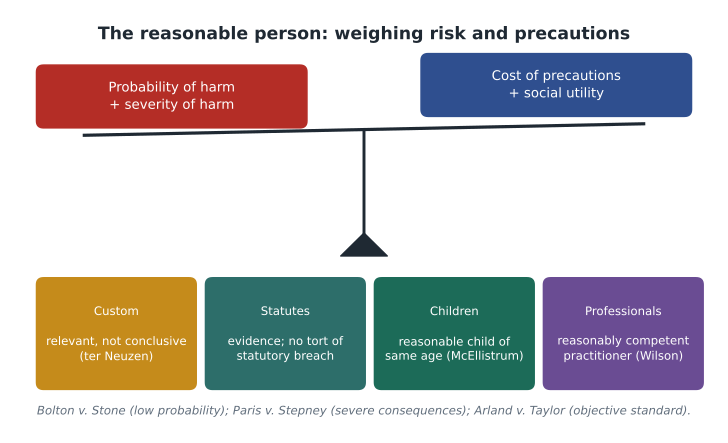
American courts sometimes express this balance as a formula, from Judge Learned Hand's decision in United States v. Carroll Towing Co., 159 F.2d 169 (2d Cir. 1947): a defendant is negligent if the burden of precautions is less than the probability of harm multiplied by its gravity. Canadian courts do not apply the formula mathematically, but the factors it names are the same ones they weigh.
Applying the factors to the arena
The probability of carbon monoxide buildup from a poorly running propane engine in an enclosed arena is significant; it is the reason detectors and emissions testing are standard. The severity is very high, because carbon monoxide can kill. The cost of precautions, a working detector, an emissions test during servicing, and good ventilation, is modest compared with the risk. The social utility of running a public skate does not justify exposing spectators to that risk. A court is very likely to find that both the city, through its manager's decision to disconnect the detector without replacing it, and Tri-County, by skipping a recommended emissions test, fell below the standard of care.
Custom and industry practice
Evidence of what others in the same field usually do is relevant to the standard of care, but it is not conclusive. Conformity with industry practice suggests that the defendant acted reasonably, and departure from it suggests negligence. But an entire industry can be careless. In ter Neuzen v. Korn, [1995] 3 SCR 674, a woman contracted HIV through artificial insemination in 1985, before the risk of HIV transmission through semen was widely known. The Court held that a doctor who follows the standard practice of the profession is generally not negligent, but that a practice may itself be negligent if it is fraught with obvious risks that anyone could recognize without medical expertise. Courts are slow to second-guess technical medical judgments, but they will find a common practice negligent where its danger is obvious to a lay person.
Statutes and the standard of care
Many statutes and regulations set safety standards, such as traffic laws, building codes and workplace safety rules. In The Queen in right of Canada v. Saskatchewan Wheat Pool, [1983] 1 SCR 205, the Court held that Canada does not recognize a separate tort of breach of statutory duty. Breach of a statute is not automatically negligence, but it may be evidence of negligence, and the statute may help define the reasonable standard. Conversely, compliance with a statute does not necessarily mean a defendant acted reasonably.
Ryan v. Victoria (City), [1999] 1 SCR 201, illustrates the second point. A motorcyclist was injured when his tire caught in a railway flangeway on a city street. The railway's tracks met the standards approved by the federal railway regulator. Major J. held that statutory compliance did not end the inquiry: where a statute sets only a general standard or allows discretion, a defendant may have to do more than the minimum. The Court upheld the finding that the railway was negligent despite its regulatory compliance.
In the arena case, TSSA rules on propane equipment and published guidance on resurfacer emissions are strong evidence of what reasonable care requires. Tri-County's failure to follow the manufacturer's schedule and the regulator's guidance is persuasive evidence of breach, even though there is no separate tort of breaching the regulation.
Res ipsa loquitur and inferences
Plaintiffs sometimes have no direct evidence of what went wrong. The old doctrine of res ipsa loquitur ('the thing speaks for itself') allowed a presumption of negligence where an accident would not ordinarily happen without negligence and the cause was within the defendant's control. In Fontaine v. British Columbia (Official Administrator), [1998] 1 SCR 424, the Court held that the doctrine should be treated as expired. Circumstantial evidence is assessed like any other evidence: the trier of fact may draw an inference of negligence where the facts support it, and the defendant may answer it.
Special standards: children
Children are judged by the standard of a reasonable child of similar age, intelligence and experience. In McEllistrum v. Etches, [1956] SCR 787, the Court applied this standard to a six-year-old who ran onto a road. Very young children may be incapable of negligence. When a child engages in an adult activity, such as driving a car or operating a snowmobile, courts generally apply the adult standard, because others cannot protect themselves from an inexperienced operator. Parents are not vicariously liable for their children's torts at common law, but they may be liable for their own negligent supervision. Ontario's Parental Responsibility Act, 2000 makes parents liable, up to the Small Claims Court limit, for property damage intentionally caused by their children, unless the parent shows reasonable supervision.
Mental and physical disability
Canadian courts have generally refused to hold a defendant negligent where a sudden, unforeseen mental illness or medical event deprived them of the ability to understand or control their conduct. In Fiala v. Cechmanek, 2001 ABCA 169, a man in a manic episode jumped on a car and choked the driver, who then hit another car. The Alberta Court of Appeal held that he was not liable, because his illness had suddenly and without warning deprived him of the capacity to understand or appreciate the duty of care. The defence does not apply if the defendant knew of the condition and failed to take precautions.
Professionals
Professionals are held to the standard of the reasonably competent member of their profession, and specialists to the standard of the reasonable specialist. In Wilson v. Swanson, [1956] SCR 804, a surgeon decided, based on the information available during surgery, to remove a growth he believed was malignant. It proved benign. The Court held that an honest error of judgment, made after careful consideration, is not negligence. Courts distinguish between errors of judgment that a reasonable professional could make and errors that no reasonable professional would make. Lawyers, engineers, accountants and architects are judged the same way, usually through expert evidence about what a reasonable practitioner would have done.
Bouchard-Ames closes by noting that Hemmings v. Padmore, which the Supreme Court decided in October 2026 and which lesson 8 covers, began as a standard of care case. The trial judge found an obstetrician, an anesthesiologist and a nurse all fell below the standard expected of them, before the case turned on causation and remoteness.
Proving breach in practice
Most negligence trials are about breach. The evidence typically includes the defendant's own policies and manuals, industry guidelines, manufacturer instructions, inspection and maintenance records, witness accounts and expert opinion. A defendant's internal policy does not set the legal standard, but a failure to follow one's own safety rules is often persuasive evidence of carelessness, and juries and judges find it hard to accept that a defendant acted reasonably when it ignored its own rules. In the arena case, if the city's facility manual required the stands' carbon monoxide detector to be operational during public events, Doug Fenwick's decision to disconnect it will be very difficult to defend.
Hindsight is the main trap for the trier of fact. The question is what a reasonable person would have done with the knowledge available at the time, not what seems obvious after the accident. Courts warn against judging conduct through the 'retrospectoscope'. A defendant who acted reasonably on the information available is not negligent merely because a precaution would have prevented the harm. That principle protects defendants like the surgeon in Wilson v. Swanson, but it does not help a manager who deliberately disabled a safety device knowing why it was there.
Worked problem
Did the arena and Tri-County breach the standard of care?
Assume the City of Corwin and Tri-County Ice Equipment owed Lucia Ferraro a duty of care. Did either breach the standard of care?
Show solution
- Standard: the reasonable arena operator and the reasonable resurfacer service company, judged objectively.
- Probability and severity: carbon monoxide buildup from a propane engine indoors is a known risk with potentially fatal consequences (Paris v. Stepney: serious consequences demand greater care).
- Burden of precautions: a working detector, an emissions test and ventilation cost little compared with the risk (Bolton v. Stone is distinguishable because that risk was tiny).
- Custom and regulation: the manufacturer's schedule, TSSA requirements and industry guidance are strong evidence of the standard; breaching them is evidence of negligence, though there is no tort of statutory breach (Saskatchewan Wheat Pool).
- Conclusion: the city breached the standard when its manager disconnected the detector without replacing it, and Tri-County breached it by skipping the emissions test. Causation is next.
Common mistakes
MistakeAsking whether the defendant did their personal best.
InsteadThe standard is objective: what a reasonable person would have done in the circumstances (Arland v. Taylor).
MistakeTreating compliance with industry custom as a complete defence.
InsteadCustom is relevant but not conclusive; a practice fraught with obvious risks can be negligent (ter Neuzen v. Korn).
MistakePleading a tort of breach of statutory duty.
InsteadCanada recognizes no such tort; breach of a statute is evidence of negligence (Saskatchewan Wheat Pool), and compliance is not conclusive (Ryan v. Victoria).
MistakeRelying on res ipsa loquitur as a presumption.
InsteadFontaine treats the doctrine as expired; circumstantial evidence may support an inference of negligence.
Practice problems
Work each problem on paper first, then reveal the answer to check.
What four factors do courts weigh in setting the standard of care?
Show answer
The probability of harm, the severity of potential harm, the cost and burden of precautions, and the social utility of the conduct.
Why was the employer liable in Paris v. Stepney?
Show answer
The worker was already blind in one eye, so the consequences of an eye injury were especially severe and greater precautions were required.
What standard applies to children who drive cars or snowmobiles?
Show answer
Generally the adult standard, because they are engaged in an adult activity.
What did Wilson v. Swanson decide about professionals?
Show answer
An honest error of judgment made after careful consideration is not negligence; the standard is the reasonably competent practitioner.
What did Fiala v. Cechmanek decide?
Show answer
A defendant suddenly and without warning deprived by mental illness of the capacity to understand or appreciate the duty of care is not negligent.
Summary and key terms
- The standard of care is the objective standard of the reasonable person in the defendant's circumstances (Arland v. Taylor).
- Courts weigh probability and severity of harm against the cost of precautions and the utility of the conduct (Bolton v. Stone; Paris v. Stepney).
- Custom is relevant but not conclusive (ter Neuzen v. Korn); statutes are evidence of the standard without a tort of statutory breach (Saskatchewan Wheat Pool; Ryan v. Victoria).
- Res ipsa loquitur has expired; circumstantial evidence may support an inference (Fontaine).
- Children are judged against a reasonable child of similar age, intelligence and experience, except in adult activities (McEllistrum v. Etches).
- Professionals are held to the reasonably competent practitioner standard; honest errors of judgment are not negligence (Wilson v. Swanson).
- Standard of care
- The level of care a reasonable person would exercise in the circumstances.
- Reasonable person
- An objective legal construct of a prudent person of normal intelligence.
- Hand formula
- The American expression of negligence as a burden of precautions less than probability times gravity.
- Res ipsa loquitur
- A former doctrine presuming negligence from the nature of an accident, treated as expired in Fontaine.
- Error of judgment
- A reasonable professional choice that turns out badly, which is not negligence.
Lesson quiz · 5 questions
Score 60% or more to complete this lesson.
Create a free account to save your progress, take quizzes and earn a certificate.