
LAWC-112 · Lesson 3 of 12 · 22 min
Trespass, nuisance and strict liability
▶ Video coming soon A video version of this lesson is on the way.
Torts protect interests in property as well as interests in the person. This lesson covers the torts that protect land and goods: trespass to land, private nuisance, the strict liability rule in Rylands v. Fletcher, and the torts that protect chattels, such as trespass to goods and conversion. Professor Bouchard-Ames introduces them with a part of the Hallett Arena file that has nothing to do with hockey.
The arena sits beside the Maple Street Diner, a family restaurant owned by Gwen Abernethy. For two years the arena's rooftop refrigeration compressors have run late into the night, producing a low hum that Abernethy says can be heard in her upstairs apartment. On the night of the incidents, the arena's ice plant also released a cloud of ammonia-scented vapour from a faulty relief valve, forcing the diner to close for the evening. And arena patrons regularly cut across the diner's back lot to reach the parking area, leaving litter and occasionally scraping her delivery van.
Trespass to land
Trespass to land is a direct and intentional physical intrusion onto land in the possession of another. It protects possession, not ownership, so a tenant can sue a trespasser, and even a landlord can be a trespasser against a tenant in possession. Like the trespass torts to the person, it is actionable per se: the plaintiff need not prove damage. The intent required is only the intent to enter the land; a mistaken belief that the land is one's own, or that one has permission, is no defence.
Trespass includes walking onto land, placing objects on it, remaining after permission is withdrawn, and intrusions into the airspace and subsoil to the extent reasonably necessary for the owner's use of the land. Courts have held that an encroaching sign or a crane swinging over a neighbouring property can be a trespass, and injunctions are often granted to stop continuing trespasses even where the damage is small. In Ontario, the Trespass to Property Act creates provincial offences for entering premises where entry is prohibited or engaging in a prohibited activity, and allows occupiers to give notice by signs or verbal warnings. The statute supplements but does not replace the common law tort.
The arena patrons who cut across Abernethy's back lot are trespassers, if she has not consented and has made it clear that entry is not permitted. Abernethy's practical remedy is not a lawsuit against individual patrons, whom she cannot identify. It is posting signs under the Trespass to Property Act, fencing the lot and asking the city, as the arena's owner, to direct parking elsewhere. Bouchard-Ames uses the point to remind students that tort remedies are only one tool among many.
Private nuisance
Private nuisance protects the use and enjoyment of land. It covers interference that is indirect, such as noise, smells, smoke, vibration, or the spread of contaminants, and it requires proof of damage. The leading Canadian statement of the test is Antrim Truck Centre Ltd. v. Ontario (Transportation), 2013 SCC 13, [2013] 1 SCR 594. Ontario built a new section of Highway 17 that bypassed the plaintiff's truck stop, cutting off direct access and destroying its business. The case arose under the Expropriations Act, which incorporates the common law of nuisance for injurious affection claims.
Cromwell J., for a unanimous Court, held that an interference is a nuisance if it is both substantial and unreasonable. Substantial means non-trivial: the interference must amount to more than a slight annoyance or trifling interference. Unreasonable requires balancing the gravity of the harm against the utility of the defendant's conduct in all the circumstances. Relevant factors include the severity of the interference, the character of the neighbourhood, the sensitivity of the plaintiff's use and the frequency and duration of the interference. Where the defendant's activity is a public work that benefits the community, the question is whether it is reasonable for the plaintiff to bear the burden alone, without compensation. The Court upheld an award for Antrim's business losses: a public benefit does not make it reasonable to impose a severe, permanent loss on one landowner.
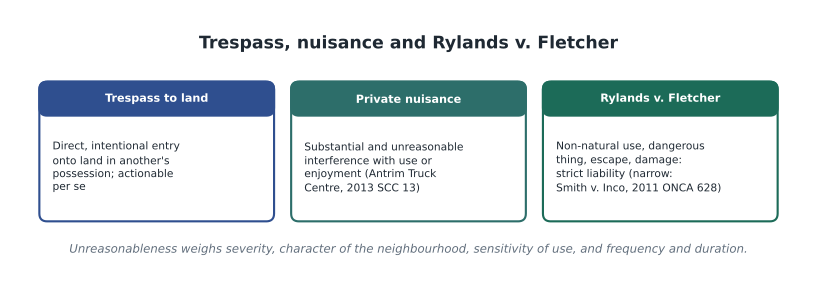
Applying Antrim to the diner, the compressor hum is a recurring interference with the enjoyment of the apartment. Whether it is substantial depends on evidence of noise levels and its effect on sleep; a bylaw noise study helps. Whether it is unreasonable depends on the character of the neighbourhood, which mixes commercial and residential uses, the hours of operation, the availability of cheap noise dampening, and the fact that the diner was there first, although the defence of 'coming to the nuisance' is not available in Canada as a complete answer. The ammonia vapour release is a single incident, but a severe one that forced a business to close; isolated escapes can be nuisances when they cause physical damage or serious interference, and they may also fall under Rylands v. Fletcher.
Defences to nuisance include statutory authority, which applies when the nuisance is the inevitable result of doing what a statute authorized; the defendant must show that it was practically impossible to avoid the nuisance (Ryan v. Victoria (City), [1999] 1 SCR 201, discussed further in lesson 7). In Tock v. St. John's Metropolitan Area Board, [1989] 2 SCR 1181, a municipal storm sewer backed up into a house; the Court divided on how statutory authority should apply, and the case remains a reminder that public bodies are not automatically immune from nuisance liability. Remedies include damages and injunctions. Courts in Ontario may award damages in lieu of an injunction under section 99 of the Courts of Justice Act.
Public nuisance
Public nuisance is a separate tort that protects the public at large, such as the obstruction of a highway or pollution of a public waterway. It is usually enforced by the Attorney General or a municipality. A private plaintiff may sue for public nuisance only if they suffered special damage, different in kind from that suffered by the public generally. A delivery truck blocked from reaching the diner by a dangerous ice dam the city allowed to form on Maple Street would be suffering the same inconvenience as other motorists; a diner whose only entrance was blocked for days might show special damage.
The rule in Rylands v. Fletcher
In Rylands v. Fletcher (1868), LR 3 HL 330, the defendants built a reservoir on their land. Water broke through old mine shafts and flooded the plaintiff's mine. The defendants were not negligent, because they did not know the shafts existed. The House of Lords held them liable anyway. Blackburn J., in the court below, said that a person who for their own purposes brings onto their land something likely to do mischief if it escapes must keep it in at their peril. Lord Cairns added the requirement that the use of the land be non-natural.
The Court of Appeal for Ontario restated the rule in Smith v. Inco Ltd., 2011 ONCA 628. Residents of Port Colborne sued Inco for nickel particles deposited on their properties from a refinery that operated for decades. The trial judge had awarded damages under both nuisance and Rylands v. Fletcher. The Court of Appeal reversed. On nuisance, it held that the presence of nickel in the soil did not cause actual, substantial physical damage, because there was no evidence of harm to health or of physical change to the properties, only concern that lowered property values. On Rylands, it held that operating a refinery in an industrial area of Port Colborne, in compliance with regulatory requirements, was not a non-natural use. The court described a non-natural use as one that is extraordinary or unusual in the circumstances, assessed by reference to the place and time, and emphasized that strict liability is for exceptional cases.
The elements of Rylands, as summarized in Smith v. Inco, are: (1) the defendant made a non-natural or special use of its land; (2) the defendant brought onto its land something likely to do mischief if it escaped; (3) the substance escaped; and (4) the escape caused damage. Defences include consent of the plaintiff, the default of the plaintiff, an act of God, the deliberate act of a stranger and statutory authority. Rylands remains rare in Canadian litigation, because most escapes can also be framed as negligence or nuisance, and courts are reluctant to impose strict liability where an activity is common in its location.
Bouchard-Ames asks whether an arena's ammonia refrigeration plant is a non-natural use. Ammonia is toxic, and arena ammonia leaks have caused deaths in Canada, including the 2017 Fernie, British Columbia arena leak in which three workers died. But arenas with ammonia plants are common in Canadian towns and are heavily regulated. Smith v. Inco suggests a court would be slow to call an ordinary arena plant a non-natural use. Abernethy's stronger claim for the night's closure is in negligence, based on poor maintenance of the relief valve, or in nuisance.
Strict liability by statute
Legislatures have created strict liability in some areas. Ontario's Dog Owners' Liability Act, RSO 1990, c. D.16, makes the owner of a dog liable for damages resulting from a bite or attack by the dog on another person or domestic animal, whether or not the owner was at fault. Where more than one person is an owner, they are jointly and severally liable. The plaintiff's own fault in contributing to the damage, such as provoking the dog, reduces recovery in proportion to the degree of fault. The capstone problem in lesson 12 uses this statute. Other examples include environmental statutes that impose liability on persons who have charge, management or control of a pollutant that spills.
Torts to chattels
Chattels are movable property. Trespass to goods is a direct, intentional interference with goods in another's possession, such as moving, damaging or searching them. The guard's search of Mason Levesque's backpack in lesson 1 was a trespass to goods. Conversion is a more serious interference: an intentional dealing with goods that is inconsistent with the owner's rights and amounts to a denial of title, such as stealing, destroying or selling them. The plaintiff in conversion recovers the full value of the goods. In Boma Manufacturing Ltd. v. Canadian Imperial Bank of Commerce, [1996] 3 SCR 727, the Court held that a bank that credited cheques fraudulently made out to payees and deposited by an employee committed conversion, which is a strict liability tort: the bank's honesty was no defence. Detinue is the wrongful refusal to return goods after a demand. Today these older torts often overlap with claims in unjust enrichment and contract.
Nuisance and climate, water and light
Nuisance law is increasingly used in environmental disputes. Neighbours have sued over odours from cannabis production facilities, noise from wind turbines and flooding caused by changes to drainage. Courts generally apply the Antrim framework, giving weight to land use planning approvals and environmental permits without treating them as conclusive. Interference with a view or with sunlight is usually not actionable as nuisance at common law in Canada, because there is no natural right to a view or to light; those interests are protected, if at all, through zoning, easements and restrictive covenants. Interference with water flow, by contrast, has long been actionable, and riparian owners may sue upstream users who unreasonably diminish or pollute a watercourse.
Bouchard-Ames asks whether a nuisance claim could ever address climate change. Plaintiffs in the United States and elsewhere have tried to sue large emitters in nuisance, and some Canadian municipalities have explored similar claims. The difficulties are causation, since every emitter's contribution is a tiny part of a global problem, and the question whether courts or legislatures should set emission limits. The Supreme Court's decision in References re Greenhouse Gas Pollution Pricing Act, 2021 SCC 11, which students met in Constitutional Law, treated climate change as a matter of national concern for Parliament, which may make courts more cautious about developing private law remedies in the same field.
Worked problem
The diner, the compressors and the ammonia
Gwen Abernethy sues the City of Corwin, which owns and operates Hallett Arena, for the compressor noise and for the night the diner closed because of the ammonia vapour. What claims should she plead?
Show solution
- Private nuisance (noise): prove a substantial, non-trivial interference with the use and enjoyment of her apartment, through noise readings and evidence of disturbed sleep; then argue it is unreasonable given the hours, the mixed neighbourhood and the low cost of dampening (Antrim).
- Private nuisance (vapour): a single severe escape that closed the business can be a substantial and unreasonable interference; her damages are the lost profits of the evening and any spoiled food.
- Rylands v. Fletcher: possible, but an ordinary municipal arena plant is unlikely to be a non-natural use (Smith v. Inco), so it should be a secondary argument.
- Negligence: plead that the city failed to maintain the relief valve; lesson 5 covers duty and lesson 7 the standard of care.
- Defences: the city may argue statutory authority, but must show the nuisance was the inevitable result of operating the arena (Ryan v. Victoria). Coming to the nuisance would not be a complete answer in any event, and the diner was there first.
Common mistakes
MistakeRequiring proof of damage for trespass to land.
InsteadTrespass is actionable per se; nuisance requires damage.
MistakeTreating any annoyance as a nuisance.
InsteadUnder Antrim the interference must be substantial (non-trivial) and unreasonable after balancing all the circumstances.
MistakeApplying Rylands v. Fletcher to any industrial escape.
InsteadSmith v. Inco requires a non-natural use, meaning extraordinary or unusual in its place and time; ordinary industrial uses in industrial areas usually do not qualify.
MistakeSaying conversion requires dishonesty.
InsteadConversion is a strict liability tort; an honest dealing inconsistent with the owner's title is enough (Boma).
Practice problems
Work each problem on paper first, then reveal the answer to check.
What interest does trespass to land protect, and who can sue?
Show answer
Possession; a person in possession, including a tenant, can sue, even against an owner who is not in possession.
What two questions does Antrim Truck Centre ask?
Show answer
Whether the interference is substantial (non-trivial), and whether it is unreasonable after balancing its gravity against the utility of the defendant's conduct.
Why did the nuisance claim fail in Smith v. Inco?
Show answer
There was no actual, substantial physical damage to the properties; concern about nickel levels lowering property values was not enough.
When can a private plaintiff sue for public nuisance?
Show answer
Only if they suffered special damage different in kind from that of the public generally.
What does Ontario's Dog Owners' Liability Act provide?
Show answer
Owners are liable for damage from a bite or attack without proof of fault, jointly and severally if there are several owners, with reductions for the plaintiff's contributory fault.
Summary and key terms
- Trespass to land is a direct, intentional entry onto land in another's possession and is actionable per se.
- Private nuisance requires a substantial and unreasonable interference with the use or enjoyment of land (Antrim Truck Centre, 2013 SCC 13).
- Public nuisance protects the public; private plaintiffs need special damage.
- Rylands v. Fletcher imposes strict liability for escapes from a non-natural use of land, a narrow category in Canada (Smith v. Inco, 2011 ONCA 628).
- Statutes such as Ontario's Dog Owners' Liability Act impose strict liability.
- Trespass to goods, conversion and detinue protect chattels; conversion is strict liability (Boma).
- Trespass to land
- A direct, intentional physical intrusion onto land in another's possession.
- Private nuisance
- A substantial and unreasonable interference with the use or enjoyment of land.
- Special damage
- Damage different in kind from that suffered by the public, needed for a private public nuisance claim.
- Non-natural use
- A use of land that is extraordinary or unusual in its place and time, required for Rylands v. Fletcher.
- Conversion
- An intentional dealing with goods inconsistent with the owner's title.
- Statutory authority
- A defence where the harm is the inevitable result of doing what a statute authorized.
Lesson quiz · 5 questions
Score 60% or more to complete this lesson.
Create a free account to save your progress, take quizzes and earn a certificate.