
LAWC-112 · Lesson 12 of 12 · 20 min
Capstone: solving a torts problem
▶ Video coming soon A video version of this lesson is on the way.
The final lesson brings the course together in a single problem, the kind that appears on a first-year torts exam. Professor Bouchard-Ames distributes it at the last class with a warning: 'Every year someone writes six pages on the dog and forgets the car crash. Map the issues first. Then write.' This lesson sets out the problem, a method for answering it, and a model answer.
The problem
Dana and Marcus Beaulieu host a backyard party at their home in Corwin on a hot Saturday in July to celebrate their daughter's graduation. About forty guests attend. The Beaulieus provide food and soft drinks and tell guests to bring their own alcohol. They have an in-ground pool, installed three years earlier by Corwin Pool Supply. The deep end is marked 2.4 metres; the shallow end, which has no depth markings, is 1.1 metres. A sign on the fence reads 'Swim at your own risk. No diving.' Guests were asked to sign a short form at the gate saying, 'I agree that the Beaulieus are not responsible for any injury at this party.' Most guests, including everyone mentioned below, signed it without reading it.
Jordan Reyes, twenty-four, a friend of the daughter, has had four beers over three hours. At about 9 p.m., as the light is fading, he dives from the side of the pool into what he believes is the deep end but is actually the shallow end. He strikes the bottom and suffers a spinal cord injury, leaving him with permanent partial paralysis. The pool lights were not switched on.
The Beaulieus' dog, Biscuit, a large mixed breed that has never bitten anyone, is usually kept inside during parties. At about 7 p.m. Marcus lets Biscuit into the yard. Eight-year-old Arun Venkatesh, playing tag, runs past Biscuit and pulls his tail. Biscuit bites Arun on the forearm, causing a wound that needs stitches and leaves a scar.
Trent Whitlock, a neighbour, drinks heavily all evening. Dana notices him stumbling and slurring at about 10 p.m. and suggests he 'take it easy'. He leaves at 11 p.m., gets into his car and, a few blocks away, runs a stop sign and hits a car driven by Rosa Delgado, who is seriously injured. Whitlock's blood alcohol concentration is later found to be well over the legal limit.
Finally, another guest, Kelsey Marsh, filmed Jordan being lifted out of the pool, motionless and crying, and posted the video to her public social media account with the caption 'Too many beers lol'. It was viewed thousands of times before she deleted it two days later. Jordan learned of it from his sister while in hospital.
Advise all parties on their potential liability in tort.
Method: map the issues first
Bouchard-Ames recommends a three-step method. First, list every plaintiff and every possible defendant. Second, for each pairing, list the possible causes of action and the main defences. Third, decide the order: start with the strongest and most valuable claims, and deal briefly with weak ones. For each issue, state the rule with its authority, apply it to the facts, address the counterargument and reach a conclusion, even if it is qualified.
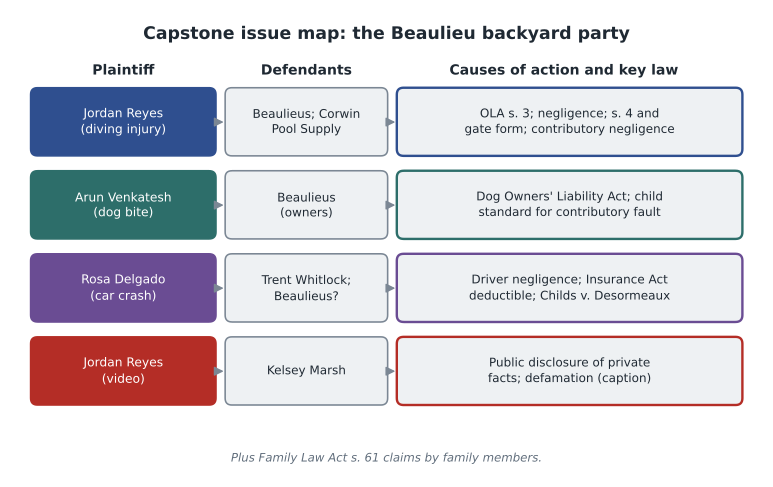
The plaintiffs are Jordan Reyes, Arun Venkatesh (suing through his parent as litigation guardian), Rosa Delgado, and Jordan again for the video. The possible defendants are Dana and Marcus Beaulieu, Corwin Pool Supply, Trent Whitlock and Kelsey Marsh. Claims by family members under section 61 of the Family Law Act should also be mentioned.
Model answer: Jordan Reyes and the pool
Duty. The Beaulieus are occupiers of their home and yard under section 1 of the Occupiers' Liability Act. Under section 3, they owed Jordan a duty to take reasonable care to see that he was reasonably safe while on the premises. No novel duty analysis is needed. Corwin Pool Supply, which installed the pool, falls within the established category of manufacturers and installers who owe a duty to foreseeable users of their products (Donoghue v. Stevenson).
Standard of care. The Beaulieus were not required to guarantee Jordan's safety. But the risk of diving injuries in residential pools is well known, the consequences are catastrophic and the precautions are cheap: depth markings, pool lights, supervision and enforcing a no-diving rule (Paris v. Stepney; Bolton v. Stone distinguished). The 'no diving' sign is relevant, but a sign alone may not be reasonable care when the host knows guests are drinking at dusk around an unlit pool with no shallow end markings. Corwin Pool Supply's liability depends on evidence: if industry standards or the building code required depth markings or a particular configuration at the shallow end, failure to provide them is strong evidence of negligence (Saskatchewan Wheat Pool; ter Neuzen).
Causation. Jordan must prove that the injury would not have occurred but for the breaches, applying a robust common-sense approach (Clements; Snell). If depth markings and lighting would probably have shown him he was at the shallow end, causation is established. Where both the Beaulieus' and Corwin Pool Supply's negligence caused the indivisible injury, they are jointly and severally liable, with contribution between them under the Negligence Act (Athey).
Defences. Section 4 of the Occupiers' Liability Act reduces the duty for risks willingly assumed, and the Beaulieus will argue that Jordan willingly assumed the risk of diving. Courts interpret this narrowly: Jordan accepted the physical risk of swimming, not the legal risk of the hosts' failure to mark the pool or light it. Voluntary assumption of risk at common law fails for the same reason (Dube v. Labar; Crocker). The gate form is an attempt to restrict liability under section 5, which requires reasonable steps to bring the restriction to the entrant's attention. A one-line form signed without reading in a festive atmosphere, with no explanation, is unlikely to meet that standard (Crocker). It also says nothing about Corwin Pool Supply. Contributory negligence is the real defence: diving into a pool in fading light after four beers, despite a 'no diving' sign, is a failure to take reasonable care for his own safety. A court could reasonably reduce his damages by a significant proportion, perhaps between a quarter and a half, under section 3 of the Negligence Act.
Damages. Jordan's damages will be very large. Pecuniary damages include loss of future earning capacity over a working lifetime and the cost of future care, which in spinal cord cases can run to many millions of dollars. Non-pecuniary damages will approach the trilogy cap, now a little under 470,000 dollars, given a catastrophic permanent injury to a young man (Andrews). His family members can claim under section 61 of the Family Law Act.
Model answer: Arun Venkatesh and the dog
Ontario's Dog Owners' Liability Act makes the owner of a dog liable for damages resulting from a bite or attack on another person, without proof of fault. Biscuit's previous good behaviour is irrelevant; the Act displaces the old common law scienter rule, which required knowledge of the dog's vicious propensity. If Dana and Marcus both own Biscuit, they are jointly and severally liable. The Act allows damages to be reduced in proportion to the plaintiff's contributory fault. Arun pulled Biscuit's tail, but an eight-year-old's conduct is measured against a reasonable child of similar age, intelligence and experience (McEllistrum v. Etches). Many eight-year-olds would not appreciate that pulling a calm dog's tail could provoke a bite, so any reduction is likely to be small. Arun's damages are modest compared with the other claims: general damages for pain and the scar, and any cost of scar revision. His parents may claim their expenses under the Family Law Act.
Model answer: Rosa Delgado and the drunk guest
Trent Whitlock is plainly liable to Rosa Delgado in negligence: a driver owes a duty to other road users, and driving while impaired and running a stop sign falls far below the standard of care. Causation and remoteness raise no difficulty. Because this is a motor vehicle accident, Ontario's Insurance Act applies: her non-pecuniary damages are subject to the permanent serious impairment threshold and, for 2026, a deductible of 47,913.01 dollars on awards up to 159,708.71 dollars. Her statutory accident benefits are deducted from her tort recovery.
The harder question is whether the Beaulieus are liable to her as social hosts. In Childs v. Desormeaux, 2006 SCC 18, the Supreme Court held that social hosts who held a bring-your-own-alcohol party owed no duty to third parties injured by a guest who drove drunk. The Court distinguished commercial hosts, who sell alcohol, profit from it, are regulated and are better placed to monitor consumption. It left open the possibility of a duty where the host did more, such as continuing to serve alcohol to a visibly intoxicated guest and then facilitating their driving. The Beaulieus did not serve alcohol; guests brought their own. Dana noticed Whitlock was drunk and told him to take it easy, but she did not supply alcohol to him and did not know he was about to drive. On these facts, Childs strongly suggests that no duty arises. Delgado's lawyer would argue that the Beaulieus' knowledge of his condition and the fact that he drove from their party bring the case closer to the exception, but the argument is weak.
Model answer: Jordan and the video
Jordan may sue Kelsey Marsh for public disclosure of private facts (Jane Doe 72511 v. Morgan). She publicized a matter concerning his private life, a moment of catastrophic injury, medical distress and vulnerability, without his consent. Publication of a video of a seriously injured person being lifted from a pool, with a mocking caption, would be highly offensive to a reasonable person. There is no legitimate public concern in a private individual's injury at a backyard party. Intrusion upon seclusion (Jones v. Tsige) is less apt, because filming in a backyard full of guests may not be an intrusion into a private place, but the publication tort fits well. The caption, implying that his drinking caused the injury, may also be defamatory, though Marsh could try to argue justification if Jordan had in fact been drinking. Damages for privacy torts are modest, usually up to about 20,000 dollars for intrusion, though awards for public disclosure of especially intimate material have been higher, and aggravated damages may be justified by the mocking caption.
What a strong answer looks like
Bouchard-Ames tells the class that a strong answer does not reach every possible conclusion with certainty. It identifies all the plaintiffs and defendants, applies the right tests in the right order, uses the key authorities accurately and takes positions on the difficult issues, such as the effect of the gate form, the likely reduction for Jordan's contributory negligence and the social host question. It notes procedural traps, such as limitation periods and notice requirements. And it remembers that a defendant's ability to pay matters: the Beaulieus' homeowner's insurance policy will likely respond to the pool and dog claims but may contain exclusions, while Whitlock's automobile insurer will respond to Delgado's claim.
The course in review
The capstone touches nearly every lesson in the course. The pool claim draws on duty, the Occupiers' Liability Act, standard of care, causation and the defences of voluntary assumption of risk, waiver and contributory negligence. The dog bite applies statutory strict liability and the standard of care for children. The drunk driving claim tests the limits of duty for omissions and the social host rule. The video brings in the privacy torts and defamation. Across all of them, damages and insurance determine what the litigation is really about.
Theo Marchetti asks what the professor most wants them to remember. She points back to the board, where 'Who pays?' has stayed since the first class. 'Tort law is about allocating the costs of injury. Every rule you have learned, from duty to remoteness to the trilogy cap, is a way of deciding when it is fair to move a loss from the person who suffered it to someone else. When you are not sure of the answer, ask which allocation the law's purposes support: compensation, deterrence, fairness between the parties and respect for people's freedom to act.'
Common pitfalls
Bouchard-Ames lists the errors she sees most often on this kind of question. Students forget to identify the occupier and jump straight to negligence. They treat the 'no diving' sign as conclusive, when it is only one factor in assessing reasonable care. They apply the common law scienter rule to the dog instead of the statute. They assume that because Whitlock left the Beaulieus' party drunk, the hosts must be liable, ignoring Childs. And they spend paragraphs on the privacy claim's interesting new law while forgetting that the spinal injury claim is worth hundreds of times more. 'Proportion matters,' she says. 'Write the most about the claim that matters most to your client.'
Practice problems
Work each problem on paper first, then reveal the answer to check.
Why is the gate form unlikely to protect the Beaulieus from Jordan's claim?
Show answer
Section 5 of the Occupiers' Liability Act requires reasonable steps to bring a restriction to the entrant's attention; a one-line form signed without reading at a party is unlikely to meet that standard (Crocker), and it does not protect Corwin Pool Supply.
Why does Biscuit's good record not matter?
Show answer
The Dog Owners' Liability Act imposes liability without proof of fault, displacing the common law requirement of knowledge of the dog's vicious propensity.
How should Arun's tail pulling be assessed?
Show answer
Against the standard of a reasonable child of similar age, intelligence and experience (McEllistrum v. Etches); any reduction under the Act is likely small.
What is the best argument against a social host duty to Rosa Delgado?
Show answer
Childs v. Desormeaux: the Beaulieus did not serve alcohol, guests brought their own, and social hosts lack the control, profit and regulation that ground commercial host duties.
Which privacy tort fits Kelsey Marsh's post best, and why?
Show answer
Public disclosure of private facts, because she publicized a highly offensive private matter, his injury and distress, without consent and with no legitimate public concern.
Summary and key terms
- Map every plaintiff, defendant and cause of action before writing.
- The pool claim turns on the Occupiers' Liability Act, the standard of care, causation and the narrow defences of willing assumption of risk and waiver; contributory negligence is the real defence.
- Dog bites are governed by strict liability under the Dog Owners' Liability Act, with reductions for contributory fault measured by the child standard.
- Social hosts generally owe no duty to third parties injured by drunk guests (Childs v. Desormeaux); the drunk driver is liable, subject to the Insurance Act threshold and deductible.
- Posting a video of a person's injury can be public disclosure of private facts and possibly defamation.
- Strong answers state rules with authority, apply them to facts, address counterarguments and reach conclusions, remembering procedure and insurance.
- Issue map
- A plan listing each plaintiff, defendant and cause of action before an answer is written.
- Litigation guardian
- An adult who conducts a lawsuit on behalf of a minor or a person under disability.
- Scienter rule
- The old common law rule requiring knowledge of an animal's dangerous propensity, displaced in Ontario for dogs by statute.
- Social host
- A person who hosts a private gathering where alcohol is consumed, as distinct from a commercial host.
- Joint and several liability
- Liability of each of several defendants for the whole of an indivisible loss, with contribution between them.
Lesson quiz · 5 questions
Score 60% or more to complete this lesson.
Create a free account to save your progress, take quizzes and earn a certificate.