
LAWC-112 · Lesson 6 of 12 · 22 min
Pure economic loss and public authorities
▶ Video coming soon A video version of this lesson is on the way.
Negligence law developed to compensate physical injury and property damage. When a careless act causes only financial loss, without damage to the plaintiff's person or property, courts have been much more cautious. These losses are called pure economic loss. The concern is indeterminacy: a single careless act, such as cutting a power cable, can cause financial losses to hundreds of businesses that depend on the power, and the law has to stop somewhere. This lesson covers the categories in which pure economic loss is recoverable and the related question of when public authorities are liable in negligence.
Professor Bouchard-Ames adds two facts to the Hallett Arena file. On the Saturday afternoon before the game, a city contractor digging to repair a water main severed the power line feeding the arena and the block around it. The power was out for six hours. The Maple Street Diner lost its busiest afternoon, and Corwin Outdoor Supply, a shop on the same block, closed early. Neither suffered any physical damage. Separately, the city's building inspector had approved the arena's renovated front entrance two years earlier, signing off on stairs whose drainage design allowed water to pool and freeze, the cause of the fall examined in lesson 9.
Why pure economic loss is different
In 1688782 Ontario Inc. v. Maple Leaf Foods Inc., 2020 SCC 35, franchisees of Mr. Sub sandwich shops sued Maple Leaf Foods after a 2008 listeriosis outbreak forced the recall of its ready-to-eat meats, which the franchisees were required to buy exclusively from Maple Leaf. The franchisees lost sales and suffered reputational harm, but none of the meat they sold injured anyone. The majority, Brown and Martin JJ., held that Maple Leaf owed them no duty of care. There is no general duty to avoid causing pure economic loss, because the law protects people's physical integrity and property rights, but does not generally protect a person's interest in profits or business expectations against careless conduct.
The majority explained that pure economic loss is recoverable only within established categories, or where a novel claim meets the Anns/Cooper framework with particular attention to proximity. Proximity for pure economic loss usually requires that the defendant undertook responsibility to the plaintiff and the plaintiff reasonably relied on it. The franchisees' relationship was governed by their franchise agreements with Mr. Sub, not with Maple Leaf, and Maple Leaf had made no undertaking to them about protecting their profits. Karakatsanis, Gascon, Côté and Kasirer JJ. dissented, finding proximity on the facts.
Negligent misrepresentation
The best-established category is negligent misrepresentation. In Hedley Byrne & Co. v. Heller & Partners Ltd., [1964] AC 465 (HL), a bank gave a careless credit reference about a customer to an advertising agency, which relied on it and lost money. The House of Lords held that a duty of care could arise where a special relationship existed, though the bank escaped liability because of a disclaimer.
In Queen v. Cognos Inc., [1993] 1 SCR 87, a company's interviewer told a job applicant that the job he was offered was secure, when in fact it depended on funding that had not been approved. He gave up a secure job to accept, and was dismissed when the project was cancelled. The Court held the employer liable and set out five requirements: (1) a duty of care based on a special relationship between the representor and the representee; (2) the representation was untrue, inaccurate or misleading; (3) the representor acted negligently in making it; (4) the representee reasonably relied on it; and (5) the reliance was detrimental, in the sense that damages resulted.
In Hercules Managements Ltd. v. Ernst & Young, [1997] 2 SCR 165, shareholders sued auditors for losses on their investments, claiming they relied on negligent audit reports. The Court held that a prima facie duty arose, because the auditors could foresee reliance and the reliance was reasonable. But policy concerns about indeterminate liability negated the duty, except where the statements were used for the very purpose for which they were prepared. The purpose of a statutory audit is to let shareholders as a group supervise management, not to guide individual investment decisions. Livent, discussed in lesson 5, built on Hercules and now treats these concerns as part of proximity.
Shoddy goods and dangerous structures
A second category concerns defective products and buildings that are not yet dangerous to people or other property, but cost money to fix. In Winnipeg Condominium Corporation No. 36 v. Bird Construction Co., [1995] 1 SCR 85, a large slab of exterior stone cladding fell from the ninth storey of an apartment building. The condominium corporation replaced all the cladding and sued the builder, even though it was not the original owner and had no contract with the builder. La Forest J. held that builders owe a duty to subsequent purchasers to avoid defects that pose a real and substantial danger to occupants. The recoverable loss is the cost of repairing the dangerous defect, not the cost of fixing defects that merely reduce quality or value.
The rationale is to encourage owners to fix dangers before someone is hurt. If recovery were allowed only after an injury, owners would have no incentive to repair. Purely shoddy work, such as cracked tiles or poor finishes, remains a matter for contract and statutory warranties, such as Ontario's Tarion new home warranty program.
Relational economic loss
Relational economic loss arises when the defendant damages the property of a third party and the plaintiff, who has a relationship with that third party, suffers financial loss as a result. In Canadian National Railway Co. v. Norsk Pacific Steamship Co., [1992] 1 SCR 1021, a barge negligently struck a bridge over the Fraser River owned by Public Works Canada. CN, the main user of the bridge, lost revenue while it was closed. A divided Court allowed CN to recover, because its relationship with the bridge owner was akin to a joint venture.
In Bow Valley Husky (Bermuda) Ltd. v. Saint John Shipbuilding Ltd., [1997] 3 SCR 1210, the Court confirmed that relational economic loss is recoverable only in exceptional categories: where the plaintiff has a possessory or proprietary interest in the damaged property, in cases of general average in maritime law, and where the relationship between the plaintiff and the property owner is a joint venture. Otherwise, the risk of indeterminate liability prevents recovery.
The diner and the outdoor shop in the Hallett Arena file are classic relational loss plaintiffs. The contractor damaged the utility's power line, not their property. They have no proprietary interest in the line and no joint venture with the utility. Under Bow Valley and Maple Leaf, their claims in negligence will fail. Their losses are the kind of ordinary business risk the law expects people to insure against, through business interruption insurance.
Public authorities: the core policy immunity
Public bodies, such as municipalities, provinces and their agencies, can be sued in negligence like anyone else, subject to statutory immunities and one important common law limit. Courts will not impose liability for core policy decisions, because those decisions involve choices about public resources and priorities that belong to elected officials and are not suitable for review by courts applying the standard of the reasonable person.
The leading case is Nelson (City) v. Marchi, 2021 SCC 41. After a heavy snowfall, city crews plowed downtown streets and left snowbanks along the curbs, blocking access to the sidewalk from angled parking stalls. Ms. Marchi tried to cross a snowbank to reach the sidewalk and was seriously injured. The city argued that its snow-clearing practices were policy decisions immune from liability. Karakatsanis and Martin JJ., for a unanimous Court, disagreed.
The Court held that core policy decisions are those based on public policy considerations, such as economic, social and political factors, made by elected officials or high-ranking officials, after deliberation, weighing competing interests. Courts should consider the level and responsibilities of the decision-maker, the process by which the decision was made, the nature and extent of the budgetary considerations and the extent to which the decision was based on objective criteria. Decisions that implement policy, or that are not the product of such deliberation, are operational and reviewable. The way crews created the snowbanks was not a core policy decision, so the city owed a duty and the case was sent back for a new trial on the standard of care.
Earlier cases, such as Just v. British Columbia, [1989] 2 SCR 1228, involving rock inspection on a highway, and R. v. Imperial Tobacco Canada Ltd., 2011 SCC 42, involving government statements about light cigarettes, used a policy-operational distinction. Marchi did not abandon that distinction, but clarified that the immunity covers only true core policy decisions.
Statutory immunity in Ontario
Legislatures can also limit liability by statute. Ontario's Crown Liability and Proceedings Act, 2019 sets out when the provincial Crown can be sued and includes broad immunity for policy decisions, including decisions about funding programs, made in good faith. Courts have considered how its definition of policy decisions relates to the common law test in Marchi. Municipalities are governed by the Municipal Act, 2001, which, for example, requires written notice within ten days of an injury caused by a failure to keep a road or bridge in repair (section 44), protects municipalities from liability for snow and ice on sidewalks unless they were grossly negligent, and permits reliance on minimum maintenance standards.
Building inspectors
Negligent building inspection is a recognized source of public authority liability. In Kamloops (City of) v. Nielsen, the city's inspector knew that a house was being built without adequate foundations but failed to enforce the bylaw. The Court held the city liable to a later purchaser. In Ingles v. Tutkaluk Construction Ltd., 2000 SCC 12, the Court confirmed that a municipality that decides to inspect owes a duty to do so with reasonable care. The decision whether to have an inspection scheme is policy; the manner of inspection is operational.
Applied to Hallett Arena, the city wears two hats: owner and occupier of the arena, and building regulator that approved the stairs. As occupier, it owes the statutory duty discussed in lesson 9. As inspector, its approval of a drainage design that allowed water to pool and freeze was an operational act. A spectator who falls may be able to frame claims in both capacities, though in practice the occupier's duty is the more direct route.
Negligent misrepresentation in practice
Negligent misrepresentation claims are common in commercial disputes, real estate transactions and employment. A seller's agent who carelessly states that a house has never flooded, a lender who misstates the terms of a loan or an employer who exaggerates job security, as in Cognos, may all be liable if the plaintiff reasonably relied on the statement. Contractual terms matter: a clause in a purchase agreement stating that the buyer has not relied on any representation, or a disclaimer like the one in Hedley Byrne, may defeat reasonable reliance. Courts also examine whether the statement was made in the course of the defendant's business or profession and whether the defendant knew the plaintiff would rely on it for the purpose in question.
Economic loss caused by regulators
Plaintiffs who suffer financial loss because a regulator failed to act face both the pure economic loss rules and the public authority rules. Cases like Cooper show that regulators acting in the public interest rarely owe duties to individual investors, depositors or consumers. Proximity may arise where a regulator had direct dealings with the plaintiff, gave specific assurances or assumed responsibility for a particular task, but those cases are exceptional. Legislatures also often provide statutory immunity for regulators acting in good faith. The result is that most losses caused by regulatory failure are addressed, if at all, through compensation funds, insurance or political accountability rather than tort litigation.
Worked problem
The power outage on Maple Street
The Maple Street Diner and Corwin Outdoor Supply sue the contractor that cut the power line for the profits they lost during the six-hour outage. Will they succeed?
Show solution
- Classify the loss: neither plaintiff suffered physical injury or property damage; their losses are pure economic loss.
- Category: the contractor damaged the utility's property, and the plaintiffs lost money because of their dependence on it, so this is relational economic loss.
- Exceptions (Bow Valley): neither plaintiff has a possessory or proprietary interest in the line, there is no general average issue, and there is no joint venture with the utility.
- Maple Leaf Foods: there is no general duty to avoid causing pure economic loss; a novel duty would require an undertaking and reliance, which are absent.
- Conclusion: the claims fail in negligence. Contrast the diner's night-time closure from the ammonia vapour (lesson 3), which interfered with its land and may be a nuisance.
Common mistakes
MistakeAssuming any foreseeable financial loss is recoverable in negligence.
InsteadMaple Leaf Foods holds there is no general duty to avoid causing pure economic loss; recovery is limited to recognized categories or proximate novel relationships.
MistakeAllowing recovery for all construction defects under Winnipeg Condominium.
InsteadOnly the cost of repairing defects that pose a real and substantial danger is recoverable; shoddiness is for contract and warranties.
MistakeTreating every municipal decision as immune policy.
InsteadMarchi limits the immunity to core policy decisions made by high-level officials after weighing public policy considerations; implementation is operational.
MistakeForgetting statutory notice periods against municipalities.
InsteadThe Municipal Act requires written notice within ten days for road and bridge repair claims, and limits sidewalk snow and ice claims to gross negligence.
Practice problems
Work each problem on paper first, then reveal the answer to check.
Why did the franchisees lose in Maple Leaf Foods?
Show answer
Their losses were pure economic loss, and Maple Leaf had made no undertaking to protect their profits; their relationship was governed by franchise agreements with Mr. Sub.
What are the five requirements of negligent misrepresentation in Queen v. Cognos?
Show answer
A special relationship giving rise to a duty; an untrue, inaccurate or misleading representation; negligence in making it; reasonable reliance; and detrimental reliance causing damage.
What can a subsequent purchaser recover under Winnipeg Condominium v. Bird?
Show answer
The cost of repairing defects that pose a real and substantial danger to occupants.
When is relational economic loss recoverable after Bow Valley Husky?
Show answer
Where the plaintiff has a possessory or proprietary interest, in general average cases, and in joint venture relationships.
What factors identify a core policy decision under Nelson v. Marchi?
Show answer
The level and responsibilities of the decision-maker, the deliberative process, the budgetary considerations, and whether the decision rested on public policy considerations rather than objective criteria.
Summary and key terms
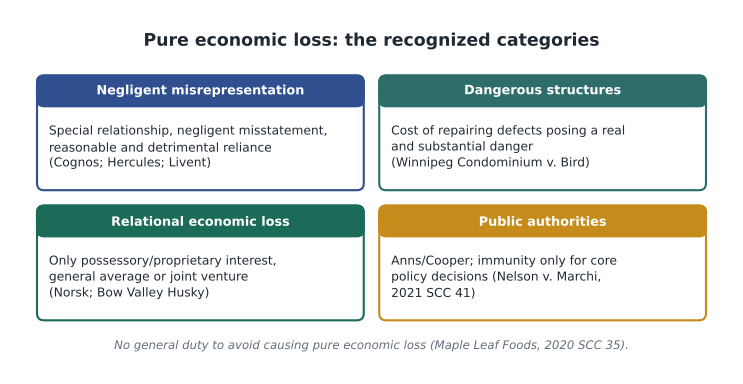
- Pure economic loss is financial loss without injury to the plaintiff's person or property; there is no general duty to avoid causing it (Maple Leaf Foods, 2020 SCC 35).
- Negligent misrepresentation requires a special relationship, a negligent misstatement and reasonable, detrimental reliance (Cognos), limited by the purpose of the statement (Hercules; Livent).
- Builders owe subsequent purchasers the cost of repairing dangerous defects (Winnipeg Condominium).
- Relational economic loss is recoverable only in exceptional categories (Norsk; Bow Valley Husky).
- Public authorities are immune only for core policy decisions (Nelson v. Marchi, 2021 SCC 41); statutes such as the Crown Liability and Proceedings Act, 2019 and the Municipal Act add immunities and notice rules.
- Inspection, once undertaken, must be done with reasonable care (Kamloops; Ingles).
- Pure economic loss
- Financial loss not consequent on injury to the plaintiff's person or property.
- Relational economic loss
- Loss suffered because of damage to a third party's property with which the plaintiff has a relationship.
- Special relationship
- A relationship of reliance and undertaking that grounds a duty for negligent misrepresentation.
- Core policy decision
- A decision by high-level officials based on public policy considerations, immune from negligence liability (Marchi).
- Operational decision
- A decision implementing policy, reviewable in negligence.
Lesson quiz · 5 questions
Score 60% or more to complete this lesson.
Create a free account to save your progress, take quizzes and earn a certificate.