
LAWC-112 · Lesson 5 of 12 · 22 min
Duty of care
▶ Video coming soon A video version of this lesson is on the way.
Negligence is the dominant tort of the modern world. Its elements are usually stated as: (1) the defendant owed the plaintiff a duty of care; (2) the defendant breached the standard of care; (3) the plaintiff suffered damage; (4) the damage was caused, in fact, by the breach; and (5) the damage was not too remote, meaning the defendant's breach was its legal cause. The Supreme Court set out this structure in Mustapha v. Culligan of Canada Ltd., 2008 SCC 27, and the next four lessons take the elements one at a time. This lesson covers duty: the question of whether the law requires the defendant to take care for the plaintiff at all.
Professor Bouchard-Ames starts with the arena's ice resurfacer. On the night of the incidents, its propane engine was running poorly. Exhaust gases built up in the low-ceilinged arena, and a dozen spectators in the upper stands developed headaches and nausea; two were taken to hospital with carbon monoxide poisoning, including Lucia Ferraro, a seventy-year-old season-ticket holder with asthma. The resurfacer had been serviced the previous month by Tri-County Ice Equipment, a private contractor hired by the city. The arena's carbon monoxide detector in the stands had been disconnected weeks earlier after repeated false alarms.
Donoghue v. Stevenson and the neighbour principle
The modern law of negligence begins with Donoghue v. Stevenson, [1932] AC 562 (HL). Mrs. Donoghue's friend bought her a bottle of ginger beer at a café in Paisley, Scotland. She said she found the decomposed remains of a snail in the bottle, which was opaque, and became ill. She had no contract with the manufacturer, because her friend had bought the drink. The House of Lords held that the manufacturer owed her a duty of care.
Lord Atkin's speech gave the common law its general principle: 'You must take reasonable care to avoid acts or omissions which you can reasonably foresee would be likely to injure your neighbour.' A neighbour is a person 'so closely and directly affected by my act that I ought reasonably to have them in contemplation as being so affected'. The case established both a specific duty, that manufacturers owe a duty to the ultimate consumers of their products, and a general approach: duties arise from foreseeability of harm and a close relationship, not only from fixed categories.
Established categories
Most negligence cases involve established duties. Drivers owe a duty to other road users; doctors to their patients; employers to their employees; manufacturers to consumers; occupiers to visitors (now largely governed by statute, see lesson 9); schools to their pupils; and professionals such as lawyers, accountants and engineers to their clients. If a case falls within an established or analogous category, the court need not do a full duty analysis. In Deloitte & Touche v. Livent Inc. (Receiver of), 2017 SCC 63, the Court emphasized that the first question is always whether the relationship falls within an existing category; only a novel relationship requires the full framework.
Tri-County Ice Equipment's position is close to that of a manufacturer or repairer of a dangerous machine. Courts have long held that repairers owe a duty to people who may foreseeably be injured by negligent repairs. The City of Corwin, as the occupier of the arena, owes a statutory duty to spectators under the Occupiers' Liability Act. Lucia Ferraro does not need a novel duty against either defendant.
The Anns/Cooper framework
For novel cases, Canadian courts use a two-stage framework derived from Anns v. Merton London Borough Council, [1978] AC 728 (HL), adopted in Kamloops (City of) v. Nielsen, [1984] 2 SCR 2, and refined in Cooper v. Hobart, 2001 SCC 79, [2001] 3 SCR 537. England abandoned Anns in 1990, but Canada kept it in modified form.
At the first stage, the court asks whether the harm was a reasonably foreseeable consequence of the defendant's conduct and whether the parties were in a relationship of sufficient proximity to make it just and fair to impose a duty. Proximity looks at the closeness and directness of the relationship, considering expectations, representations, reliance and the property or other interests involved. If foreseeability and proximity are established, a prima facie duty arises. At the second stage, the court asks whether there are residual policy considerations, outside the relationship of the parties, that should negate or limit the duty, such as the risk of indeterminate liability to an indeterminate class, the effect on the legal system or society more broadly, or the existence of other remedies.
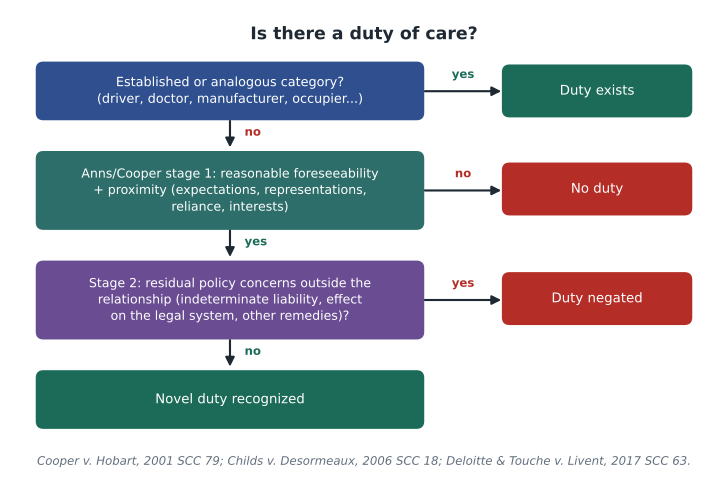
In Cooper, investors who lost money to a mortgage broker sued the provincial Registrar of Mortgage Brokers for failing to suspend the broker's licence sooner. The Court held that the Registrar owed no duty to individual investors. The statute required the Registrar to act in the public interest, not to protect particular investors, so there was insufficient proximity; and even if there had been, policy concerns, including the quasi-judicial nature of the Registrar's decisions and the risk of turning the public into insurers of investors, would have negated the duty.
Foreseeability and proximity in practice
Foreseeability at the duty stage asks whether a reasonable person in the defendant's position would have foreseen that carelessness could injure someone in the plaintiff's position. It is a relatively low threshold, but not meaningless. In Rankin's Garage & Sales v. J.J., 2018 SCC 19, two teenagers stole an unlocked car with the keys inside from a commercial garage at night. The driver, who was drunk, crashed, and his passenger suffered a catastrophic brain injury. The passenger sued the garage. Karakatsanis J., for the majority, held that the garage owed no duty: a reasonable person would not have foreseen, from the garage's practice of leaving cars unlocked, a risk of personal injury from minors stealing and driving a car, without evidence that the garage knew of such a risk. The theft of property was foreseeable, but not injury from reckless driving. The decision shows that the type of harm, not just harm in general, must be foreseeable.
Proximity is where most of the work is done. It examines the nature of the relationship: whether the defendant made representations, whether the plaintiff relied on them, whether the defendant assumed responsibility, and whether the defendant had control over the risk. In Deloitte & Touche v. Livent, an accounting firm audited a company whose managers were committing fraud. The Court held that the auditor owed the company a duty in relation to the statutory audit, because the purpose of the audit was to allow shareholders to supervise management, but that the scope of the duty was limited to that purpose. Damages had to be confined to losses within the scope of the undertaking and reliance.
Omissions and the duty to rescue
The common law distinguishes between misfeasance, doing something carelessly, and nonfeasance, failing to act. Generally, there is no duty to rescue a stranger or to prevent harm caused by others. A passer-by who sees a child drowning has no common law duty to help, although Quebec's Charter of human rights and freedoms imposes a duty to assist a person whose life is in peril.
Courts recognize exceptions where the defendant has a special relationship with the plaintiff or with the person who causes harm, has created or controls the risk, or has undertaken to act. In Childs v. Desormeaux, 2006 SCC 18, a guest left a New Year's Eve party at a private home after drinking heavily and drove into another car, killing a passenger and seriously injuring others, including Zoe Childs. The hosts had not served alcohol; it was a bring-your-own-alcohol party. The Court held that the social hosts owed no duty to third parties on the road. Unlike commercial hosts, who sell alcohol, profit from it and are regulated, social hosts generally do not have the same control or knowledge. McLachlin C.J. emphasized that a duty to act positively may arise where the defendant invites others into an inherently dangerous activity it controls, or where it has paternalistic relationships of supervision and control, or where it exercises a public function or commercial enterprise that implies responsibilities. None applied. Commercial hosts, by contrast, have owed duties to intoxicated patrons and to third parties since Jordan House Ltd. v. Menow, [1974] SCR 239, and Stewart v. Pettie, [1995] 1 SCR 131.
The duty of police and public officials
Some relationships raise special policy concerns. In Hill v. Hamilton-Wentworth Regional Police Services Board, 2007 SCC 41, the Court recognized a duty of care owed by police to a particularized suspect under investigation, creating the tort of negligent investigation. The majority reasoned that suspects have a critical interest in the investigation and that the duty would not unduly chill policing, because the standard is that of a reasonable officer in similar circumstances. Claims against regulators and government bodies are more difficult, as Cooper shows, and lesson 6 examines the core policy immunity for public authorities.
Back to the arena
Bouchard-Ames asks whether anyone other than the city and Tri-County could owe a duty to Lucia Ferraro. Theo Marchetti suggests the manufacturer of the resurfacer, if a design defect caused the exhaust buildup, which would fall squarely within Donoghue's manufacturer category. Hannah Kowalczyk suggests the company that sold the carbon monoxide detector, but Bouchard-Ames points out that the detector worked; the arena disconnected it. Daniel Whitecloud asks about the provincial technical safety regulator that licenses propane equipment. Bouchard-Ames calls this a Cooper problem: a regulator acting in the public interest is unlikely to owe a private law duty to individual spectators, absent a specific interaction that creates proximity.
Sophie Tremblay-Hart asks how Quebec would handle the same facts. Bouchard-Ames explains that under article 1457 of the Civil Code, every person has a duty to abide by the rules of conduct incumbent on them so as not to cause injury to another, and is liable for injury caused by their fault. There is no separate duty question in the common law sense; the analysis focuses on fault, injury and causation. Many cases reach the same results by different routes.
Duties owed to rescuers and unborn children
Two other duty questions often appear on exams. First, rescuers. A defendant who negligently creates a danger owes a duty not only to the person endangered but also to a person who is injured trying to rescue them, because rescue is a foreseeable response to danger: 'danger invites rescue', as Cardozo J. put it in Wagner v. International Railway Co. (1921). Canadian courts have followed the principle, and the rescuer's own carelessness is assessed generously, given the emergency. A spectator injured while carrying Lucia Ferraro out of the stands could sue the city and Tri-County on that basis.
Second, unborn children. A child born alive with injuries caused by negligence before birth can sue the person who caused them. But in Dobson (Litigation Guardian of) v. Dobson, [1999] 2 SCR 753, the Supreme Court held that a pregnant woman owes no duty of care in tort to her foetus for lifestyle choices or negligent driving, because imposing such a duty would intrude on women's autonomy and privacy and create unworkable standards. Some provinces, such as Alberta through its Maternal Tort Liability Act, have created a limited exception for motor vehicle accidents where insurance is available.
Why duty matters strategically
Duty is a question of law, decided by the judge. That makes it a common battleground on motions to strike, where a defendant argues that even if every alleged fact were true, the claim discloses no reasonable cause of action because no duty exists. Under the test in R. v. Imperial Tobacco Canada Ltd., 2011 SCC 42, a claim will be struck only if it is plain and obvious that it cannot succeed, and courts are reluctant to strike novel claims at an early stage. Bouchard-Ames notes that many of the cases in this lesson, including Cooper and Imperial Tobacco itself, were decided on motions to strike, which is why they read as statements of principle rather than as detailed factual analyses.
Worked problem
Carbon monoxide in the stands
Lucia Ferraro sues the City of Corwin, Tri-County Ice Equipment and the resurfacer's manufacturer for carbon monoxide poisoning. Does each defendant owe her a duty of care?
Show solution
- Established category first (Livent): ask whether each relationship falls within or is analogous to a recognized duty.
- City: as occupier of the arena, the city owes spectators the statutory duty of care under the Occupiers' Liability Act (lesson 9); no novel duty analysis is needed.
- Tri-County: a repairer of dangerous machinery owes a duty to people foreseeably injured by negligent repairs, a category analogous to Donoghue v. Stevenson.
- Manufacturer: manufacturers owe a duty to consumers and others foreseeably affected by defective products (Donoghue); spectators exposed to exhaust are within the class.
- Provincial safety regulator: a novel claim; under Cooper, a regulator acting in the public interest lacks proximity to individual spectators, and policy concerns would likely negate any duty.
Common mistakes
MistakeRunning the full Anns/Cooper analysis for every negligence claim.
InsteadCheck established or analogous categories first (Deloitte & Touche v. Livent); only novel relationships need the full framework.
MistakeTreating foreseeability of any harm as enough.
InsteadThe type of harm must be foreseeable; in Rankin's Garage, theft was foreseeable but personal injury from reckless driving was not.
MistakeAssuming social hosts owe the same duties as bars.
InsteadChilds v. Desormeaux held that social hosts generally owe no duty to third parties injured by intoxicated guests, unlike commercial hosts (Stewart v. Pettie).
MistakeSaying the common law imposes a general duty to rescue.
InsteadThere is no general duty to rescue strangers; exceptions arise from special relationships, control of the risk or undertakings. Quebec's Charter is different.
Practice problems
Work each problem on paper first, then reveal the answer to check.
What are the five elements of negligence according to Mustapha v. Culligan?
Show answer
Duty of care, breach of the standard of care, damage, factual causation, and legal causation (remoteness).
What two questions are asked at the first stage of the Anns/Cooper framework?
Show answer
Whether the harm was reasonably foreseeable and whether the relationship was sufficiently proximate to make a duty just and fair.
Why did the Registrar owe no duty in Cooper v. Hobart?
Show answer
The statute required the Registrar to act in the public interest, not for individual investors, so there was no proximity; policy concerns would also have negated a duty.
What duty did Hill v. Hamilton-Wentworth recognize?
Show answer
A duty owed by police to a particularized suspect, giving rise to the tort of negligent investigation, measured by the reasonable officer standard.
How did Deloitte & Touche v. Livent limit the auditor's duty?
Show answer
The scope of the duty, and the recoverable losses, were confined to the purpose of the statutory audit and the reliance it invited.
Summary and key terms
- Negligence requires duty, breach, damage, factual causation and legal causation (Mustapha).
- Donoghue v. Stevenson established the neighbour principle and the manufacturer's duty to consumers.
- Most cases fall within established categories; only novel relationships need the Anns/Cooper framework (Livent).
- Anns/Cooper asks about reasonable foreseeability and proximity, then residual policy considerations.
- The type of harm must be foreseeable (Rankin's Garage); proximity depends on expectations, representations, reliance and control.
- There is no general duty to rescue; social hosts generally owe no duty to third parties (Childs), while commercial hosts do (Stewart v. Pettie).
- Duty of care
- A legal obligation to take reasonable care to avoid causing foreseeable harm to another.
- Neighbour principle
- Lord Atkin's rule that one must take reasonable care to avoid foreseeable injury to those closely and directly affected by one's acts.
- Proximity
- A relationship close and direct enough that it is just and fair to impose a duty of care.
- Residual policy considerations
- Concerns outside the parties' relationship, such as indeterminate liability, that may negate a prima facie duty.
- Nonfeasance
- A failure to act, for which there is generally no liability absent a special relationship or undertaking.
- Negligent investigation
- The tort recognized in Hill v. Hamilton-Wentworth for careless police investigation of a particularized suspect.
Lesson quiz · 5 questions
Score 60% or more to complete this lesson.
Create a free account to save your progress, take quizzes and earn a certificate.