
LAWC-112 · Lesson 10 of 12 · 21 min
Defences and damages
▶ Video coming soon A video version of this lesson is on the way.
A plaintiff who proves duty, breach, causation and remoteness has established liability. Two questions remain: does the defendant have a defence that reduces or eliminates liability, and how much should the plaintiff receive? This lesson covers the defences to negligence and the principles of damages. Professor Bouchard-Ames tells the class that in practice almost every personal injury case settles, and that the numbers in settlement negotiations are driven by exactly these rules.
She returns to Ravi Sandhu, whose vertebra was fractured by Kyle Dunmore's cross-check, and to Agnes Proulx, who broke her hip on the arena steps. She adds a detail: Sandhu had signed the league's online registration form, which included a release of all claims against the league 'arising from participation in recreational hockey, including injuries caused by other players'. And Proulx was wearing smooth-soled dress shoes and was not holding the handrail when she fell.
Contributory negligence
At common law, any contributory negligence by the plaintiff was a complete defence, which produced harsh results. Every common law province has replaced that rule by statute. Under Ontario's Negligence Act, RSO 1990, c. N.1, where damage is caused by the fault of two or more persons, the court determines the degree to which each is at fault and liability is apportioned accordingly; section 3 provides that where the plaintiff was also at fault, damages are reduced by the plaintiff's degree of fault. If it is not practicable to determine the respective degrees of fault, liability is apportioned equally (section 4).
Contributory negligence asks whether the plaintiff failed to take reasonable care for their own safety and whether that failure contributed to the damage. The classic examples are failing to wear a seatbelt or a helmet. In Galaske v. O'Donnell, [1994] 1 SCR 670, the Court held that a driver has a duty to take reasonable steps to ensure that child passengers wear seatbelts. Seatbelt reductions are typically in the range of 5 to 25 percent, depending on how much the failure contributed to the injuries. Proulx's footwear and her failure to use the handrail may be argued as contributory negligence, though courts are often reluctant to make large reductions against elderly pedestrians who are simply walking into a public building.
Voluntary assumption of risk
Voluntary assumption of risk, the negligence version of volenti non fit injuria, is a complete defence. Because it eliminates recovery, Canadian courts apply it very narrowly. In Dube v. Labar, [1986] 1 SCR 649, the Court held that the defence applies only where the plaintiff, expressly or by necessary implication, agreed to accept both the physical and the legal risk of the activity, waiving their right to sue. Knowledge of a risk is not enough.
In Crocker v. Sundance Northwest Resorts Ltd., [1988] 1 SCR 1186, a ski resort held a 'tubing' race down a mogul run. The plaintiff, visibly intoxicated, signed a release he did not read, and the resort let him race. He was rendered quadriplegic. The Court held the resort liable. It had a duty to prevent a visibly drunk patron from participating in a dangerous competition it organized, and the plaintiff had not voluntarily assumed the legal risk, given his intoxication. The release was unenforceable because the resort had not taken reasonable steps to bring it to his attention. His damages were reduced by 25 percent for contributory negligence.
Waivers and releases
Exclusion clauses in contracts, often called waivers or releases, can bar claims if they are clearly worded, brought to the plaintiff's attention and not unconscionable or contrary to public policy (Tercon Contractors Ltd. v. British Columbia, 2010 SCC 4, which students met in Contracts). In Loychuk v. Cougar Mountain Adventures Ltd., 2012 BCCA 122, a zipline company's waiver was enforced against customers injured when one rider was sent down the line before the other had cleared it. In Ontario, the Court of Appeal held in Schnarr v. Blue Mountain Resorts Ltd., 2018 ONCA 313, that ski resort waivers remain enforceable despite the Consumer Protection Act, 2002, because the Occupiers' Liability Act specifically permits occupiers to restrict their liability.
Sandhu's release from the league's registration form protects the league, not Dunmore, who was not a party to it and cannot rely on it unless the release expressly extends to other players and a principled exception to privity applies. Even then, a court would ask whether a release in a non-contact league was meant to cover deliberate violence after the whistle; clauses are interpreted narrowly, and public policy will not allow a person to contract out of liability for intentional harm.
Illegality
The defence of illegality, ex turpi causa non oritur actio (no action arises from a disgraceful cause), was narrowed in Hall v. Hebert, [1993] 2 SCR 159. The plaintiff and defendant had been drinking together; the defendant let the plaintiff, who was obviously drunk, drive his car, and the plaintiff crashed and was badly injured. McLachlin J. held that illegality bars a tort claim only where allowing recovery would undermine the integrity of the legal system, for example by allowing a person to profit from their crime or to evade a criminal penalty. Compensating the plaintiff for his injuries did neither; his conduct was dealt with through contributory negligence, which reduced his damages by half.
Limitation periods
Every tort claim must be started within a limitation period. Under Ontario's Limitations Act, 2002, the basic limitation period is two years from the day the claim was discovered (section 4). A claim is discovered when the plaintiff knew, or reasonably ought to have known, that the injury occurred, that it was caused by an act or omission of the defendant, and that a proceeding would be an appropriate means to seek a remedy (section 5). There is an ultimate limitation period of fifteen years from the act or omission (section 15). Some claims have no limitation period, including claims based on sexual assault and, since amendments, assault in intimate relationships and misconduct of a sexual nature where the person was a minor or in a relationship of dependency (section 16). Other statutes impose shorter notice periods, such as the Municipal Act's ten days and the Occupiers' Liability Act's 60 days for snow and ice.
The purpose of damages
Compensatory damages aim to put the plaintiff, as far as money can, in the position they would have been in had the tort not occurred. Damages are assessed once, as a lump sum, at trial, and must cover past and future losses. Courts divide them into pecuniary losses, which are financial, and non-pecuniary losses, such as pain and suffering.
Pecuniary damages
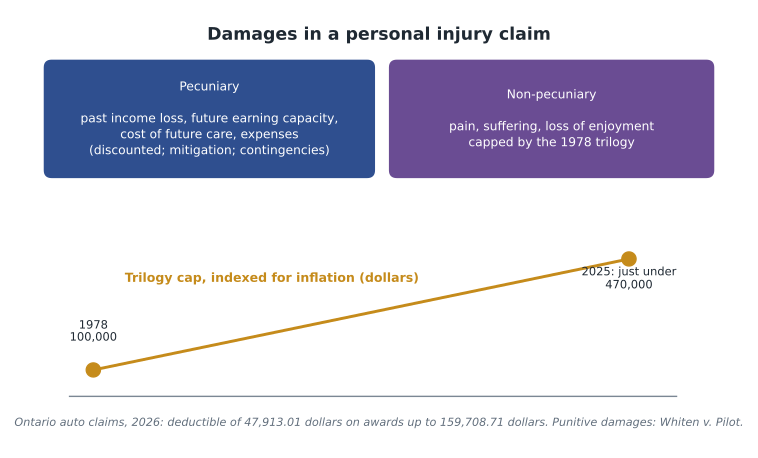
Pecuniary damages include past income loss, loss of future earning capacity, the cost of future care, and out-of-pocket expenses. Future losses are calculated with the help of actuaries and economists and then discounted to present value, using discount rates set in Ontario by rule 53.09 of the Rules of Civil Procedure. Contingencies, the chance that life would have taken a different course anyway, are taken into account. Plaintiffs have a duty to mitigate their losses, for example by undergoing reasonable treatment and returning to suitable work.
Collateral benefits raise difficult questions. In Cunningham v. Wheeler, [1994] 1 SCR 359, the Court held that disability benefits paid under a plan the plaintiff had paid for, directly or by giving up wages, were not deducted from tort damages. In motor vehicle cases, Ontario's Insurance Act requires statutory accident benefits to be deducted. Since July 1, 2026, under amendments to Ontario's Statutory Accident Benefits Schedule, income replacement and several other benefits are optional rather than mandatory for automobile policies, while medical, rehabilitation and attendant care benefits remain mandatory, which will change how these deductions work in future cases.
Non-pecuniary damages and the trilogy
In 1978 the Supreme Court decided three cases together, the 'trilogy': Andrews v. Grand & Toy Alberta Ltd., [1978] 2 SCR 229; Thornton v. School District No. 57 (Prince George), [1978] 2 SCR 267; and Arnold v. Teno, [1978] 2 SCR 287. Each involved a young person catastrophically injured. Dickson J. held that pecuniary losses, especially the cost of future care, should be generously compensated, because they can be measured and money can buy care. Non-pecuniary damages, by contrast, cannot truly restore what was lost, and very large awards would burden insurance and society. The Court set an upper limit of 100,000 dollars for non-pecuniary damages, to be awarded only in the most catastrophic cases, and adjusted for inflation thereafter. In Lindal v. Lindal, [1981] 2 SCR 629, the Court confirmed that the cap was adjusted for inflation; by 2025 it had reached a little under 470,000 dollars, and it continues to rise each year.
The cap applies to non-pecuniary damages in negligence cases involving personal injury. It does not apply to defamation: in Hill v. Church of Scientology of Toronto, [1995] 2 SCR 1130, the Court refused to extend it, upholding a large general damages award to a Crown attorney. Some courts have also held that the cap does not apply to intentional torts such as sexual assault, where damages compensate for different harms, including humiliation and loss of dignity.
Ontario's automobile deductible
For motor vehicle accidents, Ontario's Insurance Act restricts tort claims. A plaintiff can recover non-pecuniary damages only if they meet a threshold of permanent serious impairment or disfigurement, and the damages are reduced by a statutory deductible that is indexed annually. For 2026, the deductible is 47,913.01 dollars, and it does not apply to awards above 159,708.71 dollars; a smaller deductible applies to Family Law Act claims for loss of guidance, care and companionship. A 100,000 dollar award for pain and suffering in a car crash in 2026 would therefore yield about 52,000 dollars before costs.
Aggravated and punitive damages
Aggravated damages are compensatory. They are awarded for the additional humiliation, anxiety or distress caused by the defendant's high-handed or malicious conduct. Punitive damages are not compensatory; they punish and deter. In Whiten v. Pilot Insurance Co., 2002 SCC 18, [2002] 1 SCR 595, an insurer refused to pay a fire claim, falsely alleging arson against a family that had lost its home in the middle of a winter night, and kept up the allegation for years despite its own experts' views. The jury awarded 1 million dollars in punitive damages. Binnie J., for the majority, restored the award. Punitive damages are exceptional, awarded only for malicious, oppressive and high-handed misconduct that offends the court's sense of decency, and only where compensatory damages are insufficient to achieve the goals of retribution, deterrence and denunciation. The award must be rational and proportionate.
Kyle Dunmore's deliberate cross-check after the whistle could support punitive damages if it was malicious, but courts often decline to add them where the defendant has already been punished criminally for the same conduct. If Dunmore is convicted of assault causing bodily harm, a civil court may consider the criminal sentence in deciding whether further punishment is needed.
Family Law Act claims
Under section 61 of Ontario's Family Law Act, the spouse, children, grandchildren, parents, grandparents, brothers and sisters of a person injured or killed by fault can sue for their own pecuniary losses and for loss of the guidance, care and companionship they might reasonably have expected to receive. Agnes Proulx's adult daughter, who now drives her to appointments and helps her at home, could claim for her expenses and lost time, and for loss of companionship.
Worked problem
Defences and damages for Ravi Sandhu
Sandhu, a 34-year-old electrician, sues Dunmore in battery and negligence and the league in negligence for failing to enforce its no-contact rules. He signed the league's online release. How do defences and damages work?
Show solution
- Release: it may protect the league if clearly worded and brought to Sandhu's attention (Tercon; Schnarr), but Dunmore, a stranger to the contract, cannot generally rely on it, and no release covers deliberate violence.
- Voluntary assumption of risk: fails, because Sandhu did not accept the legal risk of deliberate assault (Dube v. Labar; Crocker).
- Contributory negligence: unlikely; Sandhu did nothing unreasonable for his own safety (Negligence Act, section 3).
- Pecuniary damages: income loss while he cannot work as an electrician, future loss of earning capacity if he must change jobs, and future care costs, discounted to present value.
- Non-pecuniary and punitive: general damages well below the trilogy cap unless the injury is catastrophic; possible aggravated and punitive damages for deliberate violence, considering any criminal sentence (Whiten).
Common mistakes
MistakeTreating contributory negligence as a complete defence.
InsteadOntario's Negligence Act apportions damages by degrees of fault; it is a partial defence.
MistakeFinding voluntary assumption of risk whenever the plaintiff knew of a danger.
InsteadThe plaintiff must have accepted both the physical and the legal risk (Dube v. Labar; Crocker).
MistakeUsing illegality to bar any claim by a plaintiff who broke the law.
InsteadHall v. Hebert limits illegality to preventing profit from crime or evasion of a criminal penalty.
MistakeApplying the trilogy cap to defamation.
InsteadHill v. Church of Scientology refused to extend the cap to defamation.
Practice problems
Work each problem on paper first, then reveal the answer to check.
What did Crocker v. Sundance decide?
Show answer
A resort that let a visibly drunk patron race a tube down a mogul run was liable; he had not assumed the legal risk, the release was not brought to his attention, and damages were reduced 25 percent for contributory negligence.
When does the Limitations Act, 2002 limitation period begin?
Show answer
When the claim is discovered: when the plaintiff knew or ought to have known of the injury, that the defendant caused it, and that a proceeding is appropriate. The basic period is two years, with a fifteen-year ultimate period.
Why did the trilogy cap non-pecuniary damages?
Show answer
Money cannot truly restore non-pecuniary losses; generous pecuniary awards for care are better, and very large non-pecuniary awards would burden insurance and society.
What is the 2026 Ontario statutory deductible for non-pecuniary damages in motor vehicle claims?
Show answer
47,913.01 dollars, not applied to awards above 159,708.71 dollars.
When are punitive damages available under Whiten v. Pilot?
Show answer
Exceptionally, for malicious, oppressive and high-handed misconduct, where compensatory damages are insufficient for retribution, deterrence and denunciation; the award must be rational and proportionate.
Summary and key terms
- Contributory negligence is a partial defence under the Negligence Act; voluntary assumption of risk is a complete but narrow defence (Dube; Crocker).
- Waivers can bar claims if clear, brought to the plaintiff's attention and not unconscionable (Tercon; Schnarr).
- Illegality bars claims only to protect the integrity of the legal system (Hall v. Hebert).
- Ontario's Limitations Act, 2002 sets a two-year discoverability period and a fifteen-year ultimate period, with exceptions such as sexual assault.
- Damages compensate pecuniary and non-pecuniary loss; the trilogy cap, now a little under 470,000 dollars, limits non-pecuniary damages, and Ontario's 2026 auto deductible is 47,913.01 dollars.
- Aggravated damages compensate humiliation; punitive damages punish exceptional misconduct (Whiten); family members can claim under section 61 of the Family Law Act.
- Contributory negligence
- The plaintiff's failure to take reasonable care for their own safety, reducing damages.
- Voluntary assumption of risk
- A complete defence requiring acceptance of the physical and legal risk.
- Ex turpi causa
- The illegality defence, limited by Hall v. Hebert.
- Discoverability
- The rule that a limitation period runs from when a claim was or ought to have been discovered.
- Trilogy cap
- The upper limit on non-pecuniary damages set in 1978 and indexed to inflation.
- Punitive damages
- Damages to punish and deter malicious, high-handed conduct.
Lesson quiz · 5 questions
Score 60% or more to complete this lesson.
Create a free account to save your progress, take quizzes and earn a certificate.