
LAWC-112 · Lesson 11 of 12 · 22 min
Defamation
▶ Video coming soon A video version of this lesson is on the way.
Defamation protects reputation. It is one of the oldest torts and one of the most technical, and it raises a constant tension between two values the law treats as fundamental: a person's interest in their good name, and everyone's interest in free expression. This lesson covers the elements of defamation, its defences, and the procedure Ontario created to dismiss lawsuits brought to silence public debate.
Professor Bouchard-Ames brings the Hallett Arena file to its last incident. The day after the game, Glen Pomeroy, the volunteer commissioner of the Corwin Recreational Hockey League, posted on the league's public Facebook page: 'Everyone saw what happened Saturday. Lena Hrabovsky has been on the take from the Red Wings all season. That's why nobody got a penalty until it was too late. She won't be refereeing in this league again.' Hrabovsky, a referee for twelve years and a high school teacher, received abusive messages and was asked by her school principal about the post. She says she has never accepted anything from any team. Pomeroy says he heard the bribery rumour from two players.
Elements of defamation
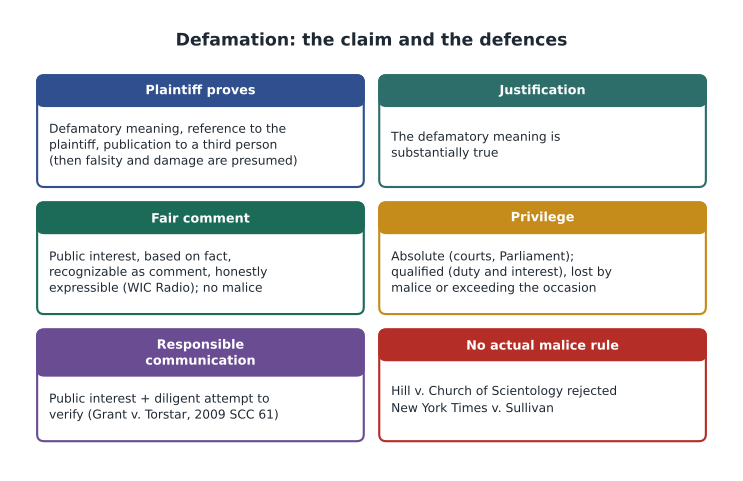
In Grant v. Torstar Corp., 2009 SCC 61, [2009] 3 SCR 640, McLachlin C.J. summarized what a plaintiff must prove: (1) the impugned words were defamatory, in the sense that they would tend to lower the plaintiff's reputation in the eyes of a reasonable person; (2) the words in fact referred to the plaintiff; and (3) the words were published, meaning they were communicated to at least one person other than the plaintiff. If these elements are proved, falsity and damage are presumed. The plaintiff does not have to prove that the words were false, that the defendant intended to defame, or that any financial loss resulted. The onus then shifts to the defendant to establish a defence.
Defamation is a strict liability tort in that sense: the defendant's good faith does not matter at the liability stage. In Hill v. Church of Scientology of Toronto, [1995] 2 SCR 1130, the Court declined to adopt the American 'actual malice' rule from New York Times v. Sullivan, which requires public figures to prove that defendants knew their statements were false or acted with reckless disregard for the truth. The Court held that the common law of defamation, as it stood, struck an appropriate balance between reputation and expression consistent with Charter values, and upheld a general damages award of 300,000 dollars and aggravated and punitive damages against the church.
Words can be defamatory in their natural and ordinary meaning, including implications a reasonable reader would draw, or by innuendo, where the words convey a defamatory meaning to readers who know particular extrinsic facts. Pomeroy's post is defamatory in its ordinary meaning: saying a referee 'has been on the take' from a team accuses her of corruption, which would lower her reputation in the eyes of any reasonable person. It refers to her by name and was published to everyone who read the league's page.
Libel, slander and statutes
The common law distinguished libel, which was written or in another permanent form, from slander, which was spoken. Libel was actionable without proof of damage; slander required proof of special damage, except in certain categories such as imputations of crime or unfitness in a profession. Ontario's Libel and Slander Act, RSO 1990, c. L.12, treats defamatory words in a broadcast as libel and modifies the rules for newspapers and broadcasters. Under section 5(1), a plaintiff who wishes to sue a newspaper or broadcaster for libel must give written notice within six weeks after the alleged libel has come to the plaintiff's knowledge, and under section 6 must start the action within three months after the libel came to their knowledge. Courts have debated whether these provisions apply to online publications. The Law Commission of Ontario recommended in 2020 that the Act be replaced with a modern Defamation Act, but as of 2026 Ontario had not done so.
Online publication raises further issues. In Crookes v. Newton, 2011 SCC 47, the Court held that merely hyperlinking to defamatory material is not publication of it; publication requires that the defendant present the content itself, for example by repeating or endorsing it. In Haaretz.com v. Goldhar, 2018 SCC 28, the Court declined to allow an Ontario businessman to sue an Israeli newspaper in Ontario over an online article, finding Israel the clearly more appropriate forum. Each repetition of a defamatory statement is a new publication, and people who republish others' defamatory posts, for example by sharing them with endorsing comments, can be liable themselves.
Justification
Truth, called justification, is a complete defence. The defendant must prove that the defamatory meaning of the words was substantially true. It is not enough to prove that the defendant honestly believed the statement, or that the defendant accurately repeated a rumour; repeating a defamatory rumour is treated as asserting its truth. Pomeroy cannot rely on justification unless he can prove that Hrabovsky actually accepted payments from the Red Wings. Two players' gossip will not do.
Fair comment
Fair comment protects opinion on matters of public interest. In WIC Radio Ltd. v. Simpson, 2008 SCC 40, [2008] 2 SCR 420, a radio host compared an anti-gay rights activist to Hitler and the Ku Klux Klan on air. Binnie J. restated the defence: the comment must be on a matter of public interest; it must be based on fact; though it can include inferences of fact, it must be recognizable as comment; and it must satisfy the objective test of whether any person could honestly express that opinion on the proved facts. The defence is defeated if the plaintiff proves that the defendant was actuated by express malice. The radio host's comments met the test.
Pomeroy might argue that his post was comment on the referee's performance in a game of local public interest. But 'on the take' is not an opinion about refereeing; it is an assertion of fact, that she took payments. A statement that her calls were biased or incompetent might be protected comment if based on true facts about the game. A specific accusation of bribery is not.
Privilege
Absolute privilege protects statements made in judicial proceedings, in Parliament and the legislatures, and in certain other official settings, regardless of malice. Qualified privilege protects statements made by a person with a legal, social or moral duty or interest in making them, to a person with a corresponding duty or interest in receiving them, such as a reference letter from a former employer to a prospective employer, or a report to police. Qualified privilege is defeated by malice or if the defendant exceeds the scope of the occasion, for example by publishing to a wider audience than the duty requires.
If Pomeroy had reported his concerns privately to the league's board or to the referees' association, which had an interest in receiving them, his communication might have been protected by qualified privilege, unless he knew it to be false or acted recklessly. Posting the accusation on a public Facebook page took the statement far beyond any privileged occasion.
Responsible communication on matters of public interest
In Grant v. Torstar, the Toronto Star published an article about a proposed private golf course development on the property of Peter Grant, a businessman with political connections, including allegations by neighbours that he was using his influence. Grant sued. The Supreme Court created a new defence of responsible communication on matters of public interest, available to anyone who publishes material, not only journalists. The defendant must show that the publication was on a matter of public interest and that the defendant was diligent in trying to verify the allegations, having regard to factors such as the seriousness of the allegation, the public importance of the matter, its urgency, the status and reliability of the source, whether the plaintiff's side was sought and accurately reported, whether including the defamatory statement was justifiable, whether its public interest lay in the fact it was made rather than its truth, and any other relevant circumstances. A companion case, Quan v. Cusson, 2009 SCC 62, applied the new defence to a newspaper report about an Ontario police officer who went to New York after September 11, 2001.
Pomeroy fails the diligence requirement. He relied on hearsay from two players, made no attempt to verify it and did not contact Hrabovsky. The integrity of a local league's officiating is arguably a matter of public interest to its members and their families, but responsible communication requires responsible conduct.
Damages
General damages in defamation compensate for harm to reputation and hurt feelings, and the trilogy cap does not apply (Hill). Courts consider the seriousness of the defamatory statement, the extent of its publication, the plaintiff's standing in the community, whether the defendant apologized or retracted, and the defendant's conduct throughout the litigation. Aggravated damages may be awarded where the defendant acted with malice, for example by refusing to retract a statement it knew was false or by repeating it. Punitive damages are available under the Whiten principles. Courts may also grant injunctions requiring removal of online statements and prohibiting their repetition.
Anti-SLAPP: section 137.1
A SLAPP, or strategic lawsuit against public participation, is a lawsuit brought not to vindicate a genuine wrong but to silence or intimidate critics through the cost of litigation. In 2015 Ontario added sections 137.1 to 137.5 to the Courts of Justice Act, allowing a defendant to move early to dismiss a proceeding arising from expression on a matter of public interest. British Columbia and Quebec have similar laws.
In 1704604 Ontario Ltd. v. Pointes Protection Association, 2020 SCC 22, [2020] 2 SCR 587, a developer sued a ratepayers' association for testifying against its project before a municipal board, alleging breach of a settlement agreement. Côté J., for the Court, explained the test. First, the defendant must show that the proceeding arises from expression relating to a matter of public interest, interpreted broadly. Second, the burden shifts to the plaintiff to show that there are grounds to believe that the proceeding has substantial merit and that the defendant has no valid defence, and that the harm likely to be suffered by the plaintiff as a result of the expression is sufficiently serious that the public interest in permitting the proceeding to continue outweighs the public interest in protecting the expression. The final weighing is the core of the analysis. The action against the association was dismissed.
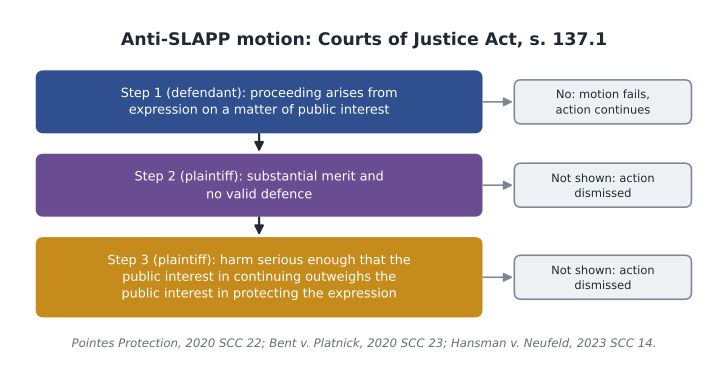
In the companion case Bent v. Platnick, 2020 SCC 23, a lawyer emailed members of a professional association alleging that a doctor had altered medical reports in insurance assessments. The majority allowed the doctor's defamation claim to proceed, because it had substantial merit, the lawyer's qualified privilege defence was likely defeated by her exceeding the scope of the occasion, and the serious harm to the doctor's reputation outweighed the public interest in the expression. In Hansman v. Neufeld, 2023 SCC 14, under British Columbia's equivalent statute, the Court dismissed a school trustee's defamation claim against a teachers' union leader who had criticized his statements about a provincial sexual orientation and gender identity program as hateful. Karakatsanis J. emphasized the public interest in counter-speech that responds to expression perceived as harmful to marginalized groups, and held that the defendant's fair comment defence was likely to succeed.
Bouchard-Ames asks whether Pomeroy could bring an anti-SLAPP motion. The class agrees that the integrity of a public recreational league's officiating is probably a matter of public interest, so he would meet the first step. But Hrabovsky can likely show substantial merit and no valid defence, given the lack of truth, the factual nature of the accusation and the absence of diligence. And the harm to a teacher accused of corruption is serious, while the public interest in protecting an unverified bribery accusation is low. Pomeroy's motion would probably fail, and Arjun Mehta notes the costs rules: under section 137.1(7) a defendant who wins the motion is presumptively entitled to full indemnity costs, while under section 137.1(8) a plaintiff who defeats the motion is generally not entitled to costs on it unless the judge finds an award appropriate.
Worked problem
The referee and the Facebook post
Lena Hrabovsky sues Glen Pomeroy for defamation over his post accusing her of being "on the take". Pomeroy brings a motion under section 137.1 and pleads fair comment and responsible communication. How should the issues be analysed?
Show solution
- Elements: the words are defamatory (an accusation of corruption), refer to her by name and were published on a public page; falsity and damage are presumed (Grant v. Torstar).
- Justification fails unless Pomeroy proves she took payments; repeating a rumour is no defence.
- Fair comment fails: "on the take" is an assertion of fact, not recognizable comment on proved facts (WIC Radio).
- Responsible communication fails for lack of diligence: unverified hearsay, no attempt to contact her (Grant v. Torstar).
- Anti-SLAPP: the expression likely relates to a matter of public interest, but she can show substantial merit, no valid defence and serious harm that outweighs the public interest in the expression (Pointes; Bent v. Platnick). The motion fails, and she can seek general, aggravated and possibly punitive damages and an order removing the post.
Common mistakes
MistakeRequiring the plaintiff to prove the words were false.
InsteadOnce the three elements are proved, falsity and damage are presumed; the defendant must prove truth as a defence.
MistakeApplying the American actual malice rule to Canadian public figures.
InsteadHill v. Church of Scientology rejected the New York Times v. Sullivan rule.
MistakeTreating any statement on a matter of public interest as protected.
InsteadResponsible communication requires diligence in verifying the allegation; fair comment requires recognizable comment based on proved facts.
MistakeThinking an anti-SLAPP motion succeeds whenever the expression concerns a public issue.
InsteadUnder Pointes, the plaintiff can defeat the motion by showing substantial merit, no valid defence, and harm that outweighs the public interest in the expression.
Practice problems
Work each problem on paper first, then reveal the answer to check.
What three elements must a defamation plaintiff prove?
Show answer
The words were defamatory, they referred to the plaintiff, and they were published to at least one other person.
What is the objective test for fair comment in WIC Radio?
Show answer
Whether any person could honestly express the opinion on the proved facts.
Who can use the responsible communication defence?
Show answer
Anyone who publishes material on a matter of public interest, not only journalists, if they were diligent in trying to verify it.
What did Crookes v. Newton decide about hyperlinks?
Show answer
A mere hyperlink to defamatory content is not publication of that content.
What must a plaintiff show to defeat a section 137.1 motion?
Show answer
Grounds to believe the proceeding has substantial merit and the defendant has no valid defence, and that the harm likely suffered is serious enough that the public interest in continuing outweighs the public interest in protecting the expression.
Summary and key terms
- Defamation requires defamatory words, reference to the plaintiff and publication; falsity and damage are then presumed (Grant v. Torstar).
- Canada rejected the American actual malice rule (Hill v. Church of Scientology).
- Ontario's Libel and Slander Act sets notice and limitation rules for newspapers and broadcasters; hyperlinking alone is not publication (Crookes).
- Defences include justification, fair comment (WIC Radio), absolute and qualified privilege, and responsible communication (Grant; Quan v. Cusson); malice defeats fair comment and qualified privilege.
- Defamation damages are not capped by the trilogy.
- Ontario's anti-SLAPP provisions allow early dismissal of proceedings arising from expression on matters of public interest, subject to the public interest weighing (Pointes; Bent; Hansman).
- Defamatory
- Tending to lower a person's reputation in the eyes of a reasonable person.
- Publication
- Communication of the words to at least one person other than the plaintiff.
- Justification
- The defence that the defamatory meaning is substantially true.
- Qualified privilege
- Protection for statements made on an occasion of duty and interest, defeated by malice or exceeding the occasion.
- Responsible communication
- A defence for diligent publication on matters of public interest.
- SLAPP
- A strategic lawsuit against public participation.
Lesson quiz · 5 questions
Score 60% or more to complete this lesson.
Create a free account to save your progress, take quizzes and earn a certificate.