
LAWC-112 · Lesson 2 of 12 · 22 min
Defences to intentional torts
▶ Video coming soon A video version of this lesson is on the way.
Lesson 1 showed that a plaintiff in battery need only prove a direct, intentional physical interference. The real fight is usually about defences, and the defendant carries the burden of proving them on a balance of probabilities. Professor Bouchard-Ames calls this lesson 'the reasons people are allowed to touch you'. Surgeons, hockey players, police officers, parents and people defending themselves all make intentional physical contact every day. Tort law decides which of those contacts are justified.
The class returns to the Hallett Arena file. Kyle Dunmore says Ravi Sandhu agreed to the risk of being hit when he laced up his skates. The security guard says he was entitled to hold Mason Levesque until the manager arrived. And Dunmore adds a new claim: when the benches emptied, Sandhu's teammate Owen Kirsch shoved Dunmore into the boards. Kirsch says he was protecting Sandhu, who was lying on the ice.
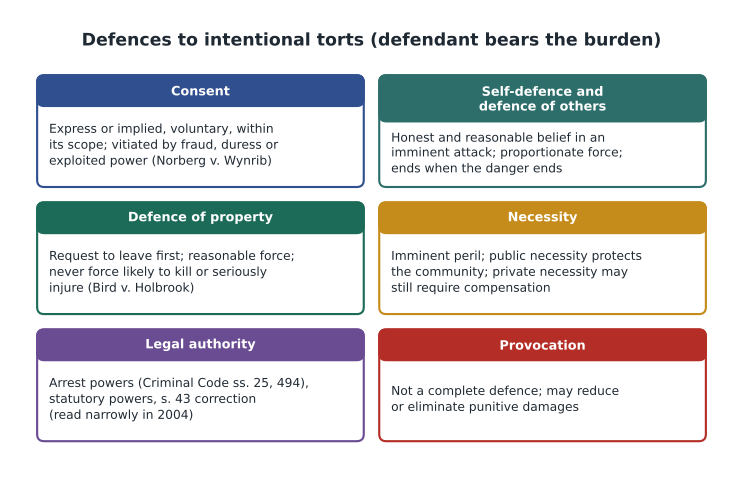
Consent
Consent is the most important defence to the intentional torts. A person who agrees to a contact cannot complain of it, a principle expressed in the Latin maxim volenti non fit injuria (no wrong is done to one who consents). Consent can be express, as in a signed surgical consent form, or implied from conduct and circumstances, as when a person rolls up a sleeve for a vaccination or joins a crowded subway car.
Consent must be genuine and voluntary, and it is limited to the scope of what was agreed. A patient who consents to one operation does not consent to another. In Mulloy v. Hop Sang, [1935] 1 WWR 714 (Alta CA), a surgeon amputated a patient's hand after the patient had expressly asked him only to repair it and not to amputate. The surgeon was liable in battery, even though the amputation may have been medically sound. In Malette v. Shulman (1990), 72 OR (2d) 417 (CA), an emergency physician gave blood transfusions to an unconscious patient who was carrying a card stating that, as a Jehovah's Witness, she refused blood under any circumstances. The Court of Appeal upheld a battery award: the card was a valid advance refusal, and a competent adult's right to refuse treatment includes the right to make choices others consider unwise.
Consent in medical treatment
Medical consent illustrates an important boundary between battery and negligence. In Reibl v. Hughes, [1980] 2 SCR 880, the Supreme Court held that a failure to disclose the risks of a procedure the patient did agree to is not battery but negligence. Battery is reserved for cases where there was no consent at all, where the treatment went beyond the consent given, or where consent was obtained by fraud or misrepresentation. If a doctor performs the agreed operation but fails to warn of a material risk, the patient must prove in negligence that a reasonable person in their position would have refused the treatment had they been properly informed (a modified objective test). That distinction matters because negligence requires proof of causation and damage, while battery does not.
When consent is vitiated: Norberg v. Wynrib
Consent can be vitiated, which means apparent consent is treated as no consent at all, when it is obtained by fraud about the nature of the act, by duress, or by exploiting a relationship of power and dependency. The leading case is Norberg v. Wynrib, [1992] 2 SCR 226. A young woman addicted to painkillers obtained prescriptions from an elderly physician in exchange for sexual contact. She later sued him. At trial and on appeal the claim failed because she had appeared to consent.
The Supreme Court allowed her appeal. La Forest J., for three judges, held that consent was not a defence where there was a marked inequality of power between the parties and the stronger party exploited it; the factors include the nature of the relationship, the dependency of the weaker party and whether the transaction is one that community standards would consider exploitative. McLachlin J., for two judges, would have decided the case as a breach of fiduciary duty, and Sopinka J. would have found the doctor negligent. All agreed that the plaintiff should recover. Norberg remains the starting point for analysing consent in relationships of trust, such as doctor and patient, therapist and client, coach and athlete, or employer and employee.
Consent in sport
Participants in sport consent to the contact that is an ordinary and expected part of the game, including contact that breaks the rules in minor ways. They do not consent to deliberate attempts to injure or to violence far outside the conduct of the game. In Agar v. Canning (1965), 54 WWR 302 (Man QB), affirmed (1966), 55 WWR 384 (Man CA), a hockey player who was hooked from behind retaliated by striking the other player in the face with his stick. The court held that while players accept the risk of injury from the ordinary incidents of the game, retaliation of this kind went beyond the implied consent, and the retaliating player was liable.
Recreational leagues raise the question more sharply, because the rules themselves may prohibit body checking. In Sandhu's case, a cross-check to the back of the neck after the whistle, in a non-contact league, is well outside anything a player can be taken to have accepted. Dunmore's defence of consent is likely to fail. Bouchard-Ames notes that criminal courts take a similar approach: in R. v. Jobidon, [1991] 2 SCR 714, the Supreme Court limited the effect of consent to fist fights where serious harm is intended and caused, but recognized that consent remains effective for the ordinary contact of sports played within their rules and customs.
Self-defence and defence of others
A person may use reasonable force to defend themselves against an actual or reasonably apprehended attack. The defendant must honestly and reasonably believe that an attack is imminent, and the force used must be proportionate to the threat. The defence is lost if the response is excessive, if it continues after the danger has passed, or if it amounts to retaliation. In Wackett v. Calder (1965), 51 DLR (2d) 598 (BCCA), the court accepted that a man who was struck first in a bar could respond with comparable blows. Courts allow some latitude, because a person under attack cannot be expected to measure their response precisely, but punches thrown after an attacker has fallen or fled are not defence.
The same principles apply to defending another person. Owen Kirsch shoved Dunmore into the boards as Dunmore skated toward Sandhu, who was lying on the ice. If Kirsch honestly and reasonably believed that Dunmore was about to attack Sandhu again, a shove to keep him away is likely proportionate. If Dunmore was skating away and Kirsch chased him down, the shove is retaliation and Kirsch will be liable for battery, subject to any argument about provocation reducing damages.
Provocation
Provocation is not a complete defence to a tort, but in Canadian common law it may reduce or eliminate punitive damages, and in some cases it has been taken into account in assessing general damages. A plaintiff who starts a fight and is injured in it may recover less. The Negligence Act's apportionment provisions do not apply directly to intentional torts, so courts adjust damages instead.
Defence of property
An occupier may use reasonable force to remove a trespasser from land or to prevent property from being taken. The occupier must first ask the trespasser to leave, unless the trespasser entered by force, and must allow a reasonable time to go. The force must be proportionate to the threat to property, and property never justifies force likely to cause death or serious bodily harm. In the old English case Bird v. Holbrook (1828), 4 Bing 628, a man who set a spring gun in his garden without warning was liable to a trespasser injured by it. Ontario's Trespass to Property Act lets an occupier ask a trespasser to leave and authorizes arrest of a person found on premises in contravention of the Act, but it requires the arrested person to be handed over to police.
Necessity
Necessity justifies an interference with another's person or property where it is reasonably necessary to prevent a greater, imminent harm. Public necessity covers acts done to protect the community, such as destroying a building to stop the spread of a fire. Private necessity covers acts done to protect oneself or one's own property, such as mooring a boat at someone else's dock to escape a storm, but the actor may have to pay for the damage caused. Courts apply the defence narrowly. In the medical context, emergency treatment of an unconscious patient is justified by necessity when the patient cannot consent and delay would endanger life or health, unless, as in Malette, the patient has validly refused.
Legal authority
Many intentional contacts are justified by legal authority. Police officers may use force reasonably necessary to make a lawful arrest, under section 25 of the Criminal Code. Private citizens have the narrower arrest power in section 494 discussed in lesson 1. Statutes authorize contact in other settings, such as mental health detentions or child protection apprehensions, if their conditions are met. Section 43 of the Criminal Code justifies a parent's or schoolteacher's reasonable use of force by way of correction; in Canadian Foundation for Children, Youth and the Law v. Canada (Attorney General), 2004 SCC 4, the Court read it narrowly, excluding children under two and teenagers, the use of objects and blows to the head, and teachers' corporal punishment. The Truth and Reconciliation Commission called for section 43 to be repealed, and bills to do so have been introduced in Parliament, so students should check its current status.
The guard at Hallett Arena cannot rely on legal authority. He did not find Mason committing an offence, so section 494 does not apply, and he never intended to call police. If the guard had seen Mason take the jersey, he could have arrested him and held him only until police arrived. Using reasonable force in that arrest would have been justified. Searching Mason's backpack, without consent, would still have been a separate trespass to his goods.
Consent and minors
Children raise special consent questions. At common law, a minor can consent to medical treatment if they have sufficient maturity to understand its nature and consequences, the so-called mature minor doctrine. In A.C. v. Manitoba (Director of Child and Family Services), 2009 SCC 30, the Supreme Court held that a fourteen-year-old's views about refusing a blood transfusion must be given weight in proportion to her maturity, though a court could still order treatment in her best interests under the child protection statute. Ontario's Health Care Consent Act, 1996 sets no minimum age for consent; capacity depends on the person's ability to understand the information and appreciate the consequences. For contact in sport and recreation, parents usually consent on behalf of young children, and courts interpret that consent as covering only the ordinary risks of a properly supervised activity.
Mason Levesque, at sixteen, plainly could have consented to a bag search if asked, and nothing in the file suggests he was asked. A guard who says 'open your bag' in a way that leaves the teenager believing he has no choice has not obtained genuine consent. Consent extracted by a show of authority is not voluntary, the same reasoning that makes submission to authority a restraint for false imprisonment.
Mistake
A defendant's honest mistake is usually no defence to an intentional tort. A person who takes another's coat believing it to be their own commits conversion; a person who enters land believing it to be theirs commits trespass. In the defences themselves, however, reasonable mistakes count. Self-defence protects a defendant who reasonably, but wrongly, believed an attack was imminent. A police officer who arrests the wrong person may be protected if they had reasonable and probable grounds. Bouchard-Ames tells the class to keep the two ideas separate: mistake about the facts that make conduct wrongful is no excuse, but reasonable mistake about the facts that justify conduct can be.
Worked problem
Owen Kirsch and the shove into the boards
Kyle Dunmore sues Owen Kirsch in battery for shoving him into the boards as Dunmore skated toward Ravi Sandhu, who was lying injured on the ice. Kirsch pleads defence of another. How should a court analyse the claim?
Show solution
- Plaintiff's case: Dunmore proves a direct, intentional physical interference. Under Scalera the burden shifts to Kirsch.
- Consent: the shove came after the whistle and outside the play; Dunmore did not consent to it as part of the game (Agar v. Canning).
- Defence of another: Kirsch must show he honestly and reasonably believed Dunmore was about to attack Sandhu again, and that a shove was proportionate to that threat.
- Facts decide the outcome: video showing Dunmore skating at Sandhu with his stick raised supports the defence; video showing Dunmore skating away and Kirsch chasing him defeats it, because force used after the threat has ended is retaliation.
- Damages: even if Kirsch is liable, Dunmore's own conduct may reduce or eliminate punitive damages through provocation.
Common mistakes
MistakeTreating a failure to warn of surgical risks as battery.
InsteadReibl v. Hughes holds that non-disclosure of risks of an agreed procedure is negligence; battery is for no consent, treatment beyond consent, or fraud.
MistakeSaying apparent consent is always a complete defence.
InsteadConsent is vitiated by fraud, duress or exploitation of an inequality of power (Norberg v. Wynrib).
MistakeAssuming players consent to any contact in a hockey game.
InsteadPlayers consent to contact that is an ordinary part of the game, not to deliberate violence far outside the rules (Agar v. Canning).
MistakeAllowing force likely to cause serious harm to protect property.
InsteadDefence of property permits only reasonable force after a request to leave; property never justifies force likely to kill or seriously injure (Bird v. Holbrook).
Practice problems
Work each problem on paper first, then reveal the answer to check.
What did Malette v. Shulman decide?
Show answer
A physician who gave blood transfusions to an unconscious patient despite her card refusing blood was liable in battery; a competent adult's valid advance refusal must be respected.
What factors did La Forest J. use in Norberg v. Wynrib to decide whether consent was vitiated?
Show answer
A marked inequality of power, exploitation of it by the stronger party, the dependency of the weaker party and whether community standards would view the transaction as exploitative.
What must a defendant show to rely on self-defence?
Show answer
An honest and reasonable belief in an imminent attack and the use of force proportionate to the threat, ending when the danger ends.
What is the difference between public and private necessity?
Show answer
Public necessity protects the community, such as destroying property to stop a fire; private necessity protects the actor's own interests and may still require payment for damage caused.
How did the Supreme Court read section 43 of the Criminal Code in the 2004 Canadian Foundation case?
Show answer
Narrowly: no force against children under two or teenagers, no objects or blows to the head, and no corporal punishment by teachers.
Summary and key terms
- The defendant bears the burden of proving defences to intentional torts.
- Consent may be express or implied; it must be voluntary and is limited to its scope (Mulloy v. Hop Sang; Malette v. Shulman).
- Non-disclosure of medical risks is negligence, not battery (Reibl v. Hughes).
- Consent is vitiated by fraud, duress or exploitation of an inequality of power (Norberg v. Wynrib).
- Sports participants consent to ordinary contact, not to deliberate violence (Agar v. Canning).
- Self-defence, defence of others and defence of property require honest, reasonable belief and proportionate force; necessity and legal authority justify interference in narrow circumstances.
- Volenti non fit injuria
- No wrong is done to one who consents.
- Vitiated consent
- Apparent consent the law treats as no consent because of fraud, duress or exploitation.
- Modified objective test
- In informed consent cases, whether a reasonable person in the patient's position would have refused treatment if properly informed.
- Private necessity
- Interference with another's property to protect one's own interests from imminent harm.
- Provocation
- Conduct of the plaintiff that may reduce or eliminate punitive damages in an intentional tort claim.
Lesson quiz · 5 questions
Score 60% or more to complete this lesson.
Create a free account to save your progress, take quizzes and earn a certificate.