
LAWC-112 · Lesson 1 of 12 · 23 min
Intentional torts
▶ Video coming soon A video version of this lesson is on the way.
A tort is a civil wrong, other than a breach of contract, for which the law gives the injured person a remedy, usually damages. Tort law answers a basic question that every society has to settle: when one person harms another, when must the first person pay? Criminal law punishes on behalf of the state, and contract law enforces promises people chose to make. Tort law sits between them. It imposes duties that nobody agreed to, and it compensates the person harmed rather than punishing the wrongdoer, although punitive damages blur that line in rare cases.
Professor Céline Bouchard-Ames opens the first Torts class of the winter term in the Lister Room by writing two words on the board: 'Who pays?' She spent fifteen years acting for injured people in Hamilton before switching sides for five years to defend insurers, and she tells Section B that the second stint taught her more than the first. 'Plaintiff lawyers think every injury deserves compensation. Insurance lawyers think every claim is an exaggeration. Tort law is the set of rules that decides who is right in a particular case, and it is much more principled than either side admits.'
She hands out the file the class will use all term: the Hallett Arena file. It is a fictional set of incidents at Corwin's municipal hockey arena on one Saturday night in February. A recreational league game ends in a fight. A security guard holds a teenager in a back room. The ice resurfacer leaks exhaust into the stands. A spectator falls on the icy front steps. A video of the fight and the detention appears online, and the league commissioner posts that the referee was paid off. By the end of the course, students will be able to analyse every one of those incidents.
The structure of tort law
Canadian tort law, outside Quebec, is mostly judge-made common law, supplemented by statutes such as Ontario's Negligence Act, Occupiers' Liability Act, Family Law Act and Limitations Act, 2002. Quebec applies the Civil Code of Québec, whose article 1457 sets out a general duty to abide by the rules of conduct so as not to cause injury to another; this course covers the common law provinces, with Ontario as the main example.
Torts are traditionally grouped by the defendant's state of mind. Intentional torts require that the defendant intended the act and, for most torts, its consequences. Negligence requires only careless conduct falling below a standard of reasonable care. Strict liability torts impose liability without proof of intent or carelessness, as with the rule in Rylands v. Fletcher or Ontario's Dog Owners' Liability Act. Most of this course is about negligence, because most modern litigation is about negligence: car accidents, slips and falls, medical errors and defective products. But the intentional torts come first, because they are older, simpler and still important.
Trespass and case
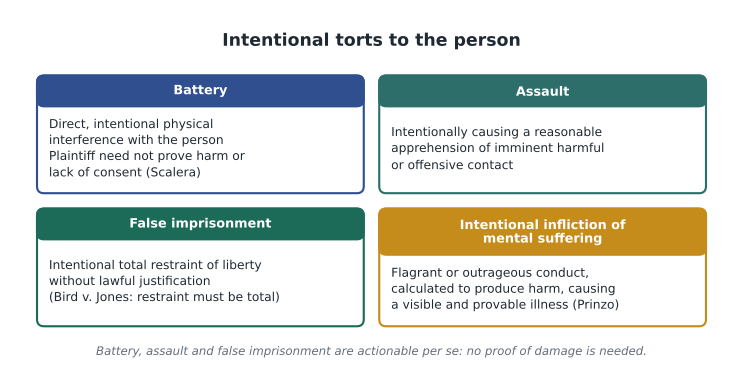
The intentional torts to the person grew out of the medieval writ of trespass, which covered direct and forcible injuries. Indirect injuries were left to the action on the case, from which negligence later developed. One feature of the old trespass torts survives: battery, assault and false imprisonment are actionable per se, which means the plaintiff can recover at least nominal damages without proving any loss. The law treats the invasion of bodily integrity or liberty as a wrong in itself.
Battery
Battery is the intentional infliction of a harmful or offensive contact with the person of another. The contact must be direct, meaning it follows immediately from the defendant's act, as when a punch lands or a thrown object strikes. It may be with the plaintiff's body or with something closely connected to it, such as clothing or an object being held. The contact need not cause physical injury. A kiss, a spit or an unwanted haircut can all be batteries because they are offensive to a reasonable sense of personal dignity.
Intent in battery means that the defendant intended the contact, or knew it was substantially certain to occur. The defendant need not intend to harm. In Bettel v. Yim (1978), 20 OR (2d) 617 (Co Ct), a shopkeeper grabbed a boy by the collar and shook him to get a confession about a fire. His head accidentally struck the boy's nose. The court held the shopkeeper liable for the full injury: once the intentional contact was a battery, the defendant was liable for its direct consequences even if he did not intend or foresee them.
The most important modern case is Non-Marine Underwriters, Lloyd's of London v. Scalera, 2000 SCC 24, [2000] 1 SCR 551. A bus driver was sued for sexual battery and his insurer argued that the policy excluded intentional acts. To decide the insurance question, the Supreme Court had to decide what a plaintiff must prove in battery. The majority held that the plaintiff proves only a direct, intentional and physical interference with the person; the onus then shifts to the defendant to prove consent or another defence. The plaintiff does not have to prove that the contact was harmful, offensive or non-consensual. McLachlin J. explained that the rule protects personal autonomy: the person who chose to touch another should have to justify it.
In the Hallett Arena file, Kyle Dunmore, playing for the Corwin Red Wings in a non-contact recreational league, skates after Ravi Sandhu following the whistle and cross-checks him in the back of the neck. Sandhu falls and fractures a vertebra. Under Scalera, Sandhu need only prove the direct, intentional contact. Dunmore will have to prove that Sandhu consented to it, and lesson 2 explains why that defence is likely to fail when the contact is far outside the rules and the ordinary conduct of the game.
Assault
Assault is intentionally causing another person to reasonably apprehend an imminent harmful or offensive contact. Unlike in criminal law, where assault includes the application of force, the tort of assault is about the apprehension, not the contact. A raised fist, a lunge or a swung bottle can be an assault even if the blow never lands. If it does land, both assault and battery are committed.
The apprehension must be reasonable and the threatened contact must be imminent. Words alone traditionally did not amount to assault, but courts now recognize that words can make a gesture threatening, or can make an otherwise threatening gesture harmless. In the old case of Tuberville v. Savage (1669), the defendant put his hand on his sword and said that if it were not assize time he would not take such language; the words showed there would be no attack, so there was no assault. Conditional threats, such as 'Give me your wallet or I will hit you', are assaults, because the defendant has no right to impose the condition.
False imprisonment
False imprisonment is the intentional total restraint of a person's liberty without lawful justification. The restraint can be physical, as by locking a door, or psychological, as when a person submits to an assertion of authority because they believe they have no choice. In Bird v. Jones (1845), 7 QB 742, the plaintiff was prevented from walking along part of a bridge but was free to go back the way he had come. The court held that there was no imprisonment, because the restraint was partial, not total. A person is imprisoned only if every reasonable means of exit is blocked.
Store detentions are the classic modern setting. Courts have repeatedly found false imprisonment where a shopper, wrongly suspected of shoplifting, is asked to come to an office and goes along because they believe they have no choice: submitting to an implied assertion of legal authority is a restraint, even without force or a locked door. Lawful justification is the key defence. Under section 494 of the Criminal Code, as amended in 2012 after the Lucky Moose grocery case in Toronto, a property owner or a person authorized by the owner may arrest someone found committing a criminal offence on or in relation to that property, or within a reasonable time after the offence if it is not feasible for a peace officer to make the arrest. The arrested person must be delivered forthwith to a peace officer.
In the Hallett Arena file, a guard employed by Corwin Patrol Services suspects sixteen-year-old Mason Levesque of taking a team jersey from the pro shop. He takes Mason by the arm to a storage room, closes the door and keeps him there for forty minutes while he searches Mason's backpack and waits for the shop manager. The jersey is found later under a bench in the change room. Mason was never seen taking it, and no police were called. Section 494 will not help the guard: he did not find Mason committing an offence, and he never intended to deliver him to a peace officer. Mason's claim for false imprisonment is strong, and lesson 9 asks whether Corwin Patrol Services is vicariously liable for its guard.
Intentional infliction of mental suffering
Some intentional conduct causes no physical contact but serious psychological harm. The tort of intentional infliction of mental suffering traces to Wilkinson v. Downton, [1897] 2 QB 57, where the defendant told the plaintiff, as a practical joke, that her husband had been badly injured. She suffered a severe nervous shock. The court held him liable because he wilfully did an act calculated to cause harm.
In Ontario, the elements were stated in Prinzo v. Baycrest Centre for Geriatric Care (2002), 60 OR (3d) 474 (CA): (1) flagrant or outrageous conduct; (2) calculated to produce harm; (3) resulting in a visible and provable illness. 'Calculated' does not require a specific intent to harm; it is enough that the defendant knew harm was substantially certain to follow. In Boucher v. Wal-Mart Canada Corp., 2014 ONCA 419, a store assistant manager was found liable after months of public belittling and abuse by her manager, which led her to resign. The Court of Appeal upheld damages against the manager personally for intentional infliction of mental suffering, while sharply reducing the punitive damages awarded by the jury. Courts also recognize a separate negligent infliction of mental injury, which lesson 8 covers under Saadati v. Moorhead.
Creating new torts: Ahluwalia v. Ahluwalia
The categories of tort are not closed, but courts are cautious about recognizing new ones. In Ahluwalia v. Ahluwalia, 2026 SCC 16, released in May 2026, the Supreme Court considered a claim by a woman who had suffered years of abuse and controlling behaviour during her marriage. The trial judge in Ontario had recognized a new tort of family violence. The Court of Appeal for Ontario disagreed, holding that existing torts such as battery, assault and intentional infliction of mental suffering were adequate, while upholding damages on those grounds.
A majority of the Supreme Court, in reasons by Kasirer J., restored liability on the basis of a new tort of intimate partner violence. The Court set out a general framework for recognizing new torts: the facts must disclose a wrongful act that offends a recognized private law interest; existing remedies must be inadequate; and if both conditions are met, the court tailors a new tort consistent with tort law's purposes and the courts' proper incremental role. Applying that framework, the majority held that the existing torts, which focus on discrete incidents, did not capture the cumulative harm of a pattern of coercive control.
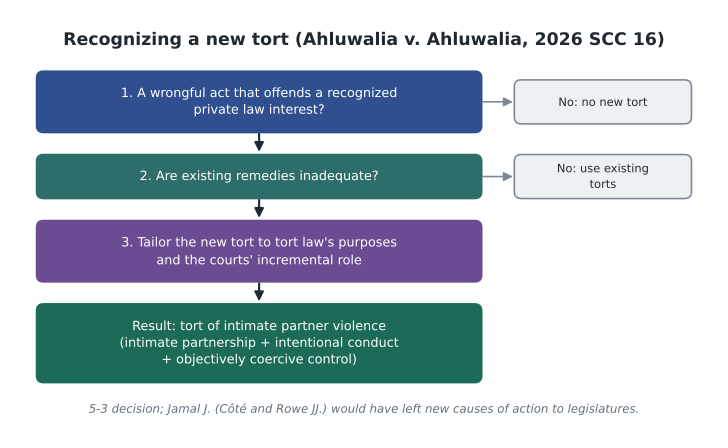
The new tort requires proof that (1) the abusive conduct arose within an intimate partnership or its aftermath; (2) the defendant intentionally engaged in the conduct; and (3) the conduct, assessed objectively and cumulatively, amounts to coercive control. Separate proof of harm is not required. Karakatsanis J. concurred and would have framed the test more broadly. Jamal J., joined by Côté and Rowe JJ., dissented, finding that existing torts were adequate and that the legislatures were better placed to create such a cause of action. The decision matters beyond family law: it is now the leading Canadian statement of how courts create new torts, and lesson 4 uses it to examine the privacy torts.
Worked problem
The fight at Hallett Arena
Ravi Sandhu sues Kyle Dunmore for the cross-check after the whistle. Sandhu also says that, moments before, Dunmore skated toward him shouting "You're done" with his stick raised over his shoulder. What torts can Sandhu plead and what must he prove?
Show solution
- Battery: Sandhu proves a direct, intentional physical interference (the cross-check to the neck). Under Scalera he need not prove lack of consent or that the contact was harmful; Dunmore must prove consent or another defence.
- Assault: the raised stick and the shouted threat, as Dunmore skated toward him, could cause a reasonable apprehension of imminent harmful contact. The assault is complete even though the battery follows.
- Intent: Dunmore intended the contact; intent to cause a fractured vertebra is unnecessary. Like the shopkeeper in Bettel v. Yim, he is liable for the direct consequences of an intentional battery.
- Damages: battery is actionable per se, but Sandhu will prove substantial damages for the fracture. Punitive damages may be available for deliberate violence (lesson 10).
- Practical point: Sandhu should also plead negligence in the alternative, because Dunmore's liability insurance (for example, under a homeowner's policy) may exclude intentional harm.
Intentional torts and insurance
Bouchard-Ames ends with a practical point. Most tort plaintiffs are paid by insurance companies, not by individual defendants, and liability insurance policies almost always exclude damage that the insured intended to cause. That is why Scalera reached the Supreme Court: the question of whether a claim was for battery or for negligence determined whether anyone would pay. Plaintiffs' lawyers often plead negligence in the alternative to an intentional tort for exactly that reason, and defence lawyers for insurers look closely at how claims are framed. 'Remember that the person who did the harm may have no money,' she says. 'The cause of action you choose can decide whether your client is compensated at all.'
Common mistakes
MistakeRequiring the plaintiff in battery to prove that the contact was non-consensual or harmful.
InsteadUnder Non-Marine Underwriters v. Scalera, the plaintiff proves a direct, intentional physical interference; the defendant must prove consent or another defence.
MistakeTreating a blocked route as false imprisonment even though another reasonable exit was open.
InsteadThe restraint must be total (Bird v. Jones). Partial obstruction is not imprisonment.
MistakeSaying intentional infliction of mental suffering requires a specific intent to harm.
InsteadUnder Prinzo, conduct is "calculated" to produce harm if the defendant knew harm was substantially certain to follow. A visible and provable illness is also required.
MistakeAssuming courts freely create new torts whenever they see unfairness.
InsteadAhluwalia requires a wrong that offends a recognized private law interest and the inadequacy of existing remedies before a court tailors a new tort.
Practice problems
Work each problem on paper first, then reveal the answer to check.
Why are battery, assault and false imprisonment called actionable per se?
Show answer
Because the plaintiff can recover at least nominal damages without proving any loss; the invasion of bodily integrity or liberty is itself the wrong.
What did Bettel v. Yim decide about the consequences of a battery?
Show answer
A defendant who commits an intentional battery is liable for its direct consequences, even unintended and unforeseen ones.
When does a citizen's arrest under section 494 of the Criminal Code justify a detention by store security?
Show answer
When the owner or a person authorized by the owner finds a person committing a criminal offence on or in relation to the property (or within a reasonable time after, if police arrest is not feasible), and the person is delivered forthwith to a peace officer.
What three elements did Prinzo set out for intentional infliction of mental suffering?
Show answer
Flagrant or outrageous conduct, calculated to produce harm, resulting in a visible and provable illness.
What three elements must be proved for the tort of intimate partner violence?
Show answer
Conduct within an intimate partnership or its aftermath, intentional conduct, and conduct that objectively and cumulatively amounts to coercive control.
Summary and key terms
- Tort law decides when one person must compensate another for harm outside contract; Canadian common law tort law is mostly judge-made, with statutes such as the Negligence Act and the Occupiers' Liability Act.
- Battery, assault and false imprisonment come from the writ of trespass and are actionable without proof of damage.
- In battery the plaintiff proves a direct, intentional physical interference; the defendant must prove consent or another defence (Scalera).
- False imprisonment requires a total restraint; submission to an assertion of authority counts; section 494 of the Criminal Code gives a limited justification.
- Intentional infliction of mental suffering requires flagrant conduct, calculated to cause harm, producing a visible and provable illness (Prinzo; Boucher v. Wal-Mart).
- Ahluwalia v. Ahluwalia, 2026 SCC 16, set a framework for recognizing new torts and created the tort of intimate partner violence based on coercive control.
- Tort
- A civil wrong, other than breach of contract, for which the law gives a remedy, usually damages.
- Actionable per se
- Actionable without proof of damage.
- Battery
- A direct, intentional and physical interference with the person of another.
- Assault
- Intentionally causing a reasonable apprehension of imminent harmful or offensive contact.
- False imprisonment
- Intentional total restraint of a person's liberty without lawful justification.
- Coercive control
- A pattern of conduct that dominates and controls an intimate partner, the core of the tort recognized in Ahluwalia.
Lesson quiz · 5 questions
Score 60% or more to complete this lesson.
Create a free account to save your progress, take quizzes and earn a certificate.