
LAWC-112 · Lesson 4 of 12 · 21 min
Privacy torts
▶ Video coming soon A video version of this lesson is on the way.
Privacy is the newest area of tort law in Ontario, and one of the fastest moving. Until 2012 no Ontario appellate court had recognized a tort of invasion of privacy, and some judges doubted whether the common law could create one. Several provinces had already acted by statute: British Columbia, Saskatchewan, Manitoba and Newfoundland and Labrador have Privacy Acts that make it a tort to violate another's privacy wilfully and without claim of right. Quebec protects privacy through the Civil Code and its Charter of human rights and freedoms. Ontario has no general privacy tort statute, so its law has developed case by case.
Professor Bouchard-Ames brings the Hallett Arena file back with a privacy twist. Two days after the incidents, a short video appears on a popular local social media account. It shows Mason Levesque sitting in the storage room while the guard empties his backpack onto a table, including a prescription bottle with Mason's name visible. The clip came from the arena's internal security camera. An arena maintenance employee, Bryce Talbot, had logged into the camera system from his phone, recorded the screen and sent the clip to a friend who runs the account. The post gathers thousands of views and comments calling Mason a thief.
Jones v. Tsige and intrusion upon seclusion
In Jones v. Tsige, 2012 ONCA 32, both women worked at different branches of the Bank of Montreal. Tsige was in a relationship with Jones's former husband. Over four years, she used her workplace computer to look at Jones's personal banking records at least 174 times. She did not publish or distribute the information. Jones sued for invasion of privacy.
Sharpe J.A., for the Court of Appeal, recognized a tort of intrusion upon seclusion, drawing on the American Restatement (Second) of Torts and on the growing recognition of privacy as a Charter value. The elements are: (1) the defendant's conduct was intentional, which includes reckless; (2) the defendant invaded, without lawful justification, the plaintiff's private affairs or concerns; and (3) a reasonable person would regard the invasion as highly offensive, causing distress, humiliation or anguish. Proof of economic loss is not required. Because the tort protects dignity, damages are usually modest: the court set a range of up to 20,000 dollars, and awarded Jones 10,000 dollars. The court said aggravated and punitive damages could be added in exceptional cases.
Sharpe J.A. stressed that the tort is limited to deliberate and significant invasions of personal privacy, such as intrusions into financial or health records, sexual practices and orientation, employment, diary or private correspondence. It is not a remedy for every unwelcome observation, and claims must be balanced against competing interests such as freedom of expression.
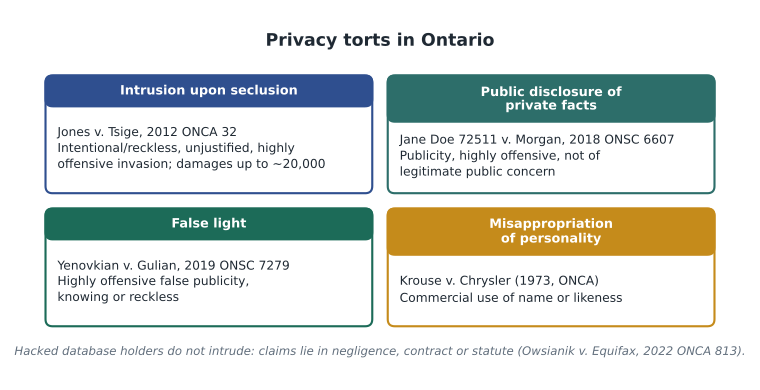
Bryce Talbot's access to the camera system is a strong candidate for intrusion upon seclusion. He deliberately viewed and recorded footage of a minor being searched in a closed room, with his medication visible, for no work purpose. Footage inside a closed storage room, as opposed to the public concourse, is part of Mason's private affairs, and a reasonable person would regard covert recording and sharing of it as highly offensive.
Public disclosure of private facts
Jones v. Tsige involved no publication. Where private information is spread to others, Ontario courts have recognized a second privacy tort: public disclosure of private facts. In Jane Doe 464533 v. N.D., 2016 ONSC 541, a young man posted an intimate video of his former girlfriend on a pornography website without her consent. Stinson J. recognized the tort and awarded general, aggravated and punitive damages. The default judgment was later set aside on procedural grounds, but courts have since adopted its reasoning. In Jane Doe 72511 v. Morgan, 2018 ONSC 6607, Gomery J. confirmed the tort, with these elements: the defendant publicized an aspect of the plaintiff's private life; the plaintiff did not consent; the matter publicized, or the act of publication, would be highly offensive to a reasonable person; and the publication was not of legitimate concern to the public.
Mason's claim against Talbot and the account owner for public disclosure looks strong: his detention and his prescription are private matters, he did not consent, and the publication of an accusation of theft against a sixteen-year-old with his medication visible would be highly offensive to a reasonable person. The account owner may argue that a security incident at a public arena is of public interest. But even if the incident were newsworthy, there is no legitimate public concern in Mason's identity and medication. Mason may also sue the account owner in defamation, because the post and comments imply he is a thief, as lesson 11 explains.
False light and misappropriation of personality
In Yenovkian v. Gulian, 2019 ONSC 7279, a father ran a years-long online campaign against his former wife and her parents, posting videos and petitions accusing them of abusing the children. Kristjanson J. recognized a third privacy tort, publicity placing a person in a false light: the defendant gives publicity to a matter concerning another that places them before the public in a false light that would be highly offensive to a reasonable person, and the defendant knew of or acted in reckless disregard of the falsity and the false light. Unlike defamation, the false light need not damage reputation, and truth is relevant only to the falsity element. The court awarded substantial general and punitive damages and issued a permanent injunction.
The fourth privacy tort, misappropriation of personality, is older. In Krouse v. Chrysler Canada Ltd. (1973), 1 OR (2d) 225 (CA), the court recognized that a person may sue for the commercial use of their name or likeness without consent, though it found no misappropriation on the facts. The tort protects the commercial value of identity. Ontario courts have since applied it to unauthorized uses of photographs in advertising.
The limits: data breaches and Owsianik
Privacy class actions became common after Jones v. Tsige, especially after data breaches in which hackers stole customer information from companies. Plaintiffs argued that companies with poor security were reckless and therefore liable for intrusion upon seclusion, which would allow damages without proof of loss for millions of class members.
In Owsianik v. Equifax Canada Co., 2022 ONCA 813, and two companion appeals released the same day, Obodo v. Trans Union of Canada, Inc., 2022 ONCA 814, and Winder v. Marriott International, Inc., 2022 ONCA 815, the Court of Appeal rejected that argument. Doherty J.A. held that the defendants who stored the data did not invade the plaintiffs' privacy; the hackers did. A company's reckless failure to protect information from third parties is not itself an intrusion. Its liability, if any, lies in negligence, breach of contract or statute, which require proof of loss. The Supreme Court of Canada denied leave to appeal in 2023. The result narrowed the tort to defendants who themselves intrude.
Applying Owsianik, Mason cannot sue the City of Corwin for intrusion upon seclusion merely because its camera system was poorly secured. Talbot was the intruder. Mason's claims against the city lie in negligence (did it fail to protect access to the footage?) and possibly in vicarious liability for Talbot's acts, which lesson 9 examines. The city is also bound by Ontario's Municipal Freedom of Information and Protection of Privacy Act, which governs the collection and disclosure of personal information by municipalities, and Mason may complain to the Information and Privacy Commissioner of Ontario.
Statutes and the Facebook case
Statutory privacy law runs alongside the torts. The federal Personal Information Protection and Electronic Documents Act (PIPEDA) governs private sector organizations in the course of commercial activity in most provinces, and is enforced by the Privacy Commissioner of Canada, who investigates complaints and can apply to the Federal Court. In Privacy Commissioner of Canada v. Facebook, Inc., 2024 FCA 140, the Federal Court of Appeal held that Facebook breached PIPEDA by failing to obtain meaningful consent before allowing third-party apps to access users' data, in the Cambridge Analytica affair, and by failing to safeguard that data. The Supreme Court granted leave and heard Facebook's appeal in March 2026; students should check whether its reasons have since been released. A proposed replacement for PIPEDA, the Consumer Privacy Protection Act in Bill C-27, died on the order paper when Parliament was prorogued in January 2025.
Statutes also create specific privacy remedies. The Criminal Code makes non-consensual distribution of intimate images an offence (section 162.1). Several provinces, including British Columbia under its Intimate Images Protection Act, which took effect in 2024, have created fast civil processes to order such images taken down. Ontario has relied on the common law torts discussed above.
Privacy and new torts after Ahluwalia
Bouchard-Ames asks the class to use the Ahluwalia framework from lesson 1 on the privacy torts. Is there a wrongful act that offends a recognized private law interest? Privacy is now well recognized, both as a Charter value and in Jones. Are existing remedies inadequate? That was exactly the reasoning in Jones and Jane Doe: defamation does not protect true private facts, and breach of confidence requires a relationship of confidence. Arjun Mehta points out that Ahluwalia now gives a structured test where Jones relied on more general reasoning, and that future claims for new privacy torts, for example for deepfake images or location tracking, will be argued under the Ahluwalia steps.
Privacy at work and in public
Two recurring questions define the limits of the privacy torts. The first is workplace monitoring. Employers have legitimate interests in security and in supervising work, and employees in federally regulated workplaces and in provinces with private sector privacy statutes have statutory protections. In Ontario, the Employment Standards Act, 2000 requires employers with 25 or more employees to have a written policy on electronic monitoring, telling employees how and in what circumstances they are monitored. The policy does not itself create new privacy rights, but courts consider whether monitoring was disclosed and proportionate when deciding whether an intrusion was justified or highly offensive.
The second question is privacy in public places. Generally, a person in public has a reduced expectation of privacy, so photographing someone on a public street is not an intrusion upon seclusion. But reduced is not eliminated. Covert, persistent surveillance, recordings in places such as washrooms and change rooms, or images that capture intimate details can still be actionable. The arena illustrates the line: the public concourse, where cameras are posted and visible, carries little expectation of privacy, while the closed storage room where Mason was searched is a different matter. Bouchard-Ames reminds the class that the Supreme Court in R. v. Jarvis, 2019 SCC 10, a voyeurism case, rejected an all-or-nothing approach to privacy in semi-public spaces, and that tort courts draw on the same idea.
Damages and class actions
The modest damages in Jones make individual privacy claims uneconomic unless aggravating facts are present, which is why many privacy claims proceed as class actions. A class action aggregates many small claims, but certification requires a cause of action that can be resolved on a common basis. After Owsianik, class actions against companies whose data was stolen usually plead negligence and breach of contract, which require proof of loss and are harder to certify. Class actions against defendants who themselves collected or used information without consent, for example by tracking users without disclosure, can still rely on intrusion upon seclusion.
Worked problem
The leaked detention video
Mason Levesque, through his mother as litigation guardian, sues Bryce Talbot, the owner of the social media account and the City of Corwin. Which privacy claims can succeed against each defendant?
Show solution
- Talbot: intrusion upon seclusion. He intentionally accessed and recorded private footage of a minor in a closed room without justification; a reasonable person would find it highly offensive (Jones v. Tsige). Damages without proof of loss, typically up to about 20,000 dollars, plus possible aggravated or punitive damages.
- Talbot and the account owner: public disclosure of private facts. They publicized private matters (the search and the medication) without consent; highly offensive; no legitimate public concern in a teenager's identity and medication (Jane Doe 72511 v. Morgan).
- Account owner: defamation for the implied accusation of theft (lesson 11); false light is possible if the publicity was knowingly or recklessly false (Yenovkian).
- City: not liable for intrusion merely because its system was insecure (Owsianik v. Equifax). Consider negligence and vicarious liability for Talbot (lesson 9), and a complaint under MFIPPA.
- Remedies: damages, an order to take down the video and an injunction against further publication.
Common mistakes
MistakeSaying intrusion upon seclusion requires publication of the information.
InsteadJones v. Tsige involved no publication; the tort is complete on the intrusion. Publication is the core of public disclosure of private facts.
MistakeSuing a hacked company for intrusion upon seclusion.
InsteadOwsianik holds that the hacker, not the database defendant, intrudes; claims against the company lie in negligence, contract or statute.
MistakeExpecting large damages awards for intrusion.
InsteadJones set a range of up to about 20,000 dollars, with aggravated or punitive damages only in exceptional cases.
MistakeTreating false light as identical to defamation.
InsteadFalse light protects against highly offensive false publicity even without reputational harm, and requires knowledge or reckless disregard of the falsity (Yenovkian).
Practice problems
Work each problem on paper first, then reveal the answer to check.
What are the elements of intrusion upon seclusion?
Show answer
Intentional or reckless conduct; an invasion, without lawful justification, of the plaintiff's private affairs or concerns; that a reasonable person would regard as highly offensive, causing distress, humiliation or anguish.
Which provinces have statutory privacy torts?
Show answer
British Columbia, Saskatchewan, Manitoba and Newfoundland and Labrador have Privacy Acts; Quebec protects privacy through the Civil Code and the Quebec Charter.
What did Owsianik v. Equifax decide?
Show answer
A company whose database is hacked by a third party does not itself intrude upon seclusion; liability, if any, lies in negligence, contract or statute.
What is the public interest element of public disclosure of private facts?
Show answer
The publication must not be of legitimate concern to the public.
What did the Federal Court of Appeal hold in Privacy Commissioner v. Facebook, 2024 FCA 140?
Show answer
Facebook breached PIPEDA by failing to obtain meaningful consent for third-party app access to user data and by failing to safeguard it; the Supreme Court heard Facebook's appeal in March 2026.
Summary and key terms
- Ontario has no general privacy statute; its privacy torts are judge-made, while four provinces have statutory privacy torts.
- Intrusion upon seclusion (Jones v. Tsige, 2012 ONCA 32) protects against deliberate, highly offensive invasions of private affairs, with modest damages without proof of loss.
- Public disclosure of private facts (Jane Doe 72511 v. Morgan) and false light (Yenovkian v. Gulian) cover publication; misappropriation of personality protects commercial identity.
- Database defendants hacked by third parties are not liable for intrusion (Owsianik v. Equifax, 2022 ONCA 813).
- PIPEDA and provincial statutes create regulatory privacy obligations; the Facebook case reached the Supreme Court in 2026.
- Ahluwalia's framework for new torts will shape future privacy claims.
- Intrusion upon seclusion
- Intentional or reckless, highly offensive invasion of another's private affairs without lawful justification.
- Public disclosure of private facts
- Publicizing a private matter that is highly offensive and not of legitimate public concern.
- False light
- Highly offensive publicity that places a person before the public in a false light, with knowledge or reckless disregard of the falsity.
- Misappropriation of personality
- Unauthorized commercial use of a person's name or likeness.
- PIPEDA
- The federal Personal Information Protection and Electronic Documents Act, governing private sector handling of personal information.
Lesson quiz · 5 questions
Score 60% or more to complete this lesson.
Create a free account to save your progress, take quizzes and earn a certificate.