
LAWC-112 · Lesson 8 of 12 · 23 min
Causation and remoteness
▶ Video coming soon A video version of this lesson is on the way.
A plaintiff who proves duty and breach has not yet won. They must also prove that the breach caused their injury, and that the injury was not too remote. These two questions are often lumped together as 'causation', but they are different. Factual causation asks whether the defendant's negligence actually caused the harm. Remoteness, sometimes called legal causation, asks whether the harm is of a kind the law will hold the defendant responsible for, even if it was factually caused. The Supreme Court stressed in Hemmings v. Padmore, decided on October 23, 2026, that the two questions must be kept analytically distinct.
Professor Bouchard-Ames uses Lucia Ferraro's claim from the carbon monoxide incident. Ferraro, seventy, already had moderate asthma. After the exposure at Hallett Arena she was hospitalized for three days, and in the following months her asthma worsened markedly. She now needs daily medication and has given up the volunteer work she loved. The defence experts say her asthma was getting worse anyway, and that carbon monoxide does not cause long-term asthma deterioration. Her expert says the exposure probably triggered a lasting inflammatory response. She has also developed what her family doctor calls 'serious anxiety' about crowded indoor spaces.
The but-for test
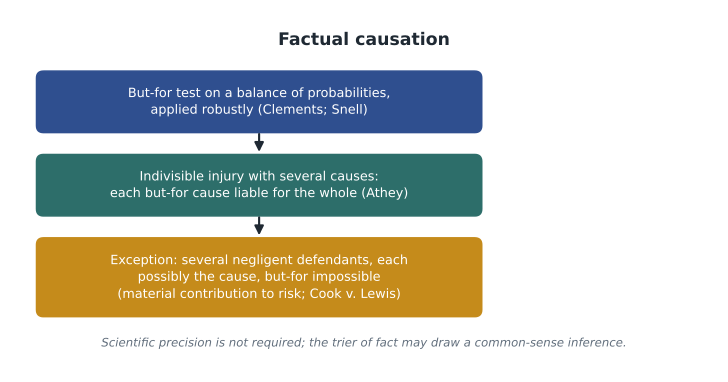
The basic test for factual causation is the but-for test: the plaintiff must show, on a balance of probabilities, that the injury would not have occurred but for the defendant's negligence. In Clements v. Clements, 2012 SCC 32, [2012] 2 SCR 181, a man was driving a motorcycle overloaded by about 100 pounds, with his wife as a passenger. A nail punctured the rear tire, and he accelerated to about 120 kilometres per hour to pass a car. The tire deflated, the motorcycle wobbled and crashed, and his wife suffered a severe brain injury. The trial judge, finding that scientific reconstruction could not prove that the overloading and speed caused the crash, applied a material contribution test instead.
McLachlin C.J., for the majority, held that this was an error. The but-for test is the general rule. It must be applied in a robust common-sense fashion. There is no need for scientific evidence of the precise contribution the defendant's negligence made to the injury. The trier of fact can infer causation from the circumstances. A new trial was ordered.
Robust inferences: Snell v. Farrell
The robust common-sense approach comes from Snell v. Farrell, [1990] 2 SCR 311. A surgeon continued a cataract operation after noticing bleeding behind the patient's eye. The patient later lost sight in that eye. Medical experts could not say with certainty whether continuing the operation caused the blindness, because the condition could also occur naturally. Sopinka J. held that causation need not be determined with scientific precision. Where the facts lie particularly within the knowledge of the defendant, very little affirmative evidence from the plaintiff may justify an inference of causation in the absence of evidence to the contrary. The Court rejected the idea of reversing the burden of proof, but upheld the inference that the surgeon's negligence caused the injury.
Ferraro's case is a typical battle of experts. The trial judge does not need scientific certainty. If the evidence shows a clear temporal link between the exposure and a marked change in her condition, and her expert's explanation is plausible, the judge may infer that the exposure caused the deterioration, even if the defence expert disagrees. The judge must decide which expert evidence to accept.
Multiple causes and indivisible injuries
Many injuries have more than one cause. In Athey v. Leonati, [1996] 3 SCR 458, a man with a history of back problems was injured in two car accidents. Some time later, while doing stretching exercises recommended for his recovery, he suffered a disc herniation. The trial judge found that the accidents had contributed to the herniation, assessing their contribution at 25 percent, and reduced damages accordingly. Major J. held that this was wrong. Where the defendant's negligence is a cause of an indivisible injury, even if other non-tortious causes also contributed, the defendant is liable for the whole injury. The law does not excuse a defendant because other factors also played a part. Causation is established if the defendant's negligence materially contributed to the injury outside the de minimis range, in the sense of being a but-for cause.
Where several tortfeasors cause an indivisible injury, each is jointly and severally liable to the plaintiff for the whole loss. Under Ontario's Negligence Act, the defendants can then claim contribution from each other in proportion to their degrees of fault. This protects the plaintiff from the risk that one defendant cannot pay. In the arena case, if both the city and Tri-County were negligent and both were but-for causes of Ferraro's exposure, she can recover her full damages from either one, leaving them to divide the bill between themselves.
Material contribution to risk
Clements recognized a narrow exception. Where the plaintiff can show that the injury would not have occurred but for the negligence of two or more tortfeasors, each possibly the cause, but cannot show which one caused it, the court may find each liable on the basis that they materially contributed to the risk of injury. The classic example is Cook v. Lewis, [1951] SCR 830: two hunters fired negligently in the plaintiff's direction, and one shot hit him, but it was impossible to say which. Without the exception, the plaintiff would lose against both, even though one of them certainly caused the harm. The exception does not apply in single-defendant cases, and McLachlin C.J. emphasized that it applies only in special circumstances where the but-for test is impossible to satisfy because of the limits of scientific knowledge and multiple negligent actors point the finger at each other.
In Resurfice Corp. v. Hanke, 2007 SCC 7, an ice resurfacer exploded at an Alberta arena when an operator put hot water into the gasoline tank by mistake, injuring him badly. He sued the manufacturer, arguing that the gas and water tanks were confusingly similar. The trial judge found no negligence and no causation, and the Supreme Court restored that result. The Court affirmed that but-for remains the general test and that material contribution applies only in exceptional circumstances. Bouchard-Ames notes that the case is a reminder that design defect claims about ice resurfacers have been litigated before, and that causation evidence is critical.
Hemmings v. Padmore (2026)
In Hemmings v. Padmore, the Supreme Court's most recent major causation decision, Sophia Hemmings, a high-risk patient, suffered a cardiac arrest during an emergency caesarean section after the anesthesiologist switched from a regional to a general anaesthetic, requiring intubation that initially failed. She was left with severe and permanent brain damage. The trial judge found the obstetrician, the anesthesiologist and the hospital (for a nurse's conduct) liable. The Court of Appeal for Ontario held only the anesthesiologist liable, for damages the parties had agreed at 12 million dollars.
The Supreme Court dismissed the appeals, with a split among the judges. The majority, in reasons by Rowe and O'Bonsawin JJ., concurred in by Jamal J., agreed that the anesthesiologist was a factual cause: the cardiac arrest would not have occurred but for his decision to give a general anaesthetic. But they held that the trial judge had misapplied remoteness to the obstetrician and the nurse, and that the injuries were too remote from their conduct. Martin J., with Karakatsanis and Moreau JJ., would have held the obstetrician liable as well. Wagner C.J. would have allowed the anesthesiologist's appeal, finding the trial analysis too flawed to sustain liability against anyone. The case confirms that factual causation and remoteness are separate steps, each needing its own analysis.
Remoteness
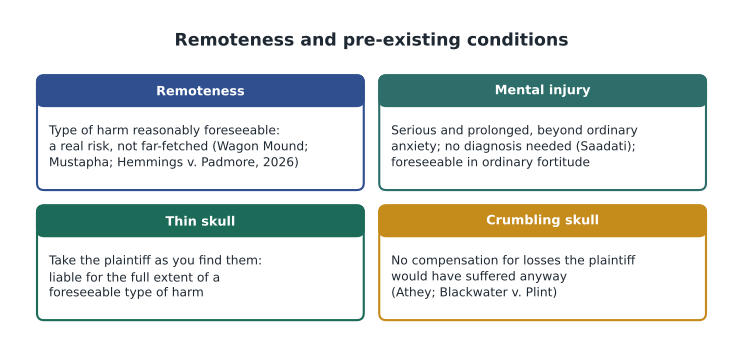
Remoteness limits liability to consequences that are reasonably foreseeable. In Overseas Tankship (U.K.) Ltd. v. Morts Dock and Engineering Co. (The Wagon Mound No. 1), [1961] AC 388 (PC), the defendants carelessly spilled furnace oil into Sydney Harbour. It drifted to the plaintiff's wharf, where welding sparks ignited it and the wharf burned. Experts testified that the oil was not thought capable of catching fire on water. The Privy Council held that the defendants were not liable, because damage by fire was not a reasonably foreseeable consequence of the spill. It rejected the earlier rule from Re Polemis, which had imposed liability for all direct consequences.
In Mustapha v. Culligan of Canada Ltd., 2008 SCC 27, Mr. Mustapha saw a dead fly, and part of another, in a bottle of water supplied by Culligan while he was replacing it. He became obsessed with the event and developed a major depressive disorder with phobia and anxiety. The Court held that his psychiatric injury was too remote. The question is whether the harm was reasonably foreseeable in a person of ordinary fortitude; a real risk is one that would occur to the mind of a reasonable person in the defendant's position and that the reasonable person would not brush aside as far-fetched. Mr. Mustapha's reaction, while genuine, was 'highly unusual or very particular', and not foreseeable in a person of ordinary fortitude.
The thin skull and crumbling skull rules
Once the type of harm is foreseeable, the extent of the harm need not be. Under the thin skull rule, the defendant takes the plaintiff as they find them, and is liable for the full extent of the injury even if the plaintiff's pre-existing vulnerability made it much worse than expected. In Smith v. Leech Brain & Co., [1962] 2 QB 405, a worker was burned on the lip by molten metal; the burn triggered a pre-malignant condition, and he died of cancer. The employer was liable for his death.
The crumbling skull rule limits the thin skull rule. If the plaintiff's pre-existing condition would have caused some or all of the same loss anyway, the defendant need not compensate for that loss, because damages aim to restore the plaintiff to their original position, not a better one (Athey; Blackwater v. Plint, 2005 SCC 58). If Ferraro's asthma was steadily worsening and would have reached its current state within a few years regardless of the exposure, her damages for long-term loss should be reduced to reflect that likelihood. If the exposure caused a deterioration she would not otherwise have suffered, the thin skull rule makes the defendants liable for all of it, even though a healthy person would have recovered in days.
Mental injury: Saadati v. Moorhead
Ferraro's anxiety about crowded spaces raises the question of mental injury. In Saadati v. Moorhead, 2017 SCC 28, [2017] 1 SCR 543, the plaintiff was injured in a series of car accidents and suffered personality changes, but no expert diagnosed a recognized psychiatric illness. Brown J., for the Court, held that a plaintiff need not prove a diagnosed psychiatric condition. Mental injury is compensable if it is serious and prolonged and rises above the ordinary annoyances, anxieties and fears that come with living in civil society. Expert evidence may help prove it, but it is not required; lay evidence from family and friends can be enough. The Court rejected special control mechanisms for mental injury, leaving the usual negligence elements, including foreseeability in a person of ordinary fortitude, to filter claims.
Applying Saadati and Mustapha, Ferraro's anxiety is compensable if it is serious and prolonged and if mental injury of that kind was foreseeable in a person of ordinary fortitude exposed to carbon monoxide in a crowded arena and hospitalized as a result. Bouchard-Ames thinks that is likely: fear of a recurrence after a frightening poisoning is a natural reaction, unlike the 'very particular' reaction in Mustapha.
Intervening acts and proof gaps
A defendant may argue that an intervening act broke the chain of causation, such as the deliberate wrongdoing of a third party or the plaintiff's own unreasonable conduct. Courts ask whether the intervening act was reasonably foreseeable; negligent medical treatment of an injury is generally considered foreseeable, so the original wrongdoer remains liable for it. Finally, gaps in proof are sometimes caused by a party's own conduct. In SS&C Technologies Canada Corp. v. Bank of New York Mellon Corp., 2026 SCC 29, the Supreme Court held unanimously that where a party intentionally destroys relevant evidence while litigation is ongoing or contemplated, a mandatory presumption arises that the evidence would have been unfavourable to it, and if the presumption is not rebutted, the court must draw an adverse inference sufficient to level the evidentiary playing field. The Court left open whether spoliation is an independent tort. If Hallett Arena's maintenance logs or the resurfacer's service records have disappeared, that decision could matter a great deal.
Worked problem
Lucia Ferraro's asthma and anxiety
Assume the City of Corwin and Tri-County breached their duties. Can Ferraro recover for her worsened asthma and her anxiety, and from whom?
Show solution
- Factual causation: apply the but-for test robustly (Clements; Snell). A clear temporal link and a plausible expert explanation can support an inference that the exposure caused the deterioration, without scientific certainty.
- Multiple defendants: if both breaches were but-for causes of an indivisible injury, each is jointly and severally liable for the whole; the Negligence Act lets them seek contribution from each other (Athey).
- Remoteness: respiratory injury from carbon monoxide is plainly a foreseeable type of harm (Mustapha; Hemmings).
- Thin or crumbling skull: the defendants take her as they find her, but damages should be reduced for any deterioration she would have suffered anyway (Athey; Blackwater).
- Anxiety: compensable if serious and prolonged (Saadati), and foreseeable in a person of ordinary fortitude after a poisoning and hospitalization (Mustapha distinguished).
Common mistakes
MistakeApplying material contribution whenever causation is scientifically uncertain.
InsteadClements limits material contribution to cases where several negligent defendants each could be the cause and but-for proof is impossible; otherwise apply but-for robustly.
MistakeReducing damages because non-tortious factors also contributed to an indivisible injury.
InsteadAthey holds the defendant liable for the whole injury if its negligence was a cause; apportionment is between tortfeasors, not against background causes.
MistakeRequiring a diagnosed psychiatric illness for mental injury.
InsteadSaadati requires a serious and prolonged disturbance, which lay evidence can prove.
MistakeMerging factual causation and remoteness into one question.
InsteadHemmings v. Padmore (2026) insists they are separate steps, each with its own analysis.
Practice problems
Work each problem on paper first, then reveal the answer to check.
What did Snell v. Farrell decide about proof of causation?
Show answer
Causation need not be proved with scientific precision; where facts lie within the defendant's knowledge, little affirmative evidence may support an inference of causation, without reversing the burden.
When does material contribution to risk apply after Clements?
Show answer
Only where the plaintiff can show the injury would not have occurred but for the negligence of two or more defendants, each possibly the cause, and cannot prove which.
What test of remoteness did Mustapha apply?
Show answer
Whether the harm was reasonably foreseeable as a real risk in a person of ordinary fortitude, not far-fetched.
What is the difference between the thin skull and crumbling skull rules?
Show answer
Thin skull makes the defendant liable for the full extent of injury despite a vulnerability; crumbling skull excludes losses the plaintiff would have suffered anyway from a pre-existing condition.
What did SS&C Technologies v. Bank of New York Mellon, 2026 SCC 29, decide about destroyed evidence?
Show answer
Intentional destruction of relevant evidence during contemplated or ongoing litigation raises a mandatory presumption that it was unfavourable, and an unrebutted presumption requires an adverse inference that levels the playing field.
Summary and key terms
- Factual causation uses the but-for test, applied robustly; scientific precision is not required (Snell; Clements).
- A defendant whose negligence caused an indivisible injury is liable for all of it, with contribution among tortfeasors (Athey; Negligence Act).
- Material contribution to risk is a narrow exception for multiple negligent defendants (Clements; Cook v. Lewis; Resurfice).
- Remoteness asks whether the type of harm was reasonably foreseeable (Wagon Mound No. 1; Mustapha); Hemmings v. Padmore (2026) keeps causation and remoteness distinct.
- Thin skull and crumbling skull rules govern pre-existing vulnerabilities.
- Mental injury must be serious and prolonged but need not be diagnosed (Saadati); destroyed evidence triggers an adverse presumption (SS&C, 2026 SCC 29).
- But-for test
- The rule that the plaintiff must show the injury would not have occurred without the defendant's negligence.
- Indivisible injury
- A single injury that cannot be divided among its causes.
- Material contribution to risk
- A narrow exception allowing liability where multiple negligent defendants may each have caused the harm.
- Remoteness
- The limit of liability to reasonably foreseeable types of harm.
- Thin skull rule
- The defendant takes the plaintiff as found and pays for the full extent of foreseeable types of harm.
- Spoliation
- The intentional destruction, alteration or concealment of evidence relevant to litigation.
Lesson quiz · 5 questions
Score 60% or more to complete this lesson.
Create a free account to save your progress, take quizzes and earn a certificate.