
LAWC-111 · Lesson 9 of 12 · 23 min
Charter remedies
▶ Video coming soon A video version of this lesson is on the way.
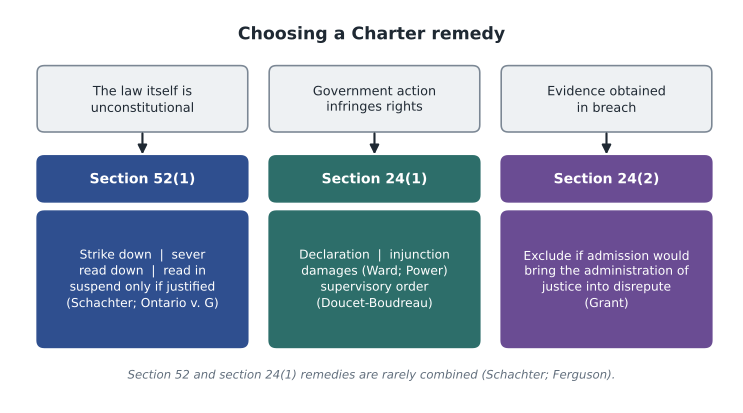
A right without a remedy is of little use. The Charter provides two main remedial sources: section 52(1) of the Constitution Act, 1982, which makes laws inconsistent with the Constitution of no force or effect, and section 24(1) of the Charter, which allows anyone whose rights have been infringed to apply to a court of competent jurisdiction for such remedy as the court considers appropriate and just in the circumstances. Section 24(2) adds a specific rule for excluding evidence obtained in breach of the Charter.
Noor Rahimi opens the reading group's session on remedies by going back over the problems the group has worked through. 'You've found that the Riverside Park bylaw probably violates section 7, that the hospital probably violates section 15 and that the university's policy might violate section 2(b). Now what do you ask the court to do?' Theo Marchetti says the answer depends on whether the problem is with the law itself or with how someone applied it. Rahimi agrees: that is the first and most important distinction in the law of remedies.
Section 52 or section 24(1)?
Section 52 applies when the law itself is unconstitutional. The remedy is a declaration that the law, or the inconsistent part of it, is of no force or effect. A section 52 declaration has general effect: it binds everyone, not just the parties. Section 24(1) applies when government action taken under a valid law, or without legal authority, infringes a person's Charter rights. Its remedies are personal to the claimant.
The two provisions are normally not combined. In Schachter v. Canada, [1992] 2 SCR 679, Chief Justice Lamer said that an individual remedy under section 24(1) will rarely be available in conjunction with a section 52 declaration. In R. v. Ferguson, 2008 SCC 6, the Court refused to grant a constitutional exemption from a mandatory minimum sentence under section 24(1): if a mandatory minimum is unconstitutional, the remedy is to strike it down under section 52, not to exempt individual offenders while leaving it in place. Courts should not rewrite a law case by case through section 24(1).
Section 52 remedies
Schachter set out the options available under section 52. A court may strike down the whole law. It may sever the unconstitutional part and leave the rest standing. It may read down the law, interpreting it narrowly so that it does not apply to the unconstitutional situations. It may read in words to extend the law to a group improperly excluded. And it may temporarily suspend the declaration of invalidity to give the legislature time to respond.
In choosing among these options, the court defines the extent of the inconsistency and then asks how best to cure it while respecting the role of the legislature. Reading in and severance are appropriate only where the court can define the remedy with sufficient precision, where doing so is consistent with the legislative objective, where the remedy would not unduly intrude on legislative choices, including budgetary choices, and where it is reasonable to assume the legislature would have enacted the law as modified.
In Vriend v. Alberta, [1998] 1 SCR 493, the Court read the words 'sexual orientation' into Alberta's human rights statute, reasoning that the omission was the precise problem, that reading in was consistent with the purpose of the legislation and that the legislature would prefer that result to having no human rights statute at all. In R. v. Sharpe, 2001 SCC 2, the Court read two narrow exceptions into the child pornography offence. In Schachter itself, the Court declined to read biological fathers into a parental leave benefit for adoptive parents, because Parliament had amended the scheme by the time the case reached the Supreme Court.
Suspended declarations
A suspended declaration keeps an unconstitutional law in force for a period, usually six to twelve months, to allow the legislature to enact a new law. Schachter described suspensions as appropriate where striking down the law immediately would pose a danger to the public, threaten the rule of law, or deny benefits to deserving people where the law was underinclusive. In practice, courts came to grant suspensions routinely, often whenever the legislature might have more than one way of responding.
In Ontario (Attorney General) v. G, 2020 SCC 38, the Court reconsidered that practice. G had been found not criminally responsible on account of mental disorder for several offences and later received an absolute discharge, but he remained subject to Ontario's sex offender registry, while people who were found guilty and later pardoned could be removed. The Court held that the registry scheme violated section 15. Justice Karakatsanis, for the majority, held that suspending a declaration is an exceptional measure that requires justification: the government must show that an immediate declaration would endanger an interest so compelling that it outweighs the cost of keeping an unconstitutional law in force, and that the length of the suspension is necessary. Where a suspension is granted, the court should consider whether to exempt the claimant, and others in the same position, from the suspension, so that the person who brought the case gets an effective remedy.
The Court's experience with Carter shows why. In Carter v. Canada (Attorney General), 2015 SCC 5, the Court suspended its declaration for twelve months. When Parliament had not acted by the deadline, in Carter v. Canada (Attorney General), 2016 SCC 4, the Court granted a four-month extension but exempted Quebec, which had its own law, and allowed individuals to apply to a superior court for an exemption during the extension.
Arjun Mehta asks whether the Riverside Park remedy should be suspended. Rahimi says the city would have to show a compelling interest that would be harmed by an immediate declaration. Because the cases have generally limited the declaration to times when shelter beds are unavailable, an immediate declaration would not leave the park unregulated, and the argument for a suspension is weak.
Section 24(1): appropriate and just remedies
Section 24(1) gives courts a broad discretion. In Doucet-Boudreau v. Nova Scotia (Minister of Education), 2003 SCC 62, francophone parents had won a declaration that Nova Scotia had to provide French-language secondary school facilities under section 23. The trial judge ordered the province to use its best efforts to build the schools by certain dates and retained jurisdiction to receive progress reports. A five to four majority upheld the order. An appropriate and just remedy, the majority said, meaningfully vindicates the claimant's rights, employs means that are legitimate within a constitutional democracy, is judicial in nature, is fair to the government and allows the remedy to evolve with the circumstances. Delay in implementing section 23 rights risks assimilation, which justified a supervisory order. The dissenting judges thought the court had exceeded its role.
The court that grants the remedy must be a court of competent jurisdiction, meaning one with jurisdiction over the parties, the subject matter and the remedy sought (R. v. Mills, [1986] 1 SCR 863). Administrative tribunals with power to decide questions of law can grant Charter remedies that fall within their statutory mandate (R. v. Conway, 2010 SCC 22).
Charter damages
In Vancouver (City) v. Ward, 2010 SCC 27, police mistakenly suspected Alan Cameron Ward of planning to throw a pie at the Prime Minister. He was arrested, strip-searched and his car was seized. The Court held that damages under section 24(1) may be awarded for Charter breaches, separate from tort law. Chief Justice McLachlin set out a four-step test: establish the breach; show that damages would serve a function of compensation, vindication of the right or deterrence of future breaches; consider countervailing factors, such as alternative remedies or good governance concerns; and assess the amount. Ward received 5,000 dollars for the strip search, which was not justified, but nothing for the seizure of his car, for which a declaration was sufficient.
Good governance concerns limit damages in some contexts. In Henry v. British Columbia (Attorney General), 2015 SCC 24, Ivan Henry spent nearly 27 years in prison for sexual assault convictions that were later overturned. He sued for damages for wrongful non-disclosure of evidence by the Crown. The Court held that malice is not required, but that the claimant must show that the prosecutor intentionally withheld information knowing, or reasonably expected to know, that it was material to the defence and that failing to disclose it would likely impinge on the accused's ability to make full answer and defence. That heightened threshold protects prosecutors from defensive behaviour while allowing compensation for serious misconduct.
Damages for legislation: Mackin and Power
Courts have traditionally been reluctant to award damages for enacting unconstitutional legislation. In Mackin v. New Brunswick (Minister of Finance), 2002 SCC 13, the Court held that damages are generally not available for legislation later declared invalid, absent conduct that is clearly wrong, in bad faith or an abuse of power. In Canada (Attorney General) v. Power, 2024 SCC 26, a former corrections officer argued that federal legislation retroactively preventing him from obtaining a record suspension had violated his rights, and claimed damages. The majority held that the state does not have absolute immunity from Charter damages for legislation, but that damages are available only where the legislation was clearly unconstitutional or was enacted in bad faith or through an abuse of power. The threshold respects parliamentary sovereignty and privilege while preserving accountability. Other judges would have recognized broader immunity. Hannah Kowalczyk says Power is a sensible compromise. Theo replies that a clearly unconstitutional standard will be very hard to meet in practice.
Declarations and the Khadr case
A declaration is a flexible remedy that states the parties' legal rights without ordering specific action. In Canada (Prime Minister) v. Khadr, 2010 SCC 3, the Court held that Canadian officials had violated Omar Khadr's section 7 rights by interrogating him at Guantanamo Bay and sharing the results with United States authorities. But it declined to order the government to request his repatriation, because foreign affairs fall within the executive's prerogative and the Court lacked the information needed to assess such an order. It issued a declaration instead, leaving the government to decide how to respond. Khadr later settled a civil claim against the federal government in 2017.
Interim relief
Claimants sometimes ask courts to suspend the operation of a law while a challenge proceeds. The test for an interlocutory injunction comes from RJR-MacDonald Inc. v. Canada (Attorney General), [1994] 1 SCR 311: a serious question to be tried, irreparable harm if relief is not granted, and a balance of convenience favouring relief. In Charter cases, courts presume that legislation serves the public interest, so it is difficult to obtain an injunction suspending a law. In Harper v. Canada (Attorney General), 2000 SCC 57, the Court set aside an injunction suspending federal third-party spending limits, emphasizing that laws should generally remain in force until declared unconstitutional. In the Saskatchewan pronoun case, a judge granted an injunction suspending a ministerial policy in 2023, and the legislature then enacted the policy as law and invoked section 33, a sequence lesson 10 examines.
Stays of proceedings and other criminal remedies
In criminal cases, the most drastic section 24(1) remedy is a stay of proceedings, which ends the prosecution. A stay is available for abuse of process only in the clearest of cases: where state conduct compromises the fairness of the trial, or where it risks undermining the integrity of the justice system even if the trial itself would be fair (R. v. Babos, 2014 SCC 16). In the second category the court balances the seriousness of the misconduct against society's interest in a trial on the merits, and considers whether any lesser remedy would be enough. A stay is also the mandatory remedy for a breach of the right to be tried within a reasonable time under section 11(b), as Jordan confirmed, which explains why delay applications are fought so hard in practice.
Costs and access to Charter litigation
Charter litigation is expensive, and remedies mean little if claimants cannot afford to bring cases. Courts may award costs to successful claimants in the ordinary way, and sometimes award costs to public interest litigants even when they lose. In British Columbia (Minister of Forests) v. Okanagan Indian Band, 2003 SCC 71, the Court held that a court may order the government to pay interim or advance costs in exceptional cases, where the litigant genuinely cannot afford to proceed, the claim is prima facie meritorious, and the issues are of public importance and have not been resolved. In Little Sisters Book and Art Emporium v. Canada (Commissioner of Customs and Revenue), 2007 SCC 2, the Court emphasized that such orders are rare and should be granted only as a last resort. The federal Court Challenges Program, which funds test cases on official language rights and equality and human rights, has been cancelled and restored more than once since 1978, and its existence has shaped which cases reach the courts.
Section 24(2): exclusion of evidence
Section 24(2) provides that where evidence was obtained in a manner that infringed Charter rights, it shall be excluded if, having regard to all the circumstances, its admission would bring the administration of justice into disrepute. R. v. Grant, 2009 SCC 32, set the test: the seriousness of the Charter-infringing state conduct, the impact of the breach on the accused's Charter-protected interests, and society's interest in the adjudication of the case on its merits. The remedy is studied in depth in Criminal Procedure, but it is worth remembering that section 24(2) is the remedy most often used in practice.
Worked problem
Remedies in the Corwin problems
Assume the court has found that (1) the Riverside Park bylaw violates section 7 when shelter beds are unavailable, and (2) Corwin General Hospital violated section 15 by refusing interpreters for deaf patients. What remedies should the claimants seek?
Show solution
- Bylaw: The problem is with the law, so section 52 applies. The narrowest effective remedy is a declaration that the bylaw is of no force or effect to the extent that it prohibits overnight shelter in the park when shelter beds are unavailable, as in Adams and Waterloo, rather than striking the whole bylaw.
- Suspension: Under Ontario v. G, the city must justify any suspension by showing a compelling public interest; because the declaration is narrow, a suspension is unlikely to be justified.
- Hospital: The problem is with a decision taken under valid legislation, so section 24(1) applies. A declaration that the hospital must provide interpreters where necessary for effective communication, as in Eldridge, is appropriate; a supervisory order is unlikely to be needed.
- Damages: A deaf patient who suffered harm because of the lack of an interpreter could seek damages under Ward if compensation, vindication or deterrence would be served and no countervailing factor applies, though a declaration may be sufficient.
Practice problems
Work each problem on paper first, then reveal the answer to check.
When is section 52 the right remedial provision, and when is section 24(1)?
Show answer
Section 52 applies when the law itself is unconstitutional, producing a general declaration of invalidity. Section 24(1) applies when government action under a valid law, or without authority, infringes an individual's rights, producing a personal remedy.
What remedial options under section 52 did Schachter describe?
Show answer
Striking down, severance, reading down, reading in, and temporarily suspending the declaration of invalidity.
What did Ontario v. G change about suspended declarations?
Show answer
It held that suspensions are exceptional and must be justified by showing that an immediate declaration would endanger a compelling public interest, and that courts should consider exempting the claimant and similarly situated people from any suspension.
What is the test for Charter damages in Ward?
Show answer
Establish a breach; show damages would serve compensation, vindication or deterrence; consider countervailing factors such as alternative remedies and good governance; then assess the amount.
What did Power (2024 SCC 26) decide about damages for legislation?
Show answer
The state is not absolutely immune, but damages for enacting legislation are available only if the law was clearly unconstitutional or was enacted in bad faith or by abuse of power.
Summary and key terms
- Section 52 gives general declarations of invalidity for unconstitutional laws; section 24(1) gives personal remedies for unconstitutional government acts; they are rarely combined (Schachter; Ferguson).
- Section 52 options are striking down, severance, reading down, reading in and suspension (Schachter; Vriend; Sharpe).
- Suspensions are exceptional and need justification, with possible exemptions for claimants (Ontario v. G; Carter 2016).
- Section 24(1) allows creative remedies, including supervisory orders (Doucet-Boudreau), declarations (Khadr) and damages (Ward; Henry).
- Damages for legislation require clear unconstitutionality, bad faith or abuse of power (Mackin; Power, 2024).
- Interlocutory injunctions against laws are hard to obtain (RJR-MacDonald; Harper 2000); section 24(2) excludes evidence under Grant.
- Reading in
- A remedy that adds words to a statute to cure underinclusiveness.
- Reading down
- Interpreting a statute narrowly so that it does not reach unconstitutional applications.
- Severance
- Removing the unconstitutional part of a law and leaving the rest in force.
- Suspended declaration
- A declaration of invalidity that takes effect only after a set period, to allow the legislature to respond.
- Constitutional exemption
- An exemption of an individual from an otherwise valid law, rejected as a remedy for mandatory minimum sentences in Ferguson.
- Charter damages
- Monetary compensation under section 24(1) for a Charter breach, governed by Ward.
Lesson quiz · 5 questions
Score 60% or more to complete this lesson.
Create a free account to save your progress, take quizzes and earn a certificate.