
LAWC-111 · Lesson 8 of 12 · 22 min
Democratic, mobility and language rights
▶ Video coming soon A video version of this lesson is on the way.
The rights in sections 3 to 6 and 16 to 23 are less often litigated than freedom of expression or equality, but they go to the heart of Canadian democracy and federalism: who may vote, who may move freely within the country, and how English and French minorities are protected. They also share a feature that makes them strategically important. Section 33 cannot override them. A legislature that invokes the notwithstanding clause cannot shield a law from a challenge under sections 3 to 6 or 16 to 23.
At the reading group's discussion of these rights, Sophie Tremblay-Hart talks about growing up as a francophone in Gatineau, a few minutes from Ottawa, where her cousins attended French-language schools under section 23. Hannah Kowalczyk mentions an Alberta friend who took a job in Newfoundland during the pandemic and could not get permission to enter the province. Professor Okafor-Lindqvist says both stories belong in this lesson, and that the second was decided by the Supreme Court in February 2026.
The right to vote: section 3
Section 3 provides that every citizen has the right to vote in an election of members of the House of Commons or of a legislative assembly and to be qualified for membership in them. It does not apply to municipal elections, school board elections or referendums (Haig v. Canada, [1993] 2 SCR 995).
In Reference re Provincial Electoral Boundaries (Sask.), [1991] 2 SCR 158, the Court held that the purpose of section 3 is not absolute equality of voting power but effective representation. Some deviation from voter parity is permissible to account for geography, community history, community interests and minority representation, so rural ridings with fewer voters did not violate section 3. In Figueroa v. Canada (Attorney General), 2003 SCC 37, the Court emphasized each citizen's right to play a meaningful role in the electoral process, and struck down a requirement that a party run candidates in at least 50 ridings to obtain certain benefits.
Limits on who may vote face stringent scrutiny. In Sauvé v. Canada (Chief Electoral Officer), 2002 SCC 68, the Court struck down a law denying the vote to prisoners serving sentences of two years or more. Chief Justice McLachlin held that denying the vote to citizens undermines the legitimacy of government and the rule of law, and that the government's objectives of promoting civic responsibility and enhancing punishment were too vague to justify the limit. In Frank v. Canada (Attorney General), 2019 SCC 1, the Court struck down the rule denying the federal vote to citizens who had lived outside Canada for five years or more. The majority held that the right to vote attaches to citizenship, not residence, and that any limit on voting requires stringent justification.
Informed voting and third-party spending
In Harper v. Canada (Attorney General), 2004 SCC 33, the Court upheld federal limits on third-party advertising during election periods, holding that section 3 includes a right to be reasonably informed of electoral choices, and that a level playing field among those who speak in elections promotes that right.
Working Families Coalition (Canada) Inc. v. Ontario (Attorney General), 2025 SCC 5, decided March 7, 2025, applied that informational component to strike down Ontario's limits on third-party political advertising. Ontario had extended the restricted period from six months to twelve months before a scheduled provincial election. In 2021 the Ontario Superior Court struck that extension down under section 2(b). Ontario responded by re-enacting the provision and invoking section 33 to protect it from section 2(b). The challengers then relied on section 3, which section 33 cannot override. The Court of Appeal held in 2023 that the law infringed section 3, and the Supreme Court, by a five to four majority, agreed. Justice Karakatsanis, for the majority, held that meaningful participation includes an informed vote, and that the twelve-month limit allowed political parties to dominate the debate during a period in which third parties were heavily constrained, creating a disproportionate imbalance. The infringement was not justified. The dissenting judges differed on whether section 3 contains a proportionality standard of this kind and on whether the limit was justified.
Okafor-Lindqvist points out that Working Families is the clearest example of how the rights outside section 33's reach can matter strategically: once Ontario used the override for section 2(b), the litigation moved to section 3.
Democratic rights: sections 4 and 5
Section 4 limits the life of the House of Commons and the provincial legislatures to five years from the date fixed for the return of the writs, except in time of real or apprehended war, invasion or insurrection, when a legislature may continue with the support of two thirds of its members. Section 5 requires a sitting of Parliament and each legislature at least once every twelve months. Fixed-date election laws, such as those federally and in Ontario, operate within those outer limits but do not prevent an earlier dissolution (Conacher v. Canada (Prime Minister), 2010 FCA 131).
Mobility rights: section 6
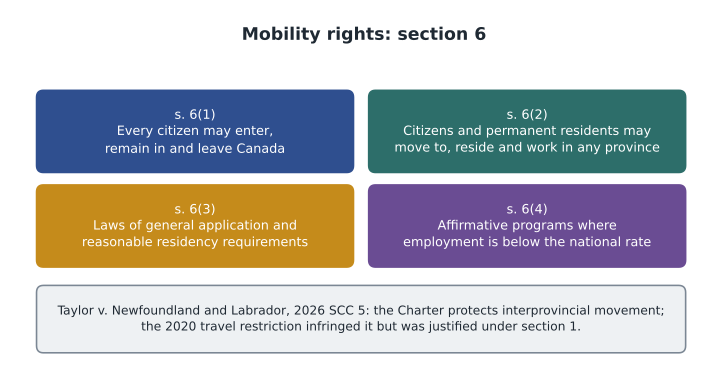
Section 6(1) gives every citizen the right to enter, remain in and leave Canada. Section 6(2) gives every citizen and every permanent resident the right to move to and take up residence in any province, and to pursue the gaining of a livelihood in any province. Section 6(3) makes those rights subject to laws of general application in a province, other than those that discriminate primarily on the basis of present or previous residence, and to reasonable residency requirements for publicly provided social services. Section 6(4) permits programs that ameliorate the conditions of socially or economically disadvantaged individuals in a province where the rate of employment is below the national rate.
Section 6(1) has been applied to extradition and foreign travel. In United States of America v. Cotroni, [1989] 1 SCR 1469, extradition of a citizen to face trial abroad limited the right to remain in Canada but was justified under section 1. In Divito v. Canada (Public Safety and Emergency Preparedness), 2013 SCC 47, the Court held that the right to enter Canada did not give a citizen imprisoned abroad a right to be transferred to serve the sentence in Canada.
Section 6(2) protects the ability to work across provincial lines but does not create a free-standing right to work. In Law Society of Upper Canada v. Skapinker, [1984] 1 SCR 357, a non-citizen challenged the citizenship requirement for admission to the bar; the Court held that section 6(2)(b) did not protect a right to work divorced from moving between provinces. In Black v. Law Society of Alberta, [1989] 1 SCR 591, by contrast, Alberta's rules preventing its lawyers from partnering with lawyers outside the province infringed section 6(2) without justification. In Canadian Egg Marketing Agency v. Richardson, [1998] 3 SCR 157, the majority upheld an egg marketing scheme, holding that section 6 targets laws that discriminate primarily on the basis of residence.
Taylor: interprovincial travel in a pandemic
In May 2020, early in the COVID-19 pandemic, Newfoundland and Labrador prohibited non-residents from entering the province except in exceptional circumstances with advance approval. Kimberley Taylor, a Nova Scotia resident, was refused entry to attend her mother's funeral. She challenged the restriction under sections 6 and 7. The trial judge found an infringement of section 6 but held it justified under section 1, and the Court of Appeal dismissed her appeal as moot after the restrictions were lifted.
In Taylor v. Newfoundland and Labrador, 2026 SCC 5, released February 13, 2026, the Supreme Court decided the Charter questions despite mootness. All judges agreed that the Charter protects interprovincial movement and that the restriction infringed it, but they divided on where that protection is found. Justices Karakatsanis and Martin, for the majority, held that a broad right of free movement within Canada underlies both section 6(1), because the right to remain in Canada includes moving freely within it, and section 6(2), because the right to reside and work in any province presupposes the ability to go there. Justices Kasirer and Jamal located the right only in section 6(2)(a), relying partly on the French text of the provision. Justice Rowe located it only in section 6(1). The Court unanimously held that the infringement was justified under section 1, given the rising case numbers, deaths and scientific uncertainty facing governments early in the pandemic. Hannah says her friend will be pleased to have the right recognized and less pleased with the result. Okafor-Lindqvist observes that Taylor shows how courts can affirm a right while deferring to emergency public health decisions under section 1.
Official languages: sections 16 to 22
Section 16 declares that English and French are the official languages of Canada and have equality of status in all institutions of Parliament and the federal government. Section 16.1 recognizes the equality of the English and French linguistic communities in New Brunswick. Sections 17 to 20 guarantee the use of either language in Parliament and the New Brunswick legislature, the bilingual publication of federal and New Brunswick statutes, the use of either language in federal and New Brunswick courts, and the right to communicate with and receive services from federal institutions in either language where there is significant demand or where it is warranted by the nature of the office. Section 16(3) permits Parliament and legislatures to advance the equality of status or use of the two languages.
In R. v. Beaulac, [1999] 1 SCR 768, the Court held that language rights must be interpreted purposively, consistently with the preservation and development of official language communities in Canada, overruling an earlier line of narrow interpretation. Parliament substantially modernized the Official Languages Act in 2023, including by recognizing the special situation of French as a minority language in North America and by creating new obligations for federally regulated private businesses. Quebec's Charter of the French Language, amended in 2022 by Bill 96, is a provincial statute that sits alongside these constitutional guarantees and is the subject of ongoing litigation.
Minority language education: section 23
Section 23 is one of the most actively litigated provisions in the Charter. It gives certain citizens the right to have their children receive primary and secondary instruction in the language of the English or French linguistic minority of the province, where numbers warrant, including in minority language educational facilities provided out of public funds. Three categories of parents hold the right: citizens whose first language learned and still understood is that of the minority (section 23(1)(a), which by section 59 of the Constitution Act, 1982 does not yet apply in Quebec); citizens who received their primary instruction in Canada in the minority language (section 23(1)(b)); and citizens who have a child who has received or is receiving primary or secondary instruction in the minority language in Canada (section 23(2)).
In Mahe v. Alberta, [1990] 1 SCR 342, the Court held that section 23 is remedial: its purpose is to preserve and promote the minority language and culture and to correct the historical erosion of minority language communities. It established the sliding scale: the rights required depend on the number of children who will potentially take advantage of the program, ranging from minority language instruction at the low end to separate facilities and a degree of management and control by minority parents at the high end, including, where numbers warrant, a separate school board. In Arsenault-Cameron v. Prince Edward Island, 2000 SCC 1, the Court held that the minority's view of what is pedagogically appropriate, including shorter travel distances for young children, must be given significant weight.
In Conseil scolaire francophone de la Colombie-Britannique v. British Columbia, 2020 SCC 13, the Court held that minority language schools must offer an educational experience substantively equivalent to that of the majority, assessed from the perspective of reasonable parents comparing the schools, and that section 23 breaches are difficult to justify under section 1 because the provision itself already contains internal limits. The Court also held that damages could be awarded for the province's failure to fund transportation, and that a province cannot justify underfunding simply by pointing to a rational policy of allocating capital funds.
In Commission scolaire francophone des Territoires du Nord-Ouest v. Northwest Territories (Education, Culture and Employment), 2023 SCC 31, the territorial Minister refused to admit to French-language schools the children of parents who did not themselves hold section 23 rights, such as immigrant families who wanted their children educated in French. The Court held that the Minister's discretionary decisions had to take into account the values underlying section 23, including the remedial purpose of preserving minority language communities, and that the decisions were unreasonable because the Minister had not done so. The case is important both for section 23 and for the Doré framework discussed in lesson 3.
In Quebec, section 23 interacts with the Charter of the French Language, which limits access to English-language public schools. In Nguyen v. Quebec (Education, Recreation and Sports), 2009 SCC 47, the Court struck down a provision preventing children from qualifying for English schooling by attending unsubsidized private English schools for a short time, while affirming Quebec's legitimate interest in limiting so-called bridging schools. Sophie points out that Quebec's position on English-language education is shaped by its demographic vulnerability as a French-speaking minority in North America.
Worked problem
Section 23 and a growing francophone community
Francophone families in Corwin, Ontario, have grown from a handful to about 180 children whose parents hold section 23 rights. The only French-language school is a portable classroom attached to an English school, thirty kilometres away, with no gym or library. The local French-language school board asks the province to fund a new school. Analyze the claim.
Show solution
- Rights-holders: Parents whose first language is French, or who were educated in French in Canada, hold section 23(1) rights outside Quebec.
- Numbers: The relevant number is the potential demand, not current enrolment; 180 children likely warrant separate facilities managed by the minority board (Mahe sliding scale).
- Substantive equivalence: Reasonable parents would compare the portable classroom, travel time and lack of facilities with the local English schools and find the experience inferior (CSF de la C-B, 2020 SCC 13; Arsenault-Cameron on travel).
- Justification: Section 23 breaches are hard to justify; the province cannot rely simply on a general capital funding policy (CSF de la C-B).
- Remedy: A declaration of the parents' rights, possibly with an order supervising construction (Doucet-Boudreau, discussed in lesson 9) or damages in appropriate cases.
Practice problems
Work each problem on paper first, then reveal the answer to check.
What is the purpose of section 3 according to the Saskatchewan Electoral Boundaries Reference?
Show answer
Effective representation, not absolute voter parity; deviations from parity may be justified by geography, community history and interests and minority representation.
Why did the challengers in Working Families rely on section 3?
Show answer
Ontario had invoked section 33 to protect the re-enacted spending limit from section 2(b), but section 33 cannot override section 3. The Court held that the limit infringed the informational component of the right to vote.
What did the judges in Taylor, 2026 SCC 5, agree and disagree on?
Show answer
All agreed that the Charter protects interprovincial movement, that the travel restriction infringed it and that the infringement was justified under section 1. They disagreed on whether the right lies in section 6(1), section 6(2) or both.
What is the sliding scale under section 23?
Show answer
The level of minority language education rights rises with the number of eligible children, from instruction to separate facilities to management and control, including a separate school board where numbers warrant (Mahe).
What did CSF TNO (2023 SCC 31) require of the territorial Minister?
Show answer
When deciding whether to admit children of non-rights-holders to French-language schools, the Minister had to consider the values underlying section 23, including its remedial purpose; failing to do so made the decisions unreasonable.
Summary and key terms
- Section 33 cannot override democratic rights, mobility rights or language rights.
- Section 3 protects effective representation (Sask. Reference), meaningful participation (Figueroa) and an informed vote; limits on who may vote need stringent justification (Sauvé; Frank).
- Working Families (2025 SCC 5) struck down Ontario's twelve-month third-party spending limit under section 3 after Ontario had used section 33 against section 2(b).
- Section 6 protects entry, residence and work across provinces; Taylor (2026 SCC 5) recognized interprovincial movement but upheld the pandemic restriction under section 1.
- Language rights are interpreted purposively (Beaulac).
- Section 23 is remedial, follows a sliding scale (Mahe), requires substantive equivalence (CSF de la C-B, 2020) and shapes ministerial discretion (CSF TNO, 2023).
- Effective representation
- The purpose of section 3, permitting some deviation from voter parity.
- Informational component
- The aspect of the right to vote that protects voters' ability to be reasonably informed of electoral choices.
- Mobility rights
- The section 6 rights to enter, remain in and leave Canada and to live and work in any province.
- Sliding scale
- The principle that section 23 rights increase with the number of eligible children.
- Substantive equivalence
- The standard requiring minority language schools to offer an educational experience equivalent to the majority's.
- Rights-holder
- A parent who meets one of the section 23 categories.
Lesson quiz · 5 questions
Score 60% or more to complete this lesson.
Create a free account to save your progress, take quizzes and earn a certificate.