
LAWC-111 · Lesson 1 of 12 · 23 min
The Charter's history, structure and interpretation
▶ Video coming soon A video version of this lesson is on the way.
On Wednesday evening, October 7, 2026, about twenty members of Section B crowd into a seminar room in Ashgrove Hall for the first meeting of Professor Miriam Okafor-Lindqvist's Charter reading group. The group is optional. It meets every other Wednesday through the fall so that students who want a head start on the winter Charter course can read the leading cases slowly and argue about them. Okafor-Lindqvist begins with a question she says she will ask again at the end of the year: 'Who decides what your rights mean in Canada?'
Theo Marchetti answers first. 'The courts. Since 1982, anyway.' Sophie Tremblay-Hart shakes her head. 'Not in Quebec, not for Bill 21. The legislature used the notwithstanding clause, so the National Assembly decided.' Daniel Whitecloud adds that for his community the answer also includes treaties and First Nations' own laws. Okafor-Lindqvist writes all three answers on the board and says that the course is about how they fit together: a constitutional bill of rights enforced by courts, a legislative override that lets elected bodies have the last word on some rights, and constitutional protection for Aboriginal and treaty rights that sits outside the Charter.
This lesson sets out where the Charter came from, how it is organized, and how courts read it. Every later lesson builds on three ideas introduced here: the Charter is supreme law, it is interpreted purposively and generously, and analysis proceeds in stages, from whether the Charter applies, to whether a right is infringed, to whether the limit is justified, to what remedy follows.
Before the Charter: the Bill of Rights and the common law
Before 1982 Canada protected rights mainly through Parliament's restraint, the common law and the division of powers. Courts sometimes struck down provincial laws that interfered with civil liberties by finding that they intruded on federal criminal law power. In Switzman v. Elbling, [1957] SCR 285, for example, the Supreme Court struck down Quebec's so-called Padlock Act, which allowed the closing of premises used to propagate communism, as an invasion of federal criminal law. Some judges went further and spoke of an implied bill of rights flowing from the preamble of the Constitution Act, 1867 and its promise of a constitution similar in principle to that of the United Kingdom. Those ideas protected expression and political debate in a few cases, but they were never a full guarantee of rights.
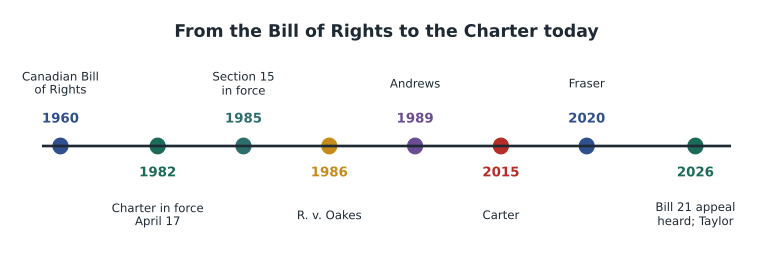
In 1960 Parliament passed the Canadian Bill of Rights under Prime Minister John Diefenbaker. It is still in force, but it is an ordinary federal statute. It applies only to federal law, and courts were reluctant to use it to override other statutes. The leading exception is R. v. Drybones, [1970] SCR 282, where the Supreme Court held that a provision of the Indian Act making it an offence for an 'Indian' to be intoxicated off a reserve was inoperative because it denied equality before the law. Later cases such as Attorney General of Canada v. Lavell, [1974] SCR 1349, read the equality guarantee narrowly, and many lawyers concluded that a statutory bill of rights would never do much.
Patriation and the making of the Charter
The Charter came out of the long effort to patriate the Constitution, that is, to bring the power to amend it home from the United Kingdom. Prime Minister Pierre Elliott Trudeau wanted a charter of rights as part of the package. Most provinces opposed both the process and the content. In the Patriation Reference, Re: Resolution to amend the Constitution, [1981] 1 SCR 753, the Supreme Court held that the federal government could legally ask the United Kingdom Parliament to amend the Constitution without provincial consent, but that doing so would breach a constitutional convention requiring a substantial degree of provincial consent.
That decision forced a return to negotiations. In November 1981 the federal government and nine provinces reached an agreement. Quebec did not sign. Part of the compromise was the inclusion of section 33, the notwithstanding clause, which several premiers insisted on to preserve legislative supremacy over some rights. The Canada Act 1982 was passed at Westminster, and the Constitution Act, 1982, including the Charter as Part I, was proclaimed in force on April 17, 1982. Section 15, the equality guarantee, came into force three years later, on April 17, 1985, to give governments time to bring their laws into line.
Quebec's National Assembly has never formally approved the Constitution Act, 1982, though it is legally bound by it, as the Supreme Court confirmed in Re: Objection by Quebec to a Resolution to amend the Constitution, [1982] 2 SCR 793. Sophie points out that this history still shapes Quebec's frequent use of section 33. Okafor-Lindqvist agrees and says the course will return to it in the lesson on the notwithstanding clause.
Supremacy: section 52
The Charter is part of the Constitution of Canada, and section 52(1) of the Constitution Act, 1982 declares that the Constitution is the supreme law of Canada and that any law inconsistent with it is, to the extent of the inconsistency, of no force or effect. This is the source of the courts' power to strike down legislation that unjustifiably infringes Charter rights. It is what makes the Charter different from the 1960 Bill of Rights: a court does not need Parliament's permission to set aside a statute that violates the Charter.
Section 52 also explains why Charter cases are often described as a dialogue between courts and legislatures. When a court strikes down a law, the legislature can usually respond by passing a new law that meets the constitutional objection, by invoking section 33 for the rights it covers, or by amending the Constitution itself. Peter Hogg and Allison Bushell popularized the dialogue metaphor in a 1997 article, and the Supreme Court has used the language in cases such as Vriend v. Alberta, [1998] 1 SCR 493.
The structure of the Charter
The Charter has 34 sections. They fall into groups that are worth memorizing because exam questions are organized around them.
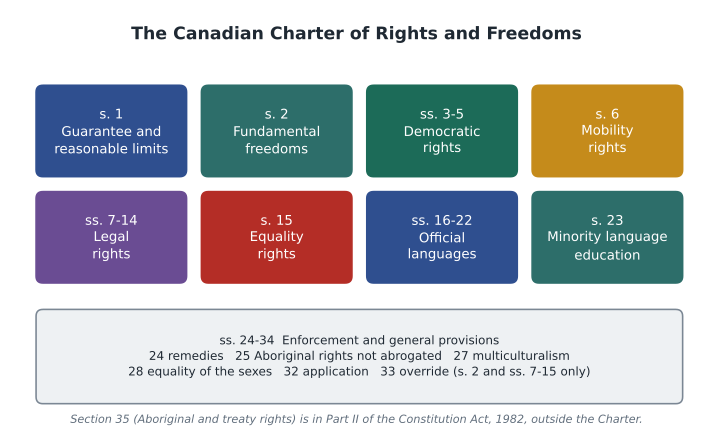
Section 1 both guarantees the rights and freedoms that follow and allows them to be subject to such reasonable limits prescribed by law as can be demonstrably justified in a free and democratic society. It is the general limitation clause, and lesson 3 is devoted to it.
Section 2 sets out the fundamental freedoms: freedom of conscience and religion; freedom of thought, belief, opinion and expression, including freedom of the press and other media; freedom of peaceful assembly; and freedom of association. Sections 3 to 5 are the democratic rights, beginning with every citizen's right to vote and to be qualified for membership in the House of Commons or a provincial legislature. Section 6 contains the mobility rights of citizens and permanent residents.
Sections 7 to 14 are the legal rights. Section 7 guarantees life, liberty and security of the person and the right not to be deprived of them except in accordance with the principles of fundamental justice. Sections 8 to 14 protect against unreasonable search or seizure, arbitrary detention, and cruel and unusual treatment or punishment, and they give rights on arrest or detention, rights to persons charged with an offence, rights against self-incrimination, and the right to an interpreter. Section 15 guarantees equality before and under the law and equal protection and benefit of the law without discrimination.
Sections 16 to 22 deal with English and French as the official languages of Canada and of New Brunswick. Section 23 gives minority language educational rights to certain citizens who are members of the English-speaking minority in Quebec or the French-speaking minority elsewhere. Sections 24 to 34 are enforcement and general provisions: remedies (section 24), Aboriginal rights not abrogated by the Charter (section 25), other rights not denied (section 26), multicultural heritage (section 27), equality of the sexes (section 28), denominational school rights (section 29), application to the territories (section 30), no expansion of legislative powers (section 31), application of the Charter (section 32), the override (section 33) and the title (section 34).
Section 35, which recognizes and affirms existing Aboriginal and treaty rights, is not part of the Charter. It is in Part II of the Constitution Act, 1982. That placement matters: section 1 and section 33 do not apply to it, and the courts have developed a separate justification test for it. Daniel notes that he has come to the reading group partly because of that difference, and Okafor-Lindqvist promises a full lesson on section 35 near the end of the course.
Who has rights?
The wording of each section tells you who may claim it. Some rights belong to 'everyone', which includes non-citizens and, for some rights, corporations. Section 7 protects 'everyone', but the Supreme Court has held that corporations cannot claim the liberty or security interests in section 7 because those are human interests (Irwin Toy Ltd. v. Quebec (Attorney General), [1989] 1 SCR 927). A corporation may, however, defend itself against a charge by arguing that the law is unconstitutional because of its effect on individuals (R. v. Big M Drug Mart Ltd., [1985] 1 SCR 295). Democratic rights and section 6(1) mobility belong to 'every citizen'. Section 15 protects 'every individual', which excludes corporations. Section 23 belongs to particular 'citizens of Canada' defined by language.
Arjun Mehta, who likes checklists, writes 'Read the words: everyone, citizen, individual' at the top of his notes. It is a good habit. In an exam answer, the first sentence of any rights analysis should identify the claimant and confirm that the claimant can hold the right in question.
The purposive approach
In its first Charter cases the Supreme Court set the interpretive method that still governs. In Hunter v. Southam Inc., [1984] 2 SCR 145, Chief Justice Dickson described the Charter as a purposive document, meant to constrain government action inconsistent with rights, and said it must be interpreted in light of its purpose. A constitution, he wrote, is drafted with an eye to the future and must be capable of growth and development over time.
In Big M Drug Mart, Dickson set out the method in more detail. The meaning of a right is to be found by analyzing the purpose of the guarantee, in light of the interests it was meant to protect. That purpose is identified by reference to the character and larger objects of the Charter, the language chosen, the historical origins of the concepts, and the meaning and purpose of associated rights. The interpretation should be generous rather than legalistic, aimed at fulfilling the purpose of the guarantee and securing the full benefit of the Charter's protection. Dickson immediately added a caution: the interpretation must not overshoot the actual purpose of the right.
Big M also established that a law can be unconstitutional either because of its purpose or because of its effects. The Lord's Day Act prohibited most commercial activity on Sunday. Its purpose, the Court held, was to compel observance of the Christian sabbath, which is a purpose that infringes freedom of religion regardless of what the law actually does in practice. A law with a valid purpose can still be struck down if its effects infringe a right and cannot be justified.
The living tree and its limits
The idea that the Constitution grows over time predates the Charter. In Edwards v. Canada (Attorney General), [1930] AC 124, the Persons case, Lord Sankey described the British North America Act as a living tree capable of growth and expansion within its natural limits. Charter cases frequently cite the image. In Reference re Same-Sex Marriage, 2004 SCC 79, the Supreme Court relied on it to hold that the federal marriage power was not frozen at the meaning of marriage in 1867.
The Supreme Court has also emphasized that purposive interpretation begins with the text. In Quebec (Attorney General) v. 9147-0732 Québec inc., 2020 SCC 32, the majority held that a corporation was not protected by the section 12 guarantee against cruel and unusual punishment, and stressed that the text of a Charter provision is the most important consideration in defining its purpose and its limits. International law and foreign decisions can inform interpretation, but binding instruments carry more weight than non-binding ones. Hannah Kowalczyk, who distrusts judges who 'find' new rights, says she likes that case. Theo replies that judges who emphasize text still have to decide what the text means.
Staged analysis
Charter litigation proceeds in a sequence, and good answers follow it. The claimant bears the burden of showing that the Charter applies and that a right has been infringed, usually on a balance of probabilities and on the evidence. If an infringement is shown, the burden shifts to the government to justify the limit under section 1. If the limit is not justified, the court decides on the remedy, under section 52 for laws and section 24(1) for government acts.
The Supreme Court has kept the stages distinct. Most rights are defined broadly at the infringement stage, with competing interests weighed under section 1. Some rights have internal limits built into their wording: section 7 asks whether a deprivation accords with the principles of fundamental justice, and section 8 protects only against unreasonable search or seizure. When a right has internal qualifications, the balancing happens partly at the infringement stage, and it is rare for a section 7 violation to be justified under section 1 (Carter v. Canada (Attorney General), 2015 SCC 5).
| Stage | Question | Burden | Typical authorities |
|---|---|---|---|
| 1. Application | Does the Charter apply to this body, law or act? Can this claimant hold the right? | Claimant | Section 32; Dolphin Delivery; Eldridge; Godbout |
| 2. Infringement | Does the law or act limit the right, in purpose or effect? | Claimant | Big M; Irwin Toy; Amselem; Fraser |
| 3. Justification | Is the limit prescribed by law and justified under the Oakes test? | Government | Section 1; Oakes; Hutterian Brethren |
| 4. Override | Has the legislature validly invoked section 33 for this right? | Not a burden; a formal question | Section 33; Ford |
| 5. Remedy | What should the court order? | Claimant proposes; court decides | Section 52; section 24(1); Schachter; Ward; Ontario v. G |
Standing and evidence
A person whose rights are affected has private interest standing. A person charged with an offence may always challenge the law under which the charge is laid. Public interest standing is discretionary. In Canada (Attorney General) v. Downtown Eastside Sex Workers United Against Violence Society, 2012 SCC 45, the Court held that it should ask whether there is a serious justiciable issue, whether the plaintiff has a real stake or genuine interest, and whether the proposed suit is a reasonable and effective means of bringing the issue before the courts, applied purposively and flexibly. British Columbia (Attorney General) v. Council of Canadians with Disabilities, 2022 SCC 27, confirmed that approach and allowed a public interest challenge to proceed even though the individual plaintiffs had dropped out.
Charter cases are usually decided on evidence. Courts distinguish adjudicative facts, which concern the parties, from legislative or social facts, which concern the background and effects of the law. In Bedford, Carter and other leading cases, trial judges heard weeks of expert evidence, and appellate courts deferred to their findings on social and legislative facts unless there was a palpable and overriding error (Canada (Attorney General) v. Bedford, 2013 SCC 72). Okafor-Lindqvist tells the group that many Charter cases are won or lost on the record built at trial, not on clever arguments on appeal.
The Charter and the courts' legitimacy
Critics from different directions have questioned whether unelected judges should decide contested moral and political questions. Some argue that judges have read too much into the Charter. Others argue that courts have been too deferential to governments, especially on social and economic rights. The Charter's drafters tried to answer the legitimacy objection with section 1, which invites courts to respect reasonable legislative choices, and section 33, which allows legislatures to override some rights for renewable five-year periods. Whether those safety valves strike the right balance is one of the live questions in Canadian constitutional law, and the Supreme Court's ruling in the Bill 21 appeal, which the Court has said it will release on November 27, 2026, is expected to address part of it.
At the end of the evening Okafor-Lindqvist returns to her opening question. She does not ask the group to choose an answer. Instead she asks them to keep three columns in their notes for the rest of the year, labelled 'courts', 'legislatures' and 'constitutional text', and to record in which column each case puts the final decision. Noor Rahimi, the teaching fellow, hands out the reading for the next session: Dolphin Delivery, McKinney and Eldridge, the cases on whom the Charter binds.
Practice problems
Work each problem on paper first, then reveal the answer to check.
Why did the Canadian Bill of Rights of 1960 have limited effect compared with the Charter?
Show answer
It was an ordinary federal statute that applied only to federal law, and courts were reluctant to use it to override other legislation; Drybones is the main exception. The Charter is entrenched constitutional law, and section 52 makes inconsistent laws of no force or effect.
A corporation is charged under a provincial law that it says infringes the religious freedom of its customers. Can it raise the Charter?
Show answer
Yes. Big M Drug Mart holds that anyone charged under an unconstitutional law may challenge it, even if the right infringed is not one the accused could personally hold.
What did the Supreme Court say in Big M about purpose and effect?
Show answer
A law may be unconstitutional because of its purpose or its effects. An unconstitutional purpose, such as compelling religious observance, invalidates the law without any need to examine its effects.
What did the Court stress about text in Quebec (AG) v. 9147-0732 Québec inc.?
Show answer
That the text of a Charter provision is the most important consideration in identifying its purpose and scope, and that binding international instruments carry more interpretive weight than non-binding ones.
Set out the stages of a Charter analysis and who bears the burden at each.
Show answer
Application and infringement: the claimant. Justification under section 1: the government. Whether section 33 has been validly invoked is a formal question. Remedy: the claimant proposes and the court decides under section 52 or section 24(1).
Summary and key terms
- Before 1982, rights were protected mainly by Parliament, the common law and the division of powers; the Canadian Bill of Rights of 1960 is a statute with limited reach.
- The Charter came out of patriation. The Patriation Reference led to the November 1981 agreement, without Quebec, that added section 33. The Charter took effect on April 17, 1982, and section 15 on April 17, 1985.
- Section 52 makes the Constitution supreme and inconsistent laws of no force or effect.
- The Charter is interpreted purposively and generously, but without overshooting the purpose of the right, and starting from the text (Hunter, Big M, 9147-0732 Québec).
- Read who holds each right: everyone, citizens or individuals.
- Analysis runs from application to infringement to justification to remedy, with section 33 as a possible legislative override.
- Patriation
- The 1982 transfer of the power to amend the Canadian Constitution from the United Kingdom Parliament to Canada.
- Purposive interpretation
- Reading a Charter right in light of the interests it was meant to protect, generously but within its purpose.
- Section 52
- The supremacy clause of the Constitution Act, 1982, making inconsistent laws of no force or effect.
- Living tree
- The metaphor, from the Persons case, for a constitution capable of growth within its natural limits.
- Public interest standing
- Discretionary standing to bring a challenge without a personal stake, under the Downtown Eastside test.
- Legislative facts
- Social, economic or scientific facts about the background and effects of a law, as opposed to facts about the parties.
Lesson quiz · 5 questions
Score 60% or more to complete this lesson.
Create a free account to save your progress, take quizzes and earn a certificate.