
LAWC-111 · Lesson 4 of 12 · 24 min
Fundamental freedoms
▶ Video coming soon A video version of this lesson is on the way.
Section 2 of the Charter lists four fundamental freedoms: (a) freedom of conscience and religion; (b) freedom of thought, belief, opinion and expression, including freedom of the press and other media of communication; (c) freedom of peaceful assembly; and (d) freedom of association. They are called fundamental because, as the Supreme Court has repeatedly said, they protect the conditions for individual self-fulfilment and for democratic self-government. This lesson introduces section 2 as a whole and then examines freedom of conscience and religion in depth. Lesson 5 covers expression, assembly and association.
The reading group's discussion of section 2(a) gets heated quickly. Sophie Tremblay-Hart explains how many Quebecers see laïcité, the secular character of the state, as a hard-won protection against the Catholic Church's former dominance of public life. Daniel Whitecloud describes how the Ktunaxa Nation lost its challenge to a ski resort on a sacred site. Arjun Mehta, who is Hindu, wants to know whether a court can decide what a religion requires. Professor Okafor-Lindqvist says the cases answer his question with a firm no, and that the reason tells you most of what you need to know about the doctrine.
The purpose of freedom of religion
In R. v. Big M Drug Mart Ltd., [1985] 1 SCR 295, Chief Justice Dickson defined freedom of religion as the right to entertain such religious beliefs as a person chooses, to declare religious beliefs openly and without fear of hindrance or reprisal, and to manifest religious belief by worship and practice or by teaching and dissemination. He also emphasized freedom from coercion: the state may not compel anyone, directly or indirectly, to act contrary to their beliefs or conscience. A law compelling Sunday observance coerced non-Christians and non-believers into honouring the Christian sabbath.
Big M did not end Sunday closing laws. In R. v. Edwards Books and Art Ltd., [1986] 2 SCR 713, Ontario's Retail Business Holidays Act, which required most stores to close on Sundays for the secular purpose of providing a common day of rest, was found to burden Saturday observers but was upheld under section 1 because it contained an exemption for small retailers who closed on Saturdays. The two cases together show the importance of purpose and effect: a religious purpose was fatal in Big M, while secular purpose with burdensome effects led to section 1 balancing in Edwards Books.
Sincerity, not orthodoxy: Amselem
The leading test for infringement comes from Syndicat Northcrest v. Amselem, 2004 SCC 47. Orthodox Jewish residents of a Montreal condominium building wanted to build individual succahs, small temporary huts, on their balconies during the festival of Succot. The building's declaration of co-ownership prohibited balcony structures. The case arose under the Quebec Charter of Human Rights and Freedoms, but the Court's analysis of religious freedom applies equally under the Canadian Charter.
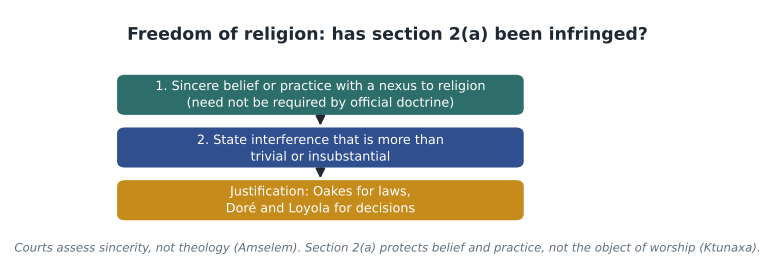
Justice Iacobucci, for the majority, held that religion is about freely and deeply held personal convictions or beliefs connected to an individual's spiritual faith and integrally linked to self-definition and spiritual fulfilment. A claimant must show that they sincerely believe in a practice or belief having a nexus with religion, and that the practice is either objectively required by the religion or subjectively believed to be connected to the divine or to the subject of spiritual faith, regardless of whether it is required by official religious dogma or the position of religious officials. The court's role is to assess sincerity, not to decide theological questions. Sincerity is a question of fact, assessed on credibility and consistency with other practices, but the inquiry should be as limited as possible.
The second requirement is that the interference be more than trivial or insubstantial. The claimant must show that the impugned measure interferes with their ability to act in accordance with their religious beliefs in a manner that is non-trivial. The majority in Amselem held that the prohibition infringed the residents' freedom of religion, and the interference was not justified by the co-owners' interests in aesthetics and safety, especially given the residents' offer to build succahs that would not obstruct fire exits.
Arjun says this answers his question: courts do not tell people what their faith requires. Hannah Kowalczyk worries that the test makes it too easy to claim religious exemptions from any rule. Okafor-Lindqvist replies that the balancing happens under section 1 or its equivalent, and that the Court has been careful about how far exemptions go, as the later cases show.
Multani and the kirpan
In Multani v. Commission scolaire Marguerite-Bourgeoys, 2006 SCC 6, a twelve-year-old orthodox Sikh student accidentally dropped his kirpan, a small ceremonial dagger worn under his clothes, in the schoolyard. The school board's council of commissioners prohibited him from wearing it, relying on the school's code of conduct banning weapons. He sincerely believed his religion required him to wear a kirpan made of metal at all times.
The Court unanimously held that the decision infringed his freedom of religion, and the majority held that the infringement was not justified under section 1. The board's objective of ensuring school safety was pressing and substantial, but a total prohibition did not minimally impair his rights. Conditions such as sealing the kirpan in a sheath, sewing it into his clothing, and carrying it under his clothes would have addressed safety concerns. There was no evidence of kirpan-related violence in Canadian schools, and a total ban sent the message that some religious practices do not merit the same protection as others. The decision preceded Doré, and the majority applied Oakes to an administrative decision; today, the analysis would proceed under the Doré and Loyola framework, though the result would likely be the same.
Limits on religious accommodation
Alberta v. Hutterian Brethren of Wilson Colony, 2009 SCC 37, discussed in lesson 3, marks the limits of accommodation. The Court held that the universal photo requirement for driver's licences infringed the Hutterites' religious freedom but was justified. The majority stressed that a law of general application is not the same as a targeted administrative decision, that courts should be cautious about requiring legislatures to carve out exemptions that undermine a regulatory scheme, and that the cost to the claimants, though real, did not deny them a meaningful choice to follow their religion.
In R. v. N.S., 2012 SCC 72, a sexual assault complainant wished to testify wearing a niqab. The Court rejected both an absolute right to wear the niqab and an absolute ban. The trial judge had to consider whether wearing the niqab was required by a sincere religious belief, whether permitting it would create a serious risk to trial fairness, whether accommodation could avoid both risks, and whether the salutary effects of requiring removal outweighed its deleterious effects. The case shows religious freedom being balanced against other Charter rights, here the accused's right to a fair trial and to make full answer and defence.
Ktunaxa Nation: the limits of the right
In Ktunaxa Nation v. British Columbia (Forests, Lands and Natural Resource Operations), 2017 SCC 54, the Ktunaxa argued that a year-round ski resort in Qat'muk, an area where the Grizzly Bear Spirit lives, would drive the spirit away and render their beliefs and practices meaningless. The Minister approved the resort. The majority, written by Chief Justice McLachlin and Justice Rowe, held that the approval did not infringe section 2(a). Freedom of religion protects the freedom to hold and manifest beliefs, they wrote, not the object of worship or the spiritual focal point of beliefs. The Ktunaxa remained free to believe and to practise; the state's action affected the subject of their faith.
Justice Moldaver, joined by Justice Côté, would have found an infringement, because the approval made the Ktunaxa's beliefs devoid of religious significance, but would have upheld the decision under Doré. Both groups of judges held that the Minister had met the duty to consult under section 35. Daniel says the majority's distinction between practice and object fits poorly with Indigenous spirituality, which is often tied to specific places. Okafor-Lindqvist notes that many commentators share that criticism, and that the case is a reminder that section 35, not section 2(a), has been the main vehicle for protecting Indigenous connections to land.
State neutrality
The Charter does not create a strict separation of church and state, but the Supreme Court has recognized a duty of state religious neutrality. In Mouvement laïque québécois v. Saguenay (City), 2015 SCC 16, the mayor of Saguenay opened municipal council meetings by reciting a Catholic prayer. A citizen who was an atheist complained to the Quebec human rights tribunal. The Court held that the prayer breached the state's duty of neutrality, which requires that the state neither favour nor hinder any particular belief, including non-belief. Neutrality, the Court said, is required of the institutions of the state, not of individual citizens, and real neutrality is a condition of the free exercise of religion by all.
In S.L. v. Commission scolaire des Chênes, 2012 SCC 7, Catholic parents argued that Quebec's mandatory Ethics and Religious Culture program, which taught about the world's religions from a neutral perspective, infringed their freedom to pass on their faith to their children. The Court held they had not shown an infringement: exposing children to a variety of religions without endorsing any of them does not in itself interfere with religious freedom. Loyola, decided three years later, held that requiring a Catholic school to teach the program from a neutral perspective did go too far.
Religious institutions and communities
Freedom of religion has an individual and a collective dimension. In Loyola High School v. Quebec (Attorney General), 2015 SCC 12, the majority accepted that religious freedom includes the right of religious communities to transmit their faith through institutions, while leaving open whether corporations themselves hold the right. Three justices would have held that Loyola, as a religious organization, could claim section 2(a) directly.
Courts are also reluctant to intervene in the internal affairs of religious groups. In Highwood Congregation of Jehovah's Witnesses (Judicial Committee) v. Wall, 2018 SCC 26, the Court held that courts have no jurisdiction to review a congregation's decision to disfellowship a member unless a legal right, such as a property or contract right, is at stake. Ecclesiastical questions are for religious bodies, not courts.
Trinity Western: religious freedom and equality
Law Society of British Columbia v. Trinity Western University, 2018 SCC 32, and its companion Trinity Western University v. Law Society of Upper Canada, 2018 SCC 33, tested how religious freedom is balanced against equality. Trinity Western, an evangelical Christian university, proposed a law school whose students would have to sign a community covenant prohibiting sexual intimacy except between a married man and woman. The law societies of British Columbia and Ontario refused to accredit the school.
The majority held that the refusals limited the religious freedom of the university's community, because studying law in an environment defined by religious beliefs was part of their practice. But applying Doré, the majority held that the law societies had reasonably balanced that limit against their statutory duty to act in the public interest, which included promoting equal access to the legal profession and preventing harm to LGBTQ students. Several justices wrote separately, and Justices Côté and Brown dissented. The cases are central to understanding how administrative bodies must balance competing Charter interests.
Freedom of conscience
Freedom of conscience protects deeply held moral beliefs that are not necessarily religious. Justice Wilson, in R. v. Morgentaler, [1988] 1 SCR 30, linked the abortion decision to conscience as well as to section 7, though her view was not the basis of the majority's decision. Conscience claims have arisen most often in health care. In Christian Medical and Dental Society of Canada v. College of Physicians and Surgeons of Ontario, 2019 ONCA 393, physicians challenged policies requiring them to provide an effective referral when they objected to providing medical assistance in dying, abortion or other services on religious or conscientious grounds. The Court of Appeal held that the policies infringed religious freedom but were justified under section 1, because patients, particularly vulnerable ones, would otherwise face barriers to care. The Supreme Court did not hear an appeal.
Bill 21: religious freedom and the notwithstanding clause
Quebec's Act respecting the laicity of the State, known as Bill 21, was enacted in June 2019. It prohibits certain public employees in positions of authority, including teachers in public schools, police officers, judges appointed by the province and government lawyers, from wearing religious symbols while at work, and requires that public services be given and received with the face uncovered. The Act invokes the notwithstanding clause in section 33 of the Charter, and the equivalent override in the Quebec Charter, so that it operates notwithstanding sections 2 and 7 to 15.
The Quebec Superior Court in 2021 upheld most of the law, holding that the override shielded it from challenge on religious freedom grounds, but exempted English-language school boards on the basis of minority language education rights in section 23, which section 33 cannot override. The Quebec Court of Appeal, in Organisation mondiale sikhe du Canada c. Procureur général du Québec, 2024 QCCA 254, reversed that exemption and upheld the law in full. Quebec renewed the override in 2024, as section 33 requires every five years. The Supreme Court of Canada heard the appeals in English Montreal School Board v. Attorney General of Quebec over four days beginning March 23, 2026, with a record number of interveners. The issues include whether courts may still declare that a law protected by section 33 infringes Charter rights, whether section 28 (equality of the sexes) limits the override, and whether section 23 protects English-language school boards' control over hiring. The Court has announced that it will release its decision on November 27, 2026.
Sophie and Hannah find themselves on the same side, defending Quebec's right to make its own choices about secularism, though for different reasons. Daniel and Arjun argue that the law falls hardest on Muslim women who wear the hijab and on Sikh men. Okafor-Lindqvist asks everyone to write down their prediction of the Supreme Court's decision and seal it in an envelope for the winter term. She also reminds them that lesson 10 examines section 33 in detail and that whatever the Court decides, the reasoning will reshape that lesson.
Worked problem
A religious freedom claim at a Corwin pool
A Corwin municipal swimming pool, run directly by the city, adopts a rule requiring all swimmers to wear standard swimsuits. A Muslim woman who wears a full-body swimsuit for religious reasons is refused entry. Analyze her section 2(a) claim.
Show solution
- Application: The pool is run by the city, which is government by nature, and the rule is a city policy, so the Charter applies.
- Sincerity: She must show that she sincerely believes wearing modest swimwear has a nexus with her religion. It does not matter whether all Muslim scholars agree (Amselem).
- Interference: Being excluded from a public pool unless she abandons her practice is more than trivial or insubstantial.
- Justification: If the rule is a binding policy adopted under the city's authority, apply Oakes; if it was a discretionary decision by the pool manager, apply Doré and Loyola. The city's objective, hygiene and safety, is pressing, but a total ban on full-body swimsuits made of swimsuit material is hard to defend as minimally impairing, given that the suits raise no hygiene or safety issue.
- Conclusion: The rule likely infringes section 2(a) without justification. She could also complain under the Ontario Human Rights Code on the ground of creed.
Practice problems
Work each problem on paper first, then reveal the answer to check.
What must a claimant show to establish an infringement of freedom of religion under Amselem?
Show answer
A sincere belief or practice having a nexus with religion, whether or not it is required by official doctrine, and an interference with it by the state that is more than trivial or insubstantial.
Why did the total ban on the kirpan in Multani fail?
Show answer
It was not minimally impairing. Conditions on how the kirpan was worn would have met the school's safety concerns, and there was no evidence of kirpan-related violence in schools.
What distinction did the majority draw in Ktunaxa?
Show answer
Section 2(a) protects the freedom to hold and manifest beliefs, not the object of worship. The ski resort approval affected the spiritual focal point of the Ktunaxa's beliefs, not their freedom to believe or practise, so there was no infringement.
What is the duty of state neutrality recognized in Saguenay?
Show answer
The state must neither favour nor hinder any particular belief, including non-belief; the duty applies to state institutions, so a municipal council could not open meetings with a Catholic prayer.
What questions were before the Supreme Court in the Bill 21 appeal heard in March 2026?
Show answer
Among others: whether courts may declare that a law protected by section 33 infringes Charter rights, whether section 28 limits the override, and whether section 23 protects English-language school boards. The decision was scheduled for release on November 27, 2026.
Summary and key terms
- Section 2 protects conscience and religion, expression, peaceful assembly and association.
- Freedom of religion protects belief, worship, practice and teaching, and freedom from state coercion (Big M).
- Infringement requires a sincere belief with a nexus to religion and a non-trivial interference (Amselem); courts assess sincerity, not doctrine.
- Justification follows Oakes for laws and Doré for decisions; compare Multani (ban not justified) with Hutterian Brethren (photo rule justified).
- Section 2(a) protects belief and practice, not the object of worship (Ktunaxa); the state must remain religiously neutral (Saguenay).
- Trinity Western shows religious freedom balanced against equality in administrative decisions.
- Bill 21 invokes section 33; the Supreme Court heard the appeals in March 2026 and scheduled its decision for November 27, 2026.
- Sincerity
- The genuineness of a claimant's religious belief, assessed as a question of fact without deciding religious doctrine.
- Nexus with religion
- A connection between a practice or belief and the claimant's spiritual faith.
- Non-trivial interference
- A state burden on religious practice that is more than trivial or insubstantial.
- State neutrality
- The duty of state institutions neither to favour nor to hinder any belief, including non-belief.
- Kirpan
- A ceremonial blade that baptized Sikhs wear as an article of faith.
- Laïcité
- The principle of the secular character of the state, central to Quebec's Bill 21.
Lesson quiz · 5 questions
Score 60% or more to complete this lesson.
Create a free account to save your progress, take quizzes and earn a certificate.