
LAWC-111 · Lesson 12 of 12 · 21 min
Capstone: solving a Charter problem
▶ Video coming soon A video version of this lesson is on the way.
At the end of the November 18 session, Noor Rahimi hands out a take-home problem for the reading group to work on before the winter term. It is longer than a typical exam question and deliberately raises most of the topics the group has covered. Professor Okafor-Lindqvist tells them that the point is not to reach the right answer on every issue, because some issues are genuinely open, but to show that they can organize a Charter analysis and use the authorities accurately.
This lesson sets out the problem, explains how to plan an answer, and then works through a model answer. The facts and the statute are fictional. The law is as it stood on November 22, 2026, five days before the Supreme Court was scheduled to release its decision in the Bill 21 appeal.
The problem
Following a series of loud and sometimes confrontational demonstrations at Ontario universities, the Ontario legislature enacts the fictional Protecting Ontario Campuses Act, 2026. Its main provisions are as follows.
Section 3 prohibits any person from participating in a demonstration within 30 metres of a building used for teaching on a university campus between 8 a.m. and 6 p.m. on weekdays. Section 4 prohibits anyone participating in a demonstration on campus from wearing a mask or other covering that conceals their face, with no exceptions. Section 5 makes contravention of sections 3 or 4 an offence punishable by a fine of up to 5,000 dollars for a first offence and, for a second or subsequent offence, by a fine or imprisonment for up to six months or both. Section 6 exempts from section 3 'ceremonies conducted by Indigenous students or communities according to their traditions', such as a sacred fire. Section 9 declares that the Act 'shall operate notwithstanding section 2(b) of the Canadian Charter of Rights and Freedoms'.
Three people consult the Brannock University Law Clinic. Amira, a Muslim student who wears a niqab, was charged under section 4 after she joined a silent vigil on the Brannock quad. Jonah, a graduate student, has been convicted once under section 3 for joining a lunchtime rally outside the law building and fears imprisonment if convicted again. A student group, Brannock Students for Fair Tuition, argues that the Indigenous ceremonies exemption in section 6 is unfair because it lets one group gather where others cannot. Advise them on the Charter issues.
Planning the answer
A good answer starts with an issue map, not with the first idea that comes to mind. Okafor-Lindqvist recommends spending a quarter of the available time planning. List each claimant and each provision, identify every right that might be engaged, and then check which of those rights section 33 can reach and which it actually does. Only then begin writing, following the stages from lesson 1: application, override, infringement, justification and remedy.
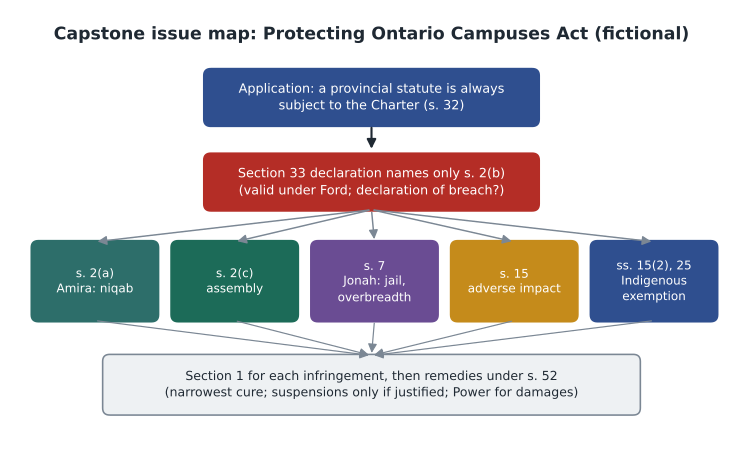
Arjun Mehta produces the most careful map in the group. He spots that the section 33 declaration names only section 2(b), which means sections 2(a), 2(c), 7 and 15 remain fully available. Hannah Kowalczyk notices that section 6 raises a distinct issue under section 15 and section 25. Theo Marchetti points out that Amira and Jonah are accused persons, so they can challenge the provisions under which they are charged regardless of standing questions.
Issue 1: application of the Charter
The Act is a provincial statute, so the Charter applies to it under section 32 (Slaight Communications; Godbout). The claimants do not need to show that Brannock University is government, because they challenge the law itself, not a university decision. That avoids the uncertainty created by McKinney and the divergent cases on universities' expression policies (compare UAlberta Pro-Life v. Governors of the University of Alberta, 2020 ABCA 1). Amira and Jonah, as accused persons, may challenge the constitutionality of the provisions under which they are charged (R. v. Big M Drug Mart Ltd.). The student group would need private or public interest standing; under Downtown Eastside Sex Workers, 2012 SCC 45, it raises a serious justiciable issue, has a genuine interest and is a reasonable means of bringing the issue to court.
Issue 2: the section 33 declaration
Section 9 is an express declaration that refers to a provision within section 2, and it is within its first five years, so it satisfies the formal requirements in Ford v. Quebec. A court cannot strike down sections 3 or 4 on the ground that they infringe freedom of expression while the declaration is in force.
Two further points matter. First, the declaration names only section 2(b). Ford allows a legislature to refer to provisions by number, but the declaration operates only for the provisions it names. Freedom of religion in section 2(a), peaceful assembly in section 2(c), and sections 7 and 15 remain fully enforceable. Second, the claimants might seek a declaration that sections 3 and 4 infringe section 2(b), even though the Act continues to operate. The Saskatchewan Court of Appeal accepted that such declarations are available in Saskatchewan (Minister of Education) v. UR Pride Centre for Sexuality and Gender Diversity, 2025 SKCA 74, while the Quebec Court of Appeal took the opposite view in Organisation mondiale sikhe du Canada c. Procureur général du Québec, 2024 QCCA 254. Neither decision binds an Ontario court. The Supreme Court's decision in the Bill 21 appeal, scheduled for November 27, 2026, and its pending appeal in UR Pride, may resolve the question. The answer should flag the uncertainty and explain why it matters to the clients: a declaration would not stop prosecutions, but it would inform public debate before the five-year renewal.
Issue 3: freedom of peaceful assembly and expression
A silent vigil and a lunchtime rally are peaceful assemblies within section 2(c). Courts have usually analyzed protest as expression under section 2(b), but here section 2(b) has been overridden, so section 2(c) must carry the claim. The answer should acknowledge that section 2(c) has been the main basis of few decisions and that a court may define it with reference to the same values as expression. Sections 3 and 5 prohibit peaceful assemblies near teaching buildings during the day on pain of penal sanctions, which limits the freedom in purpose. Section 4 limits assembly by making participation conditional on uncovering one's face.
Under section 1, the province's objectives, protecting teaching from disruption and ensuring that people who break the law at demonstrations can be identified, are pressing and substantial. Section 3 is rationally connected to the first objective. Minimal impairment is the difficult step. The prohibition applies to all demonstrations regardless of size, noise or effect on classes, including silent vigils, during all teaching hours. Less intrusive alternatives are obvious: limits on amplified sound, on blocking entrances or on disrupting classes, as in ordinary noise and trespass rules. Section 4's absolute ban on face coverings, with no exceptions for religion, health or safety from harassment, is also hard to defend as minimally impairing; the objective of identifying lawbreakers could be met by a power to require removal when there are reasonable grounds to believe an offence has been committed. At the final stage, the deleterious effects on peaceful protest in a core location for political expression are serious, and the benefit of the blanket rules over targeted rules is small. Both provisions likely fail section 1 in their application to section 2(c).
Issue 4: Amira's freedom of religion
Amira sincerely believes that wearing the niqab is connected to her faith. Under Syndicat Northcrest v. Amselem, 2004 SCC 47, she does not need to show that it is required by official doctrine. Section 4 forces her to choose between her religious practice and participating in a lawful demonstration, on pain of prosecution, which is more than a trivial interference. Section 2(a) is not covered by the declaration, so the province must justify the infringement. Applying Oakes, the objective is pressing and the provision is rationally connected, but a blanket ban without any accommodation fails minimal impairment, for the reasons in Multani v. Commission scolaire Marguerite-Bourgeoys, 2006 SCC 6, where a total ban on the kirpan failed when reasonable accommodation would have met the safety concern. The province might rely on Alberta v. Hutterian Brethren of Wilson Colony, 2009 SCC 37, to argue that courts should not require exemptions from laws of general application. But in Hutterian Brethren the photo requirement served a regulatory system that would be undermined by exemptions, and the claimants retained a meaningful choice. Here, Amira's alternative is to stay away from political protest altogether, which is a serious cost, and R. v. N.S., 2012 SCC 72, suggests that accommodation must be considered case by case. Section 4 likely infringes section 2(a) without justification, at least as applied to religious face coverings.
Issue 5: section 15 and Amira
Section 4 is neutral on its face, but its burden falls disproportionately on Muslim women who wear the niqab, and possibly on people who cover their faces for disability-related reasons. Under Fraser v. Canada (Attorney General), 2020 SCC 28, and R. v. Sharma, 2022 SCC 39, the claimant must show that the law creates or contributes to a disproportionate impact on a group defined by an enumerated ground, here religion and sex, and that it reinforces, perpetuates or exacerbates disadvantage. Evidence would be needed, for example of who wears face coverings for religious reasons and of the historical marginalization of Muslim women in Canadian public life. If the evidence is available, step two is likely met. The section 1 analysis would track the analysis under section 2(a). The answer could also mention section 28, which guarantees Charter rights equally to men and women; its relationship with section 33 was argued in the Bill 21 appeal, though here section 33 has not been invoked for section 15, so section 28's role is interpretive.
Issue 6: Jonah and section 7
For a second offence, section 5 permits imprisonment, which engages liberty. The question is whether the deprivation accords with the principles of fundamental justice. Under Canada (Attorney General) v. Bedford, 2013 SCC 72, a law is overbroad if it catches some conduct that bears no relation to its purpose. Section 3's purpose is to protect teaching from disruption. Applied to a silent vigil or a small lunchtime rally outside a building where no classes are disrupted, it catches conduct that has no connection to that purpose. The provision is therefore overbroad in at least some applications, and Bedford holds that a law can violate section 7 if it is overbroad in its effect on even one person. Because the penalty includes imprisonment, the province would also need to show that the offence requires a sufficient mental element; an absolute liability offence carrying imprisonment violates section 7 under Re B.C. Motor Vehicle Act. Section 7 is not covered by the declaration, and section 7 breaches are rarely justified under section 1 (Carter). Jonah has a strong argument that the imprisonment provision, as applied to section 3, violates section 7.
Issue 7: the Indigenous ceremonies exemption
The student group argues that section 6 discriminates by allowing Indigenous ceremonies near teaching buildings while banning other gatherings. This is a weak section 15 claim for several reasons. First, the group must show a distinction based on an enumerated or analogous ground that disadvantages its members; non-Indigenous students as a group are not historically disadvantaged by a provision that recognizes Indigenous ceremonial practices, and political opinion is not an enumerated ground. Second, under section 15(2) and R. v. Kapp, 2008 SCC 41, a provision whose object is to ameliorate the conditions of a disadvantaged group, here by accommodating Indigenous ceremonies on campuses where they were long excluded, does not violate section 15(1). Third, under Dickson v. Vuntut Gwitchin First Nation, 2024 SCC 10, section 25 may shield the exemption if it protects an Aboriginal, treaty or other right relating to Indigenous difference and there is an irreconcilable conflict with the claimed Charter right. Ceremonial practices tied to Indigenous identity fit naturally within section 25's protection. Daniel Whitecloud, reading the model answer, says it is worth adding that striking down the exemption would not help the student group at all; it would only remove an accommodation from Indigenous students.
Issue 8: remedies
If sections 3, 4 and 5 are unconstitutional on grounds other than section 2(b), the remedy lies under section 52. The court should identify the extent of the inconsistency and choose the narrowest effective remedy (Schachter v. Canada). For section 4, reading in an exception for religious and medical face coverings, or reading the provision down to require removal only on reasonable grounds to believe an offence has been committed, may be possible, but given the legislature's evident choice of an absolute rule, a court might prefer to strike the provision and leave the legislature to respond. For section 3, the overbreadth is pervasive and a court might strike it down. For section 5, the court could declare the imprisonment provision of no force or effect as applied to sections 3 and 4.
Under Ontario (Attorney General) v. G, 2020 SCC 38, any suspension of the declarations would have to be justified by a compelling public interest. Because ordinary laws on noise, trespass and disruption would continue to protect classes, there is little reason to suspend. If a suspension were granted, the court should consider exempting Amira and Jonah from it. Amira and Jonah, as accused persons, would have their charges dismissed or their convictions set aside if the provisions are invalid. A claim for damages under section 24(1) for enacting the law would face the high threshold in Canada (Attorney General) v. Power, 2024 SCC 26, requiring clear unconstitutionality, bad faith or abuse of power.
Issue 9: non-Charter arguments
A complete answer briefly considers other routes. The Act is likely valid provincial legislation in relation to education and property and civil rights, but an argument could be made that its penal provisions, especially imprisonment, are in pith and substance criminal law. The Supreme Court has upheld provincial penal regulation where the dominant purpose is regulatory, as with traffic offences, so this argument is weak, but it is worth one paragraph, and it connects LAWC-111 to the federalism analysis in LAWC-101. The Ontario Human Rights Code applies to universities' services and might also be engaged if universities discriminate in enforcing the Act.
What makes a strong answer
Okafor-Lindqvist's comments on the group's drafts identify the features of the strongest answers. They notice immediately that the declaration names only section 2(b) and organize the rest of the answer around that fact. They separate the claimants and the provisions rather than treating 'the Act' as a single target. They state the correct current tests, especially Sharma for section 15 and Dickson for section 25, and they cite cases for propositions rather than listing them. They spend their section 1 analysis on concrete alternatives. They flag genuinely open questions, such as the availability of a declaration of inconsistency and the scope of section 2(c), rather than pretending they are settled. And they end each issue with a conclusion the client can use.
Sophie Tremblay-Hart asks whether they will learn the Bill 21 result in time to rewrite their answers. Okafor-Lindqvist says that the decision is due on November 27, and that rewriting the section 33 issue in light of it would be the best possible preparation for the winter term.
Practice problems
Work each problem on paper first, then reveal the answer to check.
Why can the claimants still rely on sections 2(a), 2(c), 7 and 15 despite the section 33 declaration?
Show answer
Because the declaration expressly names only section 2(b), and a section 33 declaration operates only for the provisions it names (Ford).
Why do the claimants not need to show that Brannock University is government?
Show answer
Because they are challenging a provincial statute, which is always subject to the Charter under section 32; the McKinney problem arises only when challenging a university's own decisions or policies.
What is the strongest authority for Amira's section 2(a) claim, and what case will the province rely on?
Show answer
Amselem for sincerity and Multani for the failure of a total ban without accommodation; the province will rely on Hutterian Brethren, which upheld a law of general application without exemptions.
Why is the student group's section 15 challenge to the Indigenous ceremonies exemption weak?
Show answer
Non-Indigenous students are not a disadvantaged group defined by an enumerated or analogous ground in this context, section 15(2) protects ameliorative provisions (Kapp), and section 25 may shield the exemption (Dickson).
What remedy principles apply if sections 3 and 4 are invalid?
Show answer
Section 52, choosing the narrowest effective remedy under Schachter; any suspension needs justification under Ontario v. G, with possible exemptions; damages for legislation require clear unconstitutionality, bad faith or abuse of power (Power).
Summary and key terms
- Plan before writing: map each claimant, provision and right, and check which rights section 33 can reach and which it actually names.
- A challenge to a statute avoids the section 32 problems of challenging university decisions.
- A section 33 declaration naming only section 2(b) leaves sections 2(a), 2(c), 7 and 15 fully enforceable; whether a court may still declare a section 2(b) breach is an open question.
- Apply Amselem and Multani to religious face coverings, Fraser and Sharma to adverse impact, Bedford to overbreadth with imprisonment, and Kapp and Dickson to the Indigenous exemption.
- Use section 52 remedies with the narrowest effective cure, justify any suspension under Ontario v. G, and note Power for damages.
- Flag open questions and give each issue a usable conclusion.
- Issue map
- A plan listing each claimant, provision and right before an answer is written.
- As applied
- A challenge to a law's effect on particular facts, as opposed to its validity in all applications.
- Accused's standing
- The right of any person charged under a law to challenge its constitutionality.
- Narrowest effective remedy
- The remedial principle that courts should cure the constitutional defect with the least intrusion on legislative choices.
- Ameliorative provision
- A provision designed to improve the conditions of a disadvantaged group, protected by section 15(2).
- Declaration of inconsistency
- A judicial statement that a law infringes a right even though the law continues to operate.
Lesson quiz · 5 questions
Score 60% or more to complete this lesson.
Create a free account to save your progress, take quizzes and earn a certificate.