
LAWC-111 · Lesson 5 of 12 · 23 min
Expression, assembly and association
▶ Video coming soon A video version of this lesson is on the way.
Section 2(b) protects freedom of thought, belief, opinion and expression, including freedom of the press and other media of communication. Section 2(c) protects freedom of peaceful assembly and section 2(d) freedom of association. Together with section 2(a), they protect the open exchange of ideas and the ability of people to act together, which the Supreme Court has described as indispensable to democracy.
At the reading group, Theo Marchetti brings in a newspaper photograph of trucks lining Wellington Street in Ottawa in February 2022, and Noor Rahimi adds the campus events policy from the Brannock University problem. 'Both are about the right to protest,' Theo says. 'One is about the federal government using emergency powers, the other is a university wanting forty-eight hours' notice.' Professor Okafor-Lindqvist uses the two examples to frame the lesson: section 2(b) is defined very broadly, and nearly all the work happens at section 1.
Why protect expression?
The Supreme Court has identified three core values that freedom of expression serves: seeking and attaining truth, participation in social and political decision-making, and the diversity of forms of individual self-fulfilment and human flourishing (Irwin Toy Ltd. v. Quebec (Attorney General), [1989] 1 SCR 927). Political expression lies at the core of the guarantee. Commercial expression, artistic expression and even offensive or hateful expression are protected, though the degree of protection at the section 1 stage varies with how closely the expression relates to the core values.
In Ford v. Quebec (Attorney General), [1988] 2 SCR 712, the Court held that freedom of expression includes the freedom to express oneself in the language of one's choice. Quebec's Charter of the French Language required commercial signs to be in French only. The Court found an infringement that was not justified: a requirement that French be predominant would have protected the French language without banning other languages entirely. Ford also upheld the validity of Quebec's omnibus use of section 33, a point that returns in lesson 10.
The Irwin Toy test
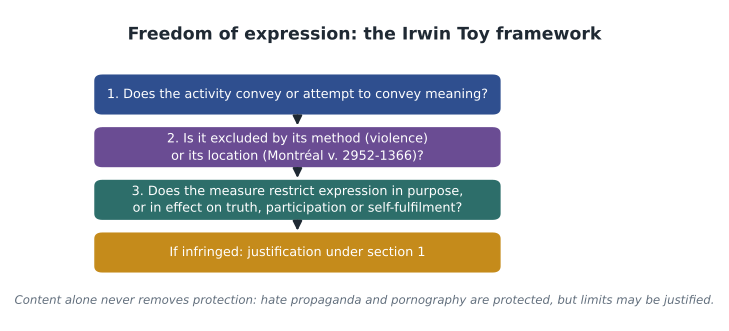
Irwin Toy challenged Quebec's ban on commercial advertising directed at children under 13. The Court set out a framework that still structures section 2(b) cases. First, does the activity have expressive content? Activity is expressive if it conveys or attempts to convey meaning, and almost all human activity combining physical acts and meaning qualifies, though parking a car to save money would not. Second, is the expression excluded from protection because of its method or location? Violence and threats of violence are excluded by method. Third, does the government measure restrict expression in purpose or effect? If the purpose is to restrict the content of expression or to control access to it, the guarantee is infringed. If only the effect does so, the claimant must show that the expression promotes at least one of the three core values.
In Montréal (City) v. 2952-1366 Québec Inc., 2005 SCC 62, a strip club broadcast music through a loudspeaker onto a downtown street, contrary to a noise bylaw. The Court added the location question: whether expression in a particular place is protected depends on whether free expression in that place would undermine the values the guarantee serves, considering the historical or actual function of the place and other features suggesting that expression there would undermine those values. Public streets have traditionally been places for expression. The bylaw infringed section 2(b) but was justified as a reasonable limit on noise.
In Irwin Toy itself, the advertising ban infringed section 2(b), but the majority upheld it under section 1. The legislature was protecting a vulnerable group, children, on the basis of a reasoned apprehension of harm, and the Court deferred to its choice of means.
Hate propaganda
R. v. Keegstra, [1990] 3 SCR 697, concerned an Alberta high school teacher who taught his students antisemitic conspiracy theories and was charged with wilfully promoting hatred against an identifiable group under what is now section 319(2) of the Criminal Code. The Court held unanimously that hate propaganda is expression protected by section 2(b), because its content cannot exclude it. A majority of four to three upheld the offence under section 1. Chief Justice Dickson emphasized the harm hate propaganda causes to targeted groups and to society, the narrow scope of the offence, which requires wilful promotion of hatred, and the defences of truth, good faith religious opinion, public interest discussion and pointing out matters producing hatred in order to remove them. Justice McLachlin, dissenting, would have struck down the provision as overbroad and as likely to chill legitimate expression.
In Saskatchewan (Human Rights Commission) v. Whatcott, 2013 SCC 11, the Court upheld most of a provincial human rights code provision prohibiting publications that expose people to hatred on the basis of a prohibited ground, but struck out the words 'ridicules, belittles or otherwise affronts the dignity of' as reaching expression that was offensive but not hateful. Hatred, the Court said, refers to extreme manifestations of detestation and vilification.
Obscenity and child pornography
In R. v. Butler, [1992] 1 SCR 452, the Court upheld the Criminal Code's obscenity provision, interpreting it to target sexually explicit material involving violence or degradation that creates a substantial risk of harm, particularly to women. In R. v. Sharpe, 2001 SCC 2, the Court upheld the offence of possessing child pornography but read in two exceptions to avoid overbreadth: written or visual material created by the accused alone and held for personal use, and recordings of lawful sexual activity created by or depicting the accused and held for private use. The Court held that the law's objective, protecting children from exploitation and harm, was pressing and that the law was largely proportionate once the exceptions were read in.
Defamation, comedy and civil liability
Freedom of expression shapes private law as well. In Grant v. Torstar Corp., 2009 SCC 61, the Court developed a defence of responsible communication on matters of public interest, recognizing that the traditional common law of defamation gave too little weight to expression on public issues. Ontario's anti-SLAPP provisions in the Courts of Justice Act, interpreted in 1704604 Ontario Ltd. v. Pointes Protection Association, 2020 SCC 22, allow early dismissal of lawsuits that target expression on matters of public interest.
In Ward v. Quebec (Commission des droits de la personne et des droits de la jeunesse), 2021 SCC 43, the comedian Mike Ward mocked a young singer with a disability in his stand-up routine. Quebec's human rights tribunal ordered him to pay damages for discrimination under the Quebec Charter. The majority of the Supreme Court reversed the decision, holding that the discrimination claim required proof that the expression incited others to treat the person as subhuman on the basis of a prohibited ground and was likely to lead to discriminatory treatment; hurtful and offensive jokes about a person were, if anything, a matter for defamation law. The case illustrates the line between offensive expression and discrimination.
Expression on government property and positive claims
Access to government property for expression is analyzed under the location question from Montréal. In Greater Vancouver Transportation Authority v. Canadian Federation of Students, 2009 SCC 31, the sides of public buses were a location where expression was compatible with the function of the space, and the transit authorities' refusal of political advertisements infringed section 2(b) without justification.
Claims that government must provide a platform for expression are treated differently. In Baier v. Alberta, 2007 SCC 31, the Court held that a claim to positive government support for expression, such as access to a particular statutory platform, succeeds only if the claimant shows that exclusion substantially interferes with freedom of expression or has the purpose of interfering with it. Toronto (City) v. Ontario (Attorney General), 2021 SCC 34, applied that test. Ontario cut the number of Toronto's wards from 47 to 25 in the middle of the 2018 municipal election. The majority held that the claim was in substance a positive claim to a particular statutory election platform, that the change did not prevent candidates or voters from expressing themselves, and that there was no infringement. The majority also held that unwritten constitutional principles, such as democracy, cannot by themselves be used to strike down legislation.
Political expression and election spending
Expression connected to elections receives close attention. In Harper v. Canada (Attorney General), 2004 SCC 33, the Court upheld federal limits on third-party election advertising, accepting that Parliament could pursue electoral fairness by preventing those with more resources from dominating debate. In Working Families Coalition (Canada) Inc. v. Ontario (Attorney General), 2025 SCC 5, decided on March 7, 2025, the Court struck down Ontario's limit on third-party political advertising in the twelve months before an election, but on the basis of the right to vote in section 3 rather than section 2(b). That choice mattered because Ontario had invoked section 33 to protect the law from section 2(b), and section 33 does not apply to section 3. Lesson 8 discusses the decision further.
The press
Section 2(b) expressly protects freedom of the press and other media. It does not give journalists a constitutional privilege to refuse to reveal their sources. In R. v. National Post, 2010 SCC 16, the Court held that source protection is decided case by case under the common law Wigmore criteria. In R. v. Vice Media Canada Inc., 2018 SCC 53, the Court upheld a production order requiring a journalist to hand over communications with a source accused of terrorism offences, while strengthening the framework for media production orders. Parliament had meanwhile enacted the Journalistic Sources Protection Act in 2017, which added section 39.1 to the Canada Evidence Act and specific requirements for warrants against journalists in the Criminal Code.
Peaceful assembly
Section 2(c) protects freedom of peaceful assembly. It has seldom been the main basis of a decision, because protest activity is usually analyzed as expression under section 2(b). The word 'peaceful' excludes violent assemblies. Courts recognize that protests can be disruptive and still be peaceful.
The litigation over the federal government's use of the Emergencies Act in February 2022 illustrates the point. In Canadian Frontline Nurses v. Canada (Attorney General), 2024 FC 42, Justice Mosley held that the decision to declare a public order emergency was unreasonable and that the emergency regulations and economic order infringed sections 2(b) and 8. In Attorney General of Canada v. Canadian Civil Liberties Association, 2026 FCA 6, released January 16, 2026, the Federal Court of Appeal dismissed the government's appeal. It held that the regulations infringed section 2(b) by criminalizing participation in protests regardless of whether participants breached the peace, that protests at border crossings and in front of Parliament remained protected even though disruptive, and that the infringement was not justified. It also held that the financial measures authorized unreasonable searches contrary to section 8. The Supreme Court granted leave to appeal in October 2026.
Freedom of association and labour
Section 2(d) protects the freedom to establish, belong to and maintain an association, and to exercise in association rights that individuals may exercise alone. Its most important applications concern labour relations, and the doctrine has changed dramatically.
In the 1987 Labour Trilogy, led by Reference re Public Service Employee Relations Act (Alta.), [1987] 1 SCR 313, the Court held that section 2(d) did not protect collective bargaining or the right to strike. Dunmore v. Ontario (Attorney General), 2001 SCC 94, held that excluding agricultural workers from Ontario's labour relations statute substantially interfered with their ability to associate, and required the province to provide a framework protecting their freedom to organize. Health Services and Support - Facilities Subsector Bargaining Assn. v. British Columbia, 2007 SCC 27, overruled the trilogy in part, holding that section 2(d) protects a process of collective bargaining, and that legislation unilaterally voiding collective agreement provisions substantially interfered with it. Ontario (Attorney General) v. Fraser, 2011 SCC 20, upheld Ontario's separate scheme for agricultural workers, holding that section 2(d) requires a good faith process of bargaining but not any particular model.
In 2015 the Court decided another trilogy. Mounted Police Association of Ontario v. Canada (Attorney General), 2015 SCC 1, held that excluding RCMP members from collective bargaining and imposing a management-controlled staff relations program substantially interfered with a meaningful process of collective bargaining, which requires employee choice and independence from management. Meredith v. Canada (Attorney General), 2015 SCC 2, upheld temporary wage restraints for RCMP members. Saskatchewan Federation of Labour v. Saskatchewan, 2015 SCC 4, held that the right to strike is an indispensable component of collective bargaining and protected by section 2(d), and that Saskatchewan's essential services law, which let the employer unilaterally designate essential workers without an independent dispute resolution mechanism, was unconstitutional.
Section 2(d) also includes a limited freedom not to associate. In Lavigne v. Ontario Public Service Employees Union, [1991] 2 SCR 211, a college teacher objected to his union dues being spent on political causes. The majority upheld the compulsory dues arrangement, though for different reasons. In R. v. Advance Cutting & Coring Ltd., 2001 SCC 70, a majority upheld Quebec's requirement that construction workers belong to one of several unions, with judges divided on whether the freedom not to associate was infringed.
Wage restraint litigation continued after 2015. Ontario's Protecting a Sustainable Public Sector for Future Generations Act, 2019, known as Bill 124, capped public sector wage increases at one percent a year. The Ontario Superior Court found that it infringed section 2(d) without justification, the Court of Appeal largely agreed in 2024, and Ontario repealed the law. Hannah Kowalczyk asks why a wage cap is about association rather than money. Rahimi answers that the problem was not the size of the raises but the legislature's removal of the subject from good faith bargaining.
Worked problem
Brannock University's campus events policy
Assume the Charter applies to Brannock University's policy requiring student groups to obtain approval forty-eight hours before any outdoor demonstration on campus. Analyze the section 2(b) and 2(c) claims.
Show solution
- Expressive content: Demonstrations convey meaning and are expressive activity.
- Method and location: A peaceful demonstration is not excluded by method. Outdoor campus spaces such as quads and walkways are places where expression has historically occurred and does not undermine their function, so location does not exclude it (Montréal; GVTA).
- Purpose or effect: The policy may have a content-neutral purpose, such as scheduling and safety, but its effect is to prevent spontaneous demonstrations responding to current events, which engages the core value of political participation.
- Section 2(c): A peaceful assembly is protected; analysis usually merges with section 2(b).
- Section 1 or Doré: If the policy is a binding rule adopted under the university's statutory authority, apply Oakes; a discretionary refusal would be reviewed under Doré. Safety and the protection of classes are pressing objectives, but a blanket forty-eight-hour notice requirement with no exception for spontaneous, non-disruptive gatherings is vulnerable at minimal impairment. A notice requirement limited to large or amplified events, or to certain buildings, would be less intrusive.
Practice problems
Work each problem on paper first, then reveal the answer to check.
What are the three values underlying freedom of expression?
Show answer
The pursuit of truth, participation in social and political decision-making, and individual self-fulfilment and human flourishing (Irwin Toy).
Why was hate propaganda held to be protected expression in Keegstra, and why was the offence upheld anyway?
Show answer
Content cannot exclude expression from section 2(b), so hate propaganda is protected. The offence was upheld under section 1 because of the harm hate causes, its narrow scope requiring wilful promotion of hatred, and its defences.
How did the Court treat the Toronto ward reduction in Toronto (City) v. Ontario?
Show answer
As a positive claim to a particular statutory platform under Baier. The change did not substantially interfere with expression, so there was no infringement, and unwritten principles could not independently invalidate the law.
What did the Federal Court of Appeal decide about the Emergencies Act regulations in 2026 FCA 6?
Show answer
That the invocation was unreasonable, that the regulations infringed section 2(b) by criminalizing protest participation regardless of breach of the peace, that the financial measures violated section 8, and that neither infringement was justified.
What did Saskatchewan Federation of Labour add to section 2(d)?
Show answer
It held that the right to strike is an essential part of meaningful collective bargaining and protected by section 2(d), striking down an essential services law that lacked an independent dispute resolution mechanism.
Summary and key terms
- Section 2(b) is defined broadly: activity that conveys meaning is protected unless excluded by violent method or incompatible location (Irwin Toy; Montréal).
- Purpose to restrict content is an infringement; effects-based claims must engage truth, participation or self-fulfilment.
- Hate propaganda, obscenity and child pornography are protected expression, but limits have been upheld under section 1 (Keegstra; Whatcott; Butler; Sharpe with read-in exceptions).
- Positive claims to a platform require substantial interference (Baier; Toronto v. Ontario); unwritten principles cannot alone invalidate laws.
- The Emergencies Act regulations were held to infringe sections 2(b) and 8 (2024 FC 42; 2026 FCA 6); the Supreme Court granted leave in October 2026.
- Section 2(d) now protects meaningful collective bargaining and the right to strike (Health Services; Mounted Police; Saskatchewan Federation of Labour).
- Expressive content
- Activity that conveys or attempts to convey meaning.
- Location test
- The question whether expression in a place would undermine the values of free expression, considering the place's function (Montréal).
- Hate propaganda
- Expression that wilfully promotes hatred against an identifiable group, limited by section 319 of the Criminal Code.
- Positive claim
- A claim that government must provide a platform or support for expression, governed by Baier.
- Anti-SLAPP motion
- A motion to dismiss a lawsuit early because it targets expression on a matter of public interest.
- Meaningful collective bargaining
- A bargaining process with employee choice and independence from management, protected by section 2(d).
Lesson quiz · 5 questions
Score 60% or more to complete this lesson.
Create a free account to save your progress, take quizzes and earn a certificate.