
LAWC-111 · Lesson 11 of 12 · 23 min
Section 35 rights
▶ Video coming soon A video version of this lesson is on the way.
Section 35(1) of the Constitution Act, 1982 provides that the existing aboriginal and treaty rights of the aboriginal peoples of Canada are hereby recognized and affirmed. Section 35(2) defines the aboriginal peoples of Canada as including the Indian, Inuit and Métis peoples. Section 35(3) provides that treaty rights include rights that now exist by way of land claims agreements or may be so acquired, and section 35(4) guarantees Aboriginal and treaty rights equally to male and female persons.
Section 35 is not part of the Charter, which ends at section 34. It sits in Part II of the Constitution Act, 1982. As a result, section 1 does not apply to it, section 33 cannot override it, and the courts have developed their own framework for when governments may infringe it. Section 25 of the Charter, by contrast, is part of the Charter, and it governs how the Charter interacts with Aboriginal, treaty and other rights. This lesson covers both.
Daniel Whitecloud leads the reading group's discussion. He explains that his First Nation signed Treaty 6 in 1876 and that the treaty is, for his community, a living agreement rather than a historical document. He also points out that Indigenous laws existed long before either Canadian constitution, and that section 35 recognizes rights rather than creating them. Professor Okafor-Lindqvist says that this is exactly how the Supreme Court has described section 35, and that the course on Indigenous Peoples and Canadian Law will take up the subject in much greater depth.
Sparrow: the justification framework
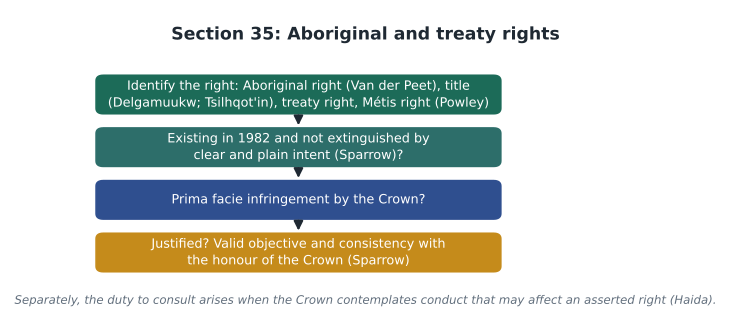
The first major case under section 35 was R. v. Sparrow, [1990] 1 SCR 1075. Ronald Sparrow, a member of the Musqueam Band, was charged under the federal Fisheries Act with fishing with a drift net longer than his licence allowed. He argued that he was exercising an existing Aboriginal right to fish. The Court held that section 35 protects rights that had not been extinguished before April 17, 1982, that extinguishment requires a clear and plain intention, and that regulation of a right does not extinguish it. Rights must be interpreted flexibly to permit their evolution over time, not frozen in the form in which they were exercised in the past.
Sparrow also set the test for when governments may infringe an Aboriginal right. The claimant must show a prima facie infringement, considering whether the limitation is unreasonable, imposes undue hardship, or denies the holders their preferred means of exercising the right. The government must then justify the infringement by showing a valid legislative objective, such as conservation, and that the infringement is consistent with the honour of the Crown and its fiduciary relationship with Aboriginal peoples. That includes questions such as whether there has been as little infringement as possible, whether fair compensation is available, whether the Aboriginal group was consulted, and whether conservation measures give priority to the Aboriginal right after conservation needs are met.
Proving an Aboriginal right: Van der Peet
In R. v. Van der Peet, [1996] 2 SCR 507, a Stó:lō woman was charged with selling salmon caught under a food fishing licence. The Court held that to be an Aboriginal right, an activity must be an element of a practice, custom or tradition integral to the distinctive culture of the Aboriginal group claiming the right, and it must have continuity with practices existing before contact with Europeans. The majority found that exchange of fish for money or goods was not integral to Stó:lō culture before contact, so there was no right to sell fish. The test has been criticized for focusing on pre-contact practices and for freezing Indigenous cultures in time. R. v. Gladstone, [1996] 2 SCR 723, decided at the same time, recognized a Heiltsuk right to sell herring spawn on kelp commercially, showing that commercial rights can be proved on the evidence.
The Court adapted the test for Métis rights in R. v. Powley, 2003 SCC 43, asking whether a practice was integral to the Métis community's distinctive culture at the time of effective European control rather than at contact. In Daniels v. Canada (Indian Affairs and Northern Development), 2016 SCC 12, the Court held that Métis and non-status Indians are 'Indians' within federal jurisdiction under section 91(24) of the Constitution Act, 1867. In R. v. Desautel, 2021 SCC 17, the Court held that the descendants of a group that occupied Canadian territory at contact can hold section 35 rights even if they now live in the United States.
Aboriginal title
Aboriginal title is a right to the land itself, not merely to engage in activities on it. In Delgamuukw v. British Columbia, [1997] 3 SCR 1010, the Court held that title requires exclusive occupation of the land at the time of the assertion of Crown sovereignty, that oral histories must be given due weight as evidence, and that title includes the right to use the land for a variety of purposes, subject to an inherent limit that the land not be used in ways that would destroy the group's relationship with it.
In Tsilhqot'in Nation v. British Columbia, 2014 SCC 44, the Court for the first time declared Aboriginal title to a specific area. It held that occupation sufficient to ground title can be established by regular use of territories for hunting, fishing and other purposes, not only by intensive occupation of village sites. Title confers the right to decide how the land will be used, to enjoy and occupy it, to possess it, to its economic benefits, and to use and manage it. After title is established, the Crown must obtain the group's consent to use the land or justify any infringement under the Sparrow framework as adapted.
Treaty rights
Treaties are solemn agreements between the Crown and Indigenous nations. Historic treaties include the Peace and Friendship Treaties in the Maritimes, the Robinson Treaties of 1850 and the numbered treaties signed between 1871 and 1921. Modern treaties are comprehensive land claims agreements, such as the James Bay and Northern Quebec Agreement of 1975 and the Nisga'a Final Agreement of 2000.
Courts interpret treaties liberally, resolving ambiguities in favour of the Indigenous signatories, and seek the common intention of the parties in light of the historical context and oral promises (R. v. Badger, [1996] 1 SCR 771). In R. v. Marshall, [1999] 3 SCR 456, the Court held that the 1760-61 Peace and Friendship Treaties gave the Mi'kmaq a right to fish and trade to earn a moderate livelihood. In Ontario (Attorney General) v. Restoule, 2024 SCC 27, the Court held that the Crown had breached the Robinson Treaties by failing to increase the annuities promised to the Anishinaabe signatories for more than a century, and directed the Crown to negotiate with the treaty partners on compensation for the Upper Great Lakes claim rather than having the courts set an amount. The honour of the Crown required diligent implementation of treaty promises.
The honour of the Crown and the duty to consult
The honour of the Crown is a constitutional principle that governs the Crown's dealings with Indigenous peoples. In Haida Nation v. British Columbia (Minister of Forests), 2004 SCC 73, the Court held that the Crown has a duty to consult, and where appropriate accommodate, when it has knowledge, real or constructive, of the potential existence of an Aboriginal right or title and contemplates conduct that might adversely affect it. The duty arises before the right is proved in court. Its content varies on a spectrum, from notice and discussion where the claim is weak or the impact minor, to deep consultation, possibly requiring accommodation, where the claim is strong and the impact serious. The duty does not give Indigenous groups a veto, but it requires good faith efforts to understand and address their concerns.
In Mikisew Cree First Nation v. Canada (Governor General in Council), 2018 SCC 40, a majority held that the duty to consult does not apply to the law-making process, so Parliament is not required to consult before enacting legislation that may affect section 35 rights, though legislation that infringes rights can still be challenged once enacted. In Quebec (Attorney General) v. Pekuakamiulnuatsh Takuhikan, 2024 SCC 39, the Court held that the honour of the Crown applied to a tripartite agreement funding a First Nation police force, and that the governments had breached their obligations by failing to negotiate the agreement's renewal in good faith.
Self-government and C-92
Whether section 35 protects an inherent right of self-government is one of the most significant questions in this area. The federal government has recognized the inherent right as an existing right under section 35 since 1995. In Reference re An Act respecting First Nations, Inuit and Métis children, youth and families, 2024 SCC 5, the Court upheld federal legislation, known as Bill C-92, that affirmed the jurisdiction of Indigenous peoples over child and family services and gave their laws the force of federal law, prevailing over provincial laws in case of conflict. The Court held the Act was valid federal legislation under section 91(24), and found it unnecessary to decide whether section 35 itself protects a right of self-government, because the Act was a valid exercise of Parliament's power to affirm that right in legislation.
In 2021 Parliament enacted the United Nations Declaration on the Rights of Indigenous Peoples Act, which affirms the Declaration as a universal international human rights instrument with application in Canadian law and requires the federal government to take measures to ensure that federal laws are consistent with it. British Columbia adopted its own Declaration on the Rights of Indigenous Peoples Act in 2019. The Supreme Court has used the Declaration as an interpretive aid, including in the C-92 Reference.
Section 25: the shield
Section 25 provides that the guarantee in the Charter of certain rights and freedoms shall not be construed so as to abrogate or derogate from any aboriginal, treaty or other rights or freedoms that pertain to the aboriginal peoples of Canada, including rights recognized by the Royal Proclamation of 1763 and rights that now exist by way of land claims agreements or may be so acquired. It does not create new rights. Its function is to protect Indigenous rights and the distinctiveness of Indigenous peoples from being undermined by Charter rights held by others.
In R. v. Kapp, 2008 SCC 41, the majority decided the case under section 15(2) and did not decide the scope of section 25, though Justice Bastarache would have held that section 25 shielded the communal fishing licence. The first full analysis came in Dickson v. Vuntut Gwitchin First Nation, 2024 SCC 10.
Dickson v. Vuntut Gwitchin First Nation
The Vuntut Gwitchin First Nation, a self-governing First Nation in Yukon, has a constitution requiring members of its council to reside on its settlement land, which centres on the community of Old Crow, or to relocate there within fourteen days of election. Cindy Dickson, a citizen who lived in Whitehorse for family and medical reasons, wanted to run for council and challenged the residency requirement under section 15, arguing that it discriminated on the basis of Aboriginality-residence.
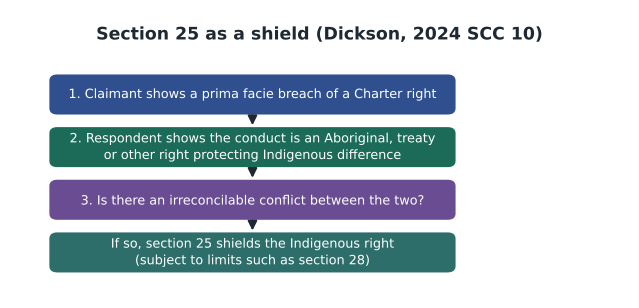
The majority, written by Justices Kasirer and Jamal, first held that the Charter applied to the First Nation under section 32, because it exercised governmental authority under its self-government agreement and implementing federal and territorial legislation. On section 25, the majority set out a framework. The claimant must first show a prima facie breach of a Charter right. The respondent must then show that the impugned conduct is a right protected by section 25, which includes not only section 35 rights but also 'other rights' that protect Indigenous difference, such as rights in self-government agreements and statutes. The court then asks whether there is an irreconcilable conflict between the Charter right and the protected Indigenous right. If there is, section 25 shields the Indigenous right, subject to limits, including section 28 and possibly fundamental individual rights the Court did not exhaustively define.
Applying the framework, the majority accepted that the residency requirement was a prima facie breach of section 15. It held that the requirement was an 'other right' protecting the Vuntut Gwitchin's interest in governance tied to their connection with their land and community, and that there was an irreconcilable conflict with Ms. Dickson's section 15 claim. Section 25 therefore shielded the requirement. Chief Justice Wagner and Justice Côté agreed with the majority. Justices Martin and O'Bonsawin, dissenting, would have held that the residency requirement did not fall within section 25, was not justified under section 1, and should be declared of no force or effect. Justice Rowe would have held that, properly applying section 32(1), the residency requirement was not subject to the Charter at all.
Daniel says the decision recognizes that self-governing nations need room to make choices that reflect their own values, even when individual citizens disagree. Hannah Kowalczyk asks whether section 25 might now protect laws that harm vulnerable individuals within Indigenous communities. Okafor-Lindqvist points to the limits the majority described, including section 28, and says that the boundaries of section 25 will be worked out in future cases.
Section 35.1 and constitutional amendment
Section 35.1, added in 1983, commits federal and provincial governments to convening a constitutional conference, including representatives of Aboriginal peoples, before any amendment to section 91(24) of the Constitution Act, 1867, section 25 or section 35. It reflects the principle that constitutional change affecting Indigenous peoples should not occur without their participation.
Worked problem
A First Nation election law and section 25
A self-governing First Nation in Ontario adopts an election law requiring that candidates for chief speak the Nation's language. A citizen who grew up in Toronto and does not speak the language challenges the law under section 15. Analyze the claim.
Show solution
- Application: A self-governing First Nation exercising authority under a self-government agreement and implementing legislation is government for section 32 purposes (Dickson).
- Prima facie breach: The citizen must show that the law creates a distinction on an enumerated or analogous ground, such as Aboriginality-residence, and reinforces disadvantage (Sharma). Language ability is closely linked to residence and upbringing, which supports a distinction claim, but the claimant still needs evidence.
- Protected right: The First Nation must show that the language requirement is an Aboriginal, treaty or other right protecting Indigenous difference; revitalizing an Indigenous language through governance is closely tied to the Nation's distinctiveness.
- Irreconcilable conflict: If the claimant's section 15 right and the language requirement cannot both be given effect, section 25 shields the requirement, subject to limits such as section 28.
- Conclusion: Following Dickson, the requirement is likely shielded by section 25, though the outcome depends on evidence about the law's purpose and the Nation's governance traditions.
Practice problems
Work each problem on paper first, then reveal the answer to check.
Why do section 1 and section 33 not apply to section 35?
Show answer
Because section 35 is in Part II of the Constitution Act, 1982, outside the Charter; courts use the Sparrow justification framework instead.
What must a claimant show to establish an Aboriginal right under Van der Peet?
Show answer
That the activity is an element of a practice, custom or tradition integral to the group's distinctive culture, with continuity to practices existing before contact (adapted to effective European control for Métis rights in Powley).
When does the duty to consult arise under Haida?
Show answer
When the Crown knows, actually or constructively, of a potential Aboriginal right or title and contemplates conduct that might adversely affect it; its content varies with the strength of the claim and the seriousness of the impact.
What did Restoule (2024 SCC 27) decide?
Show answer
That the Crown breached the Robinson Treaties by failing to increase annuities for more than a century, and that the honour of the Crown required diligent implementation; the Crown was directed to negotiate compensation for the Upper Great Lakes claim with the treaty partners.
Summarize the section 25 framework from Dickson.
Show answer
Prima facie Charter breach; the respondent shows the conduct is an Aboriginal, treaty or other right protecting Indigenous difference; if there is an irreconcilable conflict, section 25 shields the protected right, subject to limits such as section 28.
Summary and key terms
- Section 35 recognizes and affirms existing Aboriginal and treaty rights of Indian, Inuit and Métis peoples; it is outside the Charter.
- Sparrow: rights not extinguished by clear and plain intent are protected; infringements need a valid objective and consistency with the honour of the Crown.
- Van der Peet sets the test for Aboriginal rights; Powley adapts it for Métis rights; Delgamuukw and Tsilhqot'in govern title.
- Treaties are interpreted liberally (Badger; Marshall); Restoule (2024) requires diligent implementation of treaty promises.
- Haida sets the duty to consult; it does not apply to law-making (Mikisew 2018); the honour of the Crown applies to some agreements (Pekuakamiulnuatsh 2024).
- The C-92 Reference (2024 SCC 5) upheld federal affirmation of Indigenous jurisdiction over child and family services.
- Section 25 shields Aboriginal, treaty and other rights from conflicting Charter rights (Dickson, 2024 SCC 10).
- Aboriginal right
- A practice, custom or tradition integral to the distinctive culture of an Aboriginal group, protected by section 35.
- Aboriginal title
- A right to land based on exclusive occupation at the assertion of Crown sovereignty.
- Honour of the Crown
- The constitutional principle requiring the Crown to act honourably in its dealings with Indigenous peoples.
- Duty to consult
- The Crown's obligation to consult and, where appropriate, accommodate when contemplating conduct that may affect asserted Indigenous rights.
- Extinguishment
- The ending of an Aboriginal right before 1982, which requires a clear and plain intention.
- Section 25
- The Charter provision that prevents Charter rights from abrogating or derogating from Aboriginal, treaty or other Indigenous rights.
Lesson quiz · 5 questions
Score 60% or more to complete this lesson.
Create a free account to save your progress, take quizzes and earn a certificate.