
LAWC-111 · Lesson 2 of 12 · 23 min
Application of the Charter
▶ Video coming soon A video version of this lesson is on the way.
The second meeting of the reading group, on Wednesday, October 21, 2026, starts with a problem Noor Rahimi has drafted. The City of Corwin has amended its parks bylaw to prohibit anyone from erecting a tent or other shelter in Riverside Park between 7 p.m. and 7 a.m. At the same time, Brannock University has adopted a campus events policy requiring student groups to obtain approval forty-eight hours before any outdoor demonstration, and Corwin General Hospital, a public hospital, has stopped providing sign language interpreters for outpatient appointments. A group of students and residents wants to challenge all three under the Charter.
'The bylaw is easy,' Arjun Mehta says. 'It's a law made by a city, so the Charter applies.' Hannah Kowalczyk is less sure about the university: 'Brannock is a private corporation with a board. Why would the Charter bind it?' Theo Marchetti points out that the hospital is funded almost entirely by the province. Rahimi tells them that those three intuitions track the three main lines of authority on section 32, and that sorting them out is the first step in every Charter answer.
The text of section 32
Section 32(1) provides that the Charter applies to the Parliament and government of Canada in respect of all matters within the authority of Parliament, including matters relating to the Yukon Territory and the Northwest Territories, and to the legislature and government of each province in respect of all matters within the authority of the legislature of each province. Nunavut is included through section 30 and later amendments to the territorial legislation. The provision does not mention private parties, and its focus on Parliament, legislatures and government is the starting point for every application question.
Laws: the Charter always applies
Every statute, regulation and bylaw is subject to the Charter, because each is an exercise of legislative authority traceable to Parliament or a provincial legislature. Municipalities are creatures of provincial statute and exercise delegated provincial power, so a municipal bylaw is a law that must comply with the Charter (Godbout v. Longueuil (City), [1997] 3 SCR 844). The same is true of regulations made by cabinet and of rules made by statutory bodies with delegated law-making power. When a statute grants discretion, the statute itself must be read as conferring only discretion that can be exercised consistently with the Charter (Slaight Communications Inc. v. Davidson, [1989] 1 SCR 1038).
That settles the Corwin parks bylaw. Whether the bylaw infringes any right is a separate question for later lessons; here, the point is only that the bylaw is reviewable.
Private litigation: Dolphin Delivery
The Supreme Court's first major application case was RWDSU v. Dolphin Delivery Ltd., [1986] 2 SCR 573. A union wanted to picket a company that was doing business with a struck employer. The company obtained an injunction under the common law tort of inducing breach of contract. The union argued that the injunction infringed its freedom of expression. The Court held that the Charter does not apply to private litigation between private parties governed by the common law, even though the courts that issue injunctions are part of the state. If courts' orders counted as government action, Justice McIntyre reasoned, the Charter would apply to every private dispute, and section 32 would have no meaning.
Dolphin Delivery left two important qualifications. First, the Charter does apply to the common law when it is relied on by government, for example in a prosecution or when the Crown sues. Second, even in private litigation, courts should develop the common law in a manner consistent with Charter values. The Court later used that principle to reshape the common law of defamation in Hill v. Church of Scientology of Toronto, [1995] 2 SCR 1130, and to create the defence of responsible communication on matters of public interest in Grant v. Torstar Corp., 2009 SCC 61. Courts remain bound by Charter guarantees that govern their own processes in proceedings involving the state, such as the fairness of a criminal trial.
Entities that are government
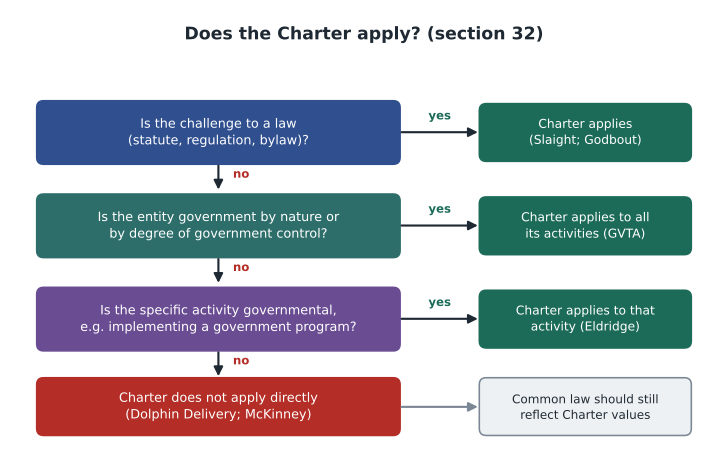
The harder cases involve bodies that are neither legislatures nor obviously part of government. The Court has developed two routes, which can be thought of as an entity test and an activity test.
Under the entity test, a body is part of government for Charter purposes if it is government by its very nature or because of the degree of governmental control exercised over it. If so, the Charter applies to everything the body does, including its private-law activities such as contracting and employment.
In McKinney v. University of Guelph, [1990] 3 SCR 229, professors challenged mandatory retirement at 65 at several Ontario universities. The Court held that the universities were not government. They were created by statute and largely publicly funded, but they were legally autonomous, governed by their own boards and senates, and committed to academic freedom; the province did not control their day-to-day operations or their employment policies. Mandatory retirement was therefore not subject to section 15. The Court reached the same conclusion about a public hospital's retirement policy in Stoffman v. Vancouver General Hospital, [1990] 3 SCR 483, emphasizing that the hospital board, not the government, set the policy.
By contrast, community colleges in Ontario and British Columbia were found to be government because the provincial minister could control their boards and operations (Douglas/Kwantlen Faculty Assn. v. Douglas College, [1990] 3 SCR 570; Lavigne v. Ontario Public Service Employees Union, [1991] 2 SCR 211). Municipalities are government by nature: they exercise powers of taxation and law-making that are inherently governmental (Godbout). In Greater Vancouver Transportation Authority v. Canadian Federation of Students, 2009 SCC 31, the Court held that TransLink and BC Transit were government because the regional municipal authority controlled TransLink and the province controlled BC Transit. Their advertising policies, which refused political advertisements on buses, were therefore subject to the Charter, and the Court found they infringed freedom of expression without justification.
Activities that are governmental
Under the activity test, even a body that is not government may be bound by the Charter when it carries out a specific governmental activity. In Eldridge v. British Columbia (Attorney General), [1997] 3 SCR 624, deaf patients challenged the failure of hospitals to provide sign language interpreters. Under McKinney and Stoffman, the hospitals were not government for all purposes. But the Court held that in delivering medically necessary services under the provincial health insurance scheme, the hospitals were implementing a specific government program and were acting as agents of government. The Charter applied to that activity, and the failure to provide interpreters where needed for effective communication denied equal benefit of the law under section 15.
Eldridge directs the analysis to the quality of the act, not the nature of the body. The question is whether the entity is implementing a specific government policy or program, or exercising powers of compulsion granted by statute, not merely whether it is publicly funded or performs a public function. Rahimi notes that Corwin General Hospital's interpreter decision looks very much like Eldridge. Theo agrees, then asks whether the hospital's decision to change its parking rates would also be covered. Probably not, Rahimi answers: setting parking fees is not part of implementing the government health insurance program, and the hospital is not government by nature.
Universities and the Charter after McKinney
Hannah's question about Brannock University is one that lower courts have struggled with. McKinney held that universities were not government for employment decisions, but it left open whether particular university activities might be governmental under the Eldridge test. Courts across the country have divided on whether universities are bound when they regulate expression on campus. The Alberta Court of Appeal held in UAlberta Pro-Life v. Governors of the University of Alberta, 2020 ABCA 1, that the Charter applied when the university regulated students' expression on campus, partly because Alberta legislation gave the university a statutory mandate to provide public post-secondary education and partly because the university was regulating access to spaces that were, in effect, public. Ontario courts have taken a narrower view in earlier cases. Rahimi tells the group to treat the question as unsettled and to argue both the entity and activity routes on the facts.
For the Brannock problem, a strong answer would note that Brannock, like the universities in McKinney, is probably not government by nature, then ask whether its events policy implements a specific provincial program or statutory mandate. Ontario's 2019 directive requiring universities to adopt free speech policies, and any statutory duties imposed on them, would be relevant facts. The answer would also note that even if the Charter does not apply, Ontario's Human Rights Code and the university's own policies might.
Administrative decision-makers
The Charter applies to decisions of administrative bodies exercising statutory power, such as tribunals, licensing bodies and ministers. A law society disciplining a lawyer, a labour arbitrator applying a statute, and an immigration officer deciding an application all act under statutory authority and are bound by the Charter. In Doré v. Barreau du Québec, 2012 SCC 12, the Court held that such decisions are reviewed for whether they proportionately balance the Charter protections at stake with the statutory objectives, rather than through a full Oakes analysis. Lesson 3 explains that framework.
Arbitrators and tribunals with power to decide questions of law can also apply the Charter and decline to apply unconstitutional provisions in the cases before them (Nova Scotia (Workers' Compensation Board) v. Martin, 2003 SCC 54; R. v. Conway, 2010 SCC 22). They cannot issue general declarations of invalidity, which remain the preserve of superior courts.
Government inaction and underinclusion
Section 32 does not require that government act before the Charter applies. In Vriend v. Alberta, [1998] 1 SCR 493, Alberta's human rights legislation omitted sexual orientation as a prohibited ground. The province argued that because it had not acted, the Charter did not apply. The Court rejected that argument: the challenge was to the legislation itself, which was underinclusive, and legislation is always subject to the Charter. The Court read sexual orientation into the statute as a remedy.
The Charter generally does not impose positive obligations on governments to act where they have not legislated at all. In Gosselin v. Quebec (Attorney General), 2002 SCC 84, the Court rejected a claim that section 7 required adequate social assistance, though the majority left open the possibility that positive obligations might be recognized in special circumstances. That question returns in lesson 6.
Territorial reach and actions abroad
Canadian officials acting outside Canada are generally not bound by the Charter, because enforcement would require applying Canadian law in another state's territory (R. v. Hape, 2007 SCC 26). There is an exception where Canadian officials participate in processes that violate Canada's international human rights obligations. In Canada (Justice) v. Khadr, 2008 SCC 28, and Canada (Prime Minister) v. Khadr, 2010 SCC 3, the Court held that Canadian officials who interviewed Omar Khadr at Guantanamo Bay and shared the results with United States authorities were bound by section 7 because the process breached international law, though the Court declined to order the government to request his repatriation.
Self-governing First Nations
In Dickson v. Vuntut Gwitchin First Nation, 2024 SCC 10, the Supreme Court considered whether the Charter applies to a self-governing First Nation in Yukon. The First Nation's constitution required its councillors to reside on its settlement land or to move there within fourteen days of election. Cindy Dickson, a citizen living in Whitehorse, challenged the requirement under section 15. The majority held that the First Nation was government for the purposes of section 32 because it exercised governmental authority under its self-government agreement and implementing legislation, so the Charter applied. The majority then held that section 25 shielded the residency requirement from the section 15 claim because the requirement protected Aboriginal or other rights relating to the First Nation's distinctiveness. Lesson 11 examines the section 25 analysis in detail. Daniel Whitecloud says that the decision is a good example of why application is never just a technical step.
Worked problem
Applying section 32 to the Corwin problem
Does the Charter apply to (1) the Riverside Park bylaw, (2) Brannock University's campus events policy, and (3) Corwin General Hospital's decision to stop providing interpreters?
Show solution
- Bylaw: A municipal bylaw is a law enacted under delegated provincial authority, so the Charter applies (Godbout). The analysis moves directly to infringement.
- University policy: Brannock is a statutory corporation with an independent board and academic senate, and the province does not control its operations, so under McKinney it is not government by nature or control. The claimants must use the activity route: is the events policy part of implementing a specific government program or statutory mandate? The 2019 provincial free speech directive and any statutory duties are key facts. Courts are divided (compare UAlberta Pro-Life, 2020 ABCA 1). Argue both sides; if the Charter does not apply, consider the Human Rights Code.
- Hospital: The hospital is not government for all purposes (Stoffman), but in delivering insured medical services it implements the provincial health insurance program, as in Eldridge. Its interpreter decision is subject to the Charter, and the section 15 analysis will follow Eldridge closely.
- Conclusion: The Charter applies to the bylaw and to the hospital's interpreter decision; its application to the university policy is arguable and depends on the evidence about government involvement.
Practice problems
Work each problem on paper first, then reveal the answer to check.
Why did the Charter not apply in Dolphin Delivery?
Show answer
The dispute was private litigation between a union and a company, governed by the common law, with no government party relying on the law. A court order resolving a private dispute is not government action under section 32, although courts should develop the common law consistently with Charter values.
What is the difference between the entity test and the activity test?
Show answer
Under the entity test, a body that is government by nature or by degree of governmental control is bound by the Charter in all its activities. Under the activity test (Eldridge), a non-governmental body is bound only for specific activities that implement a government program or policy.
Were the universities in McKinney government for Charter purposes?
Show answer
No. Although created by statute and largely publicly funded, they were autonomous and the province did not control their operations or employment policies.
Why did the Charter apply to TransLink's advertising policy?
Show answer
TransLink was controlled by a regional municipal authority, which is itself government, so it was government by degree of control and all its activities, including advertising policy, were subject to the Charter (Greater Vancouver Transportation Authority, 2009 SCC 31).
How did the Court deal with the argument in Vriend that Alberta had not acted?
Show answer
It rejected it: the challenge was to the human rights statute itself, which was underinclusive, and legislation is always subject to the Charter.
Common mistakes
MistakeSaying the Charter applies because an entity is publicly funded.
InsteadFunding is relevant but not decisive. Ask whether the entity is controlled by government or whether the specific activity implements a government program.
MistakeTreating a court injunction in a private dispute as government action.
InsteadDolphin Delivery holds that private common law litigation is not subject to direct Charter scrutiny, though Charter values guide the common law.
MistakeConcluding that the Charter cannot apply when government has failed to legislate on a matter.
InsteadAn underinclusive statute is itself subject to the Charter (Vriend); a complete absence of legislation raises the harder question of positive obligations (Gosselin).
Summary and key terms
- Section 32 applies the Charter to Parliament, the legislatures and the federal, provincial and territorial governments.
- All laws, including municipal bylaws and regulations, are subject to the Charter (Godbout; Slaight).
- Private common law litigation is not directly subject to the Charter, but the common law must develop consistently with Charter values (Dolphin Delivery; Hill; Grant v. Torstar).
- Entities that are government by nature or by degree of control are bound in all their activities (Douglas College; Godbout; GVTA); autonomous universities and hospitals are not (McKinney; Stoffman).
- Non-governmental entities are bound when implementing specific government programs (Eldridge).
- Administrative decision-makers exercising statutory power are bound, and their decisions are reviewed under Doré.
- Self-governing First Nations exercising governmental authority are subject to the Charter, subject to section 25 (Dickson, 2024 SCC 10).
- Section 32
- The Charter provision defining the governments and legislatures it binds.
- Government by nature
- An entity, such as a municipality, whose powers are inherently governmental.
- Degree of control
- The test asking whether government controls an entity's operations closely enough that the entity is government for Charter purposes.
- Governmental activity
- A specific act by a non-governmental body that implements a government program or policy, bringing it within the Charter (Eldridge).
- Charter values
- The principles underlying Charter rights, which guide the development of the common law and the exercise of administrative discretion.
- Underinclusive legislation
- A law that extends a benefit or protection to some groups but not others, reviewable under the Charter (Vriend).
Lesson quiz · 5 questions
Score 60% or more to complete this lesson.
Create a free account to save your progress, take quizzes and earn a certificate.