
LAWC-111 · Lesson 10 of 12 · 22 min
The notwithstanding clause
▶ Video coming soon A video version of this lesson is on the way.
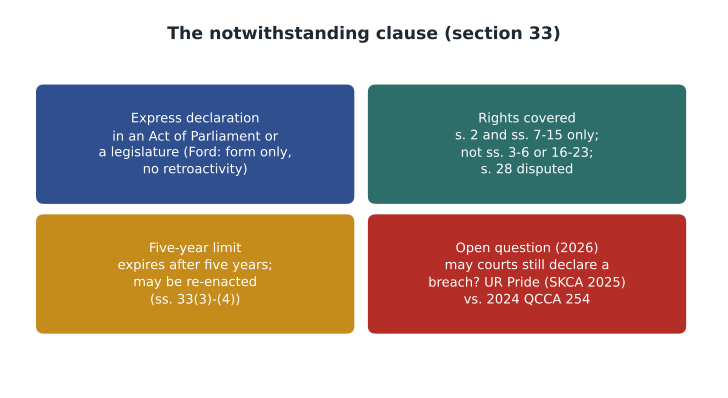
Section 33(1) of the Charter provides that Parliament or the legislature of a province may expressly declare in an Act that the Act or a provision of it shall operate notwithstanding a provision included in section 2 or sections 7 to 15 of the Charter. A law with such a declaration operates as it would but for the overridden provisions. Under section 33(3) a declaration expires five years after it comes into force, or earlier if the Act says so, and section 33(4) allows it to be re-enacted for further five-year periods.
The reading group meets for its last regular session on Wednesday, November 18, 2026, nine days before the Supreme Court is to release its decision in the Bill 21 appeal. Professor Okafor-Lindqvist begins by asking everyone to open their sealed predictions from the religion session, then immediately says not to. 'Keep them closed until the twenty-seventh,' she says. 'Tonight we're going to learn the law well enough to understand whatever the Court decides.'
Origins
Section 33 was the price of the November 1981 agreement that produced the Charter. Several premiers, led by Allan Blakeney of Saskatchewan, Sterling Lyon of Manitoba and Peter Lougheed of Alberta, insisted on preserving parliamentary supremacy over some rights. The override was meant, its defenders said, to let elected legislatures have the last word where courts interpreted rights in ways the legislature considered wrong, subject to the democratic check of a five-year sunset that would force reconsideration at least once every election cycle. Pierre Trudeau accepted the clause reluctantly.
The five-year limit tracks the maximum life of a legislature under section 4. Every override must therefore be renewed by a later legislature, potentially after an election in which voters can judge it. Supporters call this a dialogue between courts, legislatures and voters. Critics argue that the clause allows majorities to remove protections from minorities with little real political cost.
Which rights can be overridden
Section 33 applies only to section 2 (fundamental freedoms) and sections 7 to 15 (legal and equality rights). It does not apply to democratic rights (sections 3 to 5), mobility rights (section 6), language rights (sections 16 to 23), the enforcement provisions in section 24, or section 28, which guarantees rights equally to men and women 'notwithstanding anything in this Charter'. Whether section 28 limits the use of section 33 is one of the questions argued in the Bill 21 appeal. Section 35 Aboriginal and treaty rights are outside the Charter altogether and cannot be overridden.
The limited reach of section 33 shapes litigation strategy, as lesson 8 showed. When Ontario invoked section 33 to protect third-party election spending limits from section 2(b), challengers succeeded under section 3 instead (Working Families Coalition (Canada) Inc. v. Ontario (Attorney General), 2025 SCC 5). When Quebec invoked section 33 for Bill 21, the English Montreal School Board relied on section 23, which section 33 cannot override, and on section 28.
Ford v. Quebec: form, not substance
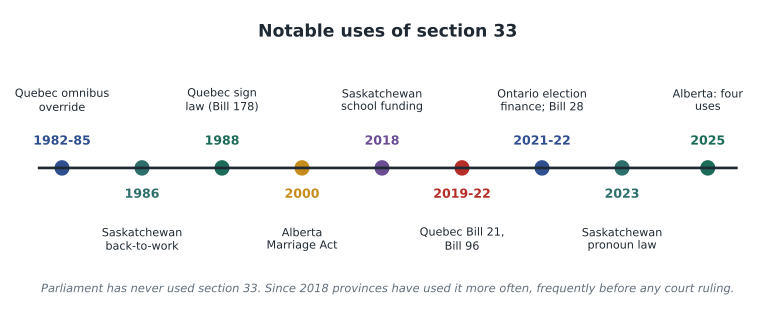
The leading case on the requirements of section 33 is Ford v. Quebec (Attorney General), [1988] 2 SCR 712. After the Charter came into force, Quebec's National Assembly, which opposed patriation, enacted a statute adding a standard override clause to every existing Quebec law and then included one in each new law it passed until 1985. The question was whether this omnibus approach met the requirements of section 33.
The Court held that it did. Section 33 lays down requirements of form only, and there is no requirement of prior justification or of substantive review by the courts. A declaration that refers to the section numbers of the overridden rights is enough; the legislature does not need to describe the rights in words. An omnibus declaration covering many laws is permissible. But a declaration cannot operate retroactively: the override for the sign provisions in Ford applied only from the date it was enacted. Because the sign provisions in issue had lost the protection of the earlier override by then, the Court went on to hold that they infringed freedom of expression without justification.
Quebec responded by enacting Bill 178 in 1988, which required outdoor commercial signs to be in French only and invoked section 33. When the override expired five years later, Quebec did not renew it and instead amended the law to allow other languages on signs provided French was markedly predominant, the solution the Court had suggested in Ford.
Early and occasional uses
Outside Quebec, the clause was rarely used for decades. Saskatchewan invoked it in 1986 in back-to-work legislation for public servants, and the Supreme Court later found in the Labour Trilogy that there was no section 2(d) right to strike in any event. Yukon enacted an override in 1982 that never came into force. Alberta inserted an override into its Marriage Act in 2000 to define marriage as a union between a man and a woman, but the provision had no legal effect because the capacity to marry falls within federal jurisdiction over marriage under section 91(26) of the Constitution Act, 1867, a point the Supreme Court's reasoning in Reference re Same-Sex Marriage, 2004 SCC 79, made clear.
For many years, Canadian politicians described section 33 as a political third rail, a tool too controversial to use. That perception began to change in 2018.
Recent uses
In 2017, a Saskatchewan court held in Good Spirit School Division No. 204 v. Christ the Teacher Roman Catholic Separate School Division No. 212, 2017 SKQB 109, that funding non-Catholic students to attend Catholic separate schools violated section 2(a) and section 15. In 2018 the legislature passed the School Choice Protection Act, invoking section 33 to protect the funding. The Saskatchewan Court of Appeal later reversed the trial decision on the merits in 2020, so the override proved unnecessary.
Quebec's Act respecting the laicity of the State (Bill 21), enacted in 2019, invokes section 33 and the Quebec Charter's equivalent override. Quebec's 2022 amendments to the Charter of the French Language (Bill 96) also invoke section 33 for the whole statute. Quebec renewed the Bill 21 override in 2024.
In Ontario, after the Superior Court struck down an extension of third-party spending limits under section 2(b) in 2021, the legislature re-enacted the provision with a section 33 declaration, the first use of the clause in Ontario's history. In November 2022, the Ontario government enacted the Keeping Students in Class Act, which imposed a contract on education support workers, banned their planned strike and invoked section 33 pre-emptively, before any court had ruled. After a province-wide walkout and widespread opposition, the government repealed the law within days.
In Saskatchewan, a ministerial policy required parental consent before teachers could use a student's chosen name or pronouns if the student was under 16. In September 2023, a judge granted an injunction suspending the policy pending a Charter challenge brought by UR Pride Centre for Sexuality and Gender Diversity. The legislature then enacted the Parents' Bill of Rights, putting the policy into the Education Act and invoking section 33.
In late 2025 Alberta invoked section 33 four times in under two months, beginning with the Back to School Act in October 2025, which ended a province-wide teachers' strike, and including legislation in December 2025 protecting three laws affecting transgender youth from Charter challenge. Hannah Kowalczyk notes that the Alberta government described the uses as protecting democratic choices from litigation. Daniel Whitecloud says that pre-emptive use means courts never get to consider the rights at all.
The current debate: can courts still declare a breach?
The recent uses have provoked litigation about what section 33 does. Its text says that an Act with a declaration 'shall operate notwithstanding' the overridden provision. One view, adopted by the Quebec Court of Appeal in Organisation mondiale sikhe du Canada c. Procureur général du Québec, 2024 QCCA 254, is that a valid declaration removes the overridden rights from the court's consideration entirely. On that view, a court has no jurisdiction to decide whether the law would otherwise infringe the Charter, because such a ruling would serve no legal purpose.
The other view was adopted by a majority of the Saskatchewan Court of Appeal in Saskatchewan (Minister of Education) v. UR Pride Centre for Sexuality and Gender Diversity, 2025 SKCA 74, released August 11, 2025. The majority held that invoking section 33 does not remove a superior court's jurisdiction to declare that a law infringes the Charter. Section 33 suspends the operation of rights, so that the law operates despite them, but it does not change the content of the rights or what counts as a reasonable limit. A declaration that the law infringes the Charter, even though it remains in force, informs public debate before the five-year renewal, giving legislatures 'the last word, but not the only word'. Courts still cannot strike down the law or grant remedies that would interfere with its operation. The Supreme Court of Canada granted leave to appeal in November 2025 and has scheduled the hearing for March 22 and 23, 2027.
The Bill 21 appeal, English Montreal School Board v. Attorney General of Quebec, heard over four days beginning March 23, 2026, raises the same question along with others: whether section 28 limits section 33, whether section 23 protects English school boards' management of teaching staff, whether Bill 21 respects the division of powers, and whether courts may issue a declaration of inconsistency despite a section 33 declaration. The Court has said it will release its decision on November 27, 2026.
Arguments on each side
Supporters of a broad reading argue that section 33 was designed to preserve legislative supremacy, that a judicial declaration would turn the courts into political commentators on laws they cannot affect, and that the five-year sunset already provides the democratic check. They also point out that legislatures in a federation have different views on contested moral questions, and that section 33 respects provincial autonomy, especially in Quebec.
Opponents argue that pre-emptive use undermines the dialogue that justified the clause, because no court has said anything for the legislature to respond to; that declarations inform voters before the five-year renewal; that section 28's 'notwithstanding anything in this Charter' language limits section 33 where women's rights are at stake; and that unwritten principles, such as the rule of law and the protection of minorities, constrain the clause. Some have called for conventions, such as using section 33 only after a final court decision, or only with a supermajority. None of those proposals has become law.
Theo Marchetti says that as a practical matter the debate is about whether litigation has any point once a legislature invokes the clause. Sophie Tremblay-Hart says that for many Quebecers, the National Assembly's ability to decide questions like laïcité for itself is not a technicality but the reason the clause exists. Okafor-Lindqvist says both are right, and that the Supreme Court is about to decide which view the Constitution adopts, at least in part.
Comparative perspective
Other democracies have tried different ways of combining judicial review with legislative responsibility for rights. Under section 4 of the United Kingdom's Human Rights Act 1998, courts that cannot interpret a statute compatibly with the European Convention on Human Rights may issue a declaration of incompatibility, which does not affect the statute's validity but signals that Parliament should reconsider it; Parliament and the government usually respond by amending the law. New Zealand's Bill of Rights Act 1990 is an ordinary statute, and in Attorney-General v. Taylor, [2018] NZSC 104, the New Zealand Supreme Court held that its courts may issue declarations that a statute is inconsistent with the Act. Supporters of the UR Pride approach point to these models to show that a court can state that a law limits rights without striking it down, leaving the final word to the legislature. Opponents reply that section 33's words, 'shall operate notwithstanding', are different, and that importing foreign models would rewrite the Canadian compromise.
The federal government and section 33
Parliament has never invoked section 33. Federal political leaders have sometimes promised not to use it, and others have suggested it could be used, for example to protect sentencing laws from Charter challenge. Whether the federal government could validly ask the Supreme Court to limit provincial use of section 33, and what position it has taken in recent litigation, are matters students should check in the reasons of the Bill 21 decision once released.
Writing about section 33 in an answer
When a problem involves a law with a section 33 declaration, a good answer does several things. It checks the formal validity of the declaration under Ford: is it express, does it refer to provisions in section 2 or sections 7 to 15, and is it within its five-year term? It identifies any rights the declaration cannot reach, such as sections 3, 6, 23 or 28, and analyzes those fully. It explains the current state of the law on whether a court may still declare an overridden law inconsistent with the Charter, noting UR Pride, the Quebec Court of Appeal's contrary view and the Supreme Court's pending or recent decisions. And it identifies non-Charter arguments, such as the division of powers or provincial human rights legislation.
Worked problem
A pre-emptive override in Ontario
Assume Ontario enacts a Public Parks Order Act that prohibits overnight shelters in all municipal parks and declares that it operates notwithstanding sections 2 and 7 of the Charter. Advise unhoused residents of Corwin.
Show solution
- Formal validity: The declaration is express, names provisions within section 2 and sections 7 to 15, and is within its first five-year term, so it meets the Ford requirements.
- Section 7: The claim that succeeded in Adams and Waterloo cannot be used to strike down the Act while the declaration is in force.
- Rights outside section 33: Consider section 15 too; the declaration does not mention section 15, so it can be raised. A claim of adverse impact discrimination on the basis of disability, given the high proportion of unhoused people with mental illness or addiction, would require evidence under Fraser and Sharma.
- Declaration of inconsistency: Under UR Pride, 2025 SKCA 74, a court might still declare that the Act infringes section 7. The Supreme Court's Bill 21 decision and its UR Pride appeal may confirm or reject that approach. In Ontario, which court of appeal decision would bind is itself an issue.
- Other routes: Consider the division of powers (provinces regulate municipalities and property, so the Act is likely valid), international human rights obligations, and political advocacy before the five-year renewal.
Practice problems
Work each problem on paper first, then reveal the answer to check.
Which Charter rights can section 33 override?
Show answer
Only section 2 and sections 7 to 15. It cannot override democratic rights, mobility rights, language rights, section 24 or, arguably, section 28.
What did Ford v. Quebec decide about the requirements of section 33?
Show answer
They are requirements of form only; a declaration may refer to section numbers and may be omnibus, but it cannot apply retroactively.
What is a pre-emptive use of section 33? Give an example.
Show answer
Invoking section 33 before any court has ruled that the law infringes the Charter, such as Ontario's Keeping Students in Class Act in 2022 or Quebec's Bill 21 in 2019.
What did the Saskatchewan Court of Appeal decide in UR Pride, 2025 SKCA 74?
Show answer
That invoking section 33 does not remove a superior court's jurisdiction to declare that a law infringes the Charter, although the law continues to operate and cannot be struck down.
What were the main section 33 questions in the Bill 21 appeal?
Show answer
Whether courts may declare an overridden law inconsistent with the Charter, whether section 28 limits section 33, and the effect of section 23, among others; the decision was scheduled for November 27, 2026.
Summary and key terms
- Section 33 lets Parliament or a legislature declare that a law operates notwithstanding section 2 or sections 7 to 15, for renewable five-year periods.
- It was part of the 1981 compromise; it cannot reach democratic, mobility or language rights, and its interaction with section 28 is disputed.
- Ford v. Quebec: requirements of form only, omnibus declarations allowed, no retroactivity.
- Uses were rare until 2018; since then Saskatchewan, Quebec, Ontario and Alberta have invoked it, often pre-emptively.
- The Quebec Court of Appeal (2024 QCCA 254) and the Saskatchewan Court of Appeal (UR Pride, 2025 SKCA 74) disagree on whether courts can still declare a breach; the Supreme Court will rule on Bill 21 on November 27, 2026 and hear UR Pride in March 2027.
- Notwithstanding clause
- Section 33 of the Charter, allowing legislatures to override certain rights for five years.
- Sunset clause
- A provision causing a law or declaration to expire after a fixed period, here five years.
- Pre-emptive use
- Invoking section 33 before a court has ruled on whether the law infringes the Charter.
- Omnibus override
- A single declaration applying section 33 to many statutes, upheld in Ford.
- Declaration of inconsistency
- A judicial statement that a law infringes the Charter even though it continues to operate.
- Dialogue
- The description of the Charter as an exchange between courts and legislatures over the meaning and limits of rights.
Lesson quiz · 5 questions
Score 60% or more to complete this lesson.
Create a free account to save your progress, take quizzes and earn a certificate.