
LAWC-111 · Lesson 7 of 12 · 23 min
Legal and equality rights
▶ Video coming soon A video version of this lesson is on the way.
Sections 7 to 14 of the Charter are grouped under the heading 'Legal Rights', and section 15 stands alone under the heading 'Equality Rights'. The legal rights are mostly about the criminal process, and students study them in detail in Criminal Procedure. Equality rights reach every area of law. This lesson gives a working overview of sections 8 to 14 and then spends most of its time on section 15, which is one of the most contested provisions in the Charter.
At the reading group, Theo Marchetti volunteers to summarize the legal rights, drawing on his years as a litigation clerk. Sophie Tremblay-Hart and Hannah Kowalczyk take the equality cases. Before they begin, Professor Okafor-Lindqvist warns them that the Supreme Court has changed its section 15 test several times, and that reading older cases without knowing which test applied is the most common mistake students make.
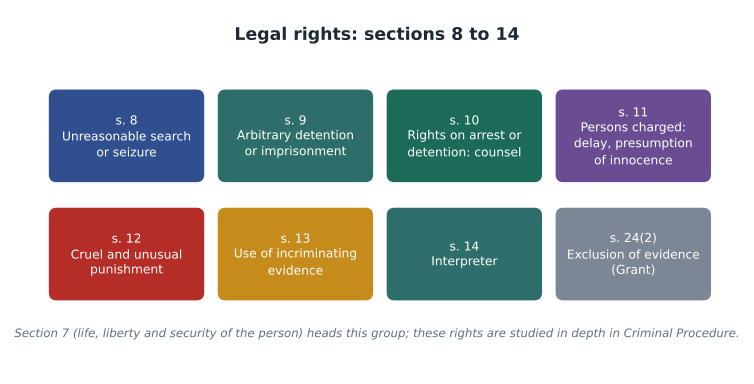
Sections 8 to 14: an overview
Section 8 protects everyone against unreasonable search or seizure. In Hunter v. Southam Inc., [1984] 2 SCR 145, the Court held that the section protects a reasonable expectation of privacy, and that a warrantless search is presumptively unreasonable; ordinarily, prior authorization by a neutral arbiter on reasonable and probable grounds is required. A search is reasonable if it is authorized by law, the law itself is reasonable, and the search is carried out reasonably (R. v. Collins, [1987] 1 SCR 265). In R. v. Bykovets, 2024 SCC 6, the majority held that internet users have a reasonable expectation of privacy in their IP addresses, so police need a production order to obtain them from a third party.
Section 9 protects against arbitrary detention or imprisonment. A detention is arbitrary if it is not authorized by law, or if the law or the manner of detention is arbitrary. R. v. Grant, 2009 SCC 32, defined detention as a suspension of liberty by significant physical or psychological restraint, and R. v. Le, 2019 SCC 34, applied that test with attention to how racialized young men experience encounters with police.
Section 10 gives everyone who is arrested or detained the right to be informed promptly of the reasons, to retain and instruct counsel without delay and to be informed of that right, and to have the validity of the detention determined by habeas corpus. The duty to inform of the right to counsel arises immediately on detention (R. v. Suberu, 2009 SCC 33).
Section 11 gives persons charged with an offence a series of rights: to be informed of the offence without unreasonable delay, to be tried within a reasonable time, not to be compelled to testify against themselves, to be presumed innocent until proven guilty in a fair and public hearing by an independent and impartial tribunal, not to be denied reasonable bail without just cause, to a jury trial for offences punishable by five years or more, protection against retroactive offences and double jeopardy, and the benefit of the lesser punishment where the penalty changes. R. v. Jordan, 2016 SCC 27, set presumptive ceilings for trial delay of 18 months in provincial court and 30 months in superior court. R. v. Oakes, discussed in lesson 3, arose under the presumption of innocence in section 11(d).
Section 12 protects against cruel and unusual treatment or punishment. A punishment is cruel and unusual if it is grossly disproportionate to what would have been appropriate for the offender or for reasonably foreseeable offenders (R. v. Nur, 2015 SCC 15; R. v. Hills, 2023 SCC 2), or if it is by its nature incompatible with human dignity. In R. v. Bissonnette, 2022 SCC 23, the Court struck down a provision allowing consecutive 25-year parole ineligibility periods for multiple murders because a sentence without a realistic possibility of parole is degrading and incompatible with human dignity. Section 13 protects witnesses from having their incriminating testimony used against them in other proceedings, and section 14 gives parties and witnesses the right to an interpreter.
Evidence obtained in a manner that infringes Charter rights may be excluded under section 24(2) if its admission would bring the administration of justice into disrepute. Grant sets the test: the seriousness of the state's misconduct, the impact on the accused's Charter-protected interests, and society's interest in an adjudication on the merits. Theo says he has seen more trials turn on section 24(2) than on any other Charter provision.
Section 15: text and purpose
Section 15(1) provides that every individual is equal before and under the law and has the right to the equal protection and equal benefit of the law without discrimination and, in particular, without discrimination based on race, national or ethnic origin, colour, religion, sex, age or mental or physical disability. Section 15(2) provides that subsection (1) does not preclude any law, program or activity that has as its object the amelioration of conditions of disadvantaged individuals or groups.
Section 15 protects substantive equality, not merely formal equality. Formal equality means treating likes alike. Substantive equality looks at the actual impact of a law on a group's position in society, recognizing that identical treatment can produce serious inequality and that differences in treatment are sometimes necessary to achieve equality.
Andrews and the grounds
In Andrews v. Law Society of British Columbia, [1989] 1 SCR 143, the first section 15 case, a British subject living in Canada was denied admission to the bar because he was not a Canadian citizen. Justice McIntyre rejected the 'similarly situated' test of formal equality and held that discrimination is a distinction, intentional or not, based on personal characteristics, that imposes burdens or withholds benefits not imposed on or withheld from others. The Court held that citizenship is an analogous ground, and that the citizenship requirement violated section 15 and was not justified.
The listed grounds are called enumerated grounds. Analogous grounds are characteristics that are immutable or constructively immutable, meaning changeable only at unacceptable personal cost, or that the government has no legitimate interest in expecting a person to change (Corbiere v. Canada (Minister of Indian and Northern Affairs), [1999] 2 SCR 203). The Court has recognized citizenship, sexual orientation (Egan v. Canada, [1995] 2 SCR 513), marital status (Miron v. Trudel, [1995] 2 SCR 418) and Aboriginality-residence, the status of off-reserve band members (Corbiere), as analogous grounds. Once a ground is recognized, it is analogous in all contexts.
The Law test and its abandonment
In Law v. Canada (Minister of Employment and Immigration), [1999] 1 SCR 497, the Court held that the ultimate question under section 15 was whether a distinction violated human dignity, and set out four contextual factors: pre-existing disadvantage, correspondence between the ground and the claimant's actual needs, the ameliorative purpose or effect of the law, and the nature of the interest affected. The test was widely criticized for making claimants prove an abstract harm to dignity and for importing justification into the infringement stage.
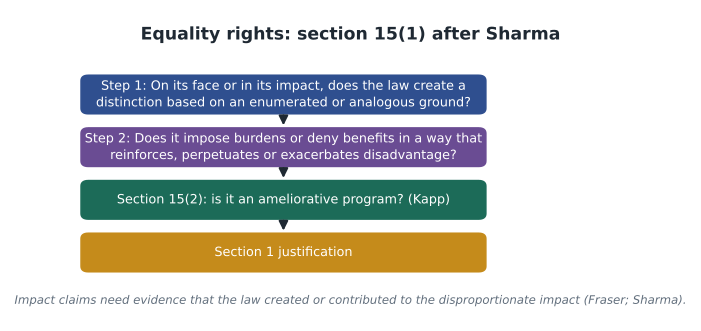
In R. v. Kapp, 2008 SCC 41, the Court stepped back from Law. It reframed the test as asking whether the law creates a distinction based on an enumerated or analogous ground, and whether the distinction creates a disadvantage by perpetuating prejudice or stereotyping. Kapp also gave section 15(2) independent force: a program whose object is to ameliorate the conditions of a disadvantaged group, and that targets a group identified by an enumerated or analogous ground, does not violate section 15. The program in Kapp, a communal fishery licence granted to three First Nations, was upheld under section 15(2). Withler v. Canada (Attorney General), 2011 SCC 12, rejected the use of mirror comparator groups as a mechanical requirement.
Fraser: adverse impact discrimination
Many laws are neutral on their face but have disproportionate effects on protected groups. In Fraser v. Canada (Attorney General), 2020 SCC 28, three retired RCMP officers had participated in a job-sharing program, mostly to care for young children. Under the RCMP pension plan, full-time members who were suspended or on leave without pay could buy back pension credit for those periods, but job-sharing service was treated as part-time and could not be bought back. Most job-sharers were women with young children.
Justice Abella, for the majority, held that the plan's rules had a disproportionate impact on women and that this perpetuated their historical disadvantage in the workplace and in pension plans. Adverse impact discrimination is established where a seemingly neutral law has a disproportionate impact on members of a protected group, and the impact has the effect of reinforcing, perpetuating or exacerbating disadvantage. Evidence about the claimant group's situation and evidence about the outcomes of the law are both useful, and claimants need not prove that the law caused the disadvantage or that it was intended. The government did not justify the breach under section 1.
Sharma: the current two-step test
In R. v. Sharma, 2022 SCC 39, an Indigenous woman pleaded guilty to importing cocaine. The Criminal Code's mandatory minimum sentences for certain offences made her ineligible for a conditional sentence served in the community. She argued that this restriction discriminated against Indigenous offenders because it prevented sentencing judges from fully applying the Gladue principles.
A five to four majority, written by Chief Justice Wagner and Justice Brown, rejected the claim and restated the section 15 test. At the first step, the claimant must show that the law, on its face or in its impact, creates a distinction based on an enumerated or analogous ground. For an impact claim, the claimant must show that the law created or contributed to a disproportionate impact on the group; the law need not be the only or dominant cause, but there must be a causal link. At the second step, the claimant must show that the law imposes burdens or denies benefits in a manner that has the effect of reinforcing, perpetuating or exacerbating disadvantage. Relevant factors include the group's circumstances and the full context, including the legislative scheme as a whole and any ameliorative effects.
The majority held that Ms. Sharma had not proved that the restrictions on conditional sentences caused or contributed to a disproportionate impact on Indigenous offenders compared with non-Indigenous offenders; the evidence about overincarceration did not show the specific provisions' effect. Justice Karakatsanis, dissenting, would have found discrimination, emphasizing the documented overincarceration of Indigenous people and the role of Gladue. Parliament had in any event repealed the provisions in issue in 2022, in Bill C-5.
Sophie notes that Sharma tightened the causation requirement for impact claims. Hannah says that is a good thing: courts should not strike down laws on general statistics about disadvantage. Okafor-Lindqvist tells them both to master the two steps in Sharma, because that is the test a court will apply today, and to cite Fraser for the principles of adverse impact discrimination.
Equality and government benefits
Section 15 applies to benefits as well as burdens. In Eldridge v. British Columbia (Attorney General), [1997] 3 SCR 624, the failure to provide sign language interpreters denied deaf patients the equal benefit of the health care system. In Vriend v. Alberta, [1998] 1 SCR 493, the exclusion of sexual orientation from human rights protection violated section 15. In Quebec (Attorney General) v. A, 2013 SCC 5, the majority held that excluding de facto spouses from Quebec's spousal support and property regime violated section 15, but a different majority held the exclusion was justified under section 1, given the importance of choice in Quebec's civil law. In Quebec (Attorney General) v. Alliance du personnel professionnel et technique de la santé et des services sociaux, 2018 SCC 17, amendments to Quebec's pay equity legislation that eliminated retroactive pay adjustments perpetuated the disadvantage of women in female-dominated jobs and violated section 15.
Courts give governments some latitude when they design complex benefit schemes. Withler upheld a federal supplementary death benefit that decreased with the age of the deceased, because the scheme as a whole met the needs of older surviving spouses through other pension benefits. In Kahkewistahaw First Nation v. Taypotat, 2015 SCC 30, an education requirement for candidates in a First Nation's elections did not violate section 15 because there was insufficient evidence that it had a disproportionate impact on older residents or residents of the reserve.
Section 28 and equality of the sexes
Section 28 provides that, notwithstanding anything in the Charter, the rights and freedoms referred to in it are guaranteed equally to male and female persons. For most of the Charter's history, section 28 was treated as an interpretive provision with little independent force. The Bill 21 litigation has given it new prominence. The English Montreal School Board and other appellants argued before the Supreme Court in March 2026 that because section 28 applies 'notwithstanding anything in this Charter', it limits the use of section 33 where a law has a disproportionate impact on women, such as Muslim teachers who wear the hijab. The Court's decision, scheduled for November 27, 2026, may settle whether section 28 has independent force.
Section 15 and section 1
Because the section 15 analysis asks only whether a law draws a discriminatory distinction, and does not ask whether the distinction is reasonable, much of the debate in section 15 cases occurs under section 1. Courts often show deference where governments allocate scarce resources among groups, but they have been clear that budgetary considerations alone rarely justify discrimination, though in Newfoundland (Treasury Board) v. N.A.P.E., 2004 SCC 66, a genuine fiscal crisis justified deferring a pay equity settlement.
Worked problem
A section 15 claim against Corwin General Hospital
Corwin General Hospital, a public hospital delivering insured services, has stopped providing sign language interpreters for outpatient appointments, offering written notes instead. Deaf patients challenge the change. Apply section 15.
Show solution
- Application: In delivering insured medical services, the hospital implements a government program and is bound by the Charter for that activity (Eldridge).
- Step one, distinction: The policy is neutral on its face but has a disproportionate impact on deaf patients, whose disability is an enumerated ground. The policy causes the impact because written notes do not provide effective communication for many patients whose first language is ASL or LSQ.
- Step two, disadvantage: Denying effective communication in medical care reinforces the historical disadvantage of deaf people in access to services and risks misdiagnosis and harm (Eldridge; Fraser; Sharma factors).
- Section 1: Cost savings alone are unlikely to justify the breach, especially given the small cost of interpreters relative to the health budget (Eldridge).
- Remedy: A declaration under section 24(1) that the hospital must provide interpreters where necessary for effective communication, as in Eldridge.
Practice problems
Work each problem on paper first, then reveal the answer to check.
What is the difference between formal and substantive equality?
Show answer
Formal equality treats likes alike. Substantive equality looks at the actual impact of a law on the group's position, recognizing that identical treatment can entrench disadvantage and that different treatment is sometimes needed.
What makes a ground analogous?
Show answer
It is a personal characteristic that is immutable or changeable only at unacceptable personal cost, or that the government has no legitimate interest in expecting people to change (Corbiere).
What is adverse impact discrimination as defined in Fraser?
Show answer
A seemingly neutral law that has a disproportionate impact on members of a protected group and has the effect of reinforcing, perpetuating or exacerbating their disadvantage.
State the two-step test from Sharma.
Show answer
(1) The law, on its face or in its impact, creates a distinction based on an enumerated or analogous ground, which for impact claims requires that it created or contributed to a disproportionate impact; (2) it imposes burdens or denies benefits in a manner that reinforces, perpetuates or exacerbates disadvantage.
What does section 15(2) do after Kapp?
Show answer
It protects ameliorative programs that target a disadvantaged group identified by an enumerated or analogous ground; such programs do not violate section 15(1).
Summary and key terms
- Sections 8 to 14 protect people in the criminal process: privacy (Hunter; Bykovets), freedom from arbitrary detention (Grant; Le), counsel, trial rights (Jordan), and protection from cruel punishment (Nur; Bissonnette).
- Section 24(2) excludes evidence whose admission would bring the administration of justice into disrepute (Grant).
- Section 15 protects substantive equality; grounds are enumerated or analogous (Andrews; Corbiere).
- The Law dignity test was abandoned in Kapp; section 15(2) protects ameliorative programs.
- Fraser recognizes adverse impact discrimination; Sharma sets the current two-step test with a causation requirement.
- Section 28 guarantees Charter rights equally to men and women; its relationship with section 33 was argued in the Bill 21 appeal.
- Reasonable expectation of privacy
- The interest protected by section 8, assessed in context.
- Enumerated grounds
- The grounds listed in section 15(1): race, national or ethnic origin, colour, religion, sex, age and mental or physical disability.
- Analogous grounds
- Personal characteristics recognized by courts as comparable to the enumerated grounds, such as citizenship and sexual orientation.
- Substantive equality
- Equality measured by a law's actual impact on disadvantaged groups, not by identical treatment.
- Adverse impact discrimination
- Discrimination resulting from a facially neutral law that disproportionately burdens a protected group.
- Ameliorative program
- A law or program aimed at improving the conditions of a disadvantaged group, protected by section 15(2).
Lesson quiz · 5 questions
Score 60% or more to complete this lesson.
Create a free account to save your progress, take quizzes and earn a certificate.