
LAWC-111 · Lesson 6 of 12 · 23 min
Life, liberty and security of the person
▶ Video coming soon A video version of this lesson is on the way.
Section 7 provides that everyone has the right to life, liberty and security of the person and the right not to be deprived thereof except in accordance with the principles of fundamental justice. It is short, open-ended and, in the forty years since the Charter took effect, the source of some of the most consequential decisions in Canadian law, on abortion, health care, safe injection sites, prostitution, assisted dying and refugee protection.
The reading group spends its fourth session on section 7, and Noor Rahimi returns to the Riverside Park bylaw. Corwin's two emergency shelters regularly turn people away for lack of beds on winter nights. The bylaw prohibits erecting any tent or shelter in the park between 7 p.m. and 7 a.m. 'If there are no beds,' Arjun Mehta asks, 'and you can't put up a tent, where are people supposed to sleep?' Theo Marchetti says that is exactly the argument that has succeeded in British Columbia and Ontario. Professor Okafor-Lindqvist suggests they first learn the doctrine and then come back to the park.
Structure of the analysis
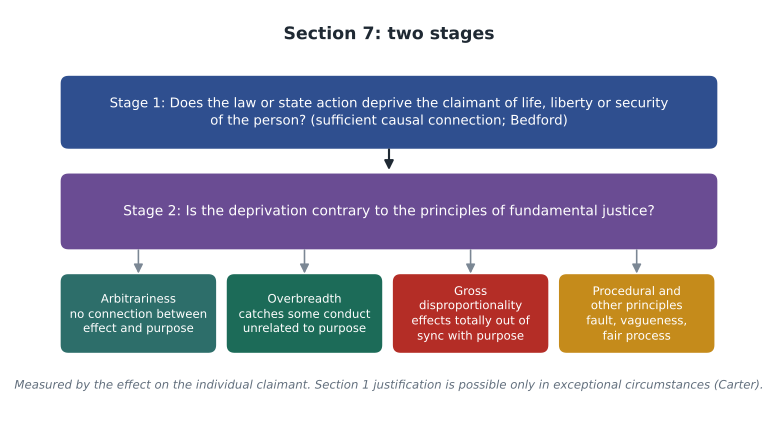
A section 7 claim has two stages. First, the claimant must show that the law or state action deprives them of life, liberty or security of the person. Second, the claimant must show that the deprivation is not in accordance with the principles of fundamental justice. Only if both are shown is section 7 infringed. The claimant bears the burden on both. The government may then try to justify the breach under section 1, but the Supreme Court has said that will be possible only in rare cases.
There is no separate right to fundamental justice. A law that is arbitrary but does not engage life, liberty or security of the person does not violate section 7. And a deprivation that accords with fundamental justice, for example a fair criminal trial leading to imprisonment, does not violate section 7 either.
The interests protected
Life is engaged where a law or state action imposes death or an increased risk of death, directly or indirectly (Carter v. Canada (Attorney General), 2015 SCC 5). In Carter, the prohibition on physician-assisted death engaged the right to life because it forced some people to take their own lives prematurely, for fear that they would be incapable of doing so when their suffering became intolerable.
Liberty includes freedom from physical restraint, such as imprisonment or the threat of it, and also the right to make fundamental personal choices free from state interference. Any offence punishable by imprisonment engages liberty, which is why the constitutionality of most criminal laws can be tested under section 7. In Blencoe v. British Columbia (Human Rights Commission), 2000 SCC 44, the Court said that liberty protects choices of fundamental personal importance, but not every choice a person might make. In R. v. Malmo-Levine; R. v. Caine, 2003 SCC 74, the Court held that smoking marijuana for recreation was not such a choice.
Security of the person includes physical and psychological integrity. In R. v. Morgentaler, [1988] 1 SCR 30, the Criminal Code's requirement that abortions be approved by hospital therapeutic abortion committees, with the delays and uneven access that resulted, interfered with women's physical and psychological integrity. Psychological harm must be serious and caused by the state, not the ordinary stress of life (New Brunswick (Minister of Health and Community Services) v. G.(J.), [1999] 3 SCR 46, where removal of children from their parent engaged security of the person). In Canada (Attorney General) v. PHS Community Services Society, 2011 SCC 44, denying drug users access to supervised injection services engaged life and security of the person because it increased the risk of overdose and disease.
Causation
The claimant must show a sufficient causal connection between the state action and the deprivation. The state need not be the only or the dominant cause; it is enough that the state is a contributing cause, established on a balance of probabilities and taking the context into account (Canada (Attorney General) v. Bedford, 2013 SCC 72). In Bedford, the Court held that criminal prohibitions on bawdy houses, living on the avails of prostitution and communicating in public for the purpose of prostitution increased the risks faced by sex workers, even though clients and pimps, not the state, inflicted the harm. In Canadian Council for Refugees v. Canada (Citizenship and Immigration), 2023 SCC 17, the Court held that returning refugee claimants to the United States under the Safe Third Country Agreement engaged section 7 because Canada's actions were a sufficient cause of the detention conditions some claimants faced there.
The principles of fundamental justice
In Re B.C. Motor Vehicle Act, [1985] 2 SCR 486, the Court rejected the argument that 'fundamental justice' meant only procedural fairness. The principles of fundamental justice, Justice Lamer wrote, are found in the basic tenets of the legal system, and they include substantive principles. A law imposing imprisonment for an absolute liability offence, which can be committed without any fault, violated section 7.
To qualify as a principle of fundamental justice, a proposition must be a legal principle, there must be sufficient consensus that it is vital or fundamental to our societal notion of justice, and it must be capable of being identified with precision and applied in a manner that yields predictable results (R. v. Malmo-Levine). Under that test, the Court has recognized principles including the requirement of fault for imprisonment, the presumption of innocence, the right to silence, the right to make full answer and defence, and the principles against arbitrariness, overbreadth, gross disproportionality and vagueness. It rejected the 'harm principle', the idea that the state may criminalize only conduct that harms others (Malmo-Levine), and the 'best interests of the child' (Canadian Foundation for Children, Youth and the Law v. Canada (Attorney General), 2004 SCC 4) as principles of fundamental justice.
Arbitrariness, overbreadth and gross disproportionality
Bedford organized the most important substantive principles into three related concepts, each of which compares the law's effects with its purpose. Chief Justice McLachlin emphasized that the analysis focuses on the effect on the individual claimant, not on society as a whole: a law can violate section 7 if it has an arbitrary, overbroad or grossly disproportionate effect on even one person.
A law is arbitrary when there is no rational connection between its purpose and its effect on the individual. In Chaoulli v. Quebec (Attorney General), 2005 SCC 35, a majority held that Quebec's prohibition on private health insurance for services covered by the public plan violated the Quebec Charter, and three judges also found it arbitrary under section 7 because there was no evidence the prohibition was necessary to protect the public system, while waiting lists caused serious harm. In PHS, the Minister's refusal to extend the exemption for Insite, Vancouver's supervised injection site, was arbitrary because it undermined the very health and safety purposes of the drug laws.
A law is overbroad when it is rational in some of its applications but goes too far and catches some conduct that bears no relation to its purpose. In Bedford, the prohibition on living on the avails of prostitution aimed to target pimps and exploitative relationships but also caught people who could increase sex workers' safety, such as drivers and bodyguards.
A law is grossly disproportionate when its effects on the claimant are so extreme that they are totally out of sync with its objective. In Bedford, the prohibition on communicating in public prevented street sex workers from screening clients, a harm grossly disproportionate to the law's objective of reducing public nuisance.
Section 7 and section 1
Because the principles of fundamental justice already ask whether a law's effects are connected to and proportionate to its purpose, the Court has said that section 7 breaches are difficult to justify under section 1. In Carter, the Court said section 1 justification might be possible in exceptional circumstances, such as natural disasters, war or epidemics. The Court has also distinguished the two analyses: section 7 focuses on the effect on the individual, while section 1 weighs the law's benefits to society. In Carter, the Court found the absolute prohibition on assisted dying was overbroad and could not be justified because a carefully designed system of safeguards could protect vulnerable people.
Assisted dying
Rodriguez v. British Columbia (Attorney General), [1993] 3 SCR 519, upheld the prohibition on assisted suicide by a five to four majority. Twenty-two years later, in Carter, the Court unanimously held that the prohibition violated section 7 for competent adults who clearly consent to the termination of life and have a grievous and irremediable medical condition causing enduring and intolerable suffering. The trial judge was entitled to revisit Rodriguez because the legal framework under section 7 had changed and the evidence about safeguards in other jurisdictions was substantially different.
The Court suspended its declaration of invalidity to give Parliament time to respond. Parliament enacted Bill C-14 in 2016, limiting medical assistance in dying to people whose natural death was reasonably foreseeable. In Truchon c. Procureur général du Canada, 2019 QCCS 3792, the Quebec Superior Court struck down that requirement. Parliament responded with Bill C-7 in 2021, which removed the requirement and created a second track with additional safeguards, but excluded people whose sole underlying condition is a mental illness until a later date. That date was postponed twice, most recently to March 2027. In October 2026 the federal Minister of Justice announced that the government would introduce legislation to exclude mental illness as a sole condition indefinitely and to address advance requests. Hannah Kowalczyk says she is glad Parliament has kept control of the details. Theo replies that Parliament is legislating in the shadow of Carter, and any exclusion may itself be challenged under sections 7 and 15.
Procedural fairness and national security
Section 7 also protects procedural fairness where liberty or security is at stake. In Charkaoui v. Canada (Citizenship and Immigration), 2007 SCC 9, the security certificate process under the Immigration and Refugee Protection Act allowed non-citizens to be detained and removed on the basis of secret evidence that they and their lawyers could not see. The Court held that the process violated section 7 because the person concerned could not know and meet the case against them. Parliament responded by creating special advocates who can see the secret evidence and challenge it on the person's behalf, a model the Court later upheld in Canada (Citizenship and Immigration) v. Harkat, 2014 SCC 37.
Refugees and the Safe Third Country Agreement
In Canadian Council for Refugees, the claimants argued that returning refugee claimants to the United States under the Safe Third Country Agreement exposed them to detention and to the risk of refoulement, violating sections 7 and 15. The Court, in a unanimous judgment by Justice Kasirer, held that section 7 was engaged, but that the scheme accorded with the principles of fundamental justice because it contained safety valves, including the ability of officials to make exceptions and to review the designation of the United States as a safe country. The Court found the scheme was not overbroad or grossly disproportionate, given those mechanisms. It sent the section 15 claim, which the lower courts had not decided, back to the Federal Court.
Positive obligations
Section 7 has generally been interpreted as protecting against state deprivations, not as requiring the state to provide benefits. In Gosselin v. Quebec (Attorney General), 2002 SCC 84, a welfare scheme that paid people under 30 much less unless they participated in training programs was upheld. Chief Justice McLachlin, for the majority, held that nothing in the jurisprudence yet recognized a positive obligation to guarantee adequate living standards, but declined to rule out that section 7 might one day be interpreted to include positive obligations. Justice Arbour, dissenting, would have recognized such an obligation. In Tanudjaja v. Canada (Attorney General), 2014 ONCA 852, the Ontario Court of Appeal struck out a claim that governments had a section 7 obligation to address homelessness, holding that the claim was not justiciable because it did not challenge any specific law.
Encampments and section 7
The encampment cases show how section 7 claims can succeed without recognizing a positive right to housing. In Victoria (City) v. Adams, 2009 BCCA 563, the British Columbia Court of Appeal held that a bylaw prohibiting overnight shelters in public parks violated section 7 when the number of homeless people exceeded available shelter beds, because it prevented people from protecting themselves from the elements. The court stressed that it was not ordering the city to provide housing, only striking down a prohibition that made people's situation worse. In Abbotsford (City) v. Shantz, 2015 BCSC 1909, the court reached a similar conclusion. In The Regional Municipality of Waterloo v. Persons Unknown and to be Ascertained, 2023 ONSC 670, the Ontario Superior Court held that a bylaw used to clear an encampment violated section 7 where there were not enough accessible shelter spaces, and declared the bylaw inoperative to the extent it prevented residents from living in and erecting temporary shelters when shelter beds were unavailable.
Back in the reading group, Daniel Whitecloud points out that these cases turn on the facts: the number of shelter beds, whether the shelters are truly accessible to people with disabilities, addictions or partners, and whether the bylaw allows daytime use of the park. Okafor-Lindqvist agrees and says that an exam answer on the Riverside Park bylaw should identify the evidence that each side would need.
Worked problem
The Riverside Park bylaw and section 7
Corwin's bylaw prohibits tents or shelters in Riverside Park between 7 p.m. and 7 a.m. On most winter nights the city's shelters are full. Analyze a section 7 challenge by unhoused residents.
Show solution
- Application: A municipal bylaw is subject to the Charter (Godbout).
- Deprivation: Prohibiting overnight shelter when no beds are available exposes people to cold, illness and violence, engaging life and security of the person, and liberty if enforcement involves fines or removal. The state is a sufficient cause (Bedford).
- Principles of fundamental justice: The bylaw's purpose is preserving the park for public use and safety. Applied to people with nowhere else to go, it is overbroad, because it catches conduct, sheltering to survive, that does not threaten the park's purposes in a way justifying the harm, and arguably grossly disproportionate (Adams; Shantz; Waterloo).
- Section 1: The city must justify the breach; Carter says section 7 breaches are rarely justified. A narrower bylaw, permitting overnight shelter when beds are unavailable and requiring removal in the morning, would be less intrusive.
- Remedy: A declaration that the bylaw is inoperative to the extent it prohibits overnight shelter when beds are unavailable, as in Adams and Waterloo, rather than an order to provide housing.
Practice problems
Work each problem on paper first, then reveal the answer to check.
What two things must a claimant show to establish a section 7 breach?
Show answer
A deprivation of life, liberty or security of the person, caused by the state, and that the deprivation is not in accordance with the principles of fundamental justice.
What makes a proposition a principle of fundamental justice?
Show answer
It must be a legal principle, with sufficient consensus that it is fundamental to the way the legal system ought fairly to operate, and capable of precise identification and predictable application (Malmo-Levine).
Distinguish arbitrariness, overbreadth and gross disproportionality.
Show answer
Arbitrariness: no connection between the law's purpose and its effect on the claimant. Overbreadth: the law is rational in some applications but catches some conduct unrelated to its purpose. Gross disproportionality: the effects on the claimant are totally out of sync with the objective.
Why was the trial judge in Carter entitled to revisit Rodriguez?
Show answer
Because the section 7 framework had changed, with overbreadth and gross disproportionality developed after Rodriguez, and the evidence about safeguards had fundamentally shifted, meeting the Bedford test for revisiting precedent.
Did the encampment cases recognize a right to housing?
Show answer
No. They held that prohibiting people from sheltering themselves when shelter beds were unavailable violated section 7, without ordering governments to provide housing (Adams; Waterloo).
Summary and key terms
- Section 7 requires a deprivation of life, liberty or security of the person and a breach of the principles of fundamental justice.
- Liberty covers physical restraint and fundamental personal choices; security covers serious physical and psychological integrity.
- The state need only be a sufficient, contributing cause (Bedford; Canadian Council for Refugees).
- Principles of fundamental justice include fault for imprisonment and the rules against arbitrariness, overbreadth and gross disproportionality, assessed by the effect on the individual (Bedford).
- Section 7 breaches are rarely justified under section 1 (Carter).
- Carter led to MAID legislation; the government announced in October 2026 that it will legislate to exclude mental illness as a sole condition indefinitely.
- Section 7 has not been read to impose positive obligations (Gosselin; Tanudjaja), but bans on sheltering when beds are full have been struck down (Adams; Waterloo).
- Principles of fundamental justice
- The basic tenets of the legal system, substantive and procedural, against which section 7 deprivations are measured.
- Arbitrariness
- A law's effect on an individual bears no connection to its purpose.
- Overbreadth
- A law catches some conduct that bears no relation to its purpose.
- Gross disproportionality
- A law's effects on an individual are totally out of sync with its objective.
- Sufficient causal connection
- The standard for linking state action to a section 7 deprivation; the state need not be the only cause.
- Special advocate
- A security-cleared lawyer who challenges secret evidence on behalf of a person in immigration security proceedings.
Lesson quiz · 5 questions
Score 60% or more to complete this lesson.
Create a free account to save your progress, take quizzes and earn a certificate.