
LAWC-111 · Lesson 3 of 12 · 23 min
Section 1 and the Oakes test
▶ Video coming soon A video version of this lesson is on the way.
At the third meeting of the reading group, on Wednesday, November 4, 2026, Professor Okafor-Lindqvist hands out a single page: the text of section 1. 'This is the most important sentence in the Charter,' she says, 'and the one that has generated the most litigation.' Section 1 guarantees the rights and freedoms set out in the Charter subject only to such reasonable limits prescribed by law as can be demonstrably justified in a free and democratic society.
Arjun Mehta reads it twice and says it seems to give with one hand and take away with the other. Okafor-Lindqvist says that is exactly the point. Section 1 recognizes that rights are not absolute and that governments must sometimes limit them to protect other rights or pressing social interests. But it puts the burden on the government, requires the limit to be prescribed by law, and demands demonstrable justification. Most Charter cases that reach the Supreme Court are decided at the section 1 stage.
Two functions of section 1
Section 1 does two things. It guarantees the rights that follow, signalling that they are constitutional entitlements rather than policy preferences. And it sets the standard against which any limit must be measured. Chief Justice Dickson explained in R. v. Oakes, [1986] 1 SCR 103, that the words 'free and democratic society' refer to the values that underlie the Charter: respect for the inherent dignity of the human person, commitment to social justice and equality, accommodation of a wide variety of beliefs, respect for cultural and group identity, and faith in social and political institutions that enhance participation. Limits are measured against those values.
Prescribed by law
The first requirement is that the limit be prescribed by law. A limit must have a legal source: a statute, a regulation, a bylaw or a common law rule. The rule must also be sufficiently precise and accessible. In R. v. Nova Scotia Pharmaceutical Society, [1992] 2 SCR 606, the Court explained that a law is impermissibly vague if it fails to give fair notice to citizens and to limit enforcement discretion, that is, if it does not provide an intelligible standard for legal debate.
Government policies can sometimes count as law. In Greater Vancouver Transportation Authority v. Canadian Federation of Students, 2009 SCC 31, the advertising policies of TransLink and BC Transit were binding rules of general application, adopted under statutory authority, and sufficiently accessible and precise, so they were prescribed by law. Internal guidelines that are not binding and not public may not be. Where a government official acts without any legal authority, the limit is not prescribed by law and fails section 1 at the outset.
Discretionary decisions present a special case. When a statute confers discretion, the limit flows from the decision rather than from the statute. Since Doré v. Barreau du Québec, 2012 SCC 12, those decisions are assessed under a different framework, discussed later in this lesson.
The Oakes test
David Oakes was charged with possession of narcotics for the purpose of trafficking. Section 8 of the Narcotic Control Act provided that once possession was proved, the accused had to prove that he did not possess the drug for the purpose of trafficking. This reverse onus infringed the presumption of innocence in section 11(d). The question was whether it was justified.
Chief Justice Dickson set out the test that still governs. First, the objective of the measure must be of sufficient importance to warrant overriding a Charter right: it must relate to concerns that are pressing and substantial in a free and democratic society. Second, the means chosen must be reasonable and demonstrably justified, which involves a proportionality test with three components: the measure must be rationally connected to the objective; it must impair the right as little as possible; and there must be proportionality between the effects of the measure and the objective.
In Oakes itself, the objective of curbing drug trafficking was pressing and substantial. But there was no rational connection between proof of possession of a small quantity and the inference that the accused intended to traffic, so the reverse onus failed at the second step.
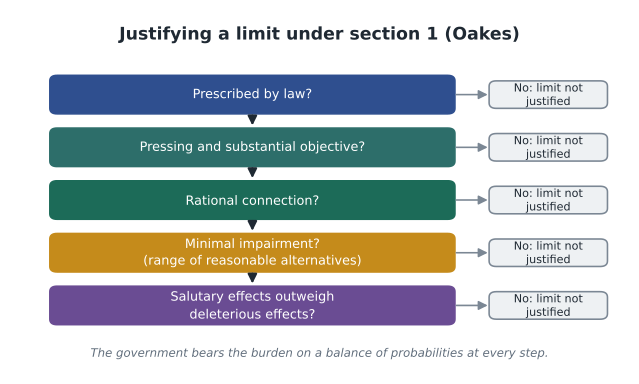
Pressing and substantial objective
The objective is assessed at the right level of generality: the objective of the infringing measure, not of the whole statute, and stated neither too broadly nor too narrowly (RJR-MacDonald Inc. v. Canada (Attorney General), [1995] 3 SCR 199). The objective is fixed at the time of enactment; the government cannot invent a new purpose to save a law, a rule known as the prohibition on shifting purpose (Big M Drug Mart; R. v. Butler, [1992] 1 SCR 452), although a legislature's emphasis may legitimately develop over time. Courts rarely reject the objective at this stage. One example is Big M Drug Mart, where the only objective the Court could find, compelling religious observance, was itself unconstitutional.
Rational connection
The measure must be carefully designed to achieve the objective and not be arbitrary, unfair or based on irrational considerations. The threshold is not high: the government must show a causal connection between the measure and the objective, which may be established by reason or logic where scientific proof is not available (RJR-MacDonald; Harper v. Canada (Attorney General), 2004 SCC 33). The question is whether the measure is likely to further the objective, not whether it will succeed completely.
Minimal impairment
Most section 1 cases are decided at minimal impairment. The question is whether the limit impairs the right no more than reasonably necessary to achieve the objective. Courts do not require the least intrusive measure imaginable. In RJR-MacDonald, Justice McLachlin explained that the law must fall within a range of reasonable alternatives, and that if the government fails to explain why a significantly less intrusive and equally effective measure was not chosen, the law may fail.
Courts grant more deference where government is balancing the interests of competing groups, protecting vulnerable people or addressing complex social problems with incomplete evidence, and less where the state is the singular antagonist of the individual, as in criminal law (Irwin Toy Ltd. v. Quebec (Attorney General), [1989] 1 SCR 927). In Irwin Toy, the Court upheld Quebec's ban on advertising directed at children under 13, deferring to the legislature's choice where the evidence on children's vulnerability was not conclusive. In RJR-MacDonald, by contrast, a total ban on tobacco advertising failed minimal impairment because the government had not shown that a partial ban, for example on lifestyle advertising, would be less effective. Parliament responded with a narrower law that was upheld in Canada (Attorney General) v. JTI-Macdonald Corp., 2007 SCC 30.
Proportionality between effects and objective
The final step weighs the benefits of the measure against its harms. Oakes described this as proportionality between the effects of the measure and the objective. In Dagenais v. Canadian Broadcasting Corp., [1994] 3 SCR 835, the Court refined the step to compare the deleterious effects of the measure with its salutary effects, not just with the importance of the objective in the abstract.
For many years this step rarely decided cases. That changed with Alberta v. Hutterian Brethren of Wilson Colony, 2009 SCC 37. Alberta required a photograph on every driver's licence, ending an earlier exemption for those with religious objections. Members of the Hutterian Brethren believed that being photographed violated the second commandment. The majority, written by Chief Justice McLachlin, held that the photo requirement infringed religious freedom but was justified. On minimal impairment, the Court deferred to the province's view that the universal photo requirement was needed to minimize identity theft. At the final step, the Court weighed the benefit of a secure licensing system against the cost to the Hutterites, finding that the cost of arranging alternative transportation, while real, did not deprive them of a meaningful choice to practise their religion. Justice Abella, dissenting, would have found the harm to the community serious and the benefit marginal.
Hutterian Brethren made clear that the final balancing step is where the court considers the full impact of the law on the claimants, and that it is the only step at which the benefits to society are weighed directly against the harms to the rights-holder. Students should never treat it as an afterthought.
Evidence and deference
The standard of proof under section 1 is the civil standard, proof on a balance of probabilities. But courts accept that social science evidence is often inconclusive and that legislatures can act on a reasoned apprehension of harm. In R. v. Butler, [1992] 1 SCR 452, and Harper, the Court accepted that Parliament could act on a reasonable apprehension of harm where scientific proof was unavailable. In Thomson Newspapers Co. v. Canada (Attorney General), [1998] 1 SCR 877, the Court described the relevant contextual factors: the vulnerability of the group being protected, subjective fears and apprehension of harm, the inability to measure scientifically the harm sought to be addressed, and the nature of the activity infringed.
Context also affects how strictly the test is applied. In Frank v. Canada (Attorney General), 2019 SCC 1, the majority held that any limit on the right to vote requires stringent justification and struck down the rule denying votes to non-resident citizens who had lived abroad for five years or more. Expression at the core of the guarantee, such as political speech, also attracts closer scrutiny than expression at the periphery, such as commercial advertising or hate propaganda.
Section 1 and other rights
Some rights are rarely justified under section 1 because their wording already incorporates balancing. A breach of section 7 requires that a deprivation be contrary to the principles of fundamental justice, such as arbitrariness or overbreadth, and the Supreme Court has said such a breach will be justified only in exceptional circumstances, such as natural disasters, war or epidemics (Carter v. Canada (Attorney General), 2015 SCC 5). Unreasonable searches under section 8 and cruel and unusual punishment under section 12 are similarly difficult to justify. Section 15 claims, by contrast, are often justified under section 1, because the infringement stage asks only whether a law draws a discriminatory distinction.
Administrative decisions: Doré and Loyola
When a discretionary administrative decision, rather than a law, limits a Charter right, the full Oakes test does not apply. In Doré, a lawyer was disciplined for writing an insulting letter to a judge. The question was whether the discipline infringed freedom of expression. Justice Abella, for the Court, held that the reviewing court should ask whether the decision-maker proportionately balanced the Charter values at stake with the statutory objectives, and that the decision would be reviewed for reasonableness.
Loyola High School v. Quebec (Attorney General), 2015 SCC 12, refined the framework. Quebec required private schools to teach a mandatory Ethics and Religious Culture program from a neutral perspective. Loyola, a Catholic school, asked to teach an equivalent program from a Catholic perspective. The Minister refused. The majority held that the refusal limited religious freedom more than necessary to achieve the program's objectives, because Loyola could teach the program's goals while discussing Catholicism from a Catholic perspective. The Court said the Doré analysis works the same justificatory muscles as Oakes: the decision-maker must ensure that Charter protections are limited no more than necessary given the statutory objectives.
Law Society of British Columbia v. Trinity Western University, 2018 SCC 32, applied the framework to the law society's refusal to accredit a proposed law school at an evangelical Christian university whose students had to sign a covenant prohibiting sexual intimacy outside heterosexual marriage. The majority held that the law society's decision engaged religious freedom but reflected a proportionate balance between that interest and the society's statutory duty to uphold the public interest, including equal access to the legal profession. In Commission scolaire francophone des Territoires du Nord-Ouest v. Northwest Territories (Education, Culture and Employment), 2023 SCC 31, the Court applied Doré to the Minister's refusal to admit children of non-rights-holder parents to French-language schools, holding that the Minister had to consider the values underlying section 23 even though the children's parents did not themselves hold section 23 rights.
The relationship between Doré and Oakes remains contested. In Canada (Minister of Citizenship and Immigration) v. Vavilov, 2019 SCC 65, the Court reset the general framework for judicial review but expressly left the Doré framework for another day. Some judges and scholars argue that Doré gives too little protection to rights. Okafor-Lindqvist tells the group that exam answers should apply Doré and Loyola to discretionary decisions and Oakes to laws, and note the debate if it is relevant.
Writing a section 1 analysis
A good section 1 answer is disciplined. Identify the limit precisely. Confirm that it is prescribed by law. State the objective at the correct level of generality and decide whether it is pressing and substantial. Test rational connection briefly unless there is real doubt. Spend most of the analysis on minimal impairment, identifying concrete alternatives and explaining why they would or would not be as effective. Then weigh the salutary and deleterious effects, using the evidence. Finally, state a conclusion.
Hannah Kowalczyk asks whether courts are just substituting their own policy views. Okafor-Lindqvist says the honest answer is that section 1 requires judgment, and that the structure of the test is designed to make that judgment transparent and reviewable. Theo Marchetti points out that in his years as a law clerk, government lawyers who had built a careful evidentiary record usually won at section 1, and those who had not usually lost.
Worked problem
Section 1 and the Riverside Park bylaw
Assume a court finds that the City of Corwin's ban on overnight shelters in Riverside Park infringes section 7 for unhoused people who have no access to shelter beds. How would the city try to justify the limit under section 1, and what are its main difficulties?
Show solution
- Prescribed by law: The limit is in a bylaw enacted under the Municipal Act, so it is prescribed by law.
- Objective: Preserving parks for public use and protecting health and safety are pressing and substantial objectives.
- Rational connection: Banning overnight shelters logically furthers those objectives.
- Minimal impairment: The city must explain why less intrusive measures, such as allowing overnight shelter only when shelter beds are unavailable, designating certain areas, or requiring tents to be taken down each morning, would not achieve its objectives. Courts in Abbotsford (City) v. Shantz, 2015 BCSC 1909, and Waterloo (Region) v. Persons Unknown, 2023 ONSC 670, found blanket bans overbroad where shelter was unavailable.
- Proportionality: The harm to people with nowhere else to sleep, including exposure to cold and loss of security, is severe; the benefit of a total ban over a targeted rule is modest.
- Conclusion: Because section 7 breaches are rarely justified (Carter), the city is unlikely to succeed under section 1 unless it can show that alternatives would not work.
Practice problems
Work each problem on paper first, then reveal the answer to check.
What are the steps of the Oakes test?
Show answer
A pressing and substantial objective, then proportionality: rational connection, minimal impairment, and proportionality between salutary and deleterious effects. Before that, the limit must be prescribed by law.
Why did the reverse onus in Oakes fail?
Show answer
There was no rational connection between possessing a small quantity of narcotics and an intention to traffic, so it failed the rational connection step.
What did Hutterian Brethren add to the final step of Oakes?
Show answer
It emphasized that the final step weighs the actual salutary effects against the deleterious effects on the claimants, and that it is the only step where the full impact on the rights-holder is balanced directly against the benefits.
When does the Doré framework apply instead of Oakes?
Show answer
When the limit flows from a discretionary administrative decision rather than a law of general application. The court asks whether the decision-maker proportionately balanced the Charter protections with the statutory objectives, reviewed for reasonableness.
Why are section 7 breaches rarely justified under section 1?
Show answer
Because a breach requires a deprivation contrary to the principles of fundamental justice, such as arbitrariness, overbreadth or gross disproportionality, which already reflect a failure of proportionality; Carter says justification is possible only in exceptional circumstances.
Summary and key terms
- Section 1 guarantees Charter rights and allows reasonable limits prescribed by law and demonstrably justified in a free and democratic society.
- The government bears the burden on a balance of probabilities, but may rely on reason, logic and a reasoned apprehension of harm where science is inconclusive.
- Oakes requires a pressing and substantial objective, rational connection, minimal impairment and proportionality of effects (refined in Dagenais and Hutterian Brethren).
- Minimal impairment asks whether the law falls within a range of reasonable alternatives (RJR-MacDonald); deference varies with context (Irwin Toy).
- Discretionary administrative decisions are reviewed under Doré and Loyola for proportionate balancing; Trinity Western and CSF TNO apply the framework.
- Section 7, 8 and 12 breaches are rarely justified; section 15 breaches are often analyzed at length under section 1.
- Prescribed by law
- The requirement that a limit have an accessible and sufficiently precise legal source.
- Oakes test
- The test for justifying a limit under section 1: pressing and substantial objective, rational connection, minimal impairment and proportionality of effects.
- Minimal impairment
- The requirement that a limit impair the right no more than reasonably necessary, within a range of reasonable alternatives.
- Shifting purpose
- The prohibited practice of relying on a new objective, not the original one, to justify a law.
- Doré framework
- The approach to reviewing discretionary administrative decisions that limit Charter protections, asking whether the decision proportionately balances them with statutory objectives.
- Reasoned apprehension of harm
- A basis for legislative action accepted by courts where harm cannot be measured scientifically.
Lesson quiz · 5 questions
Score 60% or more to complete this lesson.
Create a free account to save your progress, take quizzes and earn a certificate.