
LAWC-104 · Lesson 9 of 12 · 18 min
Citation (McGill Guide)
▶ Video coming soon A video version of this lesson is on the way.
Professor Saltire returns the first ungraded citation exercise with a green tick beside only three of seventy answers. The most common error is a missing pinpoint. The second is 'R. v. Smith' written with periods. The third, which she circles twice on several papers, is a citation to a case on CanLII that gives no neutral citation at all, just a web address. 'Citation is not decoration,' she tells the class. 'It is how a reader checks your work. A judge reading your factum, a partner reading your memo, an examiner reading your answer should be able to go straight to the page or paragraph that supports what you say. If they cannot, you have asked them to trust you, and lawyers are not paid to be trusted. They are paid to be checked.'
This lesson introduces the conventions of Canadian legal citation set out in the Canadian Guide to Uniform Legal Citation, universally called the McGill Guide after the McGill Law Journal, which prepares it. It explains why citation matters, the basic rules for cases, legislation, secondary sources and online materials, and the conventions for footnotes, pinpoints and short forms.
Why a citation standard
Legal citation has two purposes. It identifies the source precisely enough that the reader can find it, and it tells the reader something about the authority of the source: which court decided a case, when, and how much weight it may carry. A uniform standard serves both purposes, because readers can interpret any citation at a glance. The McGill Guide is the standard used in Canadian law schools and law journals and is accepted by most Canadian courts, although some courts and many firms have their own house styles and practice directions on particular points. When a court's rules require something different, the court's rules prevail.
The current edition of the McGill Guide is the tenth, published in 2023 by Thomson Reuters. The Guide is updated every few years, and editions differ on some details, so check which edition your instructor, journal or court expects. This lesson describes the main conventions of the tenth edition. For anything not covered here, consult the Guide itself, which is available in print and on Westlaw, and the citation guides published by law libraries.
Footnotes and general conventions
In academic writing and most memos, citations appear in footnotes. The footnote number in the text normally follows punctuation, and each footnote ends with a period. The McGill Guide omits periods in most abbreviations: R v Smith rather than R. v. Smith, Ltd rather than Ltd., and RSO rather than R.S.O. In factums and court documents, citations often appear in the body of the text rather than in footnotes, depending on the court's practice.
Introductory signals tell the reader how a source relates to the proposition. No signal means the source directly supports it. 'See' indicates that the source supports the proposition indirectly or by inference. 'See e.g.' gives one of several possible examples. 'But see' and 'contra' indicate contrary authority. Used carefully, signals are a form of honesty: they show the reader exactly how strongly a source supports what you say.
Cases
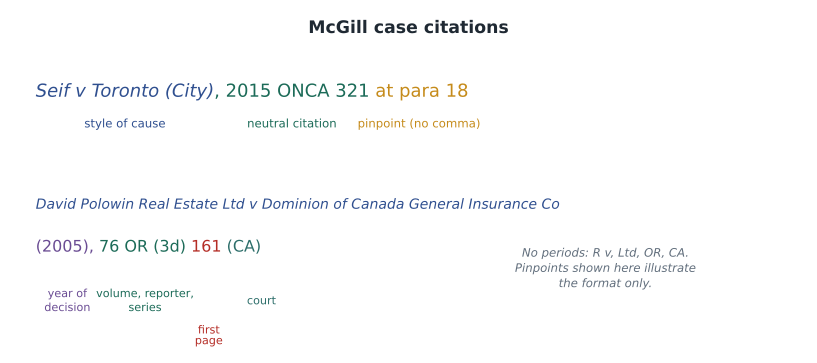
A case citation has four basic elements: the style of cause, in italics; the neutral citation, if there is one; a reporter citation, where needed or required; and a pinpoint. For a decision with a neutral citation, the neutral citation alone usually identifies the case: Crinson v Toronto (City), 2010 ONCA 44. A pinpoint to a paragraph follows without a comma: Seif v Toronto (City), 2015 ONCA 321 at para 18. If a court, instructor or journal requires a parallel citation to a printed report, it follows the neutral citation after a comma. The paragraph numbers used in this lesson's examples and exercises illustrate the format only; in real work, every pinpoint must be checked against the decision.
For a decision without a neutral citation, cite the best available report. Reports organized by volume use the year of decision in parentheses, followed by the volume, the reporter abbreviation, the series and the first page: David Polowin Real Estate Ltd v Dominion of Canada General Insurance Co (2005), 76 OR (3d) 161 (CA). Reports organized by year put the year in square brackets: Rizzo & Rizzo Shoes Ltd (Re), [1998] 1 SCR 27. The court is added in parentheses at the end, unless it is obvious from the reporter, as it is for the Supreme Court Reports. Unreported decisions without a neutral citation can be cited to an online database identifier, such as a CanLII citation in the form 2005 CanLII 12345 (ON CA).
The style of cause follows its own conventions. Use only the surname or corporate name of individual parties, and shorten names consistently. Write 'v' in italics between the parties. Use 'R' for the Crown in criminal cases. Use '(Re)' for cases styled In re or In the matter of. Provinces and governments are shortened: Ontario (Attorney General) v Smith. The McGill Guide sets out many more rules on styles of cause, such as how to cite cases with multiple parties or anonymized names, and these are worth checking when a case looks unusual.
Legislation
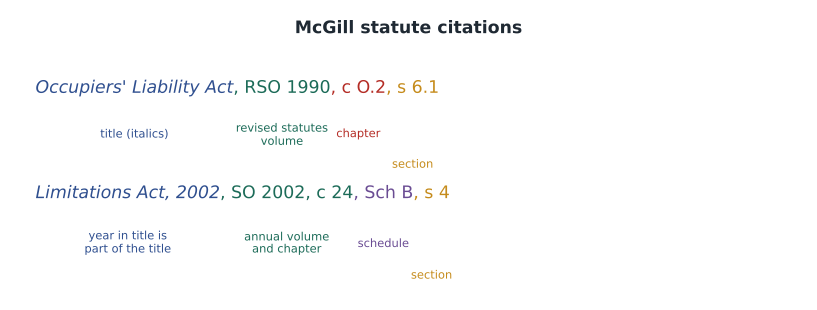
A statute citation gives the title in italics, the statute volume, the chapter and, where relevant, a pinpoint to the section. For revised statutes: Occupiers' Liability Act, RSO 1990, c O.2, s 6.1. For statutes enacted after the last revision, cite the annual volume: Occupiers' Liability Amendment Act, 2020, SO 2020, c 33. Where a statute was enacted as a schedule to another Act, the schedule is included: Limitations Act, 2002, SO 2002, c 24, Sch B, s 4. Federal statutes follow the same pattern: Interpretation Act, RSC 1985, c I-21, s 12. The year in a statute's title, if it has one, is part of the title and is not the same as the year of the volume.
Regulations are cited by their identifiers. Ontario regulations are cited O Reg followed by the number and year (O Reg 384/24); older consolidated regulations are cited by their 1990 number (Rules of Civil Procedure, RRO 1990, Reg 194, r 4.06.1). Federal regulations are cited by their SOR number, and the title may be included. Rules of court are often cited by rule number with a short form, such as r 4.06.1(2.1).
Constitutional documents have their own forms. The Charter is cited as Canadian Charter of Rights and Freedoms, s 7, Part I of the Constitution Act, 1982, being Schedule B to the Canada Act 1982 (UK), 1982, c 11. The Constitution Act, 1867 is cited as Constitution Act, 1867 (UK), 30 & 31 Vict, c 3, s 91(27), reprinted in RSC 1985, Appendix II, No 5. Once cited in full, both are usually shortened to the familiar names.
Bills are cited by number, title, session, legislature, jurisdiction and year, with a pinpoint to the clause and, where useful, the stage reached: Bill 118, Occupiers' Liability Amendment Act, 2020, 1st Sess, 42nd Leg, Ontario, 2020 (assented to 8 December 2020). Debates are cited to the legislature's record, with the date, page and, usually, the speaker.
Secondary sources
Books are cited by author, title in italics, edition, place of publication, publisher and year, followed by the pinpoint: Ruth Sullivan, The Construction of Statutes, 7th ed (Toronto: LexisNexis, 2022) at 45. Journal articles are cited by author, title in quotation marks, year in parentheses, volume and issue, journal abbreviation, first page and pinpoint. Encyclopedias are cited by title, edition, volume or online title, subject title and paragraph, such as a CED or Halsbury's title and paragraph number. Government documents, law reform reports and online commentary each have their own forms in the Guide.
Online sources should be cited to their most stable form. If a decision or statute has a neutral citation or official citation, use it rather than a web address; the reader can find it on any platform. Where a web address is necessary, as for a blog post or a government web page, the McGill Guide places it at the end of the citation after the word 'online', and recommends adding an archived version where the page may change. A bare URL is never a complete citation.
Short forms, ibid and supra
After the first full citation, a source can be referred to by a short form. The short form is placed in square brackets at the end of the first citation, for example [Crinson], and used thereafter. 'Ibid' refers to the source cited in the immediately preceding footnote, with a new pinpoint if needed. 'Supra' refers to a source cited in full in an earlier footnote, with the footnote number: Crinson, supra note 4 at para 20. Courts and many practitioners use simpler short forms in factums, but in academic work and in this course, the McGill conventions apply.
Pinpoints
A pinpoint directs the reader to the exact page, paragraph or section that supports the proposition. For decisions with numbered paragraphs, pinpoint to the paragraph: at para 18, or at paras 18-22. For older decisions without numbered paragraphs, pinpoint to the page of the report: at 167. For statutes, the section number is the pinpoint: s 6.1(1). Saltire's rule is that every citation supporting a specific proposition needs a pinpoint, and that a pinpoint which does not actually support the proposition is worse than none, because it signals carelessness or worse.
Accuracy is the point
The rules are detailed, and students sometimes treat citation as a formatting exercise to be done at the end. That is a mistake, for two reasons. First, accuracy in citation reflects accuracy in research: if you cannot cite a case precisely, you probably have not read it carefully. Second, courts now pay close attention to the authenticity of authorities. Lesson 10 explains that Ontario's Rules of Civil Procedure require counsel to certify that they are satisfied as to the authenticity of every authority listed in a factum, and that courts have imposed costs on lawyers who cited cases that did not exist. A precise citation, checked against the source, is part of that certification.
Bernard Tsang offers a practical workflow. Build citations as you research, not at the end; when you note a case in your research log, record the full neutral citation and the paragraph numbers of the key passages. Use the citation export tools on CanLII and the commercial platforms as a starting point, but check the result against the McGill rules, because exported citations often include periods, missing pinpoints or the wrong court identifiers. Before submitting anything, check every citation against the source one last time.
Citation in court documents
Court documents follow the McGill Guide in most respects, but courts add their own requirements. In Ontario, factums must list the authorities relied on in a schedule at the end, and parties often file a book or compendium of authorities containing the key cases and statutes, with the relevant passages marked. The Court of Appeal and the Superior Court publish practice directions on the format of factums and authorities, including how electronic documents should be bookmarked and hyperlinked. Many courts now prefer that cases be cited by neutral citation and that hyperlinks go to free sources such as CanLII where possible. Before filing anything, read the current practice direction for the court and the type of proceeding.
Citation in court documents also carries the professional weight discussed in lesson 10. The schedule of authorities in an Ontario factum is accompanied by the certification of authenticity required by rule 4.06.1(2.1), and since September 1, 2026 the person signing also certifies the accuracy of quotations. A missing pinpoint or a garbled citation in a class exercise costs a mark; in a factum it can cost credibility with the court, and a fabricated or misquoted authority can lead to costs or worse.
| Source | McGill-style citation |
|---|---|
| Statute (revised) | Occupiers' Liability Act, RSO 1990, c O.2, s 6.1 |
| Amending statute | Occupiers' Liability Amendment Act, 2020, SO 2020, c 33 |
| Statute in a schedule | Limitations Act, 2002, SO 2002, c 24, Sch B, s 4 |
| Federal statute | Interpretation Act, RSC 1985, c I-21, s 12 |
| Ontario regulation | O Reg 384/24 |
| Rules of court | Rules of Civil Procedure, RRO 1990, Reg 194, r 4.06.1(2.1) |
| Case with neutral citation | Seif v Toronto (City), 2015 ONCA 321 |
| Case in a yearly report | Rizzo & Rizzo Shoes Ltd (Re), [1998] 1 SCR 27 |
| Case in a volume report | David Polowin Real Estate Ltd v Dominion of Canada General Insurance Co (2005), 76 OR (3d) 161 (CA) |
| Book | Ruth Sullivan, The Construction of Statutes, 7th ed (Toronto: LexisNexis, 2022) |
Practice problems
Work each problem on paper first, then reveal the answer to check.
Correct this citation: R. v. Sullivan, 2022 S.C.C. 19, para. 64.
Show answer
R v Sullivan, 2022 SCC 19 at para 64.
Cite section 6.1 of the Occupiers' Liability Act and the amending Act that added it.
Show answer
Occupiers' Liability Act, RSO 1990, c O.2, s 6.1; Occupiers' Liability Amendment Act, 2020, SO 2020, c 33.
When should you use a web address in a citation to a court decision?
Show answer
Almost never. If the decision has a neutral citation, use it. If it has only an online database identifier, use that identifier (such as a CanLII citation). A web address is for sources without a stable legal citation, such as blog posts, and then follows the word 'online'.
Footnote 4 cites Crinson in full with the short form [Crinson]. Footnote 5 cites a statute. How do you cite paragraph 20 of Crinson in footnote 6?
Show answer
Crinson, supra note 4 at para 20.
Summary and key terms
- The McGill Guide (Canadian Guide to Uniform Legal Citation, 10th edition, 2023) is the standard for Canadian legal citation; court rules prevail where they differ.
- McGill omits periods in most abbreviations (R v, Ltd, RSO) and places pinpoints after the citation without a comma (at para 18).
- Cite cases by style of cause and neutral citation, adding reporter citations where needed; cite older cases to the best report with the court in parentheses.
- Cite statutes by title, volume, chapter and section; regulations by O Reg or SOR number; the Constitution and Charter in their prescribed forms.
- Use short forms, ibid and supra consistently after the first full citation.
- Every specific proposition needs an accurate pinpoint, and every citation should be checked against the source.
- McGill Guide
- The Canadian Guide to Uniform Legal Citation, prepared by the McGill Law Journal; the standard Canadian citation guide.
- Pinpoint
- A reference to the exact paragraph, page or section supporting a proposition.
- Parallel citation
- An additional citation to another publication of the same decision, such as a law report alongside the neutral citation.
- Ibid
- Refers to the source cited in the immediately preceding footnote.
- Supra
- Refers to a source cited in full in an earlier footnote, identified by footnote number.
- Introductory signal
- A word such as 'see' or 'but see' indicating how a source relates to the proposition it is cited for.
Lesson quiz · 5 questions
Score 60% or more to complete this lesson.
Create a free account to save your progress, take quizzes and earn a certificate.