
LAWC-104 · Lesson 8 of 12 · 21 min
Statutory interpretation
▶ Video coming soon A video version of this lesson is on the way.
By the seventh week of term, most of Section B has found the words that matter in the Ingram file. Section 6.1 of the Occupiers' Liability Act requires written notice within sixty days, and it contains an exception: failure to give notice does not bar the action if a judge finds that there is reasonable excuse for the lack of notice and that the defendant is not prejudiced in its defence. Arjun Mehta tells Professor Saltire that he has found the law and the research is finished. Saltire asks him what 'reasonable excuse' means. Arjun starts to answer, stops, and says that he supposes it means an excuse that is reasonable. 'Exactly the problem,' Saltire says. 'Finding the words is half the job. The other half is knowing how a court will read them. That is statutory interpretation, and it decides more cases than any other skill you will learn this year.'
This lesson explains the modern principle of statutory interpretation, the tools courts use to apply it, the interpretation statutes, and the special presumptions that sometimes tip the balance. It ends by applying those tools to the words 'reasonable excuse' in section 6.1.
The modern principle
Canadian courts interpret legislation using what is called the modern principle, a formulation by the legislative drafter and scholar Elmer Driedger in the second edition of his book Construction of Statutes in 1983. In his words, the words of an Act are to be read in their entire context and in their grammatical and ordinary sense harmoniously with the scheme of the Act, the object of the Act, and the intention of Parliament. The Supreme Court adopted that statement in Rizzo & Rizzo Shoes Ltd. (Re), [1998] 1 SCR 27, and has repeated it in hundreds of decisions since, including Bell ExpressVu Limited Partnership v. Rex, 2002 SCC 42.
The modern principle replaced an older approach in which courts chose among separate rules: a literal rule that applied the plain meaning of words, a golden rule that departed from plain meaning to avoid absurdity, and a mischief rule that read a statute in light of the problem it was meant to cure. Under the modern principle, text, context and purpose are considered together. No single factor is decisive in every case.
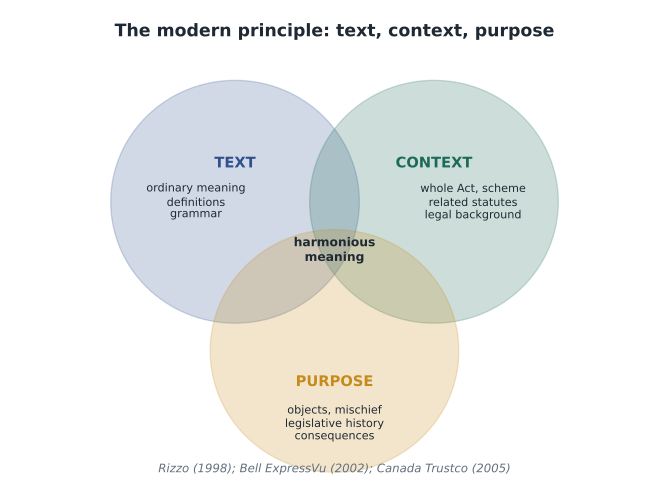
In Canada Trustco Mortgage Co. v. Canada, 2005 SCC 54, the Supreme Court described the approach as a unified textual, contextual and purposive analysis to find a meaning that is harmonious with the Act as a whole. The Court added that the relative weight of the three elements varies: where the words are precise and unequivocal, their ordinary meaning plays a dominant role, while where the words can support more than one reasonable meaning, context and purpose play a larger part.
Text
Interpretation starts with the words. What is their ordinary meaning to a competent reader of the language, at the time the statute was enacted? Is a word defined in the statute, in its regulations or in the interpretation statute? Does the grammatical structure of the sentence point one way? Are there technical or legal meanings, for example where a word has a settled meaning in law? Dictionaries can help identify the range of possible meanings, but courts warn against treating a dictionary entry as conclusive, because meaning depends on context.
Some words are precise: 'sixty days', 'in writing', 'by registered mail'. Others are open-textured: 'reasonable', 'prejudiced', 'in all the circumstances'. Open-textured words deliberately leave room for judgment, and their meaning develops through case law. 'Reasonable excuse' is of the second kind.
Context
Words are read in their entire context. Context includes the provision as a whole, the surrounding provisions, the structure and scheme of the statute, related statutes, and the legal background against which the statute was enacted. Several principles help.
- Consistent expression: the same words are presumed to have the same meaning throughout a statute, and different words are presumed to have different meanings.
- Against tautology: the legislature is presumed not to use words without purpose, so an interpretation that makes words redundant is disfavoured.
- Associated words: the meaning of a word is coloured by the words around it. Where a list of specific items is followed by general words, the general words may be limited to things of the same kind as the specific items.
- Implied exclusion: where a statute expressly mentions some things, it may be taken to exclude others of the same kind that it does not mention.
- Related statutes: statutes dealing with the same subject are presumed to be consistent, and words borrowed from another statute may carry the meaning courts have given them there.
- Legal background: the legislature is presumed to know the existing law, including how courts have interpreted similar words, when it enacts new legislation.
These presumptions are aids, not rules. Each can be displaced by stronger indications of meaning. Courts often describe them as tools for understanding the text rather than shortcuts around it.
Purpose
Every statute is presumed to have a purpose, and every provision is read in a way that promotes it. Purpose may be stated in a purpose clause, or inferred from the statute's text and scheme, its title, the problem it addressed and its legislative history. Section 12 of the federal Interpretation Act and section 64(1) of Ontario's Legislation Act, 2006 both direct that legislation be given a fair, large and liberal interpretation that best ensures the attainment of its objects. Rizzo applied the Ontario predecessor of that provision to read employment standards legislation generously, because it was designed to protect employees.
Purpose cannot override clear text. A court will not read words into or out of a statute simply because it thinks the result would better serve the purpose. But where the words are open to more than one reasonable meaning, the one that better advances the purpose is preferred. Purpose analysis also has to be precise. A statute often balances competing purposes, and an interpretation that pursues one at any cost to the others misreads it.
Consequences and the presumption against absurdity
Courts presume that the legislature does not intend absurd results. In Rizzo, the Supreme Court described absurdity broadly, including interpretations that lead to ridiculous or frivolous consequences, that are extremely unreasonable or inequitable, that are illogical or incoherent, or that are incompatible with other provisions or with the object of the statute. The presumption explains why the Court refused to read the employment statute in a way that would protect employees dismissed just before a bankruptcy but not those whose jobs ended because of it.
Extrinsic aids
Courts may consider materials outside the statute itself. Legislative history, including Hansard, committee reports and earlier versions of a bill, may be used to understand purpose, as lesson 7 explained, with caution about the weight of individual statements. Law reform reports that led to a statute can show the problem it addressed. Scholarly writing, especially Ruth Sullivan's The Construction of Statutes, is cited frequently. Headings and marginal notes may help as part of context, but the interpretation statutes say they are not part of the enactment for most purposes. Section 14 of the federal Interpretation Act, for example, provides that marginal notes are inserted for convenience of reference only.
Bilingual legislation
Federal statutes, and Ontario statutes enacted in both languages, have English and French versions that are equally authoritative. Where the versions differ, courts look first for a meaning shared by both, often the narrower meaning where one version is broader than the other, and then confirm that the shared meaning is consistent with the purpose and context of the provision. The Supreme Court explained this approach in R. v. Daoust, 2004 SCC 6. Reading the French version is therefore a legitimate and sometimes decisive research step, as Sophie Tremblay-Hart reminds her classmates whenever she gets the chance.
Special presumptions
Some presumptions apply only in particular situations, and Bell ExpressVu stressed that several of them come into play only where genuine ambiguity remains after the modern principle has been applied. The rule of strict construction of penal statutes, which resolves real ambiguity in favour of the accused, is one: it is a last resort, as the Supreme Court explained in R. v. Hasselwander, [1993] 2 SCR 398. Interpreting legislation to conform with Charter values is another: where a provision is genuinely ambiguous, a court prefers the meaning consistent with the Charter, but Charter values cannot be used to create ambiguity where none exists. Other presumptions include the presumption that legislation does not interfere with vested rights or operate retroactively, the presumption of compliance with international law, the presumption against interference with access to the courts, and the principle that benefits-conferring legislation is read generously.
Interpretation by administrative decision-makers
Statutory interpretation is not only for courts. Tribunals and officials interpret statutes every day. In Canada (Minister of Citizenship and Immigration) v. Vavilov, 2019 SCC 65, the Supreme Court said that administrative decision-makers must also interpret statutes consistently with the text, context and purpose of the provision, although they need not write reasons the way a court would. On judicial review, a court generally asks whether the decision-maker's interpretation was reasonable, not whether it was the one the court would have chosen, but an interpretation that ignores the text or purpose will not survive.
Computing time
Interpretation statutes also answer practical questions. Ontario's Legislation Act, 2006 contains rules on how periods of time are counted, including what happens when the last day of a period falls on a holiday. In the Ingram file, sixty days from February 4, 2026 ends in early April 2026. The last day fell over the Easter weekend, so the time-computation rules would determine the exact final day. On any count, though, Rosa Ingram's first meeting with a lawyer on April 20 came too late. Students who calculate deadlines in memos should cite the governing rule rather than simply counting on a calendar.
Applying the principle: 'reasonable excuse' in section 6.1
Saltire works through the analysis with the class, using the three elements.
Worked problem
Interpreting 'reasonable excuse' in section 6.1 of the Occupiers' Liability Act
How is a court likely to interpret the words 'reasonable excuse' in the exception to the sixty-day notice requirement for snow-and-ice injuries?
Show solution
- Text: 'Reasonable excuse' is open-textured. Its ordinary meaning is an explanation for the failure to give notice that a reasonable person would accept as justifying it. The provision pairs it with a second requirement: the defendant must not be prejudiced in its defence. The two requirements are cumulative.
- Context, related statutes: The exception closely mirrors the long-standing exception to the municipal notice requirement in the Municipal Act, 2001. The legislature is presumed to know the existing law, including how the Court of Appeal interpreted 'reasonable excuse' in the municipal context in Crinson v. Toronto (City), 2010 ONCA 44 and Seif v. Toronto (City), 2015 ONCA 321. Borrowing similar words suggests an intention to borrow their settled meaning.
- Context, scheme: The notice requirement sits in a statute that otherwise imposes a broad duty of care on occupiers. Reading the exception so narrowly that it almost never applies would cut against the scheme of a statute designed to compensate people injured on others' premises; reading it so broadly that late notice never matters would make the sixty-day rule meaningless, contrary to the presumption against tautology.
- Purpose: The amendment's evident purpose is to let occupiers and contractors investigate snow-and-ice claims while evidence still exists. That purpose links naturally to the prejudice requirement: if the defendants were able to investigate anyway, the purpose is not undermined.
- Conclusion: A court is likely to interpret 'reasonable excuse' as the municipal cases do, asking whether, in all the circumstances, it was reasonable for the plaintiff not to give notice until she did; ignorance of the requirement alone is unlikely to be enough, but it may combine with other circumstances, such as injury, treatment and reliance on oral reports to the defendant. Prejudice will be assessed separately and is likely to be the decisive issue in many cases.
Theo Marchetti points out that this is exactly how the Superior Court decisions the class found in its noting-up workshop seem to reason: they import the municipal case law into section 6.1. Saltire agrees, and adds a caution. 'When the courts have already interpreted a provision, your job is to report and apply their interpretation, not to invent your own. Statutory interpretation tools are for predicting how unsettled questions will be answered and for arguing about them. They are not a licence to ignore the cases.'
Common mistakes
Common mistakes
MistakeStopping at the dictionary meaning of a word.
InsteadRead the words in their entire context and in light of the statute's purpose, as the modern principle requires.
MistakeUsing purpose to rewrite clear words.
InsteadUse purpose to choose among reasonable meanings, not to override unambiguous text.
MistakeInvoking strict construction or Charter values at the start of the analysis.
InsteadApply the modern principle first; these presumptions apply only to genuine remaining ambiguity (Bell ExpressVu).
MistakeIgnoring the French version of a bilingual statute.
InsteadCompare both versions and look for a shared meaning (Daoust).
Practice problems
Work each problem on paper first, then reveal the answer to check.
State the modern principle of statutory interpretation and identify the case that adopted it in Canada.
Show answer
The words of an Act are to be read in their entire context and in their grammatical and ordinary sense harmoniously with the scheme of the Act, the object of the Act and the intention of the legislature (Driedger). The Supreme Court adopted it in Rizzo & Rizzo Shoes Ltd. (Re), [1998] 1 SCR 27.
According to Canada Trustco, when does the ordinary meaning of words play a dominant role?
Show answer
When the words are precise and unequivocal. Where they support more than one reasonable meaning, context and purpose play a greater role.
Why might a court interpret 'reasonable excuse' in section 6.1 of the Occupiers' Liability Act the same way the Court of Appeal interpreted similar words in the municipal notice provision?
Show answer
Because the legislature is presumed to know the existing law when it enacts new provisions, and borrowing similar words in a similar context suggests an intention to adopt their settled judicial meaning (Crinson; Seif).
When does the presumption in favour of Charter values apply to statutory interpretation?
Show answer
Only where genuine ambiguity remains after applying the modern principle; Charter values cannot be used to create ambiguity (Bell ExpressVu).
Summary and key terms
- The modern principle (Driedger; Rizzo; Bell ExpressVu) reads words in their entire context, in their ordinary sense, harmoniously with the scheme, object and intention of the legislature.
- Canada Trustco describes a unified textual, contextual and purposive analysis whose weighting depends on how clear the words are.
- Contextual presumptions include consistent expression, against tautology, associated words, implied exclusion and the legislature's knowledge of existing law.
- Interpretation statutes require a fair, large and liberal interpretation (Interpretation Act, s 12; Legislation Act, 2006, s 64) and set rules such as time computation.
- The presumption against absurdity, legislative history and bilingual comparison (Daoust) are important tools; strict construction and Charter values apply only to genuine ambiguity.
- Where courts have interpreted a provision, report and apply their interpretation.
- Modern principle
- The Driedger formulation adopted in Rizzo: read words in their entire context, in their ordinary sense, harmoniously with the scheme and object of the Act and the legislature's intention.
- Purposive interpretation
- Choosing the meaning that best advances the statute's objects among the meanings the words can reasonably bear.
- Presumption against absurdity
- The presumption that the legislature does not intend ridiculous, unreasonable, incoherent or self-defeating results.
- Shared meaning rule
- For bilingual legislation, the approach of seeking a meaning common to both language versions (Daoust).
- Strict construction
- Resolving genuine ambiguity in a penal statute in favour of the accused, as a last resort (Hasselwander).
- Extrinsic aids
- Materials outside the statute, such as Hansard, committee reports and law reform reports, used to understand its meaning or purpose.
Lesson quiz · 5 questions
Score 60% or more to complete this lesson.
Create a free account to save your progress, take quizzes and earn a certificate.