
LAWC-104 · Lesson 4 of 12 · 18 min
Research databases and research strategy
▶ Video coming soon A video version of this lesson is on the way.
On Tuesday, October 6, 2026, Professor Saltire hands out the major assignment of the term: a research memo of no more than 2,500 words on the Ingram file, due Friday, November 13. The question is narrow and practical. Rosa Ingram fell on ice in a private parking lot on February 4, 2026 and did not see a lawyer until April 20. Is her claim against the plaza owner and its snow-clearing contractor barred because she did not give written notice within sixty days, and what should her lawyer do now? Saltire tells the class that the answer is findable, that every student will use the same databases, and that the difference between a good memo and a weak one will come from strategy, not luck. 'Anyone can type words into a search box,' she says. 'A researcher knows what to type, where, in what order, and when to stop.'
This lesson surveys the main Canadian research platforms and then explains how to plan and carry out a research project: analyzing the facts, framing the issues, choosing search terms and sources, keeping a research log and knowing when the research is complete.
CanLII and other free sources
The Canadian Legal Information Institute, CanLII, is a free website that publishes court and tribunal decisions and consolidated legislation from every Canadian jurisdiction. It is funded by Canada's law societies through the Federation of Law Societies of Canada, and its technology is built by Lexum, a Montreal company. For most current Canadian decisions and statutes, CanLII is the fastest place to start. It also hosts secondary commentary in its CanLII Docs collection, including some books, articles and conference papers that authors have made freely available.
CanLII has added artificial intelligence features in recent years. According to Lexum, by March 2025 AI-generated summaries of decisions and legislation had been approved for most provinces and territories, and AI enrichments such as short summaries in search results and automatic classification by area of law were being added, starting with Saskatchewan case law and tens of thousands of Ontario decisions. These summaries can help a researcher decide quickly whether a decision is worth reading. They are not the decision, and Lexum itself describes the early enrichments as preliminary. Read the reasons.
Government and court websites are the other essential free sources. The Justice Laws website publishes the official consolidations of federal statutes and regulations. Ontario's e-Laws website publishes Ontario statutes and regulations, with point-in-time versions. The Supreme Court of Canada publishes its judgments, case information and hearing webcasts. Ontario courts publish practice directions and notices that are not always available elsewhere. LEGISinfo and the Legislative Assembly of Ontario website track bills. Lesson 7 explains how to use the legislative sites in detail.
The commercial platforms
Three large commercial platforms dominate Canadian legal research, and most law schools and firms subscribe to at least two of them. Each combines case law, legislation, secondary sources, citators and, increasingly, generative AI tools. Their main advantage over free sources is the editorial layer: digests, classification systems, citators, encyclopedias, textbooks and journals that make research faster and more complete.
LexisNexis offers Lexis+, launched in Canada in 2022 as the successor to its earlier Quicklaw and Lexis Advance Quicklaw services. It includes Halsbury's Laws of Canada, many textbooks and journals, and the QuickCITE citator. LexisNexis has since added generative AI features, including Lexis+ AI and an assistant called Protégé.
Thomson Reuters offers Westlaw, whose Canadian service includes the Canadian Encyclopedic Digest, the Canadian Abridgment, Words & Phrases, many textbooks and journals, and the KeyCite Canada citator. Thomson Reuters has also added generative AI tools to its platform, marketed under the CoCounsel name.
vLex, which began in Spain and built a large international collection, offers Canadian case law and legislation along with an AI assistant called Vincent. In 2025 the Canadian legal software company Clio completed its acquisition of vLex in a deal reported at about 1 billion US dollars, so vLex's research tools are increasingly linked to Clio's practice management software.
Other databases fill particular needs. HeinOnline is the main source for law journal articles, both Canadian and foreign. SOQUIJ publishes Quebec decisions and commentary. Specialized services cover tax, labour, securities, intellectual property and other fields. A law library's research guides list the databases available to its students.
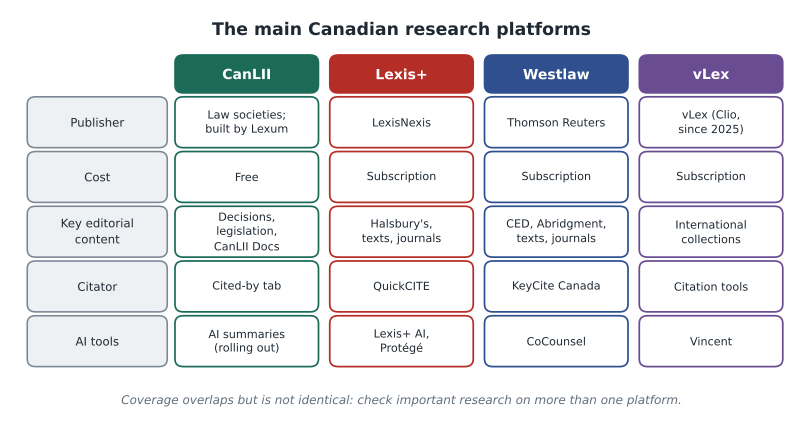
Bernard Tsang warns the class not to become loyal to one platform. 'They overlap a lot, but not completely,' he says. 'One has a textbook the other doesn't. One digests a decision the other hasn't picked up yet. Their citators sometimes disagree about how a case has been treated. For anything that matters, check in more than one place.' He also points out that subscriptions are expensive and vary between firms, so a lawyer who can do excellent research on CanLII and government websites is valuable everywhere.
Step one: analyze the facts and frame the issues
Research begins before any database is opened. Read the facts carefully and identify the legally significant ones: who the parties are, what happened, where, when, what harm resulted and what the client wants. Then frame the legal issues as specific questions. A vague issue produces a vague search. 'Can Rosa sue?' is not a research question. 'Does Rosa Ingram's failure to give written notice within sixty days under section 6.1 of the Occupiers' Liability Act bar her claim, and if so, can the bar be avoided?' is.
Students often find it useful to brainstorm search concepts using a structured list. One common method asks about the parties, the places and things involved, the basis of the claim or defence, and the relief sought. For Ingram: parties (injured visitor, owner of a commercial plaza, snow-clearing contractor); places and things (parking lot, ice, snow, private premises); basis (occupiers' liability, negligence, statutory notice requirement, limitation period); relief (damages, an order allowing the claim to proceed despite late notice). Each concept becomes a source of search terms and synonyms: ice, icy, snow, winter; notice, written notice, 60 days; reasonable excuse; prejudice.
Step two: choose jurisdiction and sources
Decide which jurisdiction's law governs and which sources are likely to answer the question. The Ingram fall happened in Ontario on private property, so Ontario statutes, Ontario case law and Supreme Court of Canada decisions are binding; decisions from other provinces on similar wording are persuasive. Because the notice provision is relatively recent, secondary sources published before 2021 will not mention it, and recent practice papers and case law will matter most.
Next, plan the order of sources. A typical plan moves from secondary to primary: an encyclopedia or practice paper to orient, the statute and its legislative history, the leading cases, then a broader search for recent cases, and finally noting up every authority to be relied on. Writing this plan down takes five minutes and saves hours.
Step three: search effectively
Every platform offers two ways to search. Natural language searching lets you type a question or description in ordinary words; the system ranks results by relevance. It is forgiving and good for getting started. Terms and connectors searching, also called Boolean searching, lets you control precisely what the results must contain, using operators such as AND, OR and NOT, phrases in quotation marks, truncation symbols that capture different word endings, and proximity connectors that require words to appear within a certain distance of each other. Boolean searches are better when you know exactly what you are looking for, or when a natural language search returns thousands of results.
The syntax differs from platform to platform. Westlaw and Lexis+ each have their own proximity connectors and truncation symbols, and CanLII supports Boolean operators, phrase searching, truncation and proximity searching with its own conventions. Always check the platform's search help page rather than guessing. A search for snow-and-ice notice cases in Ontario might combine the statute name, the phrase 'reasonable excuse', and terms such as snow OR ice, restricted to Ontario courts and to decisions from 2021 onward.
Use the platform's filters. Most databases allow you to limit results by jurisdiction, court, date and document type. Search within results to narrow a long list. Sort by date to find the newest cases, and by relevance to find the most on-point ones. When a search returns nothing, broaden it: remove a term, add synonyms, or widen the date range. When it returns too much, narrow it: add a concept, use a phrase, or restrict the court.
Step four: follow the leads
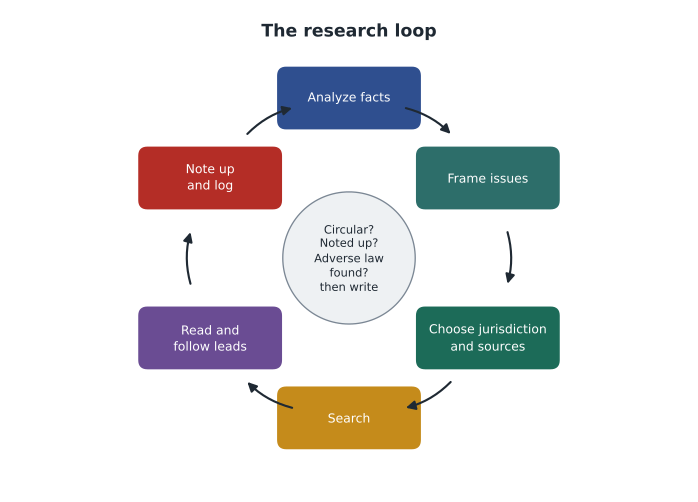
Good research is iterative. A relevant case cites other cases and statutes; read the important ones. A citator shows later decisions that cite the case; read the relevant ones. A practice paper mentions a recent appeal; find it. Each source you read should refine your understanding of the issue and may change your search terms. Saltire calls this the snowball method, and she is fond of pointing out that it works especially well in a slip-and-fall case.
Step five: keep a research log
A research log records what you searched, where, when and what you found. It prevents you from repeating searches, shows a supervisor what you have and have not covered, and protects you if you are later asked how you reached a conclusion. A good log entry is short: the date, the source, the search or path used, the number of results reviewed, and a note of anything relevant with its citation. Saltire requires every student to hand in a research log with the Ingram memo, and she reads them. 'The log tells me whether a good answer was luck or method,' she says.
Step six: know when to stop
Research could go on forever, and clients do not pay for forever. The usual sign that research is complete is circularity: new searches and new sources keep returning authorities you have already found and read, and no new lines of argument appear. Before stopping, confirm that you have the leading authorities in the binding courts, that every authority you will rely on has been noted up, that you have checked for recent amendments and decisions, and that you have looked for authority that cuts against your client's position. Failing to find and deal with adverse authority is one of the most common and most serious research failures, and lawyers have a professional duty not to mislead a court about the state of the law.
Time also matters. A supervising lawyer may ask for an answer in an hour, a day or a week, and the research should be scaled to that. Saltire advises students to ask how much time they have and what form the answer should take before they start, and to report honestly what they did not have time to check.
Research on a budget
Not every client can pay for unlimited research, and not every lawyer has access to every database. Legal aid clinics, sole practitioners and in-house lawyers often work mainly with CanLII, government websites, court websites and the resources of their local law association library. Ontario's county and district law libraries, supported by LibraryCo and the Law Society, give lawyers access to commercial databases and print collections they might not otherwise afford. Law students should take advantage of the free training sessions offered by the commercial publishers, but should also practise answering questions using only free sources, because their first job may require it. Saltire sets the class a short exercise: answer one research question on the Ingram file using only free sources, and record what was harder without the commercial tools.
A first pass at the Ingram research
By the end of the class, the students have a plan. Theo Marchetti and Hannah Kowalczyk draft theirs together on a single page. Orient in the CED title on occupiers' liability and a recent practice paper on snow-and-ice claims. Read the current Occupiers' Liability Act, especially section 6.1, on e-Laws, and find the amending statute and its in-force date. Look for legislative debates on the amendment. Search CanLII for Ontario decisions applying section 6.1, especially on reasonable excuse and prejudice. Search for decisions interpreting the similar notice provision in the Municipal Act, 2001, because the wording is similar and the case law is older. Check the Limitations Act, 2002 for the basic limitation period. Note up everything. Log everything. 'That,' Saltire says when she reads it, 'is a plan I could give to an articling student on their first day.'
Practice problems
Work each problem on paper first, then reveal the answer to check.
Rewrite this vague issue as a research question: 'Can Rosa still sue the plaza?'
Show answer
For example: 'Under section 6.1 of the Ontario Occupiers' Liability Act, does Rosa Ingram's failure to give written notice of her snow-and-ice injury within sixty days bar her action against Corwin Plaza Holdings and Northline Snow Services, and if so, can she rely on the exception for reasonable excuse where the defendants are not prejudiced?'
A natural language search for slip-and-fall notice cases returns 4,000 results. Suggest three ways to narrow it.
Show answer
Limit to Ontario courts; limit to decisions from 2021 onward; add the statute name or the phrase 'reasonable excuse'; use a Boolean search requiring snow or ice within a short distance of notice; search within results for 'section 6.1'.
Why should you check more than one platform for important research?
Show answer
Coverage, editorial content and citator treatment differ between platforms. A decision, digest or secondary source may appear on one and not another, and citators sometimes characterize treatment differently.
What is circularity, and why is it a useful signal?
Show answer
Circularity occurs when new searches and sources keep leading back to authorities you have already found. It suggests you have covered the field, although you must still confirm currency, note up authorities and look for adverse authority before stopping.
Summary and key terms
- CanLII and government and court websites provide free access to current Canadian decisions and legislation; CanLII's AI summaries help triage but do not replace reading decisions.
- Lexis+ (LexisNexis), Westlaw (Thomson Reuters) and vLex (now owned by Clio) add editorial content, citators and AI tools; coverage overlaps but is not identical.
- Plan before searching: analyze the facts, frame specific issues, identify the jurisdiction and choose sources.
- Use natural language searching to start and terms and connectors searching for precision; check each platform's syntax and use filters.
- Follow leads iteratively, keep a research log, and stop when research becomes circular, after noting up authorities and looking for adverse authority.
- CanLII
- The Canadian Legal Information Institute, a free website of Canadian decisions and legislation funded by the law societies and built by Lexum.
- Terms and connectors searching
- Searching with Boolean operators, phrases, truncation and proximity connectors to control precisely what results must contain.
- Natural language searching
- Searching with ordinary words, with results ranked by relevance.
- Research log
- A record of searches, sources, dates and findings kept during a research project.
- Circularity
- The point at which new searches return only authorities already found, suggesting research is complete.
- Adverse authority
- Law that cuts against the client's position, which a lawyer must find, assess and, where required, disclose.
Lesson quiz · 5 questions
Score 60% or more to complete this lesson.
Create a free account to save your progress, take quizzes and earn a certificate.