
LAWC-104 · Lesson 11 of 12 · 18 min
Writing a legal memo
▶ Video coming soon A video version of this lesson is on the way.
Professor Saltire opens the class on legal writing with a story from her years as a research lawyer at the Court of Appeal for Ontario. A judge once handed back one of her early memos, twenty pages long and full of careful research, with a single question written across the top: 'So what is the answer?' The answer was on page seventeen. 'I had done the research,' Saltire says. 'I had not done the writing. The reader of a memo is busy, usually more senior than you, and needs to make a decision. Your job is to give them the answer first, explain it clearly, and show them exactly how much they can rely on it.'
This lesson explains the purpose and structure of the objective legal memorandum, the most common piece of writing junior lawyers produce, and the principles of clear legal writing that apply to every document a lawyer writes. The next lesson puts them together in a complete memo on the Ingram file.
What a memo is for
A legal memorandum is an internal document, usually written by a junior lawyer, articling student or law clerk for a supervising lawyer, analyzing a legal question that arises on a client's file. It is objective, not persuasive: its job is to predict how a court or other decision-maker is likely to resolve the question, including the weaknesses in the client's position, so that the supervising lawyer can advise the client and decide what to do. A memo that hides bad news is worse than useless, because it leads to bad advice. The persuasive documents lawyers write, such as factums, demand letters and submissions, come later and draw on the memo's analysis.
Memos are also records. They may be read months later by another lawyer picking up the file, so they must stand on their own: the question, the facts relied on and the research done should be clear to a reader who knows nothing about the file.
The structure of a memo
Firms and instructors use slightly different formats, but nearly all memos contain the same parts in roughly this order.
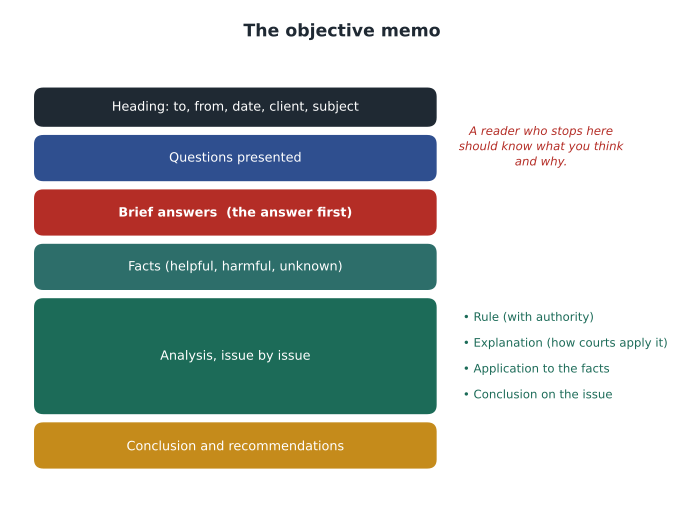
The heading identifies who the memo is to and from, the date, the client and file, and a short subject line. The date matters because the law may change after the memo is written, and a reader needs to know how current the analysis is.
The question presented, or issues, states the precise legal question or questions the memo answers. A good question combines the legal rule and the key facts in one sentence: 'Under section 6.1 of the Occupiers' Liability Act, is a claim for an injury caused by ice in a commercial parking lot barred where the plaintiff gave no written notice within sixty days, but told the property manager orally the next day?' Where there are several issues, number them and answer them in the same order throughout.
The brief answer, sometimes called the short answer or conclusion, answers each question directly in a few sentences, usually beginning with a word such as 'probably', 'probably not' or 'yes'. It gives the key reason in one or two sentences. A busy reader who reads only the brief answer should know what you think and why.
The facts set out the facts relevant to the analysis, objectively and in a logical order, usually chronological. Include the facts that help and the facts that hurt. Identify facts that are unknown or uncertain and that could change the answer, so that the supervising lawyer knows what to find out. Do not include facts you do not use in the analysis, and do not include legal conclusions disguised as facts.
The analysis, also called the discussion, is the heart of the memo. It explains the law and applies it to the facts, issue by issue, and reaches a reasoned conclusion on each. It is where the research appears, with full citations and pinpoints.
The conclusion summarizes the answers and, often, recommends next steps: further facts to gather, deadlines to meet, steps to take. Some formats put recommendations in a separate section.
Organizing the analysis
Most legal analysis follows a pattern that law students learn under various acronyms. IRAC stands for issue, rule, application, conclusion. CREAC, a variation popular in legal writing courses, stands for conclusion, rule, explanation of the rule (how courts have applied it), application to the facts, and conclusion again. Both capture the same idea: for each issue, state the governing rule with authority, explain how the courts have interpreted and applied it, apply it to the client's facts, and conclude.
The explanation of the rule is where weak memos fail. It is not enough to state that the test for reasonable excuse is whether, in all the circumstances, it was reasonable for the plaintiff not to give notice until she did. The reader needs to know what kinds of circumstances courts have accepted and rejected, with examples from the cases, so that the application to the client's facts is convincing. A strong explanation synthesizes the cases: it identifies the principle that explains the results, rather than summarizing one case after another.
The application must engage with the facts. Compare the client's facts with the facts of the decided cases, explaining which are similar and which are different, and why the differences matter. Address counterarguments: what will the other side say, and how is a court likely to respond? Where the answer is uncertain, say so, and explain what would make it more or less likely.
Writing clearly
Legal writing has a reputation for being dense and pompous, but the best lawyers and judges write plainly. Saltire gives the class a short list of principles, drawn from the plain language movement that has influenced Canadian legislation, court rules and judgments.
- Put the point first. Begin each section, and usually each paragraph, with its main point, then support it.
- Prefer short sentences and familiar words. Use a technical term when it is the precise legal term, and explain it if the reader may not know it.
- Use the active voice where it is clearer: 'The plaintiff gave no written notice' rather than 'No written notice was given by the plaintiff', unless the actor is unknown or unimportant.
- Be precise. Legal words have legal meanings. Do not use 'shall', 'must' and 'may' interchangeably, do not call a statute a regulation, and do not describe an obiter comment as a holding.
- Be consistent. Once you call Corwin Plaza Holdings Inc. 'the owner', do not switch to 'the landlord' or 'the plaza' unless you mean something different.
- Use headings and short paragraphs so the reader can find things.
- Quote sparingly and accurately. Quote the words of a statute when the wording matters, and quote a court's statement of a test. Otherwise paraphrase, with a pinpoint.
- Cut. Most first drafts can lose a third of their words without losing any content.
Objective tone
An objective memo predicts; it does not advocate. Use measured language that conveys the strength of each conclusion: 'a court will almost certainly', 'a court is likely to', 'it is arguable that', 'there is a real risk that'. Avoid adjectives that signal advocacy, such as 'clearly' and 'obviously', unless the point really is beyond dispute. Present adverse authority fairly and explain how it might be distinguished, rather than leaving it out. Saltire tells the class that a supervising lawyer who catches a memo concealing a bad case will never trust that writer's memos again.
Citing in a memo
Citations in a memo follow the conventions in lesson 9, adapted to the firm's style. Every statement of law needs authority, and every authority needs a pinpoint. Cite primary sources for the law, not secondary ones, except where the secondary source adds analysis that no primary source supplies. Be explicit about the court and date of each decision when they affect its weight. Where the research has found no authority on a point, say so, and say how thoroughly you looked; 'I found no Ontario decision applying this provision to a contractor' is valuable information.
Editing and proofreading
Good memos are rewritten, not just written. Saltire recommends three separate passes. First, a structural edit: does the memo answer the question asked, are the issues in a logical order, does the brief answer match the analysis, and could a busy reader find everything? Second, a line edit: is each paragraph clear, does each sentence earn its place, are terms used consistently? Third, a proofread and citation check: spelling, grammar, numbers, dates and every citation and pinpoint checked against the source. Reading the memo aloud, or on paper, catches errors that the eye skips on screen.
Deadlines and dates deserve special attention. A memo that miscalculates a limitation period or notice deadline can cause real harm. State the rule for counting time, show the calculation, and flag any uncertainty prominently.
A model paragraph
Saltire shows the class two versions of the same paragraph of analysis from an earlier year's memo on a different file. The first reads: 'In the case of Smith, which was decided in 2019, the court held that the plaintiff, who had been injured, did not have a reasonable excuse, and the claim was dismissed. In Jones, the court held the opposite. Therefore our client may or may not have a reasonable excuse.' The second reads: 'Courts have accepted that a plaintiff whose injuries required hospitalization and surgery may have a reasonable excuse for notice given a few weeks late, but have rejected excuses based only on ignorance of the requirement. Our client was in surgery and then on strong pain medication for most of the notice period, which places her closer to the first group, although she was back at work for three weeks before she consulted a lawyer.' The second is shorter, synthesizes the cases, applies them to the facts and acknowledges the weakness. (The names in the first version were placeholders, and the second version omits citations only because it is an illustration.)
Writing for different readers
Not every memo goes to a senior litigator who wants every authority. Some supervising lawyers want a one-page answer they can forward to a client with light editing. Others want the full research so they can draft a factum. Some files call for a short email memo; others for a formal document that will sit in the file for years. Before writing, ask who will read the memo, what they will do with it and how much time they have. A lawyer who needs to decide by tomorrow morning whether to send a demand letter needs the brief answer and the recommendations above all; a lawyer preparing for a contested motion needs the explanation of the rule and every authority, carefully pinpointed.
Email memos deserve a word of their own, because they are now the most common form. The same structure applies, compressed: a subject line that states the question, a first paragraph that gives the answer, a short explanation with the key authorities, and a closing paragraph with next steps and any urgent dates. Resist the temptation to treat email as informal. An email memo is still legal advice, it will be saved in the file, and it may be forwarded. Write it with the same care, cite the same way, and keep a copy of the research log behind it.
Length is a matter of judgment. Saltire's limit of 2,500 words for the Ingram memo is typical of the length a supervising lawyer will actually read for a single issue. If a memo grows much longer, it often means the writer is summarizing every case found rather than synthesizing the law, or answering questions that were not asked. When a file really does raise several separate issues, consider whether separate memos, each with its own brief answer, would serve the reader better.
Common mistakes
Common mistakes
MistakeBurying the answer at the end of the analysis.
InsteadGive a direct brief answer at the start and a clear conclusion on each issue.
MistakeSummarizing cases one after another without connecting them.
InsteadSynthesize the cases into the principle that explains them, then apply it.
MistakeLeaving out facts or authorities that hurt the client.
InsteadPresent them fairly and assess their effect; the memo is objective.
MistakeWriting 'clearly' and 'obviously' about uncertain points.
InsteadUse calibrated language that conveys how confident the prediction is.
MistakeMiscalculating or failing to flag a deadline.
InsteadState the rule for counting time, show the calculation and highlight urgent dates.
Practice problems
Work each problem on paper first, then reveal the answer to check.
Write a question presented for the notice issue in the Ingram file.
Show answer
For example: 'Under section 6.1 of the Occupiers' Liability Act, is Rosa Ingram's action for injuries from a fall on ice in a commercial parking lot on February 4, 2026 barred because she did not give written notice within sixty days, where she told the property manager orally the next day and was undergoing surgery and recovery during much of the notice period?'
What is the difference between the 'R' and the 'E' in CREAC?
Show answer
The rule (R) states the governing legal principle with authority. The explanation (E) shows how courts have interpreted and applied the rule in decided cases, which gives the reader the basis for applying it to the client's facts.
Rewrite in plain language: 'It is respectfully submitted that the aforementioned notice was not provided within the prescribed time period by the plaintiff.'
Show answer
For example: 'The plaintiff did not give notice within the required sixty days.' (In an objective memo, 'it is respectfully submitted' is inappropriate; that phrase belongs in persuasive writing to a court.)
Why should an objective memo include adverse authority?
Show answer
Because its purpose is to predict the outcome accurately so the supervising lawyer can advise the client. Leaving out adverse authority leads to bad advice and destroys the writer's credibility; it may also lead to breaches of the duty not to mislead the court later.
Summary and key terms
- An objective memo predicts how a legal question is likely to be resolved, including weaknesses, so a supervising lawyer can advise the client.
- Standard parts: heading, question presented, brief answer, facts, analysis and conclusion with recommendations.
- Organize each issue using IRAC or CREAC, and synthesize the cases rather than summarizing them one by one.
- Write plainly: point first, short sentences, active voice, precise and consistent terms, headings, sparing quotation.
- Use calibrated, objective language and present adverse authority fairly.
- Edit in passes, check every citation and pinpoint, and show deadline calculations explicitly.
- Objective memorandum
- An internal document predicting how a legal question is likely to be decided, including the weaknesses in the client's position.
- Question presented
- A precise statement of the legal question the memo answers, combining the rule and key facts.
- Brief answer
- A short, direct answer to the question presented with the main reason.
- IRAC
- Issue, rule, application, conclusion: a common structure for legal analysis.
- CREAC
- Conclusion, rule, explanation, application, conclusion: a variation of IRAC emphasizing explanation of the rule.
- Synthesis
- Combining several decisions into the principle that explains their results.
- Plain language
- Writing designed to be understood by its intended readers on first reading.
Lesson quiz · 5 questions
Score 60% or more to complete this lesson.
Create a free account to save your progress, take quizzes and earn a certificate.