
LAWC-104 · Lesson 7 of 12 · 18 min
Statutes and regulations
▶ Video coming soon A video version of this lesson is on the way.
Sophie Tremblay-Hart arrives at the Friday class with a printout of section 6.1 of the Occupiers' Liability Act and a question. The printout came from a website she found through a search engine, and it looks official. But when she compared it with the version on Ontario's e-Laws site, the wording of one subsection was different. Which is right? Professor Saltire asks her to look at the bottom of the printout. The page was copied from a commercial site in 2022 and has not been updated since. 'Statutes are living documents,' Saltire says. 'They are amended, renumbered, repealed and brought into force in pieces. The single most common research error I see from new lawyers is citing a version of a statute that is not in force on the relevant date. Today you learn how to make sure that never happens to you.'
This lesson explains how legislation is made, how to find current and historical versions of federal and Ontario statutes and regulations, how to track bills and coming-into-force provisions, and how to research legislative history. The examples come from the Ingram file, where the key provision, section 6.1 of the Occupiers' Liability Act, was added by an amending statute in 2020.
How a bill becomes law
Federal legislation begins as a bill introduced in the House of Commons or the Senate. Government bills introduced in the House are numbered C- followed by a number, and those introduced in the Senate are numbered S-. A bill passes through first reading, second reading (debate on its principle), committee study (clause-by-clause review, often with witnesses), report stage and third reading in one House, and then through the same stages in the other. It becomes law when it receives royal assent. Ontario has a single chamber, the Legislative Assembly, and its bills are numbered simply Bill 1, Bill 2 and so on in each session, but they also pass through readings and committee before royal assent from the Lieutenant Governor.
Royal assent does not always mean that a statute is in force. A statute may come into force on assent, on a date it specifies, or on a day fixed by proclamation or order of the government, and different sections may come into force at different times. Under the federal Interpretation Act, a federal statute with no coming-into-force provision comes into force on royal assent. Ontario's Legislation Act, 2006 sets out similar rules for Ontario. A careful researcher always checks the coming-into-force provisions, usually found at the end of an Act or in notes to each section.
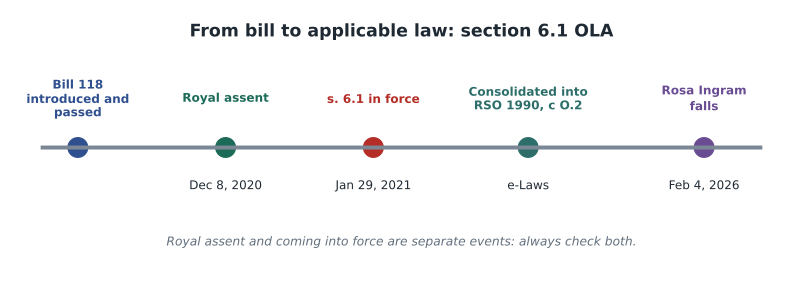
Amending statutes deserve particular attention. Many statutes are amended not by rewriting them, but by separate amending Acts that add, change or repeal particular sections. The Occupiers' Liability Amendment Act, 2020, SO 2020, c 33, introduced as Bill 118, is an example: it added section 6.1 to the Occupiers' Liability Act, requiring written notice within sixty days of an injury caused by snow or ice. It received royal assent on December 8, 2020, and the new section came into force on January 29, 2021.
Statute revisions and consolidations
From time to time a government publishes a revision, a complete re-enactment of its statutes in a new numbered series. The last general revisions were the Revised Statutes of Canada, 1985 (RSC 1985) and the Revised Statutes of Ontario, 1990 (RSO 1990). That is why the Occupiers' Liability Act is cited RSO 1990, c O.2 and the federal Interpretation Act RSC 1985, c I-21. Statutes enacted after a revision are cited to the annual volume in which they appear, such as SO 2002, c 24, Sch B for Ontario's Limitations Act, 2002, which was enacted as a schedule to a larger Act.
Between revisions, a consolidation brings a statute up to date by incorporating all the amendments in force as of a particular date. Consolidations are what researchers use every day. The question is whether a given consolidation is official, current and complete.
Federal legislation: Justice Laws
The Justice Laws website, maintained by the federal Department of Justice, publishes consolidated federal statutes and regulations. Under the Legislation Revision and Consolidation Act, the consolidations published there have been official since 2009, meaning they are evidence of the law and can be cited and relied on in court. Each statute page shows the date to which it is current and the date of the last amendment. Justice Laws also provides previous versions, so you can see the law as it stood on an earlier date; lists amendments that have been enacted but are not yet in force; and links to the enabling statute of each regulation.
Federal regulations are published in Part II of the Canada Gazette when they are made, and are identified by a SOR number (Statutory Orders and Regulations), such as SOR/2019-123, or an SI number for other statutory instruments. Older regulations from the 1978 consolidation are cited CRC (Consolidated Regulations of Canada). Proposed regulations appear first in Part I of the Gazette for public comment.
Ontario legislation: e-Laws
Ontario publishes its statutes and regulations on the e-Laws website. For each statute, e-Laws offers the current consolidated version, the source law (each statute and amending Act as originally enacted), and point-in-time versions showing the consolidated law as it stood during earlier periods. It also shows which amendments are not yet in force and links each section to the Acts that amended it. Ontario's Legislation Act, 2006 governs the official status of the e-Laws versions, and e-Laws indicates which versions are official copies.
Ontario regulations are identified as O. Reg. followed by a number and the year, such as O. Reg. 384/24, the 2024 amendment to the Rules of Civil Procedure that lesson 10 discusses. Older regulations consolidated in 1990 are cited RRO 1990, Reg followed by a number. Regulations are filed with the Registrar of Regulations and published on e-Laws, and they come into force on filing unless they say otherwise.
For the Ingram file, the e-Laws history of the Occupiers' Liability Act shows the change clearly. The point-in-time version for 2020 has no section 6.1. The current version does. The source law link leads to SO 2020, c 33, and its coming-into-force section. Because Rosa Ingram fell in February 2026, long after the section came into force, the current version applies to her. If her fall had been in December 2020, the researcher would have needed the earlier version and any transitional rules.
Point-in-time research
The relevant version of a statute depends on the question. Usually it is the version in force when the events happened, for example on the date of an accident or the signing of a contract. Sometimes it is the version in force when a proceeding was started or when a decision was made. Limitation periods, procedural rules and transitional provisions can make this complicated. The researcher's job is to identify the relevant date and then find the version in force on that date, using point-in-time tools, source law and the amending Acts' transitional sections.
A related trap involves case law. An older decision interpreting a statute may have interpreted a different version of it. Before relying on a decision's interpretation, check that the words it interpreted are the same as the words in force now. Saltire tells the class about a junior lawyer who cited three Court of Appeal decisions on a limitation period, all of them decided under a statute that had been repealed and replaced years earlier.
Tracking bills and pending changes
Law changes constantly, so researchers check for bills that might change the answer. For federal bills, LEGISinfo, run by the Library of Parliament, shows each bill's text at every stage, its status, and links to debates and committee proceedings. For Ontario bills, the Legislative Assembly's website shows the bill's text, status and debates. Ontario regulations proposed for comment appear on the Ontario Regulatory Registry, and federal proposals in Part I of the Canada Gazette. A memo should mention any bill or proposed regulation that could affect the client, even if it is not yet law.
Legislative history
Legislative history is the record of how a statute was made: earlier versions of the bill, debates in the legislature (Hansard), committee transcripts and reports, government backgrounders and explanatory notes, and, sometimes, earlier law reform reports. Courts may use legislative history to understand the purpose of a provision and the problem it was meant to solve. In Rizzo, the Supreme Court considered statements made in the Ontario legislature about a 1981 amendment. The Court has also cautioned that statements by individual legislators have limited weight, because a statute is the act of the whole legislature, not of the member who spoke in debate.
Federal debates are published as the House of Commons Debates and the Debates of the Senate. Ontario's debates are published as the Official Report of Debates (Hansard) of the Legislative Assembly. All are available free online and are searchable by bill number and date. Committee proceedings are published separately and often contain the most detailed discussion of what a provision was meant to do, because committees hear from witnesses such as industry groups, lawyers and community organizations.
For the Ingram research, the class searches Ontario Hansard for Bill 118 and reads the debates and committee proceedings for themselves, alongside law firm bulletins published when the bill passed. The problem the amendment addressed is apparent from the section's structure and from that commentary: snow-and-ice claims could reach property owners and their contractors months or even years after an incident, when weather conditions, maintenance records and witnesses could no longer be checked. A short written notice period gives occupiers and contractors a chance to investigate while the evidence is still available. Saltire reminds the students to quote the debates accurately in their memos and to give them modest weight. The purpose matters for interpretation. It suggests that the key question under the exception is whether late notice actually prevented the defendants from investigating, which connects directly to the prejudice requirement.
Regulations and the enabling statute
Every regulation depends on its enabling statute, so always read the two together. Find the regulation-making power in the statute and check that the regulation fits within it. Look for definitions in both, since a regulation may define terms differently or rely on the statute's definitions. Many statutes leave important details entirely to regulations: thresholds, forms, deadlines, exemptions and fees. In occupiers' liability, for example, the duty of care comes from the statute and the common law, but regulations under other statutes, such as building and fire codes, may provide evidence of the standard of care in a particular case.
Interpretation statutes
Both levels of government have interpretation statutes that apply to all their legislation unless a particular statute provides otherwise. The federal Interpretation Act and Ontario's Legislation Act, 2006 define common words, set rules for computing time, state that statutes speak continuously, and declare that every enactment is to be given a fair, large and liberal interpretation that best ensures the attainment of its objects. They are among the most useful statutes a researcher can know, and they answer many practical questions, such as how to count a sixty-day period. Lesson 8 explains their role in statutory interpretation.
Common mistakes
Common mistakes
MistakeCiting a statute from an unofficial website without checking its currency.
InsteadUse Justice Laws or e-Laws, note the currency date, and check for amendments not yet consolidated.
MistakeAssuming that royal assent means a provision is in force.
InsteadCheck the coming-into-force provisions and any proclamations or orders.
MistakeApplying the current version of a statute to events that happened years ago.
InsteadIdentify the relevant date and use point-in-time versions and transitional provisions.
MistakeReading a regulation without its enabling statute.
InsteadRead the statute's regulation-making power and definitions alongside the regulation.
Practice problems
Work each problem on paper first, then reveal the answer to check.
Rosa Ingram's fall was on February 4, 2026. Which version of the Occupiers' Liability Act applies, and how would you confirm it?
Show answer
The version in force on February 4, 2026, which includes section 6.1. Confirm on e-Laws by checking the point-in-time version covering that date and the coming-into-force provision of SO 2020, c 33, which brought section 6.1 into force on January 29, 2021.
A federal statute received royal assent last month but its key section says it comes into force on a day to be fixed by order of the Governor in Council. Is the section in force?
Show answer
Not until an order fixing the date has been made and that date has arrived. Check Justice Laws (amendments not in force) and Part II of the Canada Gazette for the order.
Where would you find the debates on Bill 118 and why might they matter?
Show answer
In the Official Report of Debates (Hansard) of the Legislative Assembly of Ontario and the relevant committee proceedings, searchable on the Assembly's website. They can show the purpose of the sixty-day notice requirement, which may help interpret the reasonable excuse exception, although statements by individual members carry limited weight.
What does the citation O. Reg. 384/24 tell you?
Show answer
It is Ontario regulation number 384 filed in 2024.
Summary and key terms
- Bills pass through readings and committee and become law on royal assent, but coming into force may be on assent, on a fixed date or by proclamation or order, section by section.
- Revisions (RSC 1985, RSO 1990) re-enact statutes; consolidations incorporate amendments to a date.
- Justice Laws publishes official federal consolidations, previous versions and amendments not in force; e-Laws publishes Ontario consolidations, source law and point-in-time versions.
- Regulations are cited by SOR or O. Reg. numbers and must be read with their enabling statutes.
- Always identify the relevant date and use the version in force on that date; check that older cases interpreted the same wording.
- Legislative history, including Hansard and committee proceedings, can reveal a provision's purpose, but individual statements have limited weight.
- Section 6.1 of the Occupiers' Liability Act was added by SO 2020, c 33 (Bill 118), assented to December 8, 2020 and in force January 29, 2021.
- Royal assent
- The final step that makes a bill law, given by the Governor General federally or the Lieutenant Governor provincially.
- Coming into force
- The point at which a statute or provision takes legal effect, which may be later than royal assent.
- Consolidation
- A version of a statute incorporating all amendments in force as of a stated date.
- Point-in-time version
- The consolidated text of a statute as it stood during a past period.
- Source law
- A statute or amending Act as originally enacted, before consolidation.
- Enabling statute
- The statute that authorizes the making of a regulation.
- Hansard
- The official record of debates in a legislature.
Lesson quiz · 5 questions
Score 60% or more to complete this lesson.
Create a free account to save your progress, take quizzes and earn a certificate.