
LAWC-104 · Lesson 10 of 12 · 18 min
Generative AI and responsible research
▶ Video coming soon A video version of this lesson is on the way.
Halfway through the Ingram assignment, Hannah Kowalczyk shows Professor Saltire a paragraph produced by a general-purpose AI chatbot. It explains the sixty-day notice rule fluently, cites two Ontario Court of Appeal decisions on reasonable excuse, and quotes a sentence from each. It reads like a good memo. Saltire asks Hannah to find the two decisions on CanLII. One exists, but the quoted sentence is not in it. The other does not exist at all: the style of cause, the neutral citation and the quotation were all invented. 'Now you know why this lesson is in the course,' Saltire says. 'These tools can be genuinely useful. They can also produce confident, plausible, completely false law. A lawyer who cannot tell the difference is a danger to clients and to the courts.'
This lesson explains how generative AI tools work and fail, what Canadian courts and law societies now require, how to use these tools responsibly in research and writing, and how the duties of competence, honesty and confidentiality apply. It also explains the rules that apply to students in this course.
What generative AI tools do
Generative AI tools based on large language models produce text by predicting likely sequences of words, based on patterns learned from enormous amounts of training data. They are very good at producing fluent prose, summarizing documents they are given, suggesting structures, rephrasing, and answering general questions. They do not, by default, look anything up or check whether what they produce is true. When asked about law, a general-purpose model may produce an accurate summary, an outdated one, one that mixes up jurisdictions, or one that invents cases, quotations and statutes. These inventions are commonly called hallucinations, and they are especially dangerous because they look exactly like real law.
Legal research tools built by the commercial publishers, such as Lexis+ AI, the CoCounsel tools in Westlaw and vLex's Vincent, are designed differently. They generally retrieve documents from the publisher's database and generate answers grounded in those documents, with links to the sources. This retrieval-based design reduces invented citations but does not eliminate errors: a tool can misread a case, rely on an outdated version of a statute, miss a recent decision, or describe a dissent as the majority. CanLII's AI summaries are another kind of tool: they summarize a single decision or statute and help with triage, but they are not the reasons.
The practical lesson is the same for all of them. An AI tool can help you start, organize and draft. It cannot be the authority for any statement of law, and everything it tells you must be checked against the primary sources.
When things go wrong: the cases
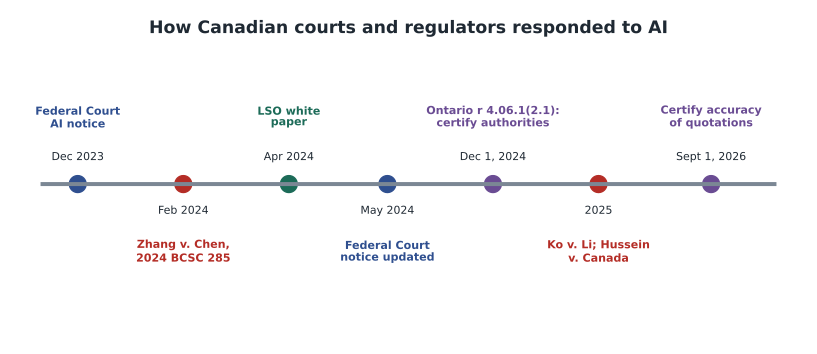
Canadian courts have dealt with fabricated authorities several times. In Zhang v. Chen, 2024 BCSC 285, a family law lawyer in British Columbia filed a notice of application that cited two cases that did not exist. She explained that she had obtained them from ChatGPT and had not verified them. The other side spent time looking for them before raising the problem. The Supreme Court of British Columbia declined to order special costs, but held the lawyer personally responsible for costs caused by the error, and warned that citing fake cases in court filings is an abuse of process and could amount to misleading the court. The judge emphasized that generative AI is still no substitute for the professional expertise that the justice system requires of lawyers.
In Ko v. Li, 2025 ONSC 2766, an Ontario lawyer's written submissions cited cases that did not exist. The Superior Court of Justice required the lawyer to attend a hearing on whether she should be found in contempt. After she acknowledged the problem, apologized and took corrective steps, including professional development on the risks of AI, the court found that the possible contempt had been adequately addressed. In Hussein v. Canada (Immigration, Refugees and Citizenship), 2025 FC 1060, the Federal Court ordered special costs after counsel twice produced incomplete books of authorities and did not disclose the use of AI, finding that concealing it amounted to misleading the court.
Similar cases have arisen across Canada, in the United States and elsewhere, involving lawyers, self-represented litigants and even expert witnesses. The pattern is always the same: a tool produced plausible text, the person relying on it did not check it, and the court and opposing party wasted time and money finding out that the law cited did not exist.
What Ontario's rules now require
Ontario responded with amendments to the Rules of Civil Procedure made by O. Reg. 384/24, in force December 1, 2024. Rule 4.06.1(2.1) now requires a factum to include a statement signed by the party's lawyer, or by the party if self-represented, certifying that the person signing is satisfied as to the authenticity of every authority listed in the factum. Rule 4.06.1(2.2) provides that an authority published on a government website, by a government printer, on CanLII, on a court's website or by a commercial publisher of court decisions is presumed authentic, absent evidence to the contrary. Parallel amendments require experts to certify the authenticity of the authorities cited in their reports. The certification applies whether or not AI was used: its point is that the person signing has checked.
A further amendment, O. Reg. 275/26, in force September 1, 2026, extends the certification in factums and expert reports to the accuracy of quotations attributed to authorities. In practice, this means that a lawyer who quotes a passage from a decision must have checked that the passage appears, word for word, in the decision. The Ingram chatbot paragraph that Hannah showed Saltire would have failed both requirements.
Court notices and practice directions
Several Canadian courts have issued notices or practice directions on AI. The Federal Court's notice, first issued in December 2023 and updated on May 7, 2024, requires parties to include a declaration in the first paragraph of a document submitted to the Court if content in it was created or generated by AI, identifying the AI-generated content. The declaration is not required where AI was used only to suggest changes that a human then reviewed and adopted. The notice also reminds parties that they remain responsible for the accuracy of everything they file. Courts in Manitoba, Yukon, Alberta, Quebec, Nova Scotia and elsewhere have issued their own notices, some requiring disclosure and others reminding counsel of existing duties of accuracy and verification. Before filing anything in any court, check that court's current practice directions.
Law society guidance and professional duties
Law societies have applied their existing rules of professional conduct to AI rather than creating entirely new ones. The Law Society of Ontario published a white paper on licensees' use of generative AI in April 2024, together with a quick-start checklist, best-practice tips and a summary of professional obligations. The guidance emphasizes several duties.
- Competence: lawyers must understand the benefits and risks of the technology they use, including its tendency to produce inaccurate output, and must review and verify AI-assisted work. The Federation of Law Societies' Model Code and the rules of several provinces, including Ontario, contain commentary on technological competence.
- Honesty and candour: lawyers must not mislead a court, which includes citing authorities that do not exist or misdescribing what they say.
- Confidentiality: lawyers must protect client information. Entering confidential facts into a public AI tool that may retain or use the data can breach that duty. Use tools with appropriate contractual and technical protections, and anonymize where possible.
- Supervision: lawyers remain responsible for work delegated to staff, students and tools.
- Fees: lawyers may bill only for time actually spent and must charge fair and reasonable fees, which affects how time saved by AI is reflected in accounts.
- Client communication: depending on the circumstances, a client may reasonably expect to be told how AI is being used on their file.
Federal legislation specifically regulating AI was proposed in 2022 as the Artificial Intelligence and Data Act, but that bill died when Parliament was prorogued in January 2025. Lawyers therefore work mainly within professional rules, court requirements, privacy law and contracts with their technology providers.
A responsible workflow
Bernard Tsang gives the class a workflow that fits both practice and this course.
- Decide what the tool is for. Brainstorming search terms, outlining the issues, summarizing a document you provide, and polishing your own prose are low-risk uses. Asking a general chatbot to tell you the law is high-risk.
- Never enter confidential client information into a tool that is not approved for it. For the Ingram exercise, the facts are fictional, but practise the habit anyway.
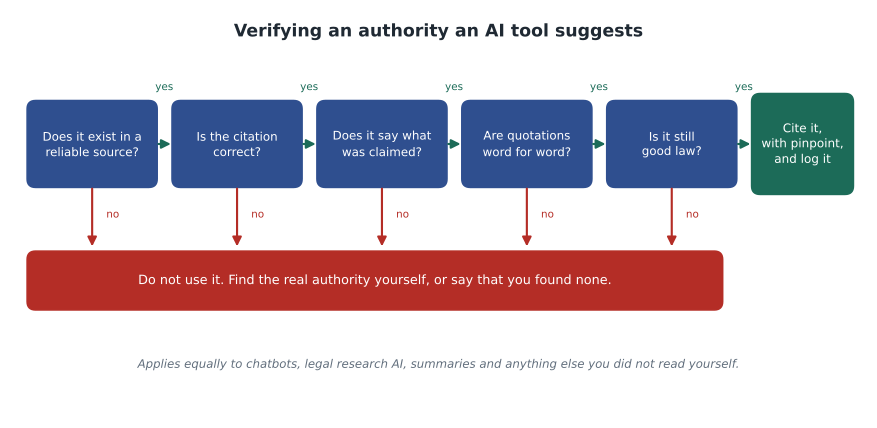
- Treat every authority the tool mentions as a lead. Find it yourself on CanLII, Justice Laws, e-Laws or a commercial platform. Confirm that it exists, that the citation is correct, that it says what the tool claims, and that it is still good law.
- Check quotations word for word against the source. If you cannot find the passage, do not use it.
- Do the noting up and the search for adverse authority yourself. AI tools are especially weak at telling you what they did not find.
- Record in your research log which tools you used and how, and follow any disclosure rules that apply.
- Take responsibility for the final product. If your name is on it, you are certifying it, whatever produced the first draft.
Where AI genuinely helps
Used this way, AI tools can be valuable. They can suggest search terms and synonyms you might not have thought of. They can produce a first outline of the issues in a complicated fact pattern, which you then test against the law. They can summarize long documents you supply, such as a contract or a transcript, to help you find the passages to read closely. Retrieval-based legal tools can point quickly to relevant decisions and secondary sources. And they can help with editing: tightening sentences, catching inconsistent defined terms and improving clarity. Many firms now use approved AI tools routinely, and a new lawyer who knows how to use them well, and safely, is an asset.
Theo Marchetti, who used early versions of these tools at his old firm, offers a comparison. 'It is like a very fast articling student who has read everything and remembers it badly,' he says. 'Useful for ideas. Never send its work out without checking it, and never let it near anything confidential.'
The rules for this course
Brannock University Faculty of Law has an academic integrity policy, and Professor Saltire's course rules apply it to AI. Students may use AI tools to brainstorm, to suggest search terms and to check grammar and style. They may not submit AI-generated analysis as their own work, and every authority cited in an assignment must have been located and read by the student in a reliable source. Students must describe any AI use in their research log. Saltire explains her reasons: the course exists to build the skills that make AI safe to use, and those skills cannot be built by outsourcing them.
Hannah's chatbot paragraph becomes a teaching example. She rewrites the analysis herself, finds the real Court of Appeal decisions on reasonable excuse, Crinson and Seif, reads them, and quotes them accurately with pinpoints. The invented decision is gone. In her research log she records what the chatbot produced, how she checked it, and what she found. Saltire gives her the highest mark in the section for that log entry.
Common mistakes
Common mistakes
MistakeCiting a case suggested by an AI tool without finding and reading it.
InsteadLocate every authority in a reliable source, read it, confirm the citation and pinpoint, and note it up.
MistakePasting confidential client facts into a public chatbot.
InsteadUse only approved tools with appropriate protections, and anonymize information.
MistakeAssuming that legal research AI tools cannot make mistakes because they cite real documents.
InsteadCheck that the cited documents say what the tool claims and are current.
MistakeIgnoring a court's practice direction on AI disclosure.
InsteadCheck the current notices of the court where you are filing and comply with them.
Practice problems
Work each problem on paper first, then reveal the answer to check.
What did the court do in Zhang v. Chen, 2024 BCSC 285, and why?
Show answer
Counsel cited two non-existent cases generated by ChatGPT without verifying them. The court declined special costs but held counsel personally responsible for costs caused by the error, warning that citing fake cases is an abuse of process and can mislead the court.
What does rule 4.06.1(2.1) of Ontario's Rules of Civil Procedure require, and which authorities are presumed authentic?
Show answer
A factum must include a signed statement certifying that the signer is satisfied as to the authenticity of every authority listed. Under rule 4.06.1(2.2), authorities from government websites or printers, CanLII, court websites and commercial publishers of court decisions are presumed authentic absent evidence to the contrary.
Under the Federal Court's AI notice, when must a declaration be made?
Show answer
When a document submitted to the Court contains content created or generated by AI; the declaration goes in the first paragraph and identifies the AI-generated content. It is not required where AI only suggested changes that a human reviewed and adopted.
Identify two professional duties engaged when a lawyer uses a public AI chatbot on a client file.
Show answer
Confidentiality (entering client information into a tool that may retain it) and competence (understanding the tool's risks and verifying its output); also honesty and candour if output is filed with a court, and supervision.
Summary and key terms
- Generative AI predicts likely text and can produce fluent but false law, including invented cases and quotations.
- Retrieval-based legal research tools reduce but do not eliminate errors; CanLII's AI summaries help triage but are not the reasons.
- Courts have responded firmly to fabricated authorities (Zhang v. Chen; Ko v. Li; Hussein v. Canada).
- Ontario rule 4.06.1(2.1), in force December 1, 2024, requires certification of the authenticity of authorities in factums; from September 1, 2026, certification extends to the accuracy of quotations.
- The Federal Court requires a declaration when AI-generated content is filed; other courts have their own notices.
- Professional duties of competence, candour, confidentiality, supervision and fair billing apply to AI use.
- Use AI for brainstorming, organizing and editing; locate, read, verify and note up every authority yourself.
- Generative AI
- Software that produces new text or other content by predicting likely outputs from patterns in training data.
- Hallucination
- Plausible but false output from an AI tool, such as an invented case or quotation.
- Retrieval-based tool
- An AI system that retrieves documents from a database and grounds its answer in them, with links to sources.
- Certification of authorities
- The statement required in Ontario factums that the signer is satisfied the authorities cited are authentic.
- Technological competence
- The professional duty to understand the benefits and risks of the technology a lawyer uses.
Lesson quiz · 5 questions
Score 60% or more to complete this lesson.
Create a free account to save your progress, take quizzes and earn a certificate.