
LAWC-104 · Lesson 2 of 12 · 20 min
Courts, precedent and stare decisis
▶ Video coming soon A video version of this lesson is on the way.
In the second week of term Professor Saltire draws a pyramid on the whiteboard and asks Section B to fill it in. Hannah Kowalczyk writes 'Supreme Court of Canada' at the top. Arjun Mehta adds 'Court of Appeal for Ontario' underneath. The base causes an argument. Theo Marchetti insists that the Superior Court of Justice and the Ontario Court of Justice are different courts, not two names for one, and that the Divisional Court is part of the Superior Court rather than a separate court. He is right on all three points, and Saltire uses the argument to make the lesson's main point: you cannot tell whether a decision binds a court until you know exactly which court made it and which court is being asked to follow it.
This lesson explains the structure of the courts that Ontario lawyers use most, the federal courts, and the doctrine of precedent, called stare decisis, which tells a researcher which decisions are binding and which are only persuasive. It also explains how to find the part of a decision that binds, the ratio decidendi, and how much weight to give the rest.
The courts of Ontario
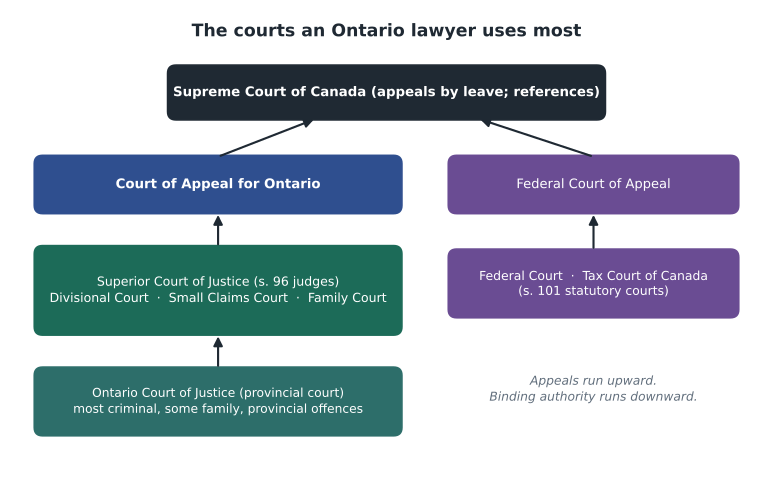
The Ontario Court of Justice is a provincial court whose judges are appointed by the province. It hears the great majority of criminal cases, including bail hearings and trials of most offences, many family law cases, youth criminal justice matters and provincial offences such as traffic charges. It has no inherent jurisdiction: it can only do what statutes allow it to do.
The Superior Court of Justice is Ontario's superior court of general jurisdiction. Its judges are appointed and paid by the federal government under section 96 of the Constitution Act, 1867. It hears civil claims of any amount, the most serious criminal cases, divorce and family property cases, estates and many other matters, and it has inherent jurisdiction to control its own process and supervise inferior tribunals. Three branches operate within it: the Small Claims Court for lower-value civil claims, the Family Court in some regions, and the Divisional Court, which hears certain appeals and most applications for judicial review of provincial tribunals, usually with a panel of three judges.
The Court of Appeal for Ontario is the province's highest court. It hears appeals from the Superior Court and, in criminal matters, from summary conviction appeal courts and some other decisions. It normally sits in panels of three judges. Its decisions bind every court in Ontario below it.
The Supreme Court of Canada sits at the top of the whole Canadian court system. It hears appeals from the courts of appeal of every province and territory and from the Federal Court of Appeal, almost always only with leave, which it grants in a small number of cases each year raising issues of public importance. It also answers reference questions from the federal government and, on appeal, from provincial reference opinions. Its decisions bind every other court in Canada.
The federal courts
Parliament has created several courts under section 101 of the Constitution Act, 1867. The Federal Court hears claims against the federal government, intellectual property cases, admiralty matters and judicial review of most federal tribunals and officials, including immigration decisions. The Federal Court of Appeal hears appeals from the Federal Court and judicial review of certain federal tribunals. The Tax Court of Canada hears appeals from tax assessments. The Court Martial Appeal Court hears appeals from military courts. These courts have only the jurisdiction Parliament gives them, and the line between their work and the provincial superior courts is a frequent research question in its own right.
Stare decisis: the basic rule
Stare decisis, short for stare decisis et non quieta movere, means to stand by things decided. The doctrine has two dimensions. Vertical stare decisis requires lower courts to follow the decisions of higher courts in the same hierarchy. Horizontal stare decisis concerns whether a court follows its own previous decisions or those of courts at the same level. The doctrine serves certainty, predictability, equality before the law and efficiency: people can plan their affairs, lawyers can advise them, and like cases are treated alike.
Vertical stare decisis is strict. The Supreme Court made this clear in Canada v. Craig, 2012 SCC 43, where the Federal Court of Appeal had declined to follow an earlier Supreme Court decision because later case law seemed to have undermined it. The Supreme Court held that the lower court should have followed the earlier decision and left it to the Supreme Court to decide whether to overrule it. A lower court may say that it thinks a binding decision is wrong, and explain why, but it must apply it.
The Supreme Court did recognize a narrow exception in Canada (Attorney General) v. Bedford, 2013 SCC 72, at paragraph 42: a trial judge may reconsider a binding precedent if a new legal issue is raised, or if there is a change in the circumstances or evidence that fundamentally shifts the parameters of the debate. The Court applied that reasoning again in Carter v. Canada (Attorney General), 2015 SCC 5, which departed from its own earlier decision on assisted dying. In R. v. Comeau, 2018 SCC 15, the Court emphasized that the threshold is high: new historical scholarship or a different view of old evidence is not enough on its own.
Horizontal stare decisis
The Supreme Court of Canada is not bound by its own previous decisions. It overrules them rarely and only for compelling reasons, for example when a decision has proved unworkable, has been undermined by later developments, or rests on reasoning the Court no longer accepts. Canada (Minister of Citizenship and Immigration) v. Vavilov, 2019 SCC 65, which reset the framework for judicial review of administrative decisions, is a prominent recent example of the Court changing direction.
Provincial courts of appeal generally follow their own previous decisions. In Ontario, the Court of Appeal has said that it may depart from one of its own decisions, but ordinarily does so only with a five-judge panel convened for that purpose, as discussed in David Polowin Real Estate Ltd. v. Dominion of Canada General Insurance Co. (2005), 76 OR (3d) 161 (CA). A three-judge panel that disagrees with an earlier panel is normally expected to follow it.
For superior trial courts, the Supreme Court settled the question in R. v. Sullivan, 2022 SCC 19. Judges of a superior court should follow the prior decisions of their own court on the same point unless one of three narrow exceptions applies: the rationale of the earlier decision has been undermined by later appellate decisions; the earlier decision was reached per incuriam, meaning through carelessness or inadvertence, for example by overlooking a binding authority or a relevant statute; or the earlier decision was not fully considered, for example because it was made in urgent circumstances without full argument. These criteria come from earlier Canadian cases, notably Re Hansard Spruce Mills Ltd., [1954] 4 DLR 590 (BCSC). Sullivan also held that a superior court judge's declaration that a law is unconstitutional binds other judges of the same court only through this ordinary horizontal stare decisis.
Binding and persuasive authority
Researchers sort every decision they find into one of two categories. A binding authority is one the court hearing the case must follow. A persuasive authority is one the court may consider and may adopt if it finds the reasoning convincing, but need not follow. The same decision can be binding in one court and only persuasive in another.
For an Ontario court, binding authorities are decisions of the Supreme Court of Canada and, for courts below it, decisions of the Court of Appeal for Ontario. A Superior Court judge should also generally follow other Superior Court decisions under the Sullivan approach. Decisions of other provinces' courts of appeal are persuasive in Ontario. They carry particular weight when they interpret a federal statute that applies across the country, because courts value national consistency in federal law. Decisions of courts in England, Australia, New Zealand and the United States are persuasive only, and their weight depends on how closely their law resembles ours and how good their reasoning is. Old English decisions from before Canada's courts developed their own jurisprudence still appear in Canadian judgments, but they are rarely decisive today.
Hannah asks whether a decision of the Alberta Court of Appeal binds an Alberta trial judge hearing a case under a federal statute when the Ontario Court of Appeal has disagreed. Saltire answers that the Alberta trial judge is bound by the Alberta Court of Appeal; the Ontario decision is persuasive there, just as the Alberta decision is persuasive in Ontario. Conflicts between provincial appellate courts are a classic reason for the Supreme Court to grant leave.
Ratio decidendi and obiter dicta
Not everything a court says is binding. The binding part of a decision is its ratio decidendi, the legal principle necessary to decide the case on the facts as the court found them. Statements that were not necessary to the decision are obiter dicta, sayings by the way. A judge might discuss what would have happened on different facts, comment on a related issue the parties did not argue, or explain the history of a doctrine. Those comments can be useful, but they do not bind in the same way.
The Supreme Court qualified this distinction in R. v. Henry, 2005 SCC 76. Writing for the Court, Justice Binnie said that the question is always what the case actually decided, and that obiter comes in different strengths. Some obiter is close to the ratio and is intended to give guidance; lower courts should treat that kind of guidance from the Supreme Court as authoritative. Other obiter is more distant commentary, and its weight decreases the further it is from the issues actually decided. In practice, Ontario courts treat considered guidance from the Supreme Court as very strong authority even where it was not strictly necessary to the result.
Finding the ratio takes practice. The researcher asks: what were the material facts; what was the legal question; what did the court decide; and what reasoning was essential to that answer? Headnotes and summaries can help, but they are written by editors, not judges, and they sometimes state the ratio too broadly or too narrowly. Lesson 6 develops this skill through case briefs.
Majority, concurring and dissenting reasons
Appellate courts sit in panels, and judges do not always agree. Majority reasons state the court's decision and carry its authority. Concurring reasons agree with the result but give different or additional reasoning; if no set of reasons has the support of a majority of the panel, identifying the binding principle can be difficult, and researchers look for the points on which a majority of judges agreed. Dissenting reasons disagree with the result. A dissent is not binding, but dissents are sometimes adopted later, and a strong dissent is a signal that the law may change.
Applying, following, distinguishing and overruling
Later decisions treat earlier ones in recognizable ways, and researchers need the vocabulary. A court follows a decision when it treats it as binding or adopts it. It applies a decision when it uses the principle on new facts. It distinguishes a decision when it explains that the earlier case is different in a material way and therefore does not control. It overrules a decision when a court with authority to do so declares that the earlier decision is no longer good law. A decision is reversed when the same case goes up on appeal and the appeal court changes the result. These terms appear in citator results, which lesson 5 explains, and a researcher who confuses reversed with overruled, or distinguished with doubted, will misdescribe the law.
Precedent in the Ingram file
Saltire returns to the Ingram file. Suppose, she says, that research turns up three decisions on the snow-and-ice notice provision in Ontario's Occupiers' Liability Act: one from the Court of Appeal for Ontario, two from the Superior Court of Justice that disagree with each other, and one from the Court of King's Bench of Alberta interpreting a similar Alberta provision. Which matter, and how much? The class works it out. The Court of Appeal decision binds any Ontario court that would hear Rosa Ingram's claim, so it comes first if it is on point. The two Superior Court decisions are generally to be followed under Sullivan, but because they conflict, the researcher must read both, see whether either overlooked the other or a binding authority, and see whether later decisions have preferred one. The Alberta decision is persuasive only, and its value depends on how similar the Alberta wording is. 'This is what research looks like,' Saltire says. 'Not finding one case, but finding the right cases and putting them in the right order.'
| Decision | Ontario Court of Justice | Superior Court of Justice | Court of Appeal for Ontario |
|---|---|---|---|
| Supreme Court of Canada | Binding | Binding | Binding |
| Court of Appeal for Ontario | Binding | Binding | Follows its own decisions; a five-judge panel may depart |
| Superior Court of Justice (another judge) | Strongly persuasive in practice | Followed unless a Sullivan exception applies | Persuasive |
| Another province's court of appeal | Persuasive | Persuasive (weighty on federal statutes) | Persuasive |
| Foreign court | Persuasive only | Persuasive only | Persuasive only |
Practice problems
Work each problem on paper first, then reveal the answer to check.
A Superior Court judge in Corwin thinks a Court of Appeal for Ontario decision on the Occupiers' Liability Act is wrong. What must the judge do?
Show answer
Follow it. Vertical stare decisis binds the Superior Court to the Court of Appeal (Canada v. Craig). The judge may explain the disagreement in the reasons, but only the Court of Appeal itself or the Supreme Court can change the law.
When may a trial judge reconsider a binding Supreme Court precedent?
Show answer
Only in the narrow Bedford exception: a new legal issue is raised, or there is a change in circumstances or evidence that fundamentally shifts the parameters of the debate (Bedford, 2013 SCC 72, at para 42; applied in Carter; limited in Comeau).
Two Superior Court decisions conflict on the same point. What should a third Superior Court judge consider?
Show answer
Under R. v. Sullivan, 2022 SCC 19, the judge should follow prior decisions of the same court unless the rationale has been undermined by later appellate decisions, the decision was made per incuriam, or it was not fully considered. With a conflict, the judge examines which decision is better supported, whether one overlooked binding authority, and how later decisions have treated them.
Explain the difference between 'reversed' and 'overruled'.
Show answer
A decision is reversed when the same case is appealed and the higher court changes the result. A decision is overruled when, in a later and different case, a court with authority declares the earlier decision's principle no longer good law.
Summary and key terms
- Ontario's main courts are the Ontario Court of Justice, the Superior Court of Justice (with Small Claims Court, Family Court and the Divisional Court), the Court of Appeal for Ontario, and the Supreme Court of Canada above them all.
- The Federal Court, Federal Court of Appeal and Tax Court are statutory courts with limited jurisdiction under section 101 of the Constitution Act, 1867.
- Vertical stare decisis is strict (Canada v. Craig); the Bedford exception allows reconsideration only where a new legal issue arises or circumstances or evidence fundamentally shift.
- The Supreme Court may overrule itself for compelling reasons; the Court of Appeal for Ontario departs from its own decisions only exceptionally, usually with a five-judge panel; superior trial courts follow their own decisions subject to the Sullivan exceptions.
- Only the ratio decidendi binds strictly; obiter carries weight that depends on how close it is to the issues decided (R. v. Henry).
- Every authority is binding or persuasive relative to a particular court, and research means ranking authorities correctly.
- Stare decisis
- The doctrine that courts stand by previous decisions: lower courts follow higher courts (vertical), and courts generally follow their own decisions (horizontal).
- Ratio decidendi
- The legal principle necessary to decide the case on its material facts; the binding part of a decision.
- Obiter dicta
- Statements in a decision not necessary to the result; their weight depends on how closely they relate to the issues decided.
- Per incuriam
- Decided through carelessness or inadvertence, for example by overlooking a binding authority or statute.
- Persuasive authority
- A decision or source a court may consider and adopt but is not obliged to follow.
- Distinguish
- To explain that an earlier decision differs in a material way and therefore does not control the present case.
- Leave to appeal
- Permission to appeal, required for almost all appeals to the Supreme Court of Canada.
Lesson quiz · 5 questions
Score 60% or more to complete this lesson.
Create a free account to save your progress, take quizzes and earn a certificate.