
LAWC-104 · Lesson 1 of 12 · 22 min
Sources of law
▶ Video coming soon A video version of this lesson is on the way.
The first Legal Research and Writing class of Section B does not meet in a classroom. On Friday, September 11, 2026, Professor Imogen Saltire walks seventy first-year students down the stairs of Ashgrove Hall and into the Fenner Library, where the reference librarian, Bernard Tsang, has laid out four objects on a long oak table: a bound volume of the Supreme Court Reports, a red loose-leaf binder of Ontario statutes, a thick textbook on the law of torts and a laptop open to the CanLII website. 'One of these is the law,' Tsang says. 'Two of them contain the law. One of them only talks about the law. By the end of today you should be able to tell me which is which, and why it matters.'
Arjun Mehta, who spent six years as a civil engineer before law school, guesses that the statutes binder is the law. Sophie Tremblay-Hart points out that the binder might be out of date. Theo Marchetti, who worked for ten years as a litigation clerk in Hamilton, says that none of them is the law, strictly speaking, because the law is what the legislature enacted and what the courts decided, and these are only copies and commentary. Saltire smiles. 'Hold on to that thought,' she says. 'Legal research is mostly about knowing the difference between the law itself, the places where it is published, and the people who write about it. Lawyers who forget the difference end up citing an old version of a statute, a repealed regulation or a textbook's summary of a case they never read.'
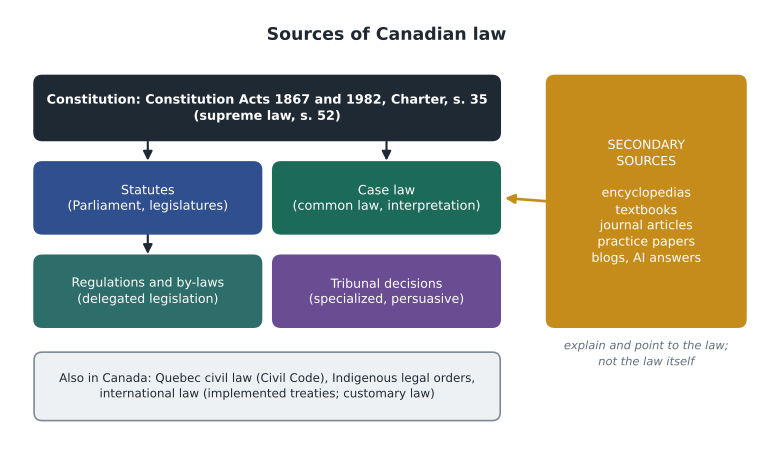
This lesson introduces the sources of Canadian law: the Constitution, legislation, regulations and municipal by-laws, case law, and the other legal traditions that operate in Canada, including the civil law of Quebec and Indigenous legal orders. It also explains the difference between primary and secondary sources and introduces the research file that runs through this course: a fictional Corwin slip-and-fall case called Ingram v. Corwin Plaza Holdings.
Primary and secondary sources
A primary source is the law itself: a constitutional provision, a statute, a regulation, a by-law or a judicial decision. A secondary source is writing about the law: a textbook, an encyclopedia entry, a journal article, a case summary, a practice guide, a blog post or an answer produced by an artificial intelligence tool. Secondary sources are indispensable for understanding an area quickly and for finding the primary sources that matter, but they are not authority in the same sense. A court is bound by a statute and, in the right circumstances, by a previous decision. It is never bound by a textbook, however respected.
The distinction shapes everything a researcher does. A good research process usually starts in secondary sources, because they explain the landscape and point to the leading statutes and cases. It then moves to the primary sources themselves, which must be read in full and checked to make sure they are current. Finally, the researcher writes from the primary sources, citing secondary sources only where their analysis adds something. Saltire puts it bluntly to the class: 'Start in the secondary sources. Finish in the primary sources. Never cite a case you have only read about.'
Some materials sit in between. Headnotes written by publishers at the start of a reported case are secondary, even though they are printed with the decision. Government policy manuals, tribunal guidelines and practice directions are not legislation, but they can be binding on officials or on litigants in particular settings and they often matter in practice. Lawyers sometimes call these materials soft law. They must be identified for what they are and used with care.
The Constitution
At the top of the Canadian legal order is the Constitution of Canada. Section 52(1) of the Constitution Act, 1982 provides that the Constitution is the supreme law of Canada and that any law inconsistent with it is, to the extent of the inconsistency, of no force or effect. The written Constitution includes the Constitution Act, 1867, which divides legislative power between Parliament and the provincial legislatures, and the Constitution Act, 1982, which contains the Canadian Charter of Rights and Freedoms, the recognition and affirmation of Aboriginal and treaty rights in section 35, and the amending formulas. Section 52(2) lists other documents that form part of the Constitution.
The Constitution also includes unwritten principles. In Reference re Secession of Quebec, [1998] 2 SCR 217, the Supreme Court identified federalism, democracy, constitutionalism and the rule of law, and respect for minorities as underlying principles that inform the interpretation of the written text. Students met these principles in LAWC-101. For research purposes the point is simple: when a question touches the validity of a law or the powers of government, the Constitution is the first place to look, and the courts' interpretation of it is found in case law.
Legislation: statutes, regulations and by-laws
Statutes, also called Acts, are laws enacted by Parliament or a provincial legislature. Federal statutes apply across Canada within Parliament's areas of authority; Ontario statutes apply in Ontario within the province's areas of authority. A statute begins as a bill, passes through readings and committee study, and becomes law on royal assent, although it may come into force later on a date fixed in the statute or by government order. Lesson 7 follows that process in detail.
Regulations are laws made by the executive, usually the federal Cabinet (the Governor in Council), a provincial Cabinet (in Ontario, the Lieutenant Governor in Council) or a minister, under authority delegated by a statute. They fill in the details: forms, fees, standards, exemptions and procedures. A regulation is valid only if the statute that authorizes it, called the enabling or parent statute, allows it. Regulations are binding law, and many legal questions turn on them. Researchers who stop at the statute often miss the answer.
Municipalities have no constitutional existence of their own. They are creatures of provincial legislation, and in Ontario their powers come mainly from the Municipal Act, 2001 and, for Toronto, the City of Toronto Act, 2006. Their by-laws regulate zoning, parking, noise, business licensing and many other local matters. By-laws are primary law within their limits and are usually published on the municipality's own website.
Theo asks what happens when a regulation and a statute conflict. Tsang answers with the hierarchy: the Constitution prevails over all other law; a statute prevails over a regulation made under it; and a regulation or by-law that goes beyond the authority granted to its maker is invalid. Federal and provincial laws that are both valid but conflict are governed by the doctrine of paramountcy, which students studied in LAWC-101.
Case law and the common law
Case law consists of the written decisions of courts and, in a broader sense, tribunals. Decisions do two different jobs. First, in common law Canada, they make law: the law of contracts, torts, trusts and much of property and remedies was developed by judges deciding cases, and it continues to develop that way. This judge-made law is called the common law. Equity, a body of principles first developed in the English Court of Chancery, is also part of it. Second, decisions interpret legislation and the Constitution. A statute's words often mean what the courts have said they mean.
The authority of a decision depends on the court that made it and on the doctrine of precedent, called stare decisis, which is the subject of lesson 2. For now, the important research habit is this: a decision is not just a story about a dispute. It contains reasons, and part of those reasons, the ratio decidendi, binds lower courts in the same hierarchy. Researchers must read decisions closely enough to identify what was decided and why.
Tribunals add another layer. Administrative tribunals such as the Landlord and Tenant Board, the Human Rights Tribunal of Ontario and the Immigration and Refugee Board decide thousands of cases a year. Their decisions are not binding on courts, and tribunals are generally not bound by their own previous decisions in the strict sense, but consistency matters and tribunal decisions are often the most useful sources in a specialized area.
Quebec civil law and bijuralism
Canada has two legal traditions for private law. The common law applies in the other provinces and the territories. Quebec follows the civil law tradition, whose central source is the Civil Code of Québec, CQLR c CCQ-1991. In a civil law system, the code is the starting point for private law questions, and judicial decisions and scholarly commentary, called doctrine, help interpret it. Public law in Quebec, including criminal law and constitutional law, is largely shared with the rest of Canada.
Federal law must operate in both traditions. Section 8.1 of the federal Interpretation Act, RSC 1985, c I-21, added in 2001, recognizes that both the common law and the civil law are equally authoritative sources of law in Canada and that, unless otherwise provided, a federal enactment that relies on private law concepts is to be interpreted according to the rules in force in the province where it applies. This is called bijuralism. Federal statutes are also enacted in English and French, and both versions are equally authoritative, a point that matters for interpretation in lesson 8.
Sophie, who grew up in Gatineau, asks whether a student in Ontario ever needs Quebec law. Saltire says yes, more often than students expect: in contracts with Quebec parties, in family property disputes involving a Quebec home, in federal statutes interpreted in Quebec cases, and in comparative arguments where a Quebec court has dealt with a question first.
Indigenous legal orders
Long before European settlement, Indigenous peoples in what is now Canada governed themselves through their own legal orders, expressed in stories, ceremonies, practices, kinship relationships and decision-making institutions. Many of those orders continue to operate. Canadian courts have recognized that Aboriginal rights and title arise from the prior occupation of the land and from Indigenous laws and customs, and section 35 of the Constitution Act, 1982 recognizes and affirms existing Aboriginal and treaty rights. Modern treaties and self-government agreements also create Indigenous law-making powers that operate alongside federal and provincial law.
The United Nations Declaration on the Rights of Indigenous Peoples Act, SC 2021, c 14, commits the federal government to take measures to ensure that federal laws are consistent with the Declaration and to prepare an action plan. The Truth and Reconciliation Commission's Calls to Action, released in 2015, urged law schools to teach Indigenous law and Indigenous-Crown relations. Daniel Whitecloud, a Cree student from northern Saskatchewan who worked in band administration, tells the class that research in Indigenous law often means looking beyond databases: to community law-makers, to written codes such as First Nation land codes and election codes, and to collections of stories and teachings. LAWC-114 returns to these questions in depth.
International law
International law enters Canadian law in two main ways. Treaties bind Canada internationally once ratified, but in general they do not change domestic law until Parliament or a legislature implements them by statute. Unimplemented treaties can still inform interpretation: in Baker v. Canada (Minister of Citizenship and Immigration), [1999] 2 SCR 817, the Supreme Court said that the values reflected in international human rights law may help inform the contextual approach to statutory interpretation. Customary international law is different: in Nevsun Resources Ltd. v. Araya, 2020 SCC 5, the majority confirmed that customary international law is part of the common law of Canada unless displaced by legislation.
For a first-year researcher, international sources usually come up as interpretive aids or comparative material. They are found through treaty databases, the Canada Treaty Information website and specialized secondary sources.
Why currency matters
Every source of law changes. Statutes are amended, regulations are revoked and remade, decisions are reversed on appeal or overruled later, and secondary sources go out of date the moment new law is made. The red binder on Tsang's table looked authoritative, but its last update was in 2019. Within an hour of the class, Hannah Kowalczyk finds an amendment to one of the statutes in it that came into force in 2021.
Currency is therefore the first habit of legal research. For legislation, a researcher checks the most recent consolidation and looks for amendments that have not yet been consolidated or not yet come into force. For case law, the researcher notes up each decision to see whether it has been appealed, followed, distinguished or overruled. For secondary sources, the researcher checks the publication date and updates any law the source describes. Lessons 5 and 7 explain how.
The course file: Ingram v. Corwin Plaza Holdings
Throughout this course, Section B works on a single fictional file. Rosa Ingram, a dental hygienist in Corwin, slipped on ice in the parking lot of the Corwin Plaza strip mall on Wednesday, February 4, 2026, and broke her wrist. The plaza is owned by Corwin Plaza Holdings Inc., and snow clearing is done by a contractor, Northline Snow Services. Rosa first saw a lawyer at Pardee & Lowe LLP, a Corwin personal injury firm, on April 20, 2026. By then more than sixty days had passed since her fall.
Saltire hands out a one-page summary and asks the class a single question: which sources of law might matter? The answers come quickly. Theo knows that Ontario has an Occupiers' Liability Act and that the law of negligence is common law. Hannah suspects there is a limitation period. Arjun wonders whether a regulation sets standards for snow clearing. Sophie asks whether it matters that the parking lot is private rather than a city sidewalk. Saltire writes every answer on the board without comment. 'Good,' she says. 'You have just done the first step of legal research, which is to identify the possible sources before you know the answer. Over the next twelve weeks you will find out which of these guesses were right, and you will learn how to prove it.'
Practical tips for the first weeks
- Keep a research log from day one: the question, the sources consulted, the search terms used, the date and what each source said.
- Always note the jurisdiction. An Ontario question is answered by Ontario law plus federal law where relevant, not by British Columbia or American law, although those may be persuasive.
- Distinguish the law from the publication. A statute on a government website, a case on CanLII and the same case in a printed reporter are copies of the same primary source; a summary of the case is a secondary source.
- Read primary sources in full before citing them, and check that they are current.
Before the class ends, Tsang returns to the four objects on the table. The Supreme Court Reports and the statutes binder contain the law, he says, although the binder is out of date. The laptop is a gateway to the law and to a great deal of commentary about it. The textbook only talks about the law. 'And none of them,' he adds, looking at Theo, 'is the law itself. The law is what Parliament, the legislatures and the courts made. Everything here is a way of finding it.'
Practice problems
Work each problem on paper first, then reveal the answer to check.
A classmate cites a well-known torts textbook for the rule that an occupier owes a duty of care to people on its premises. What is wrong with relying on the textbook alone?
Show answer
The textbook is a secondary source. It is useful for finding the rule, but the authority for the rule in Ontario is the Occupiers' Liability Act, RSO 1990, c O.2, and the cases interpreting it. The classmate should find, read and cite the statute and leading cases, checking that they are current.
Is a regulation made under an Ontario statute binding law? Can it override the statute?
Show answer
Yes, a validly made regulation is binding law. No, it cannot override its enabling statute; a regulation that goes beyond the authority the statute delegates is invalid.
A federal statute uses the word 'mortgage' without defining it. A case arises in Quebec. Which legal tradition supplies the meaning?
Show answer
Under section 8.1 of the federal Interpretation Act, unless the statute provides otherwise, a federal enactment relying on private law concepts is interpreted according to the rules in force in the province where it applies. In Quebec that means the civil law, so the corresponding civil law concept, the hypothec, would be relevant.
Name three sources of law that might matter in the Ingram file and say whether each is primary or secondary.
Show answer
For example: the Occupiers' Liability Act (primary, provincial statute); the common law of negligence as stated in decisions (primary, case law); the Limitations Act, 2002 (primary, statute); an encyclopedia entry on occupiers' liability (secondary); a practice guide on slip-and-fall claims (secondary).
Summary and key terms
- Primary sources are the law itself: the Constitution, statutes, regulations, by-laws and judicial decisions. Secondary sources are writing about the law.
- Start research in secondary sources, finish in primary sources, and never cite a case or statute you have not read.
- The Constitution is the supreme law (section 52 of the Constitution Act, 1982); statutes prevail over regulations made under them; delegated legislation beyond its authority is invalid.
- Case law makes the common law and interprets legislation and the Constitution; stare decisis determines which decisions bind which courts.
- Canada is bijural: Quebec private law follows the civil law tradition, and section 8.1 of the Interpretation Act governs how federal law uses private law concepts.
- Indigenous legal orders continue to operate and are recognized in several ways, including section 35 and modern treaties; international law informs interpretation and customary international law is part of the common law (Nevsun).
- Every source changes, so currency is the first habit of legal research.
- Primary source
- The law itself: a constitutional provision, statute, regulation, by-law or judicial decision.
- Secondary source
- Writing about the law, such as a textbook, encyclopedia, journal article, case summary or practice guide.
- Regulation
- Delegated legislation made by the executive under authority granted by a statute (the enabling statute).
- Common law
- Law developed by judges through decisions, as distinct from legislation; also the legal tradition of the provinces other than Quebec.
- Bijuralism
- The coexistence of the common law and civil law traditions in Canada, recognized for federal law in section 8.1 of the Interpretation Act.
- Soft law
- Non-legislative material such as policies, guidelines and practice directions that can shape legal outcomes without being statutes or regulations.
- Currency
- Whether a source states the law as it is now, taking account of amendments, repeals, appeals and later decisions.
Lesson quiz · 5 questions
Score 60% or more to complete this lesson.
Create a free account to save your progress, take quizzes and earn a certificate.