
LAWC-104 · Lesson 6 of 12 · 20 min
Reading and briefing a case
▶ Video coming soon A video version of this lesson is on the way.
Hannah Kowalczyk admits in the fifth week of term that she has been reading cases the way she read novels: from the first page to the last, hoping the point will become clear. It takes her two hours to get through a forty-page Supreme Court decision, and at the end she is not sure what it decided. Professor Saltire nods. 'Almost everyone starts that way,' she says. 'Judgments are not written to be read like stories. They are written to decide disputes and to explain the decision to the parties, to appeal courts and to future judges. Once you know how they are built, you can read them in a third of the time and understand them twice as well.'
This lesson explains the anatomy of a Canadian judgment, offers a method for reading decisions efficiently, and shows how to write a case brief: a short, structured summary that captures what a case decided and why. The worked example is Rizzo & Rizzo Shoes Ltd. (Re), [1998] 1 SCR 27, a Supreme Court decision that every Canadian law student meets because of what it says about statutory interpretation, the subject of lesson 8.
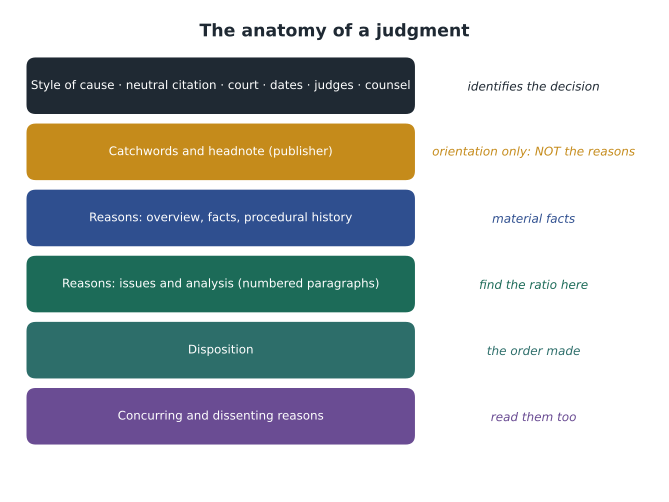
The anatomy of a judgment
A modern Canadian judgment, as published on CanLII or a court website, usually begins with the style of cause (the names of the parties), the neutral citation, the court, the date of the hearing and the date of the decision, the names of the judges, and the names of counsel. Supreme Court decisions also list the court below and the case number. If the decision appears in a law report, the publisher adds catchwords, a list of key topics, and a headnote, an editorial summary of the facts, issues and holding. The headnote is useful for orientation but is not part of the reasons, and it is occasionally wrong.
The reasons follow. Most modern reasons have numbered paragraphs and headings. They typically set out an overview, the facts, the procedural history, the issues, the legal analysis and the disposition, which is the court's formal order: appeal allowed or dismissed, judgment for the plaintiff, a new trial ordered, costs. Where judges disagree, majority reasons are followed by concurring or dissenting reasons, each identified by the judge who wrote them and the judges who joined them.
The Supreme Court also publishes plain-language summaries called Cases in Brief for many of its decisions. Like headnotes, they are excellent for deciding whether a case is relevant and for a first orientation. They are not the reasons.
A method for reading decisions
Saltire teaches a five-step method. First, orient yourself: read the headnote or summary, the list of issues and the disposition, so you know where the decision ends up before you start. Second, read the reasons actively, with a purpose: as you read, mark the material facts, the legal issues, the rules the court states, the way it applies them and its conclusions. Note paragraph numbers as you go, because you will need them for pinpoint citations. Third, identify the ratio: what legal principle was necessary to the decision on these facts? Fourth, read any concurring and dissenting reasons, asking where and why the judges disagreed. Fifth, reflect: how does this case fit with others you have read, and how would it apply to your client's facts?
Not every decision deserves the same depth of reading. For a case you plan to rely on, or that your opponent will rely on, read every word, including the dissent. For a case that a citator lists as citing your leading case, it may be enough to read the paragraphs where it does so and the disposition. Saltire's test: if you are going to cite it, you must have read enough of it to be sure it says what you claim, in the context in which it says it.
Reading speed improves with practice and with knowledge of the area. The first contracts or tort decisions take hours; by the end of first year, most students can read a typical appellate decision carefully in under an hour. Reading on paper or with an annotation tool helps many students concentrate. Keeping a list of unfamiliar terms, and looking them up, pays off quickly.
Identifying the ratio
Lesson 2 explained that the ratio decidendi is the legal principle necessary to the decision on the material facts. Identifying it is the core skill of case reading. Ask what the question before the court was, what answer it gave, and what reasoning was essential to that answer. Then state the ratio at the right level of generality. Stated too narrowly, a ratio becomes useless: 'Employees of a shoe company that went bankrupt in 1989 were entitled to termination pay.' Stated too broadly, it claims more than the court decided: 'All employment statutes must always be interpreted in favour of employees.' A well-stated ratio is general enough to apply to future cases and faithful to what the court actually held.
Courts sometimes help by saying expressly what they decide. Others leave the reader to infer it. Where there are several issues, there may be several rationes. Where the majority gives alternative reasons for the same result, each may be binding. And where no set of reasons commands a majority, the binding principle is what a majority of judges agreed on, which can be hard to find.
The case brief
A case brief is a structured summary that records the essential information about a decision in a page or less. Briefs serve several purposes: they force the reader to understand the case, they make review for exams much faster, and in practice they become the building blocks of memos and factums. Different instructors prefer different formats, but most include the same elements.
- Citation: the full citation, including the court and year.
- Facts: the material facts only, those that mattered to the decision.
- Procedural history: what the lower courts decided.
- Issues: the legal questions the court had to answer, framed as questions.
- Holding: the court's answer to each issue.
- Ratio and reasoning: the legal principle and the essential steps of the court's reasoning, with paragraph references.
- Disposition: the order made.
- Concurrence or dissent: who disagreed and why, briefly.
- Comments: the case's significance, its relationship to other cases, and how it might apply to the problem you are researching.
Worked example: briefing Rizzo
Worked problem
A case brief of Rizzo & Rizzo Shoes Ltd. (Re), [1998] 1 SCR 27
Brief the Supreme Court's decision in Rizzo using the format above.
Show solution
- Citation: Rizzo & Rizzo Shoes Ltd. (Re), [1998] 1 SCR 27, Supreme Court of Canada. Reasons by Justice Iacobucci for a unanimous court.
- Facts: Rizzo & Rizzo Shoes Ltd., an Ontario shoe retailer, went bankrupt in 1989, and its employees' employment ended as a result. The trustee in bankruptcy paid wages, salaries, commissions and vacation pay owing, but disallowed the employees' claims for termination pay and severance pay under the Ontario Employment Standards Act. The Ministry of Labour challenged that decision on the employees' behalf.
- Procedural history: The Ontario Court (General Division) allowed the claims. The Court of Appeal for Ontario reversed, holding that the statute's termination and severance pay provisions applied only when the employer terminated employment, not when employment ended because of bankruptcy.
- Issue: Does the termination of employment caused by an employer's bankruptcy give rise to a claim for termination pay and severance pay under the Employment Standards Act?
- Holding: Yes. The appeal was allowed and the employees were entitled to claim termination and severance pay as unsecured creditors in the bankruptcy.
- Ratio and reasoning: Statutory words are to be read in their entire context, in their grammatical and ordinary sense, harmoniously with the scheme of the Act, its object and the intention of the legislature (the modern principle, adopted from Elmer Driedger). The Employment Standards Act is benefits-conferring legislation that should be interpreted broadly and generously. Reading the provisions as the Court of Appeal did would produce absurd and inequitable results: employees dismissed just before a bankruptcy would receive termination pay, while those whose jobs ended because of the bankruptcy would not, defeating the purpose of protecting employees. The Court also relied on Ontario's interpretation statute, which required remedial legislation to receive a fair, large and liberal interpretation, and on the legislative history of a 1981 amendment, including statements in the legislature, which assumed that bankruptcy terminations were covered.
- Disposition: Appeal allowed; the trial judgment restored, with the employees' claims allowed.
- Dissent or concurrence: None; the decision was unanimous.
- Comments: Rizzo is the leading statement of the modern principle of statutory interpretation in Canada and is cited in thousands of later decisions. It also shows the use of legislative debates as an interpretive aid and the presumption against absurd results. For the Ingram file, Rizzo frames how a court will read the words 'reasonable excuse' in section 6.1 of the Occupiers' Liability Act: in context, with attention to the purpose of the notice requirement.
Saltire asks the class to compare the brief with the decision itself. The brief takes one page. The decision is about fifty paragraphs. Yet the brief captures what a lawyer needs to know to use the case, with paragraph references that allow anyone to check it. That is the test of a good brief: someone who has not read the case should understand what it decided and be able to find the key passages.
Briefing for research, not just for class
In practice, lawyers rarely write formal briefs, but they do the same thinking. When researching a file, a lawyer keeps short notes on each authority: citation, court, key facts, holding, the paragraph that states the rule, and how it helps or hurts the client. Those notes become the analysis section of a memo or the argument in a factum. Students who learn to brief well in first year find memo writing much easier, because the analysis is mostly a matter of arranging well-briefed cases in a logical order and applying them to the facts.
Theo Marchetti shows the class the notes he kept on authorities at his old firm: a spreadsheet with columns for citation, court, date, facts, holding, key paragraph, helps or hurts, and noted up on what date. Arjun Mehta immediately starts building one for the Ingram file. By the end of the week it has rows for Crinson, Seif and several Superior Court decisions on snow-and-ice notice.
Citing what you briefed
A brief is only as useful as its references. When you record the ratio and the key reasoning, note the paragraph numbers where the court states them, so that you can cite them later with accurate pinpoints. Where a court quotes an earlier decision, note both the paragraph in the case you are reading and the original source, because good practice is to cite the original statement of a principle, adding the later case that adopted it. And when a case is long, record which parts you have read closely and which you have only skimmed. That honesty with yourself prevents the most embarrassing kind of error: citing a case for a proposition that appears only in its summary of a party's argument, not in the court's own reasoning.
Reading dissents and concurrences
Students often skip dissenting reasons, which is a mistake. A dissent shows the strongest argument against the majority's view, which tells you how the majority's reasoning might be attacked or limited. Dissents sometimes become law later. And when you brief a case, knowing why some judges disagreed helps you state the majority's ratio precisely. Concurring reasons matter for a different reason: if the majority is split between two sets of reasons that agree on the result, you need to know which propositions command a majority.
Reading tribunal decisions and lower court decisions
The same method applies to tribunal decisions and trial judgments, with two differences. Trial decisions spend much more time on facts and evidence, because the trial judge is finding facts. When briefing them, distinguish the findings of fact, which are specific to the case, from the legal rules applied, which are what later courts may follow. Tribunal decisions often apply a specialized statute and the tribunal's own policies. Their reasoning may be persuasive in later tribunal cases, but on judicial review the question is usually whether the decision was reasonable, not whether it was correct.
Common mistakes
Common mistakes
MistakeCopying the headnote into a brief.
InsteadRead the reasons and write the brief in your own words, with paragraph references to the judgment.
MistakeIncluding every fact in the brief.
InsteadInclude only the material facts that mattered to the court's decision.
MistakeStating the ratio so narrowly that it applies only to identical facts, or so broadly that it claims more than the court decided.
InsteadState the ratio at a level of generality faithful to the court's reasoning.
MistakeIgnoring the dissent.
InsteadRead it to understand the weaknesses of the majority's reasoning and the possible direction of future law.
Practice problems
Work each problem on paper first, then reveal the answer to check.
What is the difference between a headnote and the reasons for judgment?
Show answer
A headnote is an editorial summary written by the publisher; it is not part of the judgment and may be inaccurate. The reasons are the judges' own explanation of the decision and are the authority.
State the ratio of Rizzo in one or two sentences.
Show answer
Statutory provisions must be read in their entire context and in light of the scheme and object of the Act and the intention of the legislature; read that way, the Employment Standards Act's termination and severance pay provisions apply when employment ends because of the employer's bankruptcy.
List the elements of a case brief.
Show answer
Citation; material facts; procedural history; issues; holding; ratio and reasoning with paragraph references; disposition; concurrences or dissents; comments on significance and application.
Why should you read the disposition before reading the reasons in detail?
Show answer
Knowing the result orients your reading: you can follow how the reasoning leads to the outcome and identify which parts are essential to it.
Summary and key terms
- A judgment has identifying information, sometimes a publisher's headnote and catchwords, reasons with numbered paragraphs and headings, a disposition, and any concurring or dissenting reasons.
- Headnotes and Cases in Brief help with orientation but are not the reasons.
- Read in five steps: orient, read actively, identify the ratio, read separate reasons, reflect on application.
- State the ratio at the right level of generality.
- A case brief records citation, facts, procedural history, issues, holding, ratio and reasoning, disposition, separate reasons and comments.
- Rizzo & Rizzo Shoes Ltd. (Re), [1998] 1 SCR 27, is the leading statement of the modern principle of statutory interpretation.
- Style of cause
- The name of a case, formed from the names of the parties.
- Headnote
- A publisher's summary of a decision printed before the reasons; not part of the judgment.
- Disposition
- The court's formal order, such as appeal allowed or dismissed.
- Case brief
- A short structured summary of a decision's facts, issues, holding, ratio, reasoning and significance.
- Material facts
- The facts that mattered to the court's decision and on which the ratio depends.
- Cases in Brief
- Plain-language summaries of decisions published by the Supreme Court of Canada.
Lesson quiz · 5 questions
Score 60% or more to complete this lesson.
Create a free account to save your progress, take quizzes and earn a certificate.