
LAWC-104 · Lesson 5 of 12 · 18 min
Case law research
▶ Video coming soon A video version of this lesson is on the way.
On Friday, October 23, 2026, Bernard Tsang runs a noting-up workshop in the Fenner Library's computer room. He projects a single citation on the screen: Crinson v. Toronto (City), 2010 ONCA 44. 'Several of you found this case for the Ingram memo,' he says. 'It is a Court of Appeal decision about late notice of a sidewalk injury under a municipal statute. Some of you have already written that it states the test for reasonable excuse. Before anyone cites it, I want to know three things. Is it still good law? Has the Court of Appeal said anything more about the test since 2010? And does anyone apply it to the provision Rosa Ingram is dealing with?' By the end of the hour the class has answers to all three, and nobody has had to guess.
This lesson explains how to find cases by citation, by subject and by keyword, how to read a citation and identify the court, and how to note up a decision to confirm that it is still good law and to find later cases that have applied it.
Reading a case citation
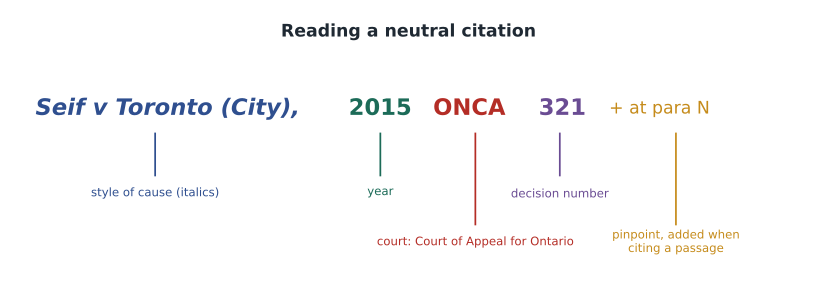
Every Canadian decision released in recent decades has a neutral citation assigned by the court itself. A neutral citation has three parts: the year of the decision, an abbreviation identifying the court, and a sequential number. In Crinson v. Toronto (City), 2010 ONCA 44, the decision is the forty-fourth released by the Court of Appeal for Ontario in 2010. In R. v. Sullivan, 2022 SCC 19, the decision is the nineteenth released by the Supreme Court of Canada in 2022. Neutral citations are independent of any publisher, so a decision can be found on CanLII, a court website or a commercial platform with the same citation. Paragraphs in decisions with neutral citations are numbered, and pinpoint citations refer to paragraph numbers.
Older decisions, and decisions from courts that adopted neutral citations later, are identified by citations to law reports. The Supreme Court Reports, cited SCR, are the official reports of the Supreme Court of Canada. The Ontario Reports, cited OR, publish selected Ontario decisions. National reporters such as the Dominion Law Reports (DLR) and subject reporters such as the Canadian Criminal Cases (CCC) or the Canadian Cases on the Law of Torts (CCLT) publish decisions from across the country. A report citation gives the year or volume, the reporter abbreviation, the series if any, and the first page: for example, David Polowin Real Estate Ltd. v. Dominion of Canada General Insurance Co. (2005), 76 OR (3d) 161 (CA). CanLII also assigns its own identifiers to older decisions that lack a neutral citation, in the form 2005 CanLII 12345 (ON CA).
Court abbreviations matter, because the court determines the authority of the decision. Common Ontario identifiers are ONCA for the Court of Appeal, ONSC for the Superior Court of Justice, ONSC (Div Ct) or ONSCDC for the Divisional Court depending on the source, and ONCJ for the Ontario Court of Justice. SCC is the Supreme Court of Canada, FCA the Federal Court of Appeal and FC the Federal Court. Each province has its own abbreviations, such as ABCA for the Alberta Court of Appeal and BCSC for the Supreme Court of British Columbia, which is a trial court despite its name.
Finding a case you already know about
If you have a neutral citation, enter it in the search box of CanLII or a commercial platform, or find it on the court's own website. If you have only a report citation, the commercial platforms will retrieve it, and CanLII will usually find the decision by its name and year. If you have only a name, search the style of cause in quotation marks, and add the year or court to narrow the results. Be careful with common names: there are many decisions called R. v. Brown and many called Smith v. Jones. Confirm the year, court and subject before relying on what you find.
Finding cases on a subject
When you do not yet know which cases matter, there are three main routes. The first is through secondary sources: encyclopedias, texts, articles and practice papers cite the leading cases, as lesson 3 explained. The second is through subject classification: the Canadian Abridgment on Westlaw digests cases under subject headings, and Lexis+ offers its own topical tools, so that one relevant case can lead you to every case classified with it. The third is keyword searching of full-text decisions, using the strategies in lesson 4.
Most good research uses all three. Secondary sources find the leading cases; classification finds the related ones; keyword searches catch the recent ones that editors have not yet digested and the ones that use unusual language. For a recent statutory provision, keyword searching for the section number and the statute name is often the fastest route to every decision that has applied it.
Judicial history and judicial treatment
Before relying on any decision, a researcher must check two different things. Judicial history is what happened to the same case on appeal: was it appealed, and was it affirmed, reversed or varied? A trial decision that was reversed on appeal is no longer authority for the point on which it was reversed. Judicial treatment is what other courts have said about the decision in later cases: has it been followed, applied, distinguished, doubted, criticized or overruled?
Both questions are answered by noting up, also called citing or Shepardizing in the United States. The term comes from the days when researchers noted later references in the margins of their own volumes. Today citators do the work.
Citators
A citator is a tool that lists the later decisions and other documents that cite a given case or statute. CanLII's citator is free: every decision page has a tab listing the decisions on CanLII that cite it, and a researcher can search within those citing decisions, for example for a particular phrase or paragraph. CanLII also lists decisions that cite a particular section of legislation. KeyCite Canada on Westlaw and QuickCITE on Lexis+ go further. They include judicial history, characterize how each citing decision treated the case, and use symbols or coloured flags to warn of negative treatment. They also list secondary sources that discuss the case.
Citator symbols are useful warnings, but they are not substitutes for reading. A red flag might mean that a case was reversed on one issue but remains good law on the issue you care about. A green symbol might hide a later case that distinguished the decision on facts like yours. And the platforms' editors sometimes characterize the same treatment differently. Tsang's rule is simple: use the symbols to decide what to read, then read it.
Noting up Crinson
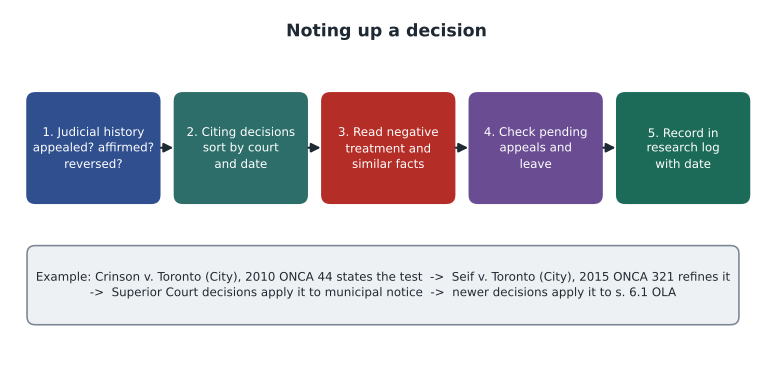
Tsang walks the class through the process. On CanLII, the Crinson decision page shows its citing decisions. The class searches within them for the words 'reasonable excuse' and sorts them by court. Among the Court of Appeal decisions, one stands out: Seif v. Toronto (City), 2015 ONCA 321. Reading it, the students find that the Court of Appeal applied the test as Crinson framed it, asking whether, in all the circumstances, it was reasonable for the plaintiff not to give notice until she did. The Court held that the injury itself need not be the reason for the delay, and that ignorance of the notice requirement is not, on its own, a reasonable excuse, although it may be part of circumstances that together amount to one. The panel divided on how the question of prejudice should be handled, with a dissent saying prejudice should be presumed.
The students then look at Superior Court decisions. Several apply Crinson and Seif to the ten-day notice requirement in the Municipal Act, 2001 and its counterparts. Some describe deficient notice as creating a rebuttable presumption of prejudice that the plaintiff must displace; Marderosian v. Niagara Falls (City), 2024 ONSC 1043 is one recent example, in which the claim was dismissed because the city had no chance to investigate and no timely photographs or witness details existed. Finally, the students search CanLII for decisions citing section 6.1 of the Occupiers' Liability Act itself. They find a growing number of Superior Court decisions applying the 2021 snow-and-ice notice requirement, many of which borrow the municipal case law on reasonable excuse and prejudice because the wording of the exception is similar.
Arjun Mehta summarizes the results on the whiteboard as a chain: Crinson states the test; Seif refines it; Superior Court decisions apply it to municipal notice; more recent Superior Court decisions apply it to the occupiers' notice rule. 'That chain,' Tsang says, 'is the backbone of your analysis. Every link has to be read, and every link has to be cited accurately.'
Leave to appeal and appeals in progress
Noting up must also catch appeals that are pending. A recent Superior Court decision might be under appeal to the Court of Appeal, and a Court of Appeal decision might be the subject of an application for leave to appeal to the Supreme Court. The Supreme Court of Canada's website shows case information, including whether leave was sought, granted or dismissed. A refusal of leave does not mean the Supreme Court approved the lower court's reasoning; it means only that the Court decided not to hear the appeal. If an appeal is pending, a careful memo says so.
Reading the citing cases strategically
A frequently cited case may have hundreds of citing decisions. Read strategically. Start with the decisions of higher courts and the most recent decisions. Search within the citing cases for the paragraph or principle you care about. Look especially for negative treatment, and for cases with facts like your client's. If many decisions simply quote the same test without adding anything, you need not read them all, but you should note in your log that you reviewed them and what you found.
Unreported and recent decisions
Not every decision is published in a law report, and many important decisions appear only on CanLII and the commercial databases. Unreported decisions are fully citable, using their neutral citation. Very recent decisions may not yet be digested or flagged by the commercial citators, so a keyword search sorted by date on CanLII or a court website is an essential final check. Courts also post decisions to their own websites, sometimes before they reach CanLII.
Building a case table
On any file with more than a handful of authorities, a case table saves time and prevents errors. A case table is a simple document or spreadsheet listing each authority with its full citation, court, date, a one-line statement of what it decides, the key paragraph numbers, whether it helps or hurts the client, and the date it was last noted up. Theo Marchetti's spreadsheet from lesson 6 is one version; many firms use a template. A case table makes it easy to see whether the binding courts have spoken, which authorities need to be distinguished, and which have not been checked recently. It also makes the final citation check before a memo or factum is filed far quicker, because every citation and pinpoint has already been recorded accurately.
Common mistakes
Common mistakes
MistakeCiting a trial decision without checking whether it was appealed.
InsteadCheck judicial history in a citator and on the appeal court's website before relying on any decision.
MistakeTreating a citator's green symbol as proof that a case is good law on your issue.
InsteadRead the citing decisions that matter to your issue, especially recent and higher-court ones.
MistakeAssuming that a refusal of leave by the Supreme Court approves the lower court's reasoning.
InsteadTreat a leave refusal as having no precedential effect; the lower decision's authority depends on its own court.
MistakeRelying on a headnote or AI summary for what a case decided.
InsteadRead the reasons and identify the ratio yourself.
Practice problems
Work each problem on paper first, then reveal the answer to check.
What do the parts of the citation 2015 ONCA 321 mean?
Show answer
It is a neutral citation: the decision was released in 2015, by the Court of Appeal for Ontario (ONCA), and it was the court's 321st decision of that year.
Explain the difference between judicial history and judicial treatment, using Crinson as an example.
Show answer
Judicial history concerns what happened to the Crinson case itself on any further appeal. Judicial treatment concerns how later decisions in other cases, such as Seif v. Toronto (City), 2015 ONCA 321, applied, followed or refined it.
You find a 2023 Superior Court decision directly on point for the Ingram file. What should you check before relying on it?
Show answer
Whether it was appealed and the result; how later decisions have treated it; whether any Court of Appeal or Supreme Court decision has addressed the same issue; and whether the statute has changed since. Read the decision in full and identify its ratio.
A colleague says that because the Supreme Court refused leave to appeal a Court of Appeal decision, the decision has Supreme Court approval. Respond.
Show answer
That is incorrect. A refusal of leave is not a decision on the merits and gives no endorsement to the reasoning. The decision's authority remains that of the Court of Appeal.
Summary and key terms
- A neutral citation gives the year, court and decision number, and paragraphs are numbered for pinpointing; older decisions are cited to law reports.
- The court identifier tells you the authority of the decision, so read it carefully.
- Find cases through secondary sources, subject classification and keyword searching, ideally all three.
- Check judicial history (appeals of the same case) and judicial treatment (later cases citing it) by noting up.
- CanLII's citing-decisions tab, KeyCite Canada and QuickCITE all note up cases; use their symbols to decide what to read, then read it.
- Crinson v. Toronto (City), 2010 ONCA 44 and Seif v. Toronto (City), 2015 ONCA 321 illustrate how a test is stated, refined and applied in later cases.
- Neutral citation
- A citation assigned by the court, made up of the year, a court identifier and a sequential number, independent of any publisher.
- Law report
- A published series of selected decisions, such as the Supreme Court Reports or the Ontario Reports.
- Noting up
- Checking the judicial history and later treatment of a decision or statute using a citator.
- Citator
- A tool listing later documents that cite a case or statute and, in commercial versions, characterizing the treatment.
- Judicial history
- The appeal history of the same case: affirmed, reversed or varied.
- Judicial treatment
- How later decisions in other cases have dealt with a decision, such as following, distinguishing or overruling it.
- Pinpoint
- A reference to the specific paragraph or page that supports a proposition.
Lesson quiz · 5 questions
Score 60% or more to complete this lesson.
Create a free account to save your progress, take quizzes and earn a certificate.