
LAWC-104 · Lesson 12 of 12 · 23 min
Capstone: a research memo
▶ Video coming soon A video version of this lesson is on the way.
Section B handed in its Ingram memos on Friday, November 13, 2026. A week later, on Friday, November 20, Professor Saltire returned them covered in green ink and spent the class on what she had seen. Most students had found the right statute and the two key Court of Appeal decisions. Fewer had found the Superior Court decisions applying the snow-and-ice notice rule itself. Several had miscounted the notice period. A handful had answered a question nobody asked, writing three pages on the occupier's standard of care when the memo was about notice. And two had written brief answers that said 'it depends' without saying on what. 'Everything you need to do well in practice is in this exercise,' Saltire told them. 'Finding the law, reading it accurately, organizing it, applying it to messy facts, being honest about uncertainty, and telling a busy lawyer what to do next.'
This capstone lesson brings the course together. It sets out the full facts of the Ingram file, shows the research trail a strong student followed, presents a model memo, and ends with the lessons Saltire drew from the class's work. Treat it as a template for the research memos you will write in practice.
The facts
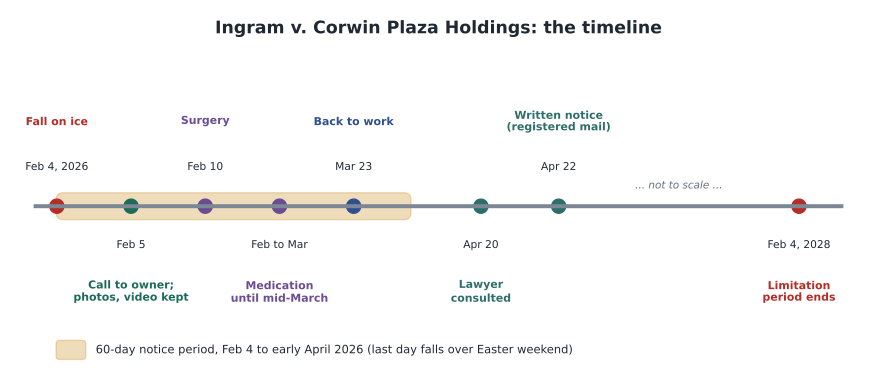
Rosa Ingram is a 41-year-old dental hygienist who lives in Corwin, Ontario. At about 7:40 a.m. on Wednesday, February 4, 2026, she parked at the Corwin Plaza, a strip mall on Ridgeway Road owned by Corwin Plaza Holdings Inc., to pick up a prescription. Freezing rain had fallen overnight. As she walked from her car toward the pharmacy, she slipped on a sheet of ice near a catch basin in the parking lot and fell on her outstretched right hand. Another customer called an ambulance. At hospital she was diagnosed with a displaced fracture of the right wrist. She had surgery to insert a plate on February 10.
Snow and ice clearing at the plaza is done under contract by Northline Snow Services, which is required by its contract to salt the lot by 7:00 a.m. after any freezing rain. Northline's records for February 4 are not yet available to Rosa.
On February 5, Rosa's husband telephoned the plaza's property manager, an employee of Corwin Plaza Holdings, and told him about the fall. The manager went to the lot, took photographs of the area near the catch basin, saved the security camera footage covering that part of the lot for the morning of February 4, and emailed Northline the same day, asking for its salting records. Neither Rosa nor anyone on her behalf sent anything in writing to the owner or to Northline at that time.
Rosa took prescription pain medication, which made her drowsy and confused, until about mid-March. She returned to work part-time on March 23. She did not know that any notice was required. On April 18 a friend told her that she might have a claim, and she met a lawyer at Pardee & Lowe LLP on April 20, 2026. The lawyer served written notice of the date, time and location of the fall on both Corwin Plaza Holdings and Northline by registered mail on April 22. The supervising lawyer, Ms. Lowe, asks for a memo on whether the claim is barred by the sixty-day notice requirement and what should be done now.
The research trail
Arjun Mehta's research log, which Saltire shares with his permission, shows the method at work. He started with a recent practice paper on snow-and-ice claims and the occupiers' liability title in an encyclopedia, which confirmed that section 6.1 of the Occupiers' Liability Act governs and pointed him to the 2020 amending Act. He read the current Act on e-Laws, checked the point-in-time versions to confirm that section 6.1 was in force on February 4, 2026, and found the amending Act, SO 2020, c 33, with its coming-into-force date of January 29, 2021. He read the Hansard debates and committee proceedings on Bill 118 to understand the provision's purpose, noting them in his log but relying on them only lightly.
Next he searched for authority on reasonable excuse and prejudice. Because the exception in section 6.1 mirrors the long-standing municipal notice exception, he followed the municipal case law: Crinson v. Toronto (City), 2010 ONCA 44, for the test, and Seif v. Toronto (City), 2015 ONCA 321, for the Court of Appeal's refinement. He noted up both on CanLII and on a commercial citator, read the Court of Appeal decisions that cited them, and read a selection of recent Superior Court decisions, including Marderosian v. Niagara Falls (City), 2024 ONSC 1043, on prejudice. Finally he searched CanLII for every decision citing section 6.1 of the Occupiers' Liability Act and read the ones dealing with late notice. He checked the Legislation Act, 2006 for the rules on computing time and the Limitations Act, 2002 for the limitation period. Every authority in his memo appears in his log with the date he read it and the date he noted it up.
The model memo
The memo that follows is Saltire's model answer, written in the format from lesson 11. It cites the authorities discussed in this course; in a real file, the writer would also cite the Superior Court decisions on section 6.1 found in the research, with their facts and holdings, and would note them up again on the day the memo is finalized.
Heading
To: Ms. Lowe. From: Articling student. Date: November 13, 2026. Client: Rosa Ingram. Re: Whether Ms. Ingram's claim for her fall at Corwin Plaza is barred by section 6.1 of the Occupiers' Liability Act.
Questions presented
1. Does section 6.1 of the Occupiers' Liability Act require Ms. Ingram to have given written notice within sixty days of her February 4, 2026 fall on ice in the Corwin Plaza parking lot, and did she comply?
2. If she did not comply, is her action nonetheless saved by the exception for reasonable excuse where the defendants are not prejudiced in their defence?
3. What steps should be taken now?
Brief answers
1. Yes, and no. Section 6.1 applies to her claim against both the owner and the snow-clearing contractor. The notice period ended in early April 2026. The telephone call made on her behalf on February 5 was not written notice served in the manner the section requires, and the registered-mail notice of April 22 was late.
2. Probably yes, although the outcome is uncertain. Her surgery, her medication and the effects of the injury during much of the notice period support a reasonable excuse, but ignorance of the requirement alone is not enough, and the gap between her return to work and her first meeting with a lawyer is a weakness. Her strongest argument concerns prejudice: the owner knew of the fall the next day, photographed the scene, preserved the video and asked the contractor for its records, so the purpose of the notice requirement was largely met. Courts have treated late notice as raising a presumption of prejudice that the plaintiff must rebut, and these facts give her a good basis to rebut it.
3. Preserve the evidence immediately, gather the medical and personal evidence supporting the excuse, and commence the action well before the two-year limitation period expires on February 4, 2028.
Facts
The facts are set out above. Facts not yet known that could affect the analysis: whether the owner's property manager in fact retained the video and photographs, and what they show; Northline's salting records for February 4; whether Northline was told of the fall by the owner on February 5 and what it did; and the medical records documenting the effects of Ms. Ingram's medication.
Analysis: issue 1, the notice requirement
Section 6.1 of the Occupiers' Liability Act, RSO 1990, c O.2, added by the Occupiers' Liability Amendment Act, 2020, SO 2020, c 33, and in force since January 29, 2021, provides that no action shall be brought for damages for personal injury caused by snow or ice on premises unless, within sixty days after the injury, written notice of the claim, including the date, time and location of the occurrence, is served on at least one occupier of the premises or on an independent contractor employed by an occupier to remove snow or ice. The notice must be served personally or by registered mail. The section was in force when Ms. Ingram fell, and her injury was caused by ice on premises occupied by Corwin Plaza Holdings and maintained by Northline. It applies.
The sixty-day period began on February 4, 2026. Counted under the time-computation rules in the Legislation Act, 2006, it ended in the first week of April; because the nominal last day fell on the Easter weekend, the precise final day depends on the holiday rules, but on any calculation the notice served on April 22 was more than two weeks late. The February 5 telephone call does not satisfy the section, which requires written notice served personally or by registered mail. The property manager's own email to Northline, though written, was not notice served by or on behalf of Ms. Ingram. An argument that the manager's actual knowledge amounts to substantial compliance is weak given the section's express requirements of writing and a method of service, and the courts' general insistence on those requirements in the municipal context. The better view is that notice was not given in time, and that the facts surrounding the call are relevant instead to the exception, especially prejudice.
Analysis: issue 2, reasonable excuse and prejudice
Under the exception in section 6.1(6), failure to give notice does not bar the action if a judge finds that there is reasonable excuse for the want or insufficiency of the notice and that the defendant is not prejudiced in its defence. Both requirements must be met.
The exception closely tracks the municipal notice exception, and the case law under that provision is likely to guide courts applying section 6.1. Under the modern principle of statutory interpretation (Rizzo & Rizzo Shoes Ltd. (Re), [1998] 1 SCR 27), the legislature is presumed to know how courts have interpreted similar words when it enacts them in a similar context. The Superior Court decisions applying section 6.1 found in the research are consistent with that approach.
Reasonable excuse. The Court of Appeal has held that the test is whether, in all the circumstances of the case, it was reasonable for the plaintiff not to give notice until she did (Crinson v. Toronto (City), 2010 ONCA 44; Seif v. Toronto (City), 2015 ONCA 321). The test is applied broadly, looking at the whole period. In Seif, the Court held that the plaintiff's injury need not be the cause of the delay, and that ignorance of the notice requirement, while not on its own a reasonable excuse, may form part of circumstances that together amount to one.
Applied here, several circumstances support an excuse. Ms. Ingram had surgery six days after the fall and was on medication that made her drowsy and confused for roughly the first six weeks of the sixty-day period. Her injury was to her dominant hand. Her husband promptly reported the fall to the owner, which shows she was not indifferent to the claim, and she reasonably understood that the owner knew what had happened. Against her: she did not know of the requirement, which alone is insufficient; she returned to work on March 23, about two weeks before the period ended, and did not consult a lawyer for four more weeks. A court could find that once she was well enough to work she was well enough to seek advice. On balance, the combination of serious injury, surgery and medication during most of the period, together with the prompt oral report, gives her a reasonable argument, but this is the weaker of the two branches.
Prejudice. The purpose of the notice requirement is to allow occupiers and contractors to investigate snow-and-ice claims while the evidence is still available. Courts applying the municipal provision have described late notice as raising a rebuttable presumption of prejudice that the plaintiff must displace with evidence (for example, Marderosian v. Niagara Falls (City), 2024 ONSC 1043, where the claim was dismissed because the municipality had no opportunity to investigate and no timely photographs or witness information existed). In Seif, the Court of Appeal divided on how the burden operates, which is a further source of uncertainty.
Ms. Ingram's facts are strong on this branch. Unlike the plaintiff in Marderosian, she can show that the owner learned of the fall the next day, inspected and photographed the area, preserved the video and asked Northline for its records the same day. If that evidence exists, the owner had every opportunity it would have had with timely written notice, and Northline was alerted through the owner. Weather conditions on February 4 can be established from public historical weather records. The defendants may argue that the passage of time affected witnesses' memories or the condition of the catch basin, but the video and photographs largely answer that. Provided the evidence is confirmed, she has a good chance of rebutting any presumption of prejudice as against the owner, and a reasonable chance as against Northline, depending on what Northline knew and did after February 5.
Conclusion on issue 2. A court is more likely than not to allow the action to proceed, but the result is uncertain, mainly because of the four-week gap after her return to work. The strength of the prejudice evidence makes this a case worth pursuing. If the defendants raise the notice defence, an early motion or summary judgment proceeding is likely, and the evidence on both branches should be assembled now.
Recommendations
- Send preservation letters to Corwin Plaza Holdings and Northline today, requesting that they retain the video, photographs, salting logs, contracts, weather monitoring records and communications about February 4.
- Obtain Ms. Ingram's hospital, surgical and pharmacy records and a short report from her treating physician on the effects of her medication.
- Obtain a statement from her husband about the February 5 call and from the customer who called the ambulance, if identifiable.
- Obtain historical weather data for Corwin for February 3 and 4, 2026.
- Diarize the limitation period. Under section 4 of the Limitations Act, 2002, SO 2002, c 24, Sch B, the basic limitation period is two years from the day the claim was discovered; on these facts, discovery was February 4, 2026, so the claim must be commenced by February 4, 2028. Commence well before then.
- Name both the owner and Northline as defendants and plead the facts supporting reasonable excuse and the absence of prejudice.
- Note up all authorities again before any court filing, and certify their authenticity as rule 4.06.1(2.1) of the Rules of Civil Procedure requires.
What the class learned
Saltire's comments on the class's memos come down to a handful of lessons, which she writes on the whiteboard.
First, answer the question asked. The memo was about notice. Students who wrote at length about the standard of care, however good their research, were not helping Ms. Lowe decide what to do.
Second, show the calculation. Several students wrote that the deadline was April 5 without noticing that it fell on Easter Sunday or citing any rule for counting time. Others counted sixty days from the day after the fall without saying so. The answer here did not turn on a day or two, but in another file it might, and a supervising lawyer needs to see the rule and the arithmetic.
Third, synthesize and distinguish. The strongest memos did not just summarize Crinson, Seif and Marderosian; they explained the principle that connects them and showed why Ms. Ingram's facts, especially the preserved video and photographs, put her on the right side of the line drawn in the prejudice cases.
Fourth, be honest about uncertainty. The best brief answers said 'probably yes, although the outcome is uncertain' and then explained exactly where the uncertainty lay. The weakest said 'it depends' and stopped.
Fifth, give practical next steps. A memo that ends with recommendations, especially urgent ones such as preserving evidence and diarizing the limitation period, is far more useful than one that ends with a conclusion of law.
Sixth, verify everything. Every authority in every memo was checked against Arjun's and Saltire's research. Two students had cited a decision from another province without saying so; one had relied on an AI summary of a decision that described the dissent's reasoning as the majority's. 'You will certify the authenticity of your authorities to a court before the end of your articles,' Saltire says. 'Start behaving as if you already have to.'
Looking ahead
The skills in this course carry directly into the rest of law school and into practice. In LAWC-201 Civil Procedure, students will see how the Ingram claim would proceed: pleadings, a notice defence, a motion, discovery of the video and logs. In the winter term, Legal Research and Writing continues with persuasive writing, factums and oral argument, and the Ingram memo will become the basis for a factum on the notice motion. Bernard Tsang closes the term with the advice he gives every first-year class: keep your research log, keep your citations accurate, keep checking whether the law has changed, and never cite anything you have not read.
Practice problems
Work each problem on paper first, then reveal the answer to check.
Why is the February 5 telephone call not compliant notice under section 6.1?
Show answer
The section requires written notice, including the date, time and location, served personally or by registered mail on an occupier or the snow-clearing contractor. An oral call does not meet those requirements, and the property manager's own email was not notice served by or for Ms. Ingram. The call is relevant instead to the exception, especially prejudice.
What is the weakest part of Ms. Ingram's reasonable excuse argument, and how might it be addressed?
Show answer
She returned to work on March 23, about two weeks before the notice period ended, and waited until April 20 to see a lawyer. It may be addressed with medical evidence of her ongoing condition, evidence that she believed the owner already knew of the fall, and the Seif principle that all the circumstances are considered together.
Why is the evidence the property manager gathered so important?
Show answer
Because the prejudice branch asks whether late notice hurt the defendants' ability to defend. If the owner photographed the scene, kept the video and requested the contractor's records the day after the fall, it had the opportunity to investigate that timely notice would have given, which helps rebut any presumption of prejudice.
When does the limitation period expire, and on what authority?
Show answer
On February 4, 2028, two years after the claim was discovered on the day of the fall, under section 4 of the Limitations Act, 2002 (subject to the discoverability rules in section 5).
Summary and key terms
- A strong research memo answers the question asked, gives direct brief answers, sets out the facts objectively and flags unknowns.
- The analysis applies section 6.1 of the Occupiers' Liability Act, then the reasonable excuse and prejudice exception, guided by Crinson, Seif and Superior Court decisions such as Marderosian.
- Ms. Ingram's notice was late and the oral report was not compliant, but her injury, surgery and medication support a reasonable excuse and the preserved evidence gives her a strong argument on prejudice.
- Recommendations matter: preserve evidence, gather proof of the excuse, and commence the action before February 4, 2028.
- Show deadline calculations, synthesize the cases, be honest about uncertainty, and verify and note up every authority.
- Research trail
- The documented path of sources, searches and checks that supports a memo's conclusions.
- Substantial compliance
- An argument that a party did enough to meet the purpose of a requirement even if not its exact terms; generally weak where a statute prescribes form and method.
- Presumption of prejudice
- The approach under which late notice is taken to prejudice the defendant unless the plaintiff shows otherwise.
- Preservation letter
- A letter asking another party to retain evidence relevant to a potential claim.
- Basic limitation period
- Under the Limitations Act, 2002, two years from the day a claim is discovered.
Lesson quiz · 5 questions
Score 60% or more to complete this lesson.
Create a free account to save your progress, take quizzes and earn a certificate.