
LAWC-104 · Lesson 3 of 12 · 18 min
Secondary sources
▶ Video coming soon A video version of this lesson is on the way.
Bernard Tsang begins his first workshop of the term by asking how many students have already looked up the Ingram problem online. Almost every hand goes up. He asks what they found. Arjun Mehta found a law firm blog post saying that Ontario requires notice within sixty days for slip-and-fall claims involving snow and ice. Hannah Kowalczyk found a different blog saying ten days. Daniel Whitecloud found a government page about the Occupiers' Liability Act that did not mention notice at all. 'Three secondary sources,' Tsang says, 'three different answers, and no idea which, if any, is right for Rosa Ingram. That is the problem this lesson solves. Secondary sources are where good research starts, but they have to be the right ones, used the right way.'
As it turns out, all three students found something true. Ontario's Occupiers' Liability Act now requires written notice within sixty days for snow-and-ice injuries on private property; the Municipal Act, 2001 has long required much faster notice, ten days, for injuries caused by the condition of a municipal road or sidewalk; and the government page described the Act's general duty of care. The blogs were not exactly wrong, but none of them told the students which rule applied to a private parking lot, when the sixty-day rule took effect, what exceptions exist, or how the courts have read it. That is what reliable secondary sources, read carefully, can do.
What secondary sources are for
Secondary sources serve four main purposes in legal research. They orient: they explain an unfamiliar area of law, define its vocabulary and describe its structure, so that the researcher knows what questions to ask. They locate: they cite the statutes and cases that matter, saving hours of searching. They analyze: good commentary identifies conflicts in the case law, criticizes weak reasoning and predicts where the law is going. And occasionally they persuade: courts cite respected texts and articles, and a well-reasoned academic argument can carry weight with a judge, particularly on a novel question.
What secondary sources cannot do is replace the primary law. They may be out of date, may oversimplify, may reflect another province's law, or may be wrong. The safe working rule from lesson 1 applies: use secondary sources to find and understand the law, then read and cite the primary sources themselves.
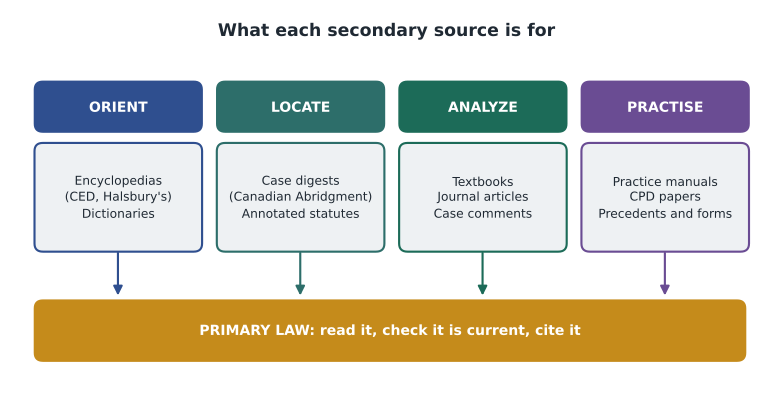
Legal encyclopedias
A legal encyclopedia states the law of a jurisdiction in short, organized propositions, each supported by footnotes to statutes and cases. It is often the best first stop for a researcher who knows little about an area. Canada has two national encyclopedias. The Canadian Encyclopedic Digest, known as the CED, is published by Thomson Reuters and available on Westlaw. It is organized into subject titles, such as Negligence or Occupiers' Liability, each divided into numbered paragraphs, and it has historically been published in Ontario and Western editions to reflect provincial differences. Halsbury's Laws of Canada, published by LexisNexis and available on Lexis+, is a newer encyclopedia organized by subject title in the tradition of the English Halsbury's Laws of England.
Using an encyclopedia well takes some technique. Start with the index or the table of contents for the relevant title, not a keyword search, because encyclopedias are organized by legal concept and the concept may use words different from the facts. Read the propositions around the one that seems relevant, because the context often reveals exceptions. Note the date the title was last updated and check the footnoted authorities for later developments. Tsang shows the class the CED title on occupiers' liability: its footnotes lead directly to the Ontario statute, to the leading Supreme Court decision on the duty of occupiers, and to Court of Appeal decisions on the standard of care.
Case digests and the Canadian Abridgment
A case digest is a short summary of a decision, classified by subject. The Canadian Abridgment, published by Thomson Reuters and available on Westlaw, digests Canadian decisions under a detailed subject classification system, so that a researcher who finds one relevant digest can find every other case digested under the same heading. The Abridgment also includes tools for finding judicial considerations of cases and statutes and for finding judicial definitions of words. Digests are faster than full decisions and useful for spotting patterns, but they are summaries written by editors, so they never substitute for reading the decision.
Words and phrases dictionaries work the same way for language. Words & Phrases Judicially Defined in Canadian Courts and Tribunals, published by Thomson Reuters, collects judicial interpretations of particular words. For the Ingram file, a researcher might look up 'reasonable excuse' to see how courts have interpreted that phrase in notice provisions in other statutes.
Textbooks and treatises
A textbook or treatise discusses an area of law in depth, usually written by an academic or experienced practitioner. Some leading Canadian texts are cited so often by courts that they have become standard references: Peter W. Hogg's Constitutional Law of Canada, now continued by Wade K. Wright, on constitutional law; Ruth Sullivan's The Construction of Statutes on statutory interpretation; and well-known texts on torts, contracts, evidence and criminal law. Texts are especially useful for understanding the reasoning behind a doctrine and the history of an area, and for finding the leading cases.
Texts age. A treatise published several years ago may predate an important amendment or Supreme Court decision. Check the edition and publication date, look for a supplement or an online version that is updated, and verify every proposition in the primary law. Theo Marchetti mentions that at his old firm, the partners would cite a textbook in a factum only when it added analysis that no case supplied, and never as the only authority for a rule.
Journal articles
Law journals, also called law reviews, publish longer analytical articles, case comments and book reviews. Canadian journals include the Canadian Bar Review, the McGill Law Journal, the Osgoode Hall Law Journal, the University of Toronto Law Journal, the Alberta Law Review, the Dalhousie Law Journal and many specialized journals in areas such as administrative law, tax and Indigenous law. Articles are valuable on new or contested questions, for comparative analysis, and for policy arguments. A case comment on a recent decision often explains its significance more clearly than any other source.
Articles are found through several tools: HeinOnline, a large database of journal articles to which most law libraries subscribe; the Index to Canadian Legal Literature, available on Westlaw; the commercial platforms' journal collections; university open-access repositories; and general academic search engines. Many Canadian journals now publish their back issues free online. Read the abstract and introduction first to decide whether an article is worth the time, and check whether it is still current.
Practice materials and continuing legal education
Practitioners rely heavily on materials written for practice. Annotated statutes reproduce legislation with notes on each section and summaries of cases interpreting it; for Ontario civil procedure, an annual annotated edition of the Rules of Civil Procedure is a standard desk reference. Practice manuals explain how to handle particular kinds of files step by step. Precedent books provide model documents and forms. Continuing professional development papers, prepared for programs run by the Law Society of Ontario, the Ontario Bar Association, the Advocates' Society and other organizations, are often the most current analysis available on a practical question, written by lawyers who handle such files every day.
Because these materials are written for lawyers in practice, they are excellent for finding the procedural steps and practical traps in a type of file. For the Ingram problem, a practice paper on slip-and-fall claims would likely flag the snow-and-ice notice requirement, the limitation period and the importance of preserving evidence such as weather records and maintenance logs. The researcher still needs to verify each point in the legislation and case law.
Government and law reform publications
Governments publish plain-language guides, policy papers, technical bulletins and explanatory notes to bills. Law reform bodies, such as the Law Commission of Ontario, publish detailed reports that analyze problems in the law and recommend changes, and courts sometimes refer to these reports to understand why a legislature acted. Legislative debates and committee reports, discussed in lesson 7, are primary sources of legislative history rather than secondary sources, but government backgrounders that accompany a bill sit somewhere in between: they explain what the government intended but are not part of the statute.
Online sources, blogs and AI-generated answers
Lawyers and firms publish a great deal of free commentary online: client bulletins, blogs, newsletters and articles. Some of it is excellent, written by specialists and published within days of a new decision or statute. Some is marketing, simplified for prospective clients, or written for another province. Use such material as a lead, not an authority. Check who wrote it, when, and for which jurisdiction, and follow its references to the primary law.
Answers generated by artificial intelligence tools are a newer kind of secondary source, and the least reliable unless verified. General-purpose chatbots may produce fluent summaries that confuse jurisdictions, misstate the law or invent authorities altogether. Specialized legal research tools built into the commercial platforms are designed to ground their answers in real sources, but they can still misread a case or miss a development. Lesson 10 is devoted to using these tools responsibly. For now, treat any AI answer exactly as you would treat an unsigned blog post: it may point you somewhere useful, and you must check everything it says.
Evaluating a secondary source
Tsang hands out a short checklist that Section B will use all term. For any secondary source, ask:
- Authority: who wrote it, and what is their expertise? A specialist practitioner or recognized academic is more reliable than an anonymous post.
- Jurisdiction: whose law does it describe? An Alberta or British Columbia source may describe a different statute.
- Currency: when was it written or last updated, and has the law changed since?
- Support: does it cite primary sources for its statements, and do those sources say what it claims?
- Purpose: is it neutral analysis, advocacy for a position, or marketing?
Applied to the three blog posts the students found, the checklist sorts them quickly. The sixty-day post was written by an Ontario firm in 2021 and cited the amending statute, but it said nothing about exceptions or later case law. The ten-day post was about municipal sidewalks and did not apply to a private parking lot. The government page was accurate but general. None of them was wrong, but none of them was enough.
Using secondary sources to find the other side's arguments
Secondary sources are also the quickest way to find the arguments against your client. A good text or practice paper explains not only the rule but the exceptions, the conflicting decisions and the open questions. A case comment on a leading decision often sets out the strongest criticism of it. Reading these sources early helps a researcher look for adverse authority deliberately rather than stumbling on it at the end, and it helps the writer of a memo anticipate how opposing counsel will frame the issue. For the Ingram file, practice papers written for defence counsel are as useful as those written for plaintiffs' counsel, because they show what the plaza owner's lawyer will look for.
A research path through secondary sources
Saltire asks each student to sketch a research path for the Ingram file using only secondary sources, before touching any statute or case. Most of the class arrives at something similar. Start with the CED or Halsbury's title on occupiers' liability to understand the duty of care and find the Ontario statute and leading cases. Look up 'reasonable excuse' in a words and phrases source to see how the courts have interpreted that phrase in notice provisions. Search the journal and practice literature for papers on the 2020 amendments to the Act. Keep a note of every primary source cited along the way, then move on to read those sources in full. 'Look at what you have done,' Saltire says. 'You have not answered the question yet. You have built a reading list of the law that will answer it. That is the job of secondary sources.'
Practice problems
Work each problem on paper first, then reveal the answer to check.
Why should a researcher usually begin an unfamiliar question in a legal encyclopedia rather than a keyword search of case law?
Show answer
An encyclopedia explains the structure and vocabulary of the area and points to the leading statutes and cases, so the researcher knows what to search for and how authorities fit together. A keyword search of raw case law without that orientation tends to return many decisions that use the right words in the wrong context.
A respected textbook published six years ago states a rule about notice in slip-and-fall cases. What should you do before relying on it?
Show answer
Check whether the law has changed since publication, for example the 2020 amendments to the Occupiers' Liability Act that took effect in 2021; look for an updated edition or supplement; and read the primary sources it cites, noting them up to confirm they are still good law.
Apply the five-point checklist to a 2019 law firm blog post from British Columbia on occupiers' liability.
Show answer
Authority: depends on the authors. Jurisdiction: British Columbia, so it describes a different statute and is of limited use for an Ontario file. Currency: 2019, before Ontario's 2021 notice rule. Support: check its citations. Purpose: likely client marketing. Conclusion: at most a lead to general principles; not reliable for the Ontario notice issue.
Where would you look for judicial interpretations of the phrase 'reasonable excuse'?
Show answer
In a words and phrases source such as Words & Phrases Judicially Defined in Canadian Courts and Tribunals, in the Canadian Abridgment's judicial definition tools, and by keyword searching case law databases for the phrase in notice cases.
Summary and key terms
- Secondary sources orient, locate, analyze and sometimes persuade, but they are not the law.
- The CED (Thomson Reuters, on Westlaw) and Halsbury's Laws of Canada (LexisNexis, on Lexis+) are the two national legal encyclopedias and are good first stops.
- The Canadian Abridgment digests cases by subject, and words and phrases sources collect judicial definitions.
- Textbooks, journal articles and practice materials provide depth, critique and practical guidance, but must be checked for currency and jurisdiction.
- Blogs and AI-generated answers are leads, not authorities; verify everything they say in the primary law.
- Evaluate every secondary source for authority, jurisdiction, currency, support and purpose.
- Legal encyclopedia
- A secondary source stating the law of a jurisdiction in organized propositions with footnotes to authorities, such as the CED or Halsbury's Laws of Canada.
- Case digest
- A short editorial summary of a decision classified by subject, as in the Canadian Abridgment.
- Treatise
- An in-depth book on an area of law, usually by an academic or senior practitioner.
- Law journal
- A periodical publishing analytical articles and case comments on legal topics.
- Annotated statute
- A publication reproducing legislation with notes and case summaries for each section.
- Continuing professional development (CPD) materials
- Papers prepared for lawyers' education programs, often the most current practical analysis of an issue.
Lesson quiz · 5 questions
Score 60% or more to complete this lesson.
Create a free account to save your progress, take quizzes and earn a certificate.