
LAWC-103 · Lesson 9 of 12 · 17 min
Inchoate offences
▶ Video coming soon A video version of this lesson is on the way.
Castellano starts the class with three short scenarios on the board. A man buys a balaclava and a crowbar and drives to a closed jewellery store at two in the morning, where police arrest him in the parking lot. Two coworkers agree over drinks to set fire to their employer's warehouse, but neither does anything further. A woman sends a message to an acquaintance offering 5,000 dollars to beat up her ex-husband; the acquaintance ignores it. 'No jewellery was stolen. No warehouse burned. No one was hurt,' she says. 'Has anyone committed a crime?'
Daniel Whitecloud says the man at the jewellery store clearly meant to break in. Sophie Tremblay-Hart says the coworkers only talked. Theo Marchetti says the woman with the message is the most dangerous of the three. 'Three different inchoate offences,' Castellano says. 'Attempt, conspiracy and counselling. Inchoate means incomplete, begun but not finished. The criminal law reaches back before the harm, and today we find out how far.'
This lesson examines the three general inchoate offences in Canadian criminal law: attempt (sections 24 and 463), conspiracy (section 465) and counselling an offence that is not committed (section 464). It covers the line between preparation and attempt, the mental element of attempt, impossibility, the agreement in conspiracy and its limits, and the elements of counselling.
Why punish incomplete crimes
Inchoate offences allow the state to intervene before harm occurs. Police who learn of a planned robbery need not wait until someone is shot. Inchoate liability also reflects culpability: a person who tries to kill and fails through bad aim is not morally better than one who succeeds. But reaching back in time raises the risk of punishing thoughts or idle talk. The law therefore requires a clear mental element, often more demanding than for the completed offence, and an act that goes beyond mere intention.
Attempt: section 24
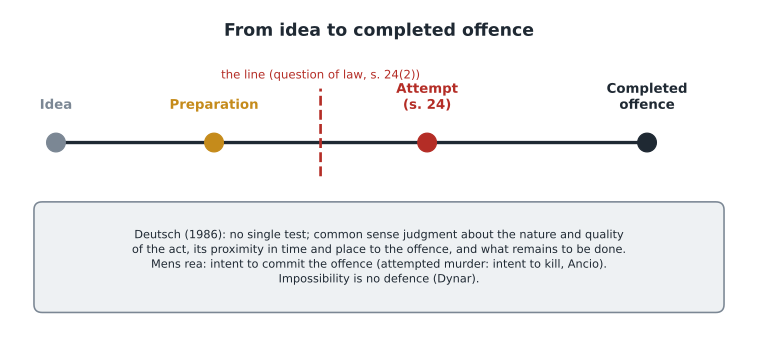
Section 24(1) provides that everyone who, having an intent to commit an offence, does or omits to do anything for the purpose of carrying out the intention is guilty of an attempt to commit the offence, whether or not it was possible under the circumstances to commit the offence. Section 24(2) provides that whether an act or omission by a person who has an intent to commit an offence is or is not mere preparation to commit the offence, and too remote to constitute an attempt, is a question of law. Section 463 sets the punishment: generally half the maximum for the completed offence, or fourteen years where the completed offence carries life imprisonment. Attempted murder is a separate offence under section 239, punishable by life imprisonment, with mandatory minimums where a firearm is used.
The mens rea of attempt
The mental element of attempt is intent to commit the completed offence. In R. v. Ancio, [1984] 1 SCR 225, the accused broke into a building with a sawed-off shotgun, intending to force his estranged wife to leave with him. When a man came at him with a chair, the gun went off, missing the man. He was charged with attempted murder. At the time, section 213(d) made it murder to cause death while committing certain offences with a weapon, so the Crown argued that he would have been guilty of murder had the man died, and therefore of attempted murder. The Court rejected that argument. Justice McIntyre held that the intent required for an attempt to commit murder is the specific intent to kill. A lesser intent, even one that would support a murder conviction if death occurred, will not suffice for attempt.
In R. v. Logan, [1990] 2 SCR 731, the Court held that subjective foresight of death is the constitutional minimum for attempted murder, because of the stigma of the offence. Ancio goes further as a matter of statutory interpretation: only an intent to kill will do. So a person who intends to cause bodily harm knowing it is likely to cause death, and is reckless about death, may be guilty of murder if the victim dies under section 229(a)(ii), but cannot be guilty of attempted murder if the victim survives.
For attempts to commit other offences, the intent must match the full mental element of the completed offence, and courts generally require intention rather than recklessness. In R. v. Williams, 2003 SCC 41, the accused had sex without disclosing his HIV status, but some of the sexual encounters occurred before he knew he was HIV positive. The Court held that he could not be convicted of aggravated assault because the Crown could not prove that the complainant was infected after he learned his status. But he was guilty of attempted aggravated assault: he had the intent to commit the offence, and it did not matter that the complainant may already have been infected, because impossibility is no defence.
The actus reus of attempt: preparation versus attempt
The hardest question in attempts is where preparation ends and attempt begins. Section 24(2) makes this a question of law. In R. v. Deutsch, [1986] 2 SCR 2, the accused interviewed women for a secretary or sales assistant position and told them that the job might involve having sexual intercourse with clients, offering large earnings. He was charged with attempting to procure women to become prostitutes. The Court held that there is no satisfactory general criterion for drawing the line. Justice Le Dain said the distinction must be drawn on the basis of common sense judgment, considering the relationship between the act and the completed offence: the nature and quality of the act, its proximity in time and space to the completed offence, and what remains to be done. An act that is itself lawful may be an attempt when combined with the necessary intent. The Court held that holding out the inducement of large earnings was a step beyond preparation. Making a job offer, although not a completed procuring, was an attempt.
Applied to the jewellery store scenario, driving to the store at two in the morning with a balaclava and a crowbar is close in time and place to a break and enter, and little remains to be done but force the door. Many courts would treat it as beyond preparation, but it is near the line. Buying the items the day before, or driving past the store during the day to look at the locks, would more likely be preparation. Two points from Deutsch guide the analysis. The act need not be the last act before completion; and because the accused's intention is already proved, it can colour acts that look innocent in isolation, such as loitering near a door with tools.
Impossibility
Section 24(1) states that an attempt is committed whether or not it was possible under the circumstances to commit the offence. In United States of America v. Dynar, [1997] 2 SCR 462, the accused was the subject of an American sting operation in which he agreed to launder money he believed was the proceeds of drug trafficking. The money was not, in fact, drug proceeds. The Court held that factual impossibility is no defence to attempt or conspiracy: a person who intends to commit an offence and does everything required is guilty of an attempt even if the circumstances make completion impossible. Shooting at a person who is already dead, or putting a hand into an empty pocket intending to steal, is an attempt.
The Court distinguished imaginary crimes. A person who does something he mistakenly believes is a crime, but which is not an offence known to law, cannot be convicted of an attempt. If a tourist believes it is illegal to bring a lawful souvenir into Canada and smuggles it in, he has committed no offence, because there is no offence he intended to commit. Dynar held that so-called legal impossibility, where the accused is mistaken about the legal character of the circumstances, collapses into factual impossibility and is not a defence. Only the imaginary crime is excused.
Abandonment
Canadian law does not recognize a general defence of voluntary abandonment once an attempt is complete. If the accused has gone beyond preparation with the required intent, the attempt is made out even if he then changes his mind. Abandonment may be relevant to whether the accused had the intent in the first place, or whether the conduct had gone beyond preparation, and it is relevant to sentencing.
Conspiracy: section 465
Section 465(1)(c) makes it an offence for everyone who conspires with anyone to commit an indictable offence, subject to the same punishment as an attempt. Section 465(1)(a) creates conspiracy to commit murder, punishable by life imprisonment, and section 465(1)(d) covers conspiracy to commit summary conviction offences. A conspiracy is complete when the agreement is made. No act beyond the agreement is required.
In R. v. Papalia; R. v. Cotroni, [1979] 2 SCR 256, the Court explained that the essence of conspiracy is the agreement between two or more persons to commit an unlawful act, with the intention to agree and to carry out the common design. In United States of America v. Dynar, the Court held that the mens rea of conspiracy includes an intention to agree, the completion of an agreement, and a common design to do something unlawful. Spouses can conspire with each other, and a corporation can conspire with others, but there must be at least two genuine parties to an agreement. If one party is a police agent who does not intend to carry out the plan, there is no agreement with that person (R. v. O'Brien, [1954] SCR 666).
There is no offence of attempting to conspire. In R. v. Déry, 2006 SCC 53, the accused participated in discussions about stealing liquor, but the Crown could not prove a concluded agreement. The Court held that Canadian law does not recognize an offence of attempted conspiracy, because it would criminalize a bare intention to agree, too remote from any harm. Conduct that is preparatory to an agreement may, however, amount to counselling.
The two coworkers who agreed over drinks to burn their employer's warehouse have committed conspiracy to commit arson if they genuinely agreed and intended to carry out the plan. That is a question of fact: was it a real agreement or drunken bravado? The law does not require that they buy gasoline or visit the warehouse.
Counselling an offence that is not committed: section 464
Section 464 makes it an offence to counsel another person to commit an indictable or summary conviction offence if the offence is not committed. The punishment is the same as for an attempt. Counselling includes procuring, soliciting and inciting (section 22(3)).
In R. v. Hamilton, 2005 SCC 47, the accused sent an email advertising a 'top secret' package of information that included instructions for making bombs, breaking into houses and generating valid credit card numbers. Justice Fish, for the majority, held that the actus reus of counselling is the deliberate encouragement or active inducement of the commission of a criminal offence, judged objectively. The mens rea is that the accused either intended that the offence counselled be committed, or knowingly counselled the commission of the offence while aware of the unjustified risk that the offence counselled was in fact likely to be committed as a result of the accused's conduct. The trial judge had acquitted because Hamilton's purpose was to make money, not to see crimes committed. The Court held that motive was irrelevant and ordered a new trial.
The woman who offered an acquaintance 5,000 dollars to beat up her ex-husband has committed counselling an offence not committed. Her message deliberately encouraged and induced an assault, and she intended it to happen. It does not matter that the recipient ignored it. If the recipient had carried out the assault, she would be a party under section 22.
How the inchoate offences fit together
At the end of the class, Arjun Mehta draws a timeline. An idea becomes counselling when someone else is encouraged to carry it out, a conspiracy when two people genuinely agree, an attempt when one of them goes beyond preparation, and a completed offence when the actus reus is done. Each stage carries its own liability, and a person may be liable for more than one. But the law punishes no one for thoughts alone. Castellano adds a note: the line between preparation and attempt, and between talk and agreement, is where most of the cases are fought.
Practice problems
Work each problem on paper first, then reveal the answer to check.
Ravi intends to kill his business partner. He buys a gun and drives to the partner's house, where he sits in the driveway for twenty minutes, then drives home. Police find a note setting out his plan. Has he committed attempted murder?
Show answer
He clearly had the intent to kill (Ancio). The question is whether his acts went beyond preparation (section 24(2); Deutsch). Buying the gun and driving to the house with intent are significant steps, close in time and place; some courts would find an attempt, while others would see sitting in the driveway as still preparatory because the gun was never produced or aimed. His decision to leave is not a defence if the attempt was complete, but may bear on whether it was.
Two people agree to sell what they believe is cocaine. It turns out to be baking soda. Are they guilty of conspiracy to traffic?
Show answer
Yes. Factual impossibility is no defence to conspiracy or attempt (Dynar; section 24(1)). They agreed to commit an offence known to law, trafficking, and intended to carry out the agreement.
A man tries to persuade his friend to agree to rob a bank, but the friend refuses. Is the man guilty of attempted conspiracy?
Show answer
No. There is no offence of attempted conspiracy in Canadian law (Déry, 2006 SCC 53). But he may be guilty of counselling an offence not committed under section 464, since he deliberately encouraged the robbery and intended it to be committed (Hamilton).
Summary and key terms
- Attempt requires intent to commit the offence and an act beyond mere preparation (section 24); the line is a question of law decided by common sense judgment (Deutsch).
- Attempted murder requires a specific intent to kill (Ancio); subjective foresight of death is the constitutional minimum (Logan).
- Factual impossibility is no defence to attempt or conspiracy; only imaginary crimes are excused (Dynar).
- Conspiracy is complete on agreement between two or more people with intent to agree and to carry out an unlawful design (Papalia; Dynar); there is no attempted conspiracy (Déry).
- Counselling an offence not committed (section 464) requires deliberate encouragement and intent that the offence be committed or awareness of the unjustified risk (Hamilton).
- There is no general defence of abandonment once an attempt is complete.
- Inchoate offence
- An offence that criminalizes conduct preliminary to a completed crime: attempt, conspiracy and counselling.
- Attempt
- Doing or omitting anything beyond mere preparation for the purpose of carrying out an intent to commit an offence.
- Mere preparation
- Acts too remote from the completed offence to amount to an attempt.
- Factual impossibility
- Circumstances that make completion impossible; not a defence to attempt or conspiracy.
- Imaginary crime
- Conduct the accused wrongly believes is criminal; not an offence.
- Conspiracy
- An agreement between two or more persons to commit an offence, complete on agreement.
- Counselling
- Deliberate encouragement or active inducement of the commission of an offence.
Lesson quiz · 5 questions
Score 60% or more to complete this lesson.
Create a free account to save your progress, take quizzes and earn a certificate.