
LAWC-103 · Lesson 2 of 12 · 19 min
The Charter, the presumption of innocence and the burden of proof
▶ Video coming soon A video version of this lesson is on the way.
On Thursday, October 22, 2026, Professor Castellano takes Section B to the Corwin courthouse. In the morning they sit in a bail court of the Ontario Court of Justice, where a duty counsel lawyer handles fourteen cases before lunch. In the afternoon they watch the closing minutes of a judge-alone assault trial. Before giving her reasons, the trial judge says something Hannah Kowalczyk writes down word for word: 'I am not deciding which version I prefer. I am deciding whether the Crown has proved this charge beyond a reasonable doubt.' She acquits.
Back in Ashgrove Hall the next week, Kowalczyk admits she found the result frustrating. 'The judge said she thought the complainant was probably telling the truth. How can that be an acquittal?' Castellano smiles. 'Because probably is not enough. That sentence is the presumption of innocence working exactly as it should. Today we look at why.'
This lesson covers the constitutional framework of substantive criminal law: the presumption of innocence in section 11(d) of the Charter, the meaning of proof beyond a reasonable doubt, reverse onus provisions and how they are justified under section 1, the evidential burden and the air of reality test, and the principles of fundamental justice under section 7. Procedural rights such as search and seizure, detention and the right to counsel are left to LAWC-211 Criminal Procedure.
The presumption of innocence
Section 11(d) of the Charter provides that any person charged with an offence has the right 'to be presumed innocent until proven guilty according to law in a fair and public hearing by an independent and impartial tribunal.' The presumption has deep common law roots. In Woolmington v. Director of Public Prosecutions, [1935] AC 462 (HL), Viscount Sankey described the principle that the prosecution must prove the guilt of the prisoner as the 'golden thread' running through the web of English criminal law.
In R. v. Oakes, [1986] 1 SCR 103, the Supreme Court of Canada gave section 11(d) its modern content. The presumption requires, at a minimum, that an individual be proven guilty beyond a reasonable doubt, that the state bear the burden of proof, and that criminal prosecutions be carried out in accordance with lawful procedures and fairness. Chief Justice Dickson explained that the presumption protects the fundamental liberty and human dignity of anyone accused by the state of criminal conduct. An accused faces grave social and personal consequences, including potential loss of physical liberty, stigma and ostracism.
What proof beyond a reasonable doubt means
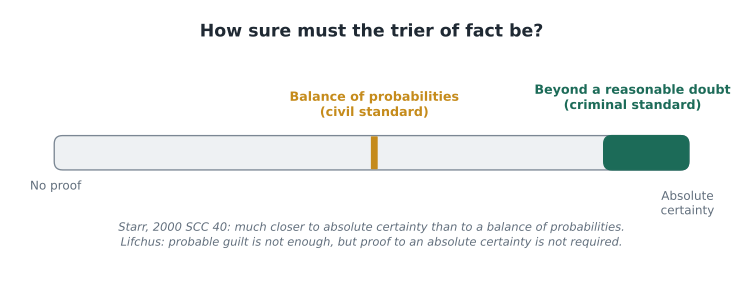
Juries must be told what proof beyond a reasonable doubt means, and the Supreme Court has said how. In R. v. Lifchus, [1997] 3 SCR 320, Justice Cory set out the elements a proper charge should contain. The standard is inextricably intertwined with the presumption of innocence. The burden rests on the prosecution throughout and never shifts to the accused. A reasonable doubt is not based on sympathy or prejudice, but on reason and common sense. It is logically connected to the evidence or absence of evidence. It does not involve proof to an absolute certainty, and it is not proof beyond any doubt, nor an imaginary or frivolous doubt. More is required than proof that the accused is probably guilty: a jury that concludes only that the accused is probably guilty must acquit.
In R. v. Starr, 2000 SCC 40, the Court added that the standard falls much closer to absolute certainty than to proof on a balance of probabilities. Judges may explain this by contrasting the two standards. That contrast is exactly what the Corwin trial judge was doing. A finding that the complainant was probably truthful is a finding on a balance of probabilities, and it cannot support a conviction.
Credibility contests raise a related problem. In R. v. W.(D.), [1991] 1 SCR 742, the Court set out a framework for cases where the accused testifies: if the trier of fact believes the accused's evidence, it must acquit; if it does not believe the accused but is left in reasonable doubt by it, it must acquit; and even if it is not left in doubt by the accused's evidence, it must ask whether, on the basis of the evidence it does accept, it is convinced beyond a reasonable doubt of guilt. The point is that a criminal trial is not a choice between competing versions.
Reverse onus provisions
Parliament sometimes places a burden on the accused. A provision that requires the accused to prove something on a balance of probabilities, or that allows a conviction despite a reasonable doubt, engages section 11(d). The leading case is Oakes itself. Section 8 of the Narcotic Control Act provided that once the Crown proved possession of a narcotic, the accused had to prove that he did not possess it for the purpose of trafficking. The Court held this violated section 11(d) because it allowed conviction for trafficking even if the trier of fact had a reasonable doubt about the purpose. Proof of possession did not rationally lead to an inference of trafficking: possession of a small amount of a narcotic does not support an inference that the possessor intends to traffic.
Oakes also set out the test for justifying limits on Charter rights under section 1, which the class studied in constitutional law. The objective must be pressing and substantial; the means must be rationally connected to the objective, impair the right as little as reasonably possible, and be proportionate in their effects. The reverse onus in Oakes failed at the rational connection stage.
The principle reaches beyond formal burdens of proof. In R. v. Whyte, [1988] 2 SCR 3, the Court held that what matters is substance, not labels: if an accused could be convicted despite a reasonable doubt about any essential element, whether the element is called an element of the offence, an excuse or a defence, section 11(d) is engaged. Whyte concerned a presumption that a person in the driver's seat of a vehicle had care or control; it violated section 11(d) but was saved under section 1. In R. v. Keegstra, [1990] 3 SCR 697, a provision requiring the accused to prove the truth of statements to escape liability for wilful promotion of hatred also violated section 11(d) but was upheld under section 1 by a narrow majority.
By contrast, in R. v. Chaulk, [1990] 3 SCR 1303, the presumption of sanity, which requires the accused to prove mental disorder on a balance of probabilities, was held to violate section 11(d) but to be justified under section 1, because requiring the Crown to disprove insanity beyond a reasonable doubt would place an almost impossible burden on it. That burden is now in section 16(2) and (3) of the Code. And in R. v. Wholesale Travel Group Inc., [1991] 3 SCR 154, the Court upheld the reverse onus of due diligence in regulatory offences, a topic for lesson 5.
Burdens of proof and evidential burdens
Lawyers distinguish two kinds of burden. The persuasive burden, also called the legal burden or ultimate burden, is the obligation to prove a fact to the required standard. In a criminal trial the Crown bears the persuasive burden on every element of the offence beyond a reasonable doubt. The evidential burden is the obligation to point to some evidence on an issue so that the trier of fact must consider it.
For most defences, the accused bears only an evidential burden. The trial judge must leave a defence with the jury only if there is an air of reality to it: some evidence on which a properly instructed jury acting reasonably could acquit. In R. v. Cinous, 2002 SCC 29, the Court held that the air of reality test applies to every defence, and that the judge must consider the totality of the evidence and assume the evidence relied on by the accused is true, without weighing credibility. In R. v. Fontaine, 2004 SCC 27, the Court clarified that the evidential burden is not a burden of proof: it is a threshold for putting a defence before the trier of fact. Once a defence passes the threshold, the Crown must disprove it beyond a reasonable doubt. Mental disorder and extreme intoxication under section 33.1 are exceptions, where the accused must prove the defence on a balance of probabilities.
Section 7 and the principles of fundamental justice
Section 7 of the Charter guarantees the right to life, liberty and security of the person and the right not to be deprived of them except in accordance with the principles of fundamental justice. Because any offence punishable by imprisonment engages liberty, section 7 applies to most criminal laws. The question is what the principles of fundamental justice require.
In Reference re s. 94(2) of the Motor Vehicle Act (BC), [1985] 2 SCR 486, the Court held that the principles of fundamental justice are not limited to procedural fairness. They include substantive principles found in the basic tenets of the legal system. British Columbia had made driving while prohibited or suspended an absolute liability offence carrying mandatory imprisonment. The Court held that combining absolute liability with imprisonment violates section 7: the innocent, those who have no fault at all, should not be punished by loss of liberty. This decision is the foundation of the constitutional fault requirements discussed in lessons 4 to 6.
Several principles of fundamental justice now shape substantive criminal law. Absolute liability combined with possible imprisonment is unconstitutional (Motor Vehicle Reference). For a small group of offences with special stigma, subjective foresight is constitutionally required: murder (R. v. Vaillancourt, [1987] 2 SCR 636; R. v. Martineau, [1990] 2 SCR 633), attempted murder (R. v. Logan, [1990] 2 SCR 731) and war crimes and crimes against humanity (R. v. Finta, [1994] 1 SCR 701). Punishment must be proportionate to moral blameworthiness. The morally involuntary may not be punished: R. v. Ruzic, 2001 SCC 24, struck down part of the statutory duress defence on this basis. And a law must not be arbitrary, overbroad or grossly disproportionate in its effects, as the Court held in Canada (Attorney General) v. Bedford, 2013 SCC 72, which struck down prostitution-related offences, and Carter v. Canada (Attorney General), 2015 SCC 5, which struck down the absolute prohibition on assisted dying.
Section 7 also includes the principle that laws must not be unconstitutionally vague. In R. v. Nova Scotia Pharmaceutical Society, [1992] 2 SCR 606, the Court held that a law is unconstitutionally vague only if it is so lacking in precision that it fails to give sufficient guidance for legal debate. The threshold is high, and few laws fail it.
Other Charter rights in substantive criminal law
Section 12 protects against cruel and unusual treatment or punishment. A sentence violates section 12 when it is grossly disproportionate to what would be appropriate for the offence and the offender. Section 12 is the main tool for challenging mandatory minimum penalties, which lesson 12 examines with R. v. Nur, 2015 SCC 15, R. v. Hills, 2023 SCC 2, and the 2026 amendments.
Section 15 equality rights occasionally reach substantive criminal law. In R. v. Sharma, 2022 SCC 39, an Indigenous offender argued that provisions making conditional sentences unavailable for certain offences violated sections 7 and 15 because they limited the use of Gladue principles. A majority rejected the claim, holding that the provisions did not create or contribute to a disproportionate impact on Indigenous offenders and were not arbitrary or overbroad. Weeks later, Parliament repealed the provisions in question in the 2022 amendments.
Freedom of expression under section 2(b) is relevant to offences that target speech, such as hate propaganda (Keegstra) and child pornography (R. v. Sharpe, 2001 SCC 2, where the Court upheld the offence of possession while reading in two narrow exceptions).
Remedies
When a criminal law violates the Charter and is not saved by section 1, the court declares it of no force or effect under section 52 of the Constitution Act, 1982, to the extent of the inconsistency. Courts may also read in, read down or sever. In R. v. Hills, for example, the Court declared the four-year mandatory minimum for discharging a firearm into a house of no force or effect. Declarations may be suspended to give Parliament time to respond, as in Bedford. Parliament often responds with new legislation, a dialogue the class will see again with intoxication in lesson 10 and mandatory minimums in lesson 12.
Back at the courthouse
In the bail court the students saw a different side of the presumption. Before trial, an accused person is presumed innocent, and section 11(e) of the Charter guarantees the right not to be denied reasonable bail without just cause. In R. v. Antic, 2017 SCC 27, the Court described the ladder principle: release without conditions is the default, and more onerous forms of release are justified only if less onerous ones are inadequate. Parliament has since added reverse onus provisions for certain accused, most recently in Bill C-48 (SC 2023, c. 30, in force January 4, 2024) for repeat violent offending involving weapons, and in Bill C-14 (royal assent June 15, 2026, in force July 15, 2026), which expanded the reverse onus categories and clarified that the principle of restraint does not require release where detention is justified. Daniel Whitecloud asks whether a reverse onus at bail fits the presumption of innocence. 'That,' Castellano says, 'is exactly the argument defence counsel will be making for the next ten years. Bail is procedure, so we will leave it for second year. But notice the tension.'
Practice problems
Work each problem on paper first, then reveal the answer to check.
A judge instructs a jury: 'If you think it is more likely than not that the accused committed the offence, you should convict.' What is wrong?
Show answer
That is the civil standard. Lifchus and Starr require proof beyond a reasonable doubt, which falls much closer to absolute certainty than to a balance of probabilities. A jury that finds the accused only probably guilty must acquit. The instruction is a serious error that would require a new trial.
A new offence provides that a person found in a vehicle with more than ten catalytic converters 'shall be presumed to have stolen them unless the person proves on a balance of probabilities that they were lawfully acquired.' Analyze under the Charter.
Show answer
The presumption allows conviction despite a reasonable doubt about an essential element, so it violates section 11(d) (Oakes, Whyte). The Crown would try to justify it under section 1: the objective of combating converter theft may be pressing, but the provision may fail rational connection or minimal impairment because possession of converters by scrap dealers or mechanics is not strongly linked to theft, and an evidential burden would be less intrusive.
The accused raises self-defence, but the only evidence is his own vague statement that he 'felt nervous.' Must the judge leave the defence to the jury?
Show answer
Only if there is an air of reality to it: evidence on which a properly instructed jury acting reasonably could acquit (Cinous). The judge assumes the defence evidence is true but asks whether it could support each element of section 34. A bare statement of nervousness, without evidence of a perceived threat or a defensive purpose, probably fails the test.
Summary and key terms
- Section 11(d) guarantees the presumption of innocence: proof beyond a reasonable doubt, with the burden on the Crown (Oakes).
- Lifchus and Starr define reasonable doubt: based on reason and common sense, not proof to absolute certainty, but much closer to certainty than to probability; probable guilt is not enough.
- W.(D.) guides credibility cases: a trial is not a choice between versions.
- Any provision allowing conviction despite a reasonable doubt engages section 11(d), whatever its label (Whyte); some are saved under section 1 (Whyte, Keegstra, Chaulk).
- The accused usually bears only an evidential burden (air of reality, Cinous); the Crown then disproves the defence beyond a reasonable doubt. Mental disorder and section 33.1 are exceptions.
- Section 7 forbids imprisonment for absolute liability, requires subjective fault for murder and a few other offences, protects the morally involuntary, and forbids arbitrary, overbroad and grossly disproportionate laws.
- Presumption of innocence
- The section 11(d) right to be presumed innocent until the Crown proves guilt beyond a reasonable doubt.
- Persuasive burden
- The obligation to prove a fact to the required standard; in criminal cases the Crown bears it on every element.
- Evidential burden
- The obligation to point to some evidence on an issue so the trier of fact must consider it.
- Air of reality
- The threshold for leaving a defence with the jury: evidence on which a properly instructed jury acting reasonably could acquit.
- Reverse onus
- A provision placing a burden of proof on the accused; it engages section 11(d) if it permits conviction despite a reasonable doubt.
- Principles of fundamental justice
- Basic tenets of the legal system protected by section 7, including substantive principles such as no imprisonment for absolute liability.
- Gross disproportionality
- The section 7 and section 12 standard for laws or punishments whose effects are wholly out of proportion to their objective or to a fit sentence.
Lesson quiz · 5 questions
Score 60% or more to complete this lesson.
Create a free account to save your progress, take quizzes and earn a certificate.