
LAWC-103 · Lesson 8 of 12 · 18 min
Parties to offences
▶ Video coming soon A video version of this lesson is on the way.
Leah Pruitt finally gets her lesson. Castellano reminds the class of the Calder file: while Owen Calder and Mark Dorey argued outside the Ridley Street bar, Pruitt stood on the sidewalk shouting 'Go on, push him!' Calder shoved Dorey, who fell and later died. 'Is Ms. Pruitt guilty of anything?' Castellano asks. Theo Marchetti, the former litigation clerk, says she just yelled. Hannah Kowalczyk says she encouraged a crime. Arjun Mehta asks whether it matters that she might have yelled it as a joke. 'All three of you have found the issues,' Castellano says. 'Section 21 is where we resolve them.'
This lesson examines how a person who does not personally commit the actus reus can be guilty of an offence: as an aider, an abettor, a party to a common intention or a counsellor. It covers sections 21 and 22 of the Code, the conduct and fault elements of party liability, presence at the scene, withdrawal, accessories after the fact and the liability of organizations. Lesson 9 covers attempts, conspiracy and counselling an offence that is not committed.
Section 21: everyone who participates
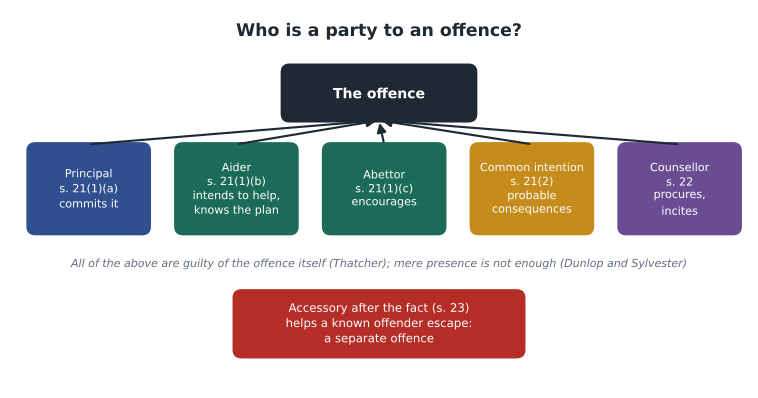
Section 21(1) provides that everyone is a party to an offence who actually commits it, does or omits to do anything for the purpose of aiding any person to commit it, or abets any person in committing it. Section 21(2) adds that where two or more persons form an intention in common to carry out an unlawful purpose and to assist each other in it, and any one of them, in carrying out the common purpose, commits an offence, each of them who knew or ought to have known that the commission of the offence would be a probable consequence of carrying out the common purpose is a party to that offence. The objective branch of section 21(2), 'ought to have known', cannot be used where the offence itself requires subjective fault such as murder or attempted murder (R. v. Logan, [1990] 2 SCR 731).
A party is guilty of the same offence as the principal. There is no separate offence of aiding or abetting. In R. v. Thatcher, [1987] 1 SCR 652, a former Saskatchewan cabinet minister was charged with murdering his ex-wife. The Crown's theory was that he either killed her himself or hired someone to do it. The Court held that the jury did not need to agree unanimously on whether he was the principal or an aider or abettor, because section 21 makes all of them guilty of the same offence. What matters is that each juror is satisfied beyond a reasonable doubt that he participated in one of the ways the section describes.
The actus reus of aiding and abetting
Aiding means to assist or help the principal. Abetting means to encourage, instigate, promote or procure the crime. The words are often used together, but each can ground liability on its own. Aiding can be physical help, such as acting as a lookout, driving the getaway car or providing a weapon. Abetting can be words or gestures of encouragement. The act of aiding or abetting must actually assist or encourage, but it need not be a cause of the offence in the sense that the offence would not have occurred without it.
In R. v. Briscoe, 2010 SCC 13, the accused drove a group of people, including a man named Laboucan, to a secluded golf course, where Laboucan and others murdered a thirteen-year-old girl. Briscoe handed over a pair of pliers when asked and stood by while the others attacked her. The Court held that his conduct, including driving the group, selecting the location and handing over the pliers, was capable of constituting aiding. The real question was whether he had the required mental element.
Presence at the scene
Mere presence at the scene of a crime is not enough. In Dunlop and Sylvester v. The Queen, [1979] 2 SCR 881, the accused were present when a woman was gang-raped by members of a motorcycle club. The Court held that mere presence at the scene, even with knowledge that a crime is being committed, does not make a person a party. Something more is required: encouragement of the principal, an act that facilitates the offence or prevents the victim from escaping, or presence in pursuance of a prearranged plan. Presence can be evidence of aiding or abetting where the accused had a duty to act and failed to, or where presence itself was intended to and did encourage the principal.
Pruitt was not merely present. She shouted encouragement. If she intended to encourage Calder to shove Dorey, she abetted the assault. Whether she is a party to manslaughter depends on the fault elements below.
The mens rea of aiding and abetting
Section 21(1)(b) requires that the aider act 'for the purpose of aiding' the principal. In R. v. Hibbert, [1995] 2 SCR 973, the Court held that purpose in this sense means intention, not desire: an accused who intends to provide assistance acts for the purpose of aiding even if he does not want the crime to be committed, for instance because he is acting under threats. Duress does not negate the mental element; it is a separate excuse.
Briscoe set out the full mental element. The aider or abettor must intend to assist or encourage the principal, and must know that the principal intends to commit the crime. The aider need not know precisely how the crime will be committed. For murder, the aider must know that the principal intends to kill, but need not share that intent or desire the death. Knowledge can be proved by wilful blindness: where an accused's suspicion is aroused to the point where he sees the need for further inquiries but deliberately chooses not to make them, he is treated as knowing. In Briscoe, the Court held that the trial judge had failed to consider wilful blindness: Briscoe's own statements suggested he suspected the group intended to kill and chose not to ask. A new trial was ordered.
A party's fault is assessed individually. A party may be guilty of a different, less serious offence than the principal, depending on his own mental state. In R. v. Kirkness, [1990] 3 SCR 74, the accused broke into a house with an accomplice who sexually assaulted and strangled the elderly occupant. The Court held that an aider to a killing can be convicted of manslaughter, rather than murder, if he lacked the knowledge required for murder but had the objective fault for manslaughter. In R. v. Jackson, [1993] 4 SCR 573, the Court confirmed that a party can be guilty of manslaughter while the principal is guilty of murder.
Applied to Pruitt, if she intended to encourage Calder to shove Dorey and knew he intended to shove him, she is a party to the assault. For manslaughter, the Crown must also prove that a reasonable person in her circumstances would have foreseen a risk of bodily harm that was neither trivial nor transitory (Jackson). Shouting encouragement to shove a man near a curb probably meets that standard. If she shouted as a joke, with no intention to encourage, the mens rea for abetting is missing, but that is a question of credibility for the trier of fact.
Common intention: section 21(2)
Section 21(2) extends liability to offences committed in carrying out a common unlawful purpose. If two people agree to rob a store and assist each other, and during the robbery one of them assaults the clerk, the other is a party to the assault if he knew or ought to have known that an assault was a probable consequence of carrying out the robbery. The provision catches offences that go beyond what was planned, as long as they were probable consequences.
The Charter limits section 21(2). In R. v. Logan, [1990] 2 SCR 731, the Court held that where the offence the principal commits requires subjective foresight as a constitutional minimum, such as murder or attempted murder, the words 'or ought to have known' must be read out of section 21(2). A party to a robbery in which the principal commits murder is guilty of murder under section 21(2) only if he subjectively knew that murder was a probable consequence of the robbery. Otherwise he may be guilty of manslaughter. In R. v. Mena (1987), 34 CCC (3d) 304 (Ont CA), the Ontario Court of Appeal explained the elements of section 21(2) and the importance of the common unlawful purpose.
Counselling: section 22
Section 22(1) provides that where a person counsels another person to be a party to an offence and that other person is afterwards a party to that offence, the person who counselled is a party, even if the offence was committed in a way different from that counselled. Section 22(2) extends this to every offence that the person counselled commits in consequence of the counselling that the counsellor knew or ought to have known was likely to be committed. Section 22(3) defines counselling to include procuring, soliciting and inciting.
Where the offence counselled is not committed, section 464 makes counselling itself an offence, as lesson 9 explains. In R. v. Hamilton, 2005 SCC 47, the Court held that the actus reus of counselling is the deliberate encouragement or active inducement of the commission of a criminal offence, and the mens rea is intent that the offence be committed, or conscious disregard of the substantial and unjustified risk inherent in the counselling. Pruitt's shout could also be seen as counselling, but because the assault was committed, section 21 is the simpler route.
Withdrawal
A party who has aided or abetted may avoid liability by withdrawing before the offence is committed. In R. v. Gauthier, 2013 SCC 32, the Court set out the requirements: an intention to abandon or withdraw from the unlawful purpose; timely communication of this abandonment or withdrawal to those who wish to continue; communication that serves unequivocal notice that the party has withdrawn; and, in some circumstances, taking reasonable steps to neutralize or cancel out the effects of the participation or to prevent the crime. The accused in Gauthier had prepared a mixture of medications for a murder-suicide pact with her husband, who killed their children; the Court held there was no air of reality to her claimed withdrawal.
Accessories after the fact
Section 23 makes a person an accessory after the fact who, knowing that a person has been a party to an offence, receives, comforts or assists that person for the purpose of enabling that person to escape. Being an accessory after the fact is a separate offence: section 463 generally sets the maximum at half the maximum for the principal offence, while section 240 makes an accessory after the fact to murder liable to imprisonment for life. In R. v. Duong (1998), 39 OR (3d) 161 (CA), the Ontario Court of Appeal held that wilful blindness satisfies the knowledge requirement for an accessory after the fact. An old rule exempting a married person who helped a spouse escape was repealed in 2000, so a spouse or common-law partner may now be an accessory after the fact.
Organizations as parties
Sections 22.1 and 22.2, introduced after the Westray mine disaster by An Act to amend the Criminal Code (criminal liability of organizations), SC 2003, c. 21, govern when an organization, including a corporation, partnership, union or association, is a party to an offence. For negligence offences, section 22.1 requires that a representative was a party and that the senior officer responsible for the relevant aspect of the organization's activities departed markedly from the standard of care that could reasonably be expected to prevent the representative from being a party. For subjective fault offences, section 22.2 requires that a senior officer, with the intent at least in part to benefit the organization, was a party, directed representatives to commit the offence, or knew that a representative was about to be a party and did not take all reasonable measures to stop them. Lesson 5 discussed R. v. Metron Construction Corp., 2013 ONCA 541, decided under section 22.1.
Pruitt's case, summarized
Castellano asks Mehta to put Pruitt's liability into a flowchart. Step one: did she aid or abet? Yes, if her shouting was encouragement. Step two: did she intend to encourage and know Calder intended to shove? That is the factual question. Step three: what offence did the principal commit? Manslaughter, on the analysis from lesson 6. Step four: does Pruitt have her own fault for that offence? For manslaughter, objective foreseeability of non-trivial bodily harm. Step five: any withdrawal? None. 'If the jury accepts that she meant it,' Castellano says, 'she is as guilty of manslaughter as Calder. Section 21 does not grade participation. Sentencing does.'
Practice problems
Work each problem on paper first, then reveal the answer to check.
Ana drives Ben to a store, believing he is going to buy groceries. Ben robs the store and runs back to the car, and Ana drives off. Is Ana a party to the robbery?
Show answer
Not as an aider to the robbery itself, because when she drove him there she lacked knowledge that he intended to commit robbery (Briscoe), unless she was wilfully blind. Driving away after the fact, knowing he had committed the robbery and intending to help him escape, may make her an accessory after the fact under section 23.
Two friends plan a break-in at an empty house. One brings a knife without telling the other. A homeowner returns unexpectedly and is stabbed and killed. Is the friend without the knife guilty of murder?
Show answer
Under section 21(2), he is a party to offences committed in carrying out the common purpose that he knew were probable consequences. For murder, Logan requires subjective knowledge that murder was a probable consequence; 'ought to have known' is read out. Without knowledge of the knife or of any plan to use violence, murder is unlikely. He may be a party to manslaughter if bodily harm was objectively foreseeable (Jackson).
A man hands his friend a gun and says 'Go teach him a lesson,' then calls the friend an hour later saying 'Don't do it, I changed my mind.' The friend shoots the victim anyway. Has the man withdrawn?
Show answer
Under Gauthier, he must have intended to withdraw, communicated that intention in a timely and unequivocal way to the friend, and, given that he supplied the gun, possibly taken reasonable steps to neutralize his contribution, such as retrieving the gun or calling police. A late phone call may be insufficient; the question is whether there is an air of reality to withdrawal.
Summary and key terms
- Section 21(1) makes principals, aiders and abettors parties to the same offence; jurors need not agree on the mode of participation (Thatcher).
- Mere presence is not enough; encouragement, facilitation or a prearranged plan is required (Dunlop and Sylvester).
- Aiding requires intent to assist and knowledge of the principal's intended crime; purpose means intention, not desire (Hibbert); wilful blindness suffices (Briscoe).
- Each party's fault is assessed individually; a party may be guilty of manslaughter while the principal is guilty of murder (Kirkness, Jackson).
- Section 21(2) covers probable consequences of a common unlawful purpose; 'ought to have known' is read out for murder and attempted murder (Logan).
- Section 22 makes counsellors parties; withdrawal requires timely, unequivocal communication and sometimes neutralizing steps (Gauthier); section 23 covers accessories after the fact; sections 22.1 and 22.2 cover organizations.
- Principal
- The person who actually commits the actus reus of an offence.
- Aiding
- Assisting the principal to commit an offence, with intent to assist and knowledge of the intended crime.
- Abetting
- Encouraging, instigating or promoting the commission of an offence.
- Common intention
- Under section 21(2), an agreement to carry out an unlawful purpose and assist each other, extending liability to probable consequences.
- Counselling
- Procuring, soliciting or inciting another person to commit an offence.
- Withdrawal
- Abandoning participation before the offence, with timely and unequivocal communication and, where needed, steps to neutralize one's contribution.
- Accessory after the fact
- A person who, knowing someone has committed an offence, helps that person escape (section 23).
Lesson quiz · 5 questions
Score 60% or more to complete this lesson.
Create a free account to save your progress, take quizzes and earn a certificate.