
LAWC-103 · Lesson 10 of 12 · 20 min
Mental disorder, automatism and intoxication
▶ Video coming soon A video version of this lesson is on the way.
Castellano opens the class with a question about the Calder file. 'Suppose Owen Calder had been drinking heavily before the fight. Suppose instead that he had a serious mental illness, or that he had suffered a concussion earlier that night and has no memory of the shove. Do any of these facts help him?' Hannah Kowalczyk says intoxication should never help someone who chose to drink. Daniel Whitecloud says mental illness is different, because no one chooses it. Arjun Mehta wants to know whether the concussion makes the shove involuntary. 'You have just outlined three defences that the Supreme Court and Parliament have argued about for forty years,' Castellano says. 'Today we look at what the law asks about the accused's mind, and what happens when that mind was not working normally.'
This lesson covers three related defences that concern the accused's mental state or capacity: the mental disorder defence in section 16 and the verdict of not criminally responsible; automatism, mental and non-mental, under R. v. Stone; and intoxication, including the distinction between specific and general intent offences, extreme intoxication akin to automatism, R. v. Daviault, R. v. Brown and Parliament's 2022 version of section 33.1. Lesson 11 covers justifications and excuses.
Mental disorder: section 16
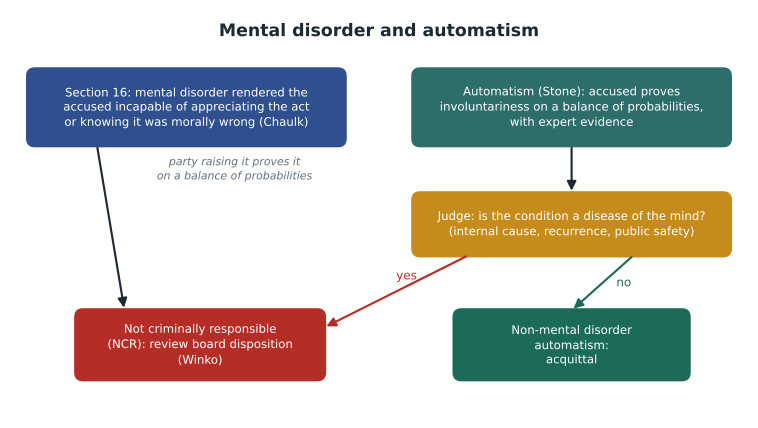
Section 16(1) provides that no person is criminally responsible for an act committed or an omission made while suffering from a mental disorder that rendered the person incapable of appreciating the nature and quality of the act or omission or of knowing that it was wrong. Section 16(2) presumes every person not to suffer from such a mental disorder until the contrary is proved on a balance of probabilities, and section 16(3) places the burden on the party that raises the issue. Section 2 defines mental disorder as a disease of the mind.
The defence has two steps. First, the accused must have suffered from a mental disorder, which is a legal concept determined by the judge. In Cooper v. The Queen, [1980] 1 SCR 1149, the Court defined disease of the mind broadly to include any illness, disorder or abnormal condition that impairs the human mind and its functioning, excluding self-induced states caused by alcohol or drugs and transitory mental states such as hysteria or concussion. Second, the disorder must have rendered the accused incapable either of appreciating the nature and quality of the act or of knowing that it was wrong.
To appreciate the nature and quality of an act means more than knowing what one is physically doing. In Cooper, the Court held that it requires the capacity to perceive the consequences, impact and results of the physical act. A person who strangles someone believing he is squeezing a lemon does not appreciate the nature and quality of his act.
The meaning of 'wrong' was decided in R. v. Chaulk, [1990] 3 SCR 1303. The Court held that wrong means morally wrong according to the ordinary moral standards of society, not merely legally wrong. A person who knows his act is illegal but, because of mental disorder, believes it is morally right according to society's standards, is incapable of knowing it is wrong. In R. v. Oommen, [1994] 2 SCR 507, the Court refined the test: the question is whether the accused lacked the capacity to rationally decide whether the act was right or wrong and hence to make a rational choice about whether to do it. Oommen, suffering from paranoid delusions, killed a friend who was sleeping in his apartment, believing she was part of a conspiracy to kill him. Although he may have known in the abstract that killing is wrong, his delusion deprived him of the capacity to apply that knowledge rationally. In R. v. Bouchard-Lebrun, 2011 SCC 58, the Court held that a toxic psychosis caused by voluntary drug use, which ended when the drugs wore off, was not a disease of the mind, so the defence was not available and the case fell under the intoxication rules.
The NCR verdict and Part XX.1
An accused who establishes the defence is found not criminally responsible on account of mental disorder (NCR). This is not an acquittal. Under Part XX.1 of the Code, the court or a provincial review board, in Ontario the Ontario Review Board, holds a disposition hearing and may order an absolute discharge, a conditional discharge, or detention in a hospital (section 672.54). In Winko v. British Columbia (Forensic Psychiatric Institute), [1999] 2 SCR 625, the Court upheld Part XX.1 against a Charter challenge, holding that an NCR accused must be absolutely discharged unless the court or review board finds that the accused poses a significant threat to the safety of the public, and that the regime is not punitive but aims to protect the public and treat the accused. Since 2014, a court may designate certain NCR accused as high risk under section 672.64, which restricts review and release.
Fitness to stand trial
Fitness is distinct from the NCR defence. The NCR defence concerns the accused's mental state at the time of the offence; fitness concerns the accused's present ability to participate in a trial. Under section 2, an accused is unfit if, on account of mental disorder, he is unable to understand the nature or object of the proceedings, understand their possible consequences or communicate with counsel. In R. v. Taylor (1992), 11 OR (3d) 323 (CA), the Ontario Court of Appeal adopted a limited cognitive capacity test: the accused need not be able to act in his own best interests, only to communicate with counsel and understand the process. An unfit accused is treated until fit, and the Crown must periodically show it has a prima facie case.
Automatism
Automatism is unconscious, involuntary behaviour. Because voluntariness is part of the actus reus, an accused who acted in a state of automatism did not commit the offence. In R. v. Parks, [1992] 2 SCR 871, the accused drove 23 kilometres in his sleep to his in-laws' home, where he killed his mother-in-law and seriously injured his father-in-law. Expert evidence showed he was sleepwalking and that sleepwalking was not a disease of the mind. The Court upheld his acquittal: his conduct was involuntary, and the automatism was non-mental disorder automatism.
In R. v. Stone, [1999] 2 SCR 290, the accused stabbed his wife 47 times after she insulted him during a car ride. He claimed her words caused a dissociative state, and that he remembered nothing until he found himself holding the knife. The Court set out a two-step framework. At the first step, the accused must establish a proper foundation for automatism: an assertion of involuntariness plus confirming expert psychiatric or psychological evidence. Because automatism is easily feigned and lies uniquely within the accused's knowledge, the majority held that the accused must prove involuntariness on a balance of probabilities. At the second step, the judge decides whether the condition is a disease of the mind, using a holistic approach that considers whether the cause was internal or external, the risk of recurrence, and policy concerns such as public safety. If the condition is a disease of the mind, the defence becomes mental disorder automatism, governed by section 16, and the verdict is NCR. If not, the accused is entitled to an acquittal. Stone's defence was left to the jury as mental disorder automatism; the jury convicted him of manslaughter.
Under the internal cause theory, a condition arising from the accused's own psychological or emotional makeup is more likely to be a disease of the mind, while one caused by an external factor such as a blow to the head, the involuntary ingestion of a drug, or a diabetic reaction to insulin is more likely to be non-mental disorder automatism. In Stone, the Court said the question is whether a normal person, in similar circumstances, might react to the trigger by entering a dissociative state. An ordinary insult would not cause that in a normal person, which suggested an internal cause.
Mehta's concussion scenario fits here. If Calder had suffered a blow to the head earlier that night and acted in a state of genuine automatism when he shoved Dorey, the cause would be external, and non-mental disorder automatism would lead to an acquittal, provided he could establish involuntariness on a balance of probabilities with expert support. In practice such claims are rare and closely scrutinized.
Intoxication: specific and general intent
Intoxication is not a defence in itself. It is relevant because it may show that the accused lacked the mental element of the offence. The common law draws a distinction, maintained in Canada, between specific intent and general intent offences. In R. v. George, [1960] SCR 871, the Court explained that specific intent offences require an intention to achieve an ulterior purpose beyond the immediate act, while general intent offences require only an intention to do the act itself. Robbery requires the intent to steal, an ulterior purpose; assault requires only the intent to apply force.
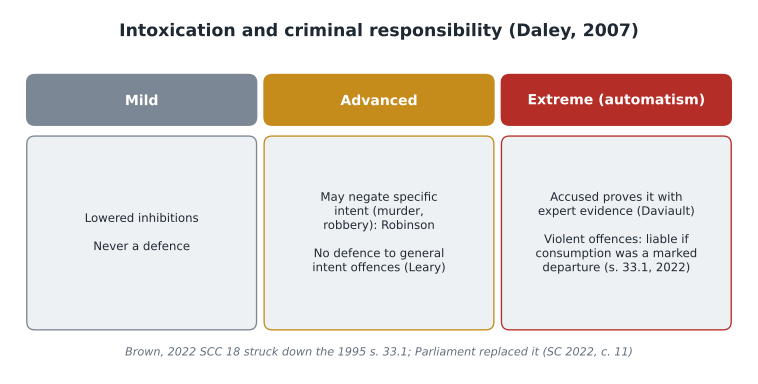
For specific intent offences, intoxication can raise a reasonable doubt about whether the accused formed the required intent. In R. v. Daley, 2007 SCC 53, the Court described three levels of intoxication. Mild intoxication, involving a relaxation of inhibitions, is never a defence. Advanced intoxication, where the accused lacks the specific intent, is relevant to specific intent offences. And extreme intoxication akin to automatism, which negates voluntariness, is the most severe. In R. v. Robinson, [1996] 1 SCR 683, the Court held that the jury must be told that the question is not whether the accused had the capacity to form the intent, but whether he actually formed it. Murder is a specific intent offence, so an intoxicated accused who did not form the intent to kill or the knowledge that death was likely may be acquitted of murder and convicted of manslaughter, a general intent offence.
For general intent offences, such as assault, sexual assault and manslaughter, intoxication short of automatism is not a defence. In Leary v. The Queen, [1978] 1 SCR 29, the Court held that self-induced intoxication is no defence to rape, a general intent offence, because the recklessness of becoming intoxicated supplies the fault.
Extreme intoxication: Daviault, section 33.1 and Brown
The hardest cases involve extreme intoxication akin to automatism. In R. v. Daviault, [1994] 3 SCR 63, the accused, a chronic alcoholic, drank about seven or eight beers and most of a bottle of brandy and then sexually assaulted a 65-year-old woman who used a wheelchair. Expert evidence suggested he may have been in a state of automatism. The Court held that the Leary rule, to the extent that it barred any intoxication defence for general intent offences, violated sections 7 and 11(d) of the Charter, because it allowed conviction of a person who acted involuntarily. Extreme intoxication akin to automatism, proved by the accused on a balance of probabilities with expert evidence, could be a defence even to general intent offences.
Parliament responded in 1995 by enacting section 33.1, which removed the defence of self-induced intoxication for general intent offences involving an assault or interference with bodily integrity, deeming such intoxication to be a marked departure from the standard of care. In R. v. Brown, 2022 SCC 18, the accused consumed alcohol and magic mushrooms and, in a psychotic state, broke into a stranger's home and attacked her with a broomstick, causing permanent injuries. Justice Kasirer, for a unanimous Court, held that the 1995 version of section 33.1 violated sections 7 and 11(d) and was not justified under section 1. It allowed conviction without proof of voluntariness or fault for the violent offence, imposing liability based on the decision to become intoxicated even where violence was not foreseeable. In the companion cases R. v. Sullivan and R. v. Chan, 2022 SCC 19, the Court held that the section was of no force or effect and that the Ontario superior court's earlier declaration bound lower courts in the province.
Brown expressly pointed to a constitutional alternative: Parliament could impose liability where the accused was criminally negligent in becoming extremely intoxicated. Parliament acted within weeks. An Act to amend the Criminal Code (self-induced extreme intoxication), SC 2022, c. 11, received royal assent on June 23, 2022. The new section 33.1 provides that a person who was in a state of extreme intoxication is criminally responsible for certain violent offences if all the other elements of the offence are present and the person departed markedly from the standard of care expected of a reasonable person in the circumstances with respect to the consumption of intoxicating substances. In deciding whether there was a marked departure, the court must consider the objective foreseeability of the risk that consuming the substances could cause extreme intoxication and lead the person to harm another person, and anything the person did to avoid the risk. Extreme intoxication is defined as intoxication that renders a person unaware of, or incapable of consciously controlling, their behaviour.
The new provision is controversial. Some commentators argue it is still too generous to accused persons, because it is often hard to prove that a person foresaw that consuming a substance could lead to violence. Others argue that the objective foreseeability inquiry could catch people who had no reason to expect a psychotic reaction. Appellate courts have not yet produced a definitive interpretation of the 2022 version, so lawyers should check for new decisions.
Kowalczyk's position, that intoxication should never help someone who chose to drink, is close to the law for most offences and for most degrees of intoxication. Only extreme intoxication akin to automatism, proved on a balance of probabilities with expert evidence, can help with general intent offences, and since 2022 even that defence fails for violent offences if the accused's consumption was a marked departure from the standard of a reasonable person.
Involuntary intoxication
Intoxication that is not self-induced, as where the accused's drink is spiked or the accused has an unexpected reaction to a prescribed medication taken as directed, is treated differently. If it produces automatism, it may support a non-mental disorder automatism defence. In R. v. King, [1962] SCR 746, discussed in lesson 3, the accused's impairment from an anaesthetic he did not know would affect him meant his driving was not voluntary.
Bringing it back to Calder
Castellano summarizes. If Calder was drunk, the intoxication cannot help him on manslaughter, a general intent offence, unless he was in a state of extreme intoxication akin to automatism, and even then section 33.1 would likely apply to an assault causing death if his drinking was a marked departure. It could help on murder, a specific intent offence, by raising a doubt about intent, but he was not charged with murder. If he had a serious mental illness, the question is whether it rendered him incapable of appreciating the nature of the shove or knowing it was wrong; nothing suggests that. And if he had a concussion, the question is non-mental disorder automatism under Stone. 'Different defences,' she says, 'different burdens, different verdicts. Know which door you are walking through.'
Practice problems
Work each problem on paper first, then reveal the answer to check.
An accused with schizophrenia kills his neighbour, believing on the basis of a delusion that God commanded it and that it was therefore morally right, although he knew it was illegal. Is he NCR?
Show answer
Possibly. Under Chaulk, 'wrong' means morally wrong by society's standards; under Oommen, the question is whether the disorder deprived him of the capacity to rationally decide whether the act was right or wrong. If his delusion prevented him from knowing that society would regard the act as morally wrong, the section 16 defence may apply. He must prove it on a balance of probabilities, and the verdict would be NCR, followed by a review board disposition.
A woman takes a prescribed sleeping pill as directed and, without any warning or prior reaction, attacks her partner while apparently asleep. What defence is available?
Show answer
Non-mental disorder automatism. The intoxication was not self-induced in the relevant sense, the cause appears external, and under Stone she would need to establish involuntariness on a balance of probabilities with expert evidence. The judge would then decide whether the condition is a disease of the mind; an unexpected drug reaction is likely external, leading to an acquittal.
After drinking heavily, an accused punches a stranger and causes bodily harm. He claims he was too drunk to know what he was doing. Is that a defence to assault causing bodily harm?
Show answer
Generally no. Assault causing bodily harm is a general intent offence, so ordinary or advanced intoxication is not a defence (Leary; Daley). Only extreme intoxication akin to automatism, proved on a balance of probabilities with expert evidence, could apply, and the 2022 version of section 33.1 would remove it if his consumption was a marked departure from the standard of a reasonable person, considering objective foreseeability of the risk of extreme intoxication and harm.
Summary and key terms
- Section 16: no criminal responsibility where a mental disorder rendered the accused incapable of appreciating the nature and quality of the act or knowing it was morally wrong (Cooper; Chaulk; Oommen); the accused proves it on a balance of probabilities.
- An NCR verdict leads to a disposition under Part XX.1; absolute discharge unless the accused poses a significant threat to public safety (Winko).
- Automatism negates voluntariness; Stone requires proof of involuntariness on a balance of probabilities and a holistic inquiry into whether the condition is a disease of the mind.
- Intoxication may negate specific intent (George, Daley, Robinson) but is not a defence to general intent offences short of automatism (Leary).
- Daviault recognized extreme intoxication akin to automatism; the 1995 section 33.1 was struck down in Brown, 2022 SCC 18.
- The 2022 section 33.1 (SC 2022, c. 11) imposes liability for violent offences where consumption was a marked departure, considering objective foreseeability of extreme intoxication and harm.
- Not criminally responsible (NCR)
- The verdict when the section 16 mental disorder defence is established; it leads to a review board disposition, not an acquittal.
- Disease of the mind
- A legal concept covering any illness, disorder or abnormal condition that impairs the mind, excluding self-induced intoxication and transitory states.
- Automatism
- Unconscious, involuntary behaviour; mental disorder automatism leads to NCR, non-mental disorder automatism to acquittal.
- Specific intent offence
- An offence requiring an intention to achieve an ulterior purpose beyond the immediate act, such as murder or robbery.
- General intent offence
- An offence requiring only intention to do the act itself, such as assault or manslaughter.
- Extreme intoxication
- Intoxication that renders a person unaware of, or incapable of consciously controlling, their behaviour.
- Fitness to stand trial
- The present capacity to understand the proceedings and their consequences and to communicate with counsel.
Lesson quiz · 5 questions
Score 60% or more to complete this lesson.
Create a free account to save your progress, take quizzes and earn a certificate.