
LAWC-103 · Lesson 3 of 12 · 19 min
Actus reus
▶ Video coming soon A video version of this lesson is on the way.
Professor Castellano introduces the Calder file on the second Monday of term. She projects a short summary. Late on a Friday night in Corwin, two men, Owen Calder and Mark Dorey, argue outside a bar on Ridley Street. Calder shoves Dorey, who stumbles backward off the curb and hits his head on a parked car. A friend of Calder's, Leah Pruitt, shouts encouragement. Dorey gets up, walks away and refuses an ambulance. The next morning he collapses at home and is taken to hospital, where he dies two days later. The autopsy finds a skull fracture and a bleed on the brain, and notes that Dorey had an unusually thin skull.
'We will spend weeks on this file,' Castellano says. 'Today we ask only one question. What did Calder do, and what did his doing cause? That is the actus reus. Fault comes later. Defences come later. And the friend shouting on the sidewalk, Ms. Pruitt, will get her own lesson.'
This lesson examines the physical element of offences: the conduct, circumstance and consequence elements; the requirement that conduct be voluntary; liability for omissions and the legal duties that support it; and causation, including the thin skull rule and intervening acts. Lesson 6 returns to causation in the special context of homicide.
The structure of an offence
Every offence can be analyzed as a set of elements the Crown must prove beyond a reasonable doubt. The traditional labels are actus reus, the guilty act, and mens rea, the guilty mind. The Latin comes from the maxim actus non facit reum nisi mens sit rea: an act does not make a person guilty unless the mind is guilty too. Modern Canadian courts use the labels as tools rather than rigid categories. As Justice Cory noted in R. v. Théroux, [1993] 2 SCR 5, the actus reus and mens rea must be determined for each offence from the words of the provision.
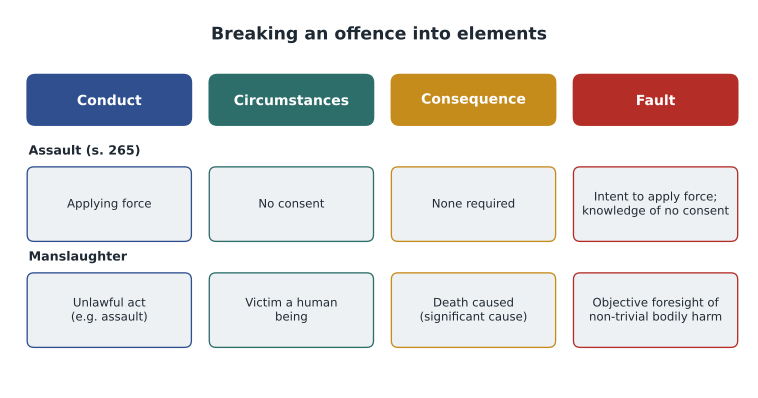
The actus reus usually has three kinds of components. The conduct element is what the accused does or fails to do: applying force, taking property, making a statement, driving. The circumstance element is the surrounding facts that make the conduct criminal: that the complainant did not consent, that the property belonged to another, that the person was under sixteen. The consequence element, present in some offences, is a result the conduct must cause: death in homicide, bodily harm in assault causing bodily harm, a deprivation in fraud.
Take assault in section 265(1)(a): a person commits an assault when, without the consent of another person, he applies force intentionally to that other person, directly or indirectly. The conduct is applying force. The circumstance is the absence of consent. There is no consequence element: the slightest touch can be an assault, though section 267 creates an aggravated form when bodily harm is caused. Calder's shove is plainly an application of force to Dorey, and Dorey plainly did not consent to being shoved. The actus reus of assault is made out. Whether he committed manslaughter depends on the consequence element, which is where causation comes in.
Voluntariness
The conduct must be voluntary. A person whose body moves without conscious control has not acted in the sense the criminal law requires. In R. v. King, [1962] SCR 746, the accused drove after receiving an anaesthetic at a dentist's office and had no idea of its effect. The Court held that a person who drives while impaired without knowing, and without having reason to know, that he was impaired had not voluntarily done the act. Voluntariness is now usually discussed as part of the actus reus, and its absence is called automatism.
Automatism covers conduct performed in a state of impaired consciousness, such as sleepwalking (R. v. Parks, [1992] 2 SCR 871) or a dissociative state caused by a psychological blow (R. v. Stone, [1999] 2 SCR 290). It is a defence, but conceptually it denies the voluntariness of the act. Stone set out a two-stage framework: the accused must first establish on a balance of probabilities that he acted involuntarily, and the judge must then decide whether the condition is mental disorder automatism, which leads to a verdict of not criminally responsible, or non-mental disorder automatism, which leads to an acquittal. Lesson 10 develops the defence.
Voluntariness in the physical sense differs from moral voluntariness. A person who acts under threats acts physically voluntarily: she chooses to drive the getaway car. But she may be morally involuntary in that she had no realistic choice. Moral involuntariness is the basis of the excuses of duress and necessity, discussed in lesson 11 (Perka; Ruzic).
Acts and omissions
The criminal law is generally reluctant to punish failures to act. There is no general duty in Canadian law to rescue a stranger. A passer-by who watches a child drown in a shallow pond commits no offence, however morally reprehensible the failure. An omission is criminal only where the law imposes a legal duty to act and the offence can be committed by omission.
The Criminal Code creates several duties. Section 215 imposes a duty on parents, guardians and heads of families to provide necessaries of life to children under sixteen, on spouses and common-law partners to provide necessaries to each other, and on anyone who has charge of a person who is unable to withdraw from that charge because of detention, age, illness or mental disorder. Section 216 imposes a duty on everyone who undertakes to administer surgical or medical treatment to use reasonable knowledge, skill and care. Section 217 provides that everyone who undertakes to do an act is under a legal duty to do it if an omission to do the act is or may be dangerous to life. Section 217.1, added after the 1992 Westray mine disaster in Nova Scotia, imposes a duty on everyone who directs how another person does work to take reasonable steps to prevent bodily harm to that person or any other person.
The section 217 duty arises from an undertaking. In R. v. Browne (1997), 33 OR (3d) 775 (CA), the Ontario Court of Appeal held that an undertaking must be clear, binding and made with an intention to be bound; a casual statement that the accused would take a friend to hospital was not enough to found a duty, and a manslaughter conviction was set aside. Duties also arise under other legislation and the common law, and section 219 provides that criminal negligence includes omitting to do anything it is one's duty to do. In R. v. Thornton (1991), 1 OR (3d) 480 (CA), aff'd [1993] 2 SCR 445, the accused donated blood knowing he was HIV positive. The Court of Appeal found a common law duty to refrain from conduct that could injure another, which could ground the offence of common nuisance in section 180; the Supreme Court affirmed the conviction.
Omission offences require care in identifying the duty. The Calder file has an omission angle. Suppose Calder's friend Pruitt drove Dorey home after the fight, promising Dorey's sister by text that she would 'stay with him all night and call 911 if he gets worse,' and then left. A Crown might argue that her undertaking created a section 217 duty. Browne shows that the analysis turns on whether the undertaking was clear and binding, not just friendly reassurance.
Continuing acts and contemporaneity
The actus reus and mens rea must coincide in time. Courts avoid artificial results by treating some conduct as continuing. In Fagan v. Metropolitan Police Commissioner, [1969] 1 QB 439, the accused accidentally drove onto a police officer's foot, then refused to move when asked. The court held that driving onto the foot and remaining there was a continuing act; when the accused formed the intent to keep the car there, the assault was complete. In R. v. Miller, [1983] 2 AC 161 (HL), a squatter who accidentally set a mattress on fire and then left without trying to put it out was liable for arson because he had created a dangerous situation and failed to take steps to counteract it. Canadian courts have accepted the same reasoning. In R. v. Cooper, [1993] 1 SCR 146, the Court held that the intent for murder need only coincide with the act at some point; it need not continue throughout. Lesson 4 returns to contemporaneity.
Circumstances
Circumstance elements often carry the moral weight of an offence. The same physical act of sexual touching is a crime or not depending on consent. The same taking of property is theft or not depending on whether the property belongs to another and whether the taker has colour of right. Because circumstances are elements of the actus reus, the Crown must prove them, and the fault requirement usually extends to them: the accused must know, be wilfully blind to or be reckless about the circumstance. Lesson 7 shows how complex the circumstance of consent can become in sexual assault.
Causation
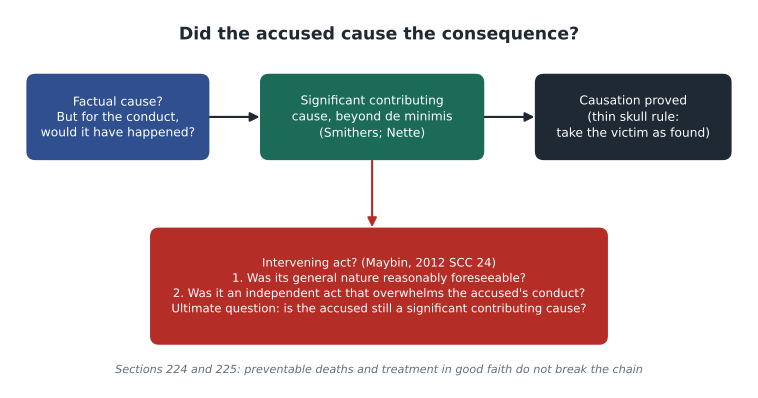
Where an offence has a consequence element, the Crown must prove that the accused caused the consequence. Causation has two parts. Factual causation asks whether the accused's conduct contributed to the result in fact, usually through a but-for inquiry: but for the accused's conduct, would the consequence have occurred? Legal causation asks whether the accused should be held criminally responsible for the result, a normative question that considers intervening acts, foreseeability and the moral significance of the connection.
In Smithers v. The Queen, [1978] 1 SCR 506, a teenage hockey player kicked an opponent in the stomach after a game. The victim vomited, inhaled the vomit because of a malfunctioning epiglottis, and died. The Court upheld a manslaughter conviction. Justice Dickson held that the Crown need only prove that the accused's act was a contributing cause of death 'outside the de minimis range', and that the thin skull rule applies: an accused takes the victim as he finds him. It did not matter that a normal person would not have died from the kick.
In R. v. Nette, 2001 SCC 78, the Court confirmed the Smithers standard and restated it as requiring that the accused's conduct be a 'significant contributing cause' of the death. The majority said this was the same standard in more positive language. The victim, an elderly widow, was hog-tied and left alone after a robbery; she died of asphyxiation over a day or two. Her age, weight and congestive heart failure contributed to her death, but the accused's conduct remained a significant contributing cause.
Applying Smithers and Nette to Calder, the shove was a factual cause of Dorey's death: but for the shove, he would not have fallen and fractured his skull. His thin skull does not break the chain; Calder takes his victim as he finds him. His refusal of an ambulance raises the question of intervening acts.
Intervening acts
Sometimes another event or person's act comes between the accused's conduct and the consequence. The question is whether the intervening act breaks the chain of legal causation. In R. v. Maybin, 2012 SCC 24, two brothers repeatedly punched a man in a bar until he was unconscious. A bouncer then struck him on the head. The medical evidence could not say which blows caused death. The Court held that the brothers' conduct could still be a significant contributing cause. It identified two analytical aids. First, was the intervening act reasonably foreseeable? If the general nature of the intervening act and the risk of harm were reasonably foreseeable at the time of the accused's conduct, the chain is not broken. Second, was the intervening act an independent act that overwhelms the accused's actions, so that the accused's acts are merely part of the history? Neither aid is a test in itself; the ultimate question is whether the accused's conduct remains a significant contributing cause.
Medical treatment is a common intervening event. Section 225 of the Code provides that where a person causes a bodily injury that is in itself of a dangerous nature, and death results, the person causes the death even if the immediate cause was proper or improper treatment applied in good faith. Section 224 provides that a person causes death even if it might have been prevented by resorting to proper means. Section 222(5)(d) provides that a person commits homicide by wilfully frightening a child or sick person. These provisions make clear that a victim's refusal of treatment, or negligent treatment, does not generally break the chain.
In R. v. Blaue, [1975] 1 WLR 1411 (CA), the victim of a stabbing refused a blood transfusion because of her religious beliefs and died. The English Court of Appeal held that the accused had to take his victim as he found her, including her beliefs. Canadian courts reach similar results under sections 224 and 225. So Dorey's refusal of an ambulance, and even his failure to seek care in the morning, would not break the chain: Calder's shove remains a significant contributing cause.
Putting it together
By the end of the class, Mehta has drawn a flowchart on the whiteboard. Identify the elements of the offence from its wording. For each conduct element, ask whether the accused acted voluntarily. For omissions, find the legal duty. For each circumstance, identify the facts the Crown must prove. For each consequence, ask whether the conduct was a factual cause and a significant contributing cause, considering intervening acts. Castellano adds one box at the end, labelled 'then fault.' 'You have the actus reus,' she says. 'On Thursday we find out whether Calder had a guilty mind.'
Practice problems
Work each problem on paper first, then reveal the answer to check.
Ava's elderly father lives with her and has advanced dementia. She stops buying food for him for two weeks, and he is hospitalized with malnutrition. Can her omission be the actus reus of an offence?
Show answer
Yes. Section 215(1)(c) imposes a duty on a person who has charge of another who is unable, because of age, illness or mental disorder, to withdraw from that charge to provide necessaries of life. Failing to provide food is an omission in breach of that duty, which can ground the section 215 offence and, if death results, criminal negligence causing death or manslaughter.
Kai punches Jordan, who falls and is knocked out. An ambulance crew drops Jordan while moving him, and he suffers a fatal brain bleed. Kai argues the paramedics caused death. Advise.
Show answer
Kai's punch is a factual cause. Under Smithers, Nette and Maybin, the question is whether the punch remains a significant contributing cause. Negligent handling by paramedics is a reasonably foreseeable kind of intervening event, and section 225 provides that improper treatment applied in good faith does not break the chain where the original injury was dangerous. Kai likely caused the death in law.
A sleepwalking man drives to his in-laws' home and attacks them, with no memory afterwards. What element is in issue?
Show answer
Voluntariness. If his conduct was involuntary, the actus reus is not made out. This is the automatism defence (Parks), analyzed under the Stone framework to determine whether it is non-mental disorder automatism (acquittal) or mental disorder automatism (not criminally responsible).
Summary and key terms
- The actus reus has conduct, circumstance and sometimes consequence elements, determined from the wording of each offence.
- Conduct must be voluntary (King); involuntary conduct is automatism (Parks, Stone).
- Omissions are criminal only where a legal duty exists, such as sections 215, 216, 217 and 217.1; an undertaking under section 217 must be clear and binding (Browne).
- Actus reus and mens rea must coincide, but continuing acts can bridge the gap (Fagan, Miller, Cooper).
- Causation requires factual causation and legal causation: a significant contributing cause beyond de minimis (Smithers, Nette); the thin skull rule applies.
- Intervening acts break the chain only if the accused's conduct is no longer a significant contributing cause; foreseeability and independence are aids (Maybin); sections 224 and 225 cover treatment and prevention.
- Actus reus
- The physical element of an offence: conduct, circumstances and any required consequence.
- Voluntariness
- The requirement that conduct be the product of the accused's conscious will.
- Omission
- A failure to act, criminal only where the law imposes a duty to act.
- Thin skull rule
- The principle that an accused takes the victim as found, including physical weaknesses and beliefs.
- Significant contributing cause
- The Nette formulation of the causation standard: a cause beyond the de minimis range.
- Intervening act
- An act or event after the accused's conduct that may break the chain of legal causation.
- Contemporaneity
- The requirement that the actus reus and mens rea coincide at some point in time.
Lesson quiz · 5 questions
Score 60% or more to complete this lesson.
Create a free account to save your progress, take quizzes and earn a certificate.