
LAWC-103 · Lesson 5 of 12 · 19 min
Objective fault and regulatory offences
▶ Video coming soon A video version of this lesson is on the way.
Hannah Kowalczyk's answer from the last class, that anyone should know that shoving a drunk man near a curb is dangerous, is where Castellano begins on Monday. 'That,' she says, 'is the voice of the reasonable person. The criminal law listens to that voice more than you might think. Dangerous driving, criminal negligence, careless storage of firearms, failing to provide the necessaries of life, unlawful act manslaughter. And then there are thousands of regulatory offences, from food safety to pollution, where the reasonable person sets the standard almost entirely.'
Arjun Mehta, the former civil engineer, mentions that in his old job a contractor was fined after a worker fell from a scaffold. 'Was that a crime?' Castellano answers with a question: 'Did anyone go to jail?' Mehta says no. 'Then you may have seen a regulatory offence. Today we learn the difference, and why it matters.'
This lesson covers objective fault: penal negligence in criminal offences such as dangerous driving and criminal negligence, the constitutional limits on objective fault, objective foreseeability of consequences, and the three categories of regulatory offences from Sault Ste. Marie, including strict liability and the defence of due diligence.
Objective fault in the criminal law
Objective fault measures the accused's conduct against the standard of a reasonable person in the circumstances. It does not ask what the accused actually thought. Criminal law uses objective fault for offences involving dangerous activities, where the law's concern is with people who fail to meet a basic standard of care, whatever their actual state of mind. The leading examples are dangerous operation of a conveyance (section 320.13), criminal negligence (sections 219 to 221), careless use or storage of a firearm (section 86), failing to provide the necessaries of life (section 215), and unlawful act manslaughter.
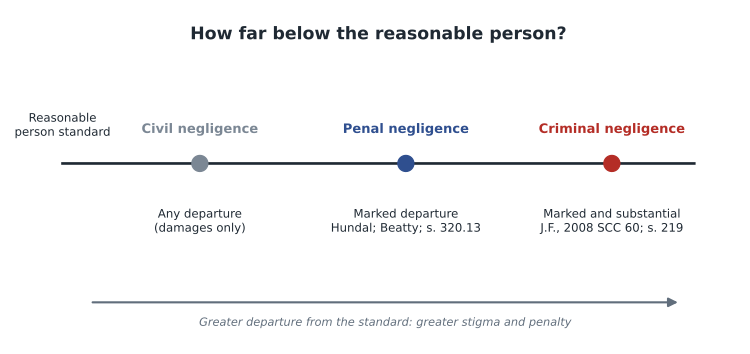
The Supreme Court has insisted that objective fault in the criminal law is not the same as civil negligence. In civil law, a defendant who falls below the standard of care, even slightly, may be liable for damages. In criminal law, the fault must be a marked departure from the standard of a reasonable person. The higher threshold reflects the stigma and punishment of a criminal conviction and keeps the criminal law away from ordinary carelessness.
Dangerous driving: Hundal and Beatty
In R. v. Hundal, [1993] 1 SCR 867, the accused drove a heavily loaded dump truck through a red light in downtown Vancouver and killed another driver. He was convicted of dangerous driving causing death. The Court held that the fault for dangerous driving is objective: the question is whether the accused's conduct, viewed objectively, was a marked departure from the standard of care that a reasonable person would observe in the accused's situation. Justice Cory explained that driving is a licensed activity, that drivers are presumed to know the standard, and that the automatic and reflexive nature of driving makes a subjective test inappropriate.
In R. v. Beatty, 2008 SCC 5, the accused's pickup truck suddenly crossed the centre line and collided with an oncoming car, killing three people. The evidence suggested he had momentarily lost consciousness or fallen asleep. A majority of the Court refined the test. First, the actus reus requires that the accused's driving, viewed objectively, was dangerous to the public in all the circumstances. Second, the mens rea requires that the driving be a marked departure from the standard of care a reasonable person would observe in the accused's circumstances. The trier of fact should consider the totality of the evidence, including any evidence about the accused's actual state of mind, which may show that a reasonable person would not have been aware of the risk or could not have avoided it. A momentary lapse of attention, without more, is generally not a marked departure. Beatty's acquittal was restored.
In R. v. Roy, 2012 SCC 26, the Court applied Beatty to a driver who pulled onto a highway from a stop sign in foggy conditions and was struck by a tractor-trailer, killing his passenger. The Court emphasized that the trial judge must focus on whether the manner of driving was a marked departure, not simply infer fault from the fact of dangerous driving. A single, brief misjudgment did not establish the mens rea, and an acquittal was entered. In R. v. Chung, 2020 SCC 8, by contrast, the Court held that a driver who accelerated to 140 kilometres per hour in a 50 zone approaching an intersection made a marked departure even though the dangerous conduct lasted only seconds. Duration is relevant, but a brief period of deliberate high-risk driving can suffice.
Since December 18, 2018, the conveyance offences are in Part VIII.1 of the Code, enacted by An Act to amend the Criminal Code (offences relating to conveyances), SC 2018, c. 21. Dangerous operation is now in section 320.13. The Hundal and Beatty framework continues to apply.
Criminal negligence
Section 219 defines criminal negligence: everyone is criminally negligent who, in doing anything, or in omitting to do anything that it is his duty to do, shows wanton or reckless disregard for the lives or safety of other persons. Criminal negligence causing death (section 220) and causing bodily harm (section 221) are serious offences; criminal negligence causing death carries a maximum of life imprisonment.
The fault standard took decades to settle. In R. v. Tutton, [1989] 1 SCR 1392, parents whose diabetic son died after they stopped giving him insulin, believing he had been healed by faith, were charged with manslaughter by criminal negligence. The Court split evenly on whether the test was objective or subjective. In R. v. J.F., 2008 SCC 60, the Court finally confirmed that criminal negligence requires a marked and substantial departure from the conduct of a reasonably prudent person in circumstances where the accused either recognized and ran an obvious and serious risk to the lives or safety of others or, alternatively, gave no thought to that risk. The 'marked and substantial' standard is higher than the 'marked' departure for dangerous driving, reflecting the more serious offence.
Constitutional limits on objective fault
Section 7 of the Charter requires some fault for any offence carrying imprisonment, and subjective fault for a small group of offences with special stigma, such as murder. But objective fault is constitutionally acceptable for most offences. In R. v. Creighton, [1993] 3 SCR 3, the accused injected a friend with cocaine; she died of an overdose. He was convicted of unlawful act manslaughter. The question was whether section 7 required foresight of death for manslaughter. A five to four majority, per Justice McLachlin, held that it did not. The fault for unlawful act manslaughter is objective foreseeability of the risk of bodily harm that is neither trivial nor transitory, in the context of a dangerous act. The constitution does not require symmetry between the actus reus and the mens rea: the consequence of death need not be foreseeable as long as bodily harm was.
Creighton also decided how personal characteristics affect the objective standard. Chief Justice Lamer, dissenting on this point, would have personalized the reasonable person to reflect the accused's human frailties. The majority rejected that approach. The standard is that of the reasonable person in the circumstances of the accused. Personal characteristics of the accused, short of incapacity to appreciate the nature of the risk, are not relevant. An inexperienced driver or a person of limited education is held to the same standard as everyone else, unless he lacked the capacity to appreciate the risk. The circumstances, such as an emergency, sudden mechanical failure or special knowledge, can be considered.
In R. v. DeSousa, [1992] 2 SCR 944, the Court held that offences that build on an underlying unlawful act, such as unlawfully causing bodily harm under section 269, require that the underlying offence be constitutionally sound and that the consequence be objectively foreseeable. The accused threw a bottle during a fight; it shattered against a wall and a fragment injured a bystander. The objective foreseeability of non-trivial bodily harm was enough.
The structure of fault for consequences
Lessons 4 and 5 together show a pattern. For many offences, fault is required for the conduct and circumstances, and a lesser fault, often objective foreseeability, is required for the consequence. Assault causing bodily harm requires the intentional application of force without consent, plus objective foreseeability of bodily harm. Unlawful act manslaughter requires an unlawful act that is objectively dangerous, plus objective foreseeability of bodily harm that is neither trivial nor transitory. In the Calder file, the shove was an assault. A reasonable person would foresee that shoving a man near a curb risked bodily harm that was more than trivial. On Creighton, that is enough for manslaughter if the shove caused death, which lesson 3 suggested it did.
Regulatory offences
Most offences in Canada are not in the Criminal Code. They are regulatory or public welfare offences in federal and provincial statutes governing environmental protection, workplace safety, food and drugs, securities, consumer protection, highways and countless other activities. They aim to protect the public by regulating activities that are lawful but potentially harmful. They typically carry fines rather than imprisonment, though imprisonment is sometimes available.
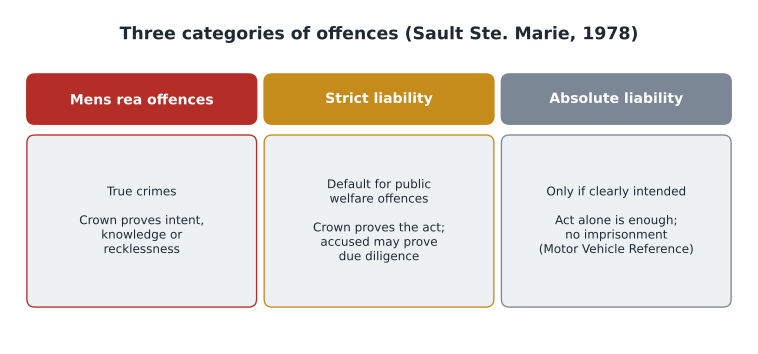
Before 1978, Canadian courts had two options for these offences: full mens rea or absolute liability. In R. v. Sault Ste. Marie, [1978] 2 SCR 1299, the city had contracted with a company to dispose of its garbage, and the company's site polluted a creek. The city was charged with discharging or permitting the discharge of pollution under the Ontario Water Resources Act. Justice Dickson created a middle category and set out three categories of offences. First, offences requiring mens rea, where some positive state of mind such as intent, knowledge or recklessness must be proved by the prosecution. Second, strict liability offences, where the prosecution need not prove mens rea, because doing the prohibited act prima facie imports the offence, but the accused may avoid liability by proving on a balance of probabilities that he took all reasonable care. Third, absolute liability offences, where it is not open to the accused to exculpate himself by showing that he was free of fault.
Public welfare offences are presumed to be strict liability. Absolute liability applies only if the legislature makes it clear that guilt follows proof of the prohibited act. The Ontario Court of Appeal in R. v. Kanda, 2008 ONCA 22, for example, held that a provincial seatbelt offence was strict, not absolute, despite arguments about administrative convenience. Most regulatory offences in Ontario are prosecuted under the Provincial Offences Act, and the same categories apply to federal regulatory offences.
The due diligence defence
In a strict liability offence, the accused must prove on a balance of probabilities that it took all reasonable care to avoid the prohibited event, or that it reasonably believed in a mistaken set of facts that would have rendered the act innocent. The defence asks what a reasonable person or business in the accused's position would have done: what systems, training, supervision and precautions were in place, what the industry standard was, how foreseeable the harm was, how serious it would be and what it would have cost to prevent. A company that relies on a contractor, like the city in Sault Ste. Marie, must show that it took reasonable steps to choose, instruct and supervise the contractor.
The reverse onus in the due diligence defence engages section 11(d) of the Charter, because an accused could be convicted despite a reasonable doubt about its diligence. In R. v. Wholesale Travel Group Inc., [1991] 3 SCR 154, the Court upheld the reverse onus. Justice Cory, in reasons supporting the result, emphasized the regulatory context: people who choose to participate in regulated activities accept the conditions that come with them, and the information about their precautions is uniquely within their knowledge. The Court has since treated Wholesale Travel as settling that the reverse onus of due diligence is constitutional for regulatory offences.
Absolute liability and the Charter
The Motor Vehicle Reference held that absolute liability combined with imprisonment, or even the possibility of imprisonment, violates section 7. Absolute liability without imprisonment is constitutionally permissible, because liberty is not at stake. In R. v. Pontes, [1995] 3 SCR 44, the Court held that a driving-while-prohibited offence was absolute liability, but because the provincial law in question did not allow imprisonment for absolute liability offences, it did not violate section 7. In Lévis (City) v. Tétreault, 2006 SCC 12, the Court confirmed that a strict liability offence allows the defences of due diligence and officially induced error, but rejected a claim that a driver's honest but unreasonable belief that his registration had been renewed was a defence.
Corporate liability
Regulatory offences are often committed by corporations, which raises the question of how a corporation can have fault. For strict liability offences, the corporation is liable unless it proves due diligence. For offences requiring subjective fault, sections 22.1 and 22.2 of the Code, added by Bill C-45 in 2003 after the Westray mine disaster, set out when an organization is a party. For negligence offences, an organization is a party if one or more of its representatives committed the act and the senior officer responsible for that aspect of its activities departed markedly from the reasonably expected standard of care. For subjective fault offences, an organization is a party if a senior officer, with intent at least in part to benefit the organization, acts as a party, directs representatives to commit the offence, or knowingly fails to take reasonable steps to stop them. In R. v. Metron Construction Corp., 2013 ONCA 541, the Court of Appeal raised a fine against a company convicted of criminal negligence causing death after four workers died when a swing stage collapsed on Christmas Eve 2009.
Back to Mehta's scaffold
Castellano returns to Mehta's question. A fine against a contractor after a worker's fall was probably a conviction under the Occupational Health and Safety Act, a strict liability offence where the company could have avoided liability by proving due diligence. If the company's senior officers had shown a marked departure from the expected standard and a worker had died, the Crown could have considered criminal negligence under section 219 and section 22.1, as in Metron. 'Two systems,' Castellano says. 'One is about regulation, the other about blame. The fault standard is how you tell them apart.'
Practice problems
Work each problem on paper first, then reveal the answer to check.
A driver glances at her phone for two seconds, drifts across the centre line and causes a collision. Is she guilty of dangerous operation under section 320.13?
Show answer
The question under Hundal and Beatty is whether her driving was objectively dangerous and whether it was a marked departure from the standard of a reasonable driver. A momentary lapse is generally not enough (Beatty, Roy), but deliberately looking at a phone while driving may be treated differently from an unexpected lapse, and Chung shows brief deliberate risk-taking can suffice. The answer depends on the full circumstances.
A food processor is charged under a provincial statute with selling contaminated meat. The statute is silent on fault. What must the prosecution prove, and what can the company do?
Show answer
As a public welfare offence silent on fault, it is presumed to be strict liability (Sault Ste. Marie). The prosecution proves the prohibited act beyond a reasonable doubt. The company can avoid liability by proving on a balance of probabilities that it took all reasonable care, through its sanitation, testing, training and supervision systems.
A provincial offence of driving while suspended is drafted as absolute liability and carries a mandatory seven-day jail term. Is it constitutional?
Show answer
No. Combining absolute liability with imprisonment violates section 7 (Motor Vehicle Reference). The province could remove imprisonment, or make the offence strict liability with a due diligence defence.
Summary and key terms
- Objective criminal fault requires a marked departure from the standard of a reasonable person in the accused's circumstances, not mere civil negligence.
- Dangerous operation: objectively dangerous driving plus a marked departure (Hundal, Beatty, Roy, Chung); now section 320.13.
- Criminal negligence requires a marked and substantial departure, with recognition of or failure to consider an obvious and serious risk (J.F., 2008 SCC 60).
- Creighton: objective fault is constitutional for manslaughter; personal characteristics short of incapacity do not modify the standard.
- Sault Ste. Marie: mens rea, strict liability (due diligence on the accused) and absolute liability; public welfare offences are presumed strict.
- The due diligence reverse onus is constitutional (Wholesale Travel); absolute liability with imprisonment is not (Motor Vehicle Reference).
- Sections 22.1 and 22.2 set out organizational liability.
- Objective fault
- Fault measured against what a reasonable person would have done or foreseen in the accused's circumstances.
- Marked departure
- The threshold for criminal objective fault, beyond ordinary civil negligence.
- Criminal negligence
- Wanton or reckless disregard for the lives or safety of others, requiring a marked and substantial departure (section 219).
- Strict liability
- A regulatory offence where the prosecution proves the act and the accused may prove due diligence on a balance of probabilities.
- Absolute liability
- An offence with no fault defence; unconstitutional if imprisonment is possible.
- Due diligence
- The defence that the accused took all reasonable care, or reasonably believed in facts that would make the act innocent.
- Public welfare offence
- A regulatory offence aimed at protecting the public from risks of lawful activities.
Lesson quiz · 5 questions
Score 60% or more to complete this lesson.
Create a free account to save your progress, take quizzes and earn a certificate.