
LAWC-103 · Lesson 1 of 12 · 22 min
Sources of criminal law
▶ Video coming soon A video version of this lesson is on the way.
Professor Ruth Castellano begins the first Criminal Law class of Section B on Thursday, September 10, 2026, without a casebook, a slide or a word of welcome. She writes three words on the whiteboard in the Lister Room: Crown, accused, liberty. 'Twelve years I prosecuted in Toronto,' she says. 'Six years I defended people in this city on legal aid certificates. In both jobs I learned the same thing. Criminal law is the one area where the state, with all its resources, sets out to take away a person's liberty. Every rule you learn in this course is either a reason the state may do that or a limit on when it may. Keep both sides in view, and you will understand the subject.'
Theo Marchetti, who spent a decade as a litigation clerk in Hamilton, asks whether the course will be about the Criminal Code. 'Mostly,' Castellano says. 'But the Code did not fall from the sky. It sits on top of a constitutional power, it is shaped by the Charter, it borrows defences from the common law, and it shares the field with hundreds of federal and provincial offences that are not in it at all. Today is about where criminal law comes from. On Monday we start taking offences apart.'
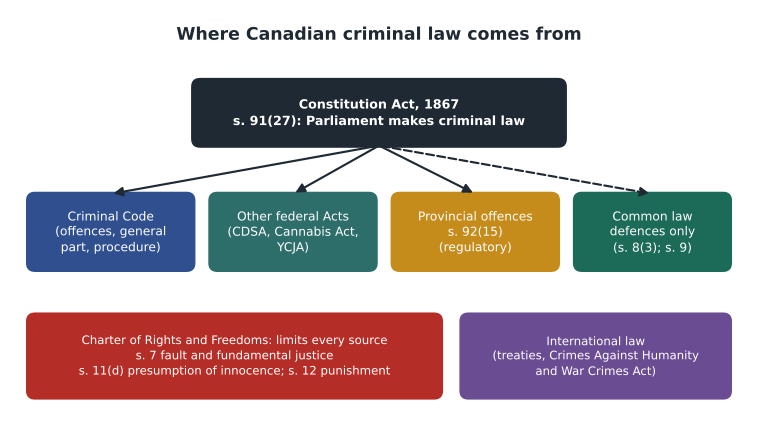
This lesson sets out the sources of Canadian criminal law: the constitutional division of powers, the Criminal Code and other federal statutes, provincial and municipal offences, the common law and its limited role, the Charter, and international law. It also introduces the classification of offences and the courts that try them. Throughout the course we will return to a fictional Corwin file, R. v. Calder, which begins with a fight outside a bar on Ridley Street. Every name in it is invented.
What makes something criminal
There is no single test for what conduct deserves to be criminal, but the question matters for two reasons. It matters constitutionally, because only Parliament may enact criminal law. And it matters for policy, because criminal punishment is the most serious response the state has to wrongdoing. Criminal law theorists have long debated the harm principle, associated with John Stuart Mill, which holds that the state may coerce a person only to prevent harm to others. In R. v. Malmo-Levine; R. v. Caine, 2003 SCC 74, the Supreme Court of Canada rejected the argument that the harm principle is a principle of fundamental justice under section 7 of the Charter. Parliament may criminalize conduct to protect the accused from self-harm or to uphold shared values, provided it does not act arbitrarily or impose grossly disproportionate punishment.
Criminal law is also distinguished from other kinds of law by its consequences. A conviction carries stigma, a criminal record and the possibility of imprisonment. These consequences explain why criminal law insists on proof beyond a reasonable doubt, a fault requirement that matches the stigma of the offence, and strict interpretation of penal statutes when real ambiguity remains after ordinary interpretation.
The constitutional source: section 91(27)
Section 91(27) of the Constitution Act, 1867 gives Parliament exclusive authority over 'The Criminal Law, except the Constitution of Courts of Criminal Jurisdiction, but including the Procedure in Criminal Matters.' Section 92(14) gives the provinces authority over the administration of justice, including the constitution, maintenance and organization of provincial courts of criminal and civil jurisdiction. The result is a shared system: Parliament writes the criminal law and its procedure, while the provinces run the courts and, for most Criminal Code offences, the prosecutions.
Students met the test for a valid criminal law in LAWC-101. In the Margarine Reference, Reference re Validity of Section 5(a) of the Dairy Industry Act, [1949] SCR 1, Justice Rand said a criminal law has three elements: a prohibition, a penalty and a typically criminal public purpose such as public peace, order, security, health or morality. The Supreme Court has applied that test many times since, most recently in Reference re Genetic Non-Discrimination Act, 2020 SCC 17, where a majority upheld federal prohibitions on compelling genetic tests as valid criminal law aimed at autonomy, privacy and discrimination.
Provinces may not enact criminal law, but they may create offences to enforce valid provincial laws. Section 92(15) gives them authority over 'the Imposition of Punishment by Fine, Penalty, or Imprisonment for enforcing any Law of the Province.' Provincial offences such as speeding under the Ontario Highway Traffic Act, or failing to follow workplace safety rules under the Occupational Health and Safety Act, are regulatory in character and are prosecuted under the Provincial Offences Act. Municipal by-laws, which draw their authority from provincial legislation, add another layer. A provincial law that is in pith and substance a punishment of moral wrongdoing, rather than regulation of a provincial matter, is invalid. In Westendorp v. The Queen, [1983] 1 SCR 43, a Calgary by-law that in substance punished street prostitution was struck down as an intrusion on the criminal law power.
The Criminal Code
The Criminal Code, RSC 1985, c. C-46, is the main source of criminal offences in Canada. The first Code was enacted in 1892, drawing heavily on an English draft code prepared by Sir James Fitzjames Stephen that was never enacted in England. Canada therefore had a codified criminal law long before most common law countries. The Code was revised in 1955 and consolidated in the Revised Statutes of 1985, which is the version cited today, although it has been amended hundreds of times since.
The Code has a general part and a special part. The general part, mostly in Part I, contains rules that apply to all offences: the definitions in section 2, the abolition of common law offences in section 9, the defences of mental disorder (section 16), duress (section 17), self-defence (section 34) and defence of property (section 35), the rules on parties (sections 21 to 23.1) and attempt (section 24). The special part sets out individual offences, grouped by subject: offences against public order, firearms offences, sexual offences, offences against the person, property offences, and many others. Later parts set out procedure: arrest, bail (Part XVI), preliminary inquiries, trials, appeals and sentencing (Part XXIII).
Reading a Code offence is a skill in itself. Castellano asks the class to read section 265, the assault provision. Arjun Mehta, a former civil engineer who thinks in flowcharts, reads it aloud and starts breaking it into elements: applying force, intentionally, without consent, directly or indirectly. 'Good,' Castellano says. 'Every offence can be broken into elements the Crown must prove. Some are conduct, some are circumstances, some are consequences, and then there is fault. That is the work of the next four lessons.'
Other federal statutes
Many serious offences live outside the Code. The Controlled Drugs and Substances Act, SC 1996, c. 19, creates drug offences such as trafficking and possession for the purpose of trafficking. The Cannabis Act, SC 2018, c. 16, legalized and regulated adult cannabis use while keeping offences for unlicensed sale, sale to young persons and possession above the public limits. The Youth Criminal Justice Act, SC 2002, c. 1, does not create offences, but it governs how young persons aged 12 to 17 are prosecuted and sentenced. The Firearms Act sets licensing and registration rules that work alongside the Code's firearms offences. The Competition Act, the Income Tax Act and the Customs Act all contain offences as well.
Federal statutes also create regulatory offences, such as offences under environmental, fisheries and transportation legislation. Not every federal offence is criminal law in the constitutional sense: Parliament may enforce its laws on trade and commerce, fisheries or navigation through penalties under the relevant head of power. The distinction matters mainly for the fault analysis, which lesson 5 covers.
The common law: no common law offences, but common law defences
Before codification, many crimes were defined by judges. Canadian law has abolished that power. Section 9 of the Criminal Code provides that no person shall be convicted of an offence at common law, except contempt of court, or of an offence under an Act of the Parliament of England or Great Britain. The Supreme Court had already refused to create new offences in Frey v. Fedoruk, [1950] SCR 517, where it held that courts could not declare conduct criminal simply because it was harmful or likely to cause a breach of the peace. Creating offences is for Parliament.
Common law defences are different. Section 8(3) of the Code preserves every rule and principle of the common law that renders any circumstance a justification or excuse for an act or a defence to a charge, except to the extent that it is altered by or inconsistent with the Code or another federal Act. That is why necessity, the common law form of duress, officially induced error and entrapment are available although no section of the Code creates them. Courts have developed those defences in cases such as Perka v. The Queen, [1984] 2 SCR 232 (necessity), and R. v. Mack, [1988] 2 SCR 903 (entrapment).
The common law also supplies the interpretive principles that courts use to read the Code. The modern approach to statutory interpretation, from Rizzo & Rizzo Shoes Ltd. (Re), [1998] 1 SCR 27, applies to criminal statutes: words are read in their entire context, in their grammatical and ordinary sense, harmoniously with the scheme and object of the Act and the intention of Parliament. The rule of strict construction of penal statutes is a fallback. In R. v. Hasselwander, [1993] 2 SCR 398, and R. v. McIntosh, [1995] 1 SCR 686, the Court explained that if real ambiguity remains after the ordinary rules are applied, the interpretation more favourable to the accused is preferred.
The Charter
Since 1982, the Canadian Charter of Rights and Freedoms has been a central source of criminal law. Most of the legal rights in sections 7 to 14 concern criminal investigations and trials: the right not to be deprived of life, liberty and security of the person except in accordance with the principles of fundamental justice (section 7), the right against unreasonable search and seizure (section 8), the right not to be arbitrarily detained (section 9), rights on arrest or detention (section 10), the rights of persons charged with an offence (section 11), protection against cruel and unusual punishment (section 12), and the protection against self-incrimination (section 13).
For substantive criminal law, the most important of these are section 7, section 11(d) and section 12. Section 7 has produced constitutional fault requirements, the principle that the morally involuntary should not be punished, and limits on overbroad, arbitrary and grossly disproportionate laws. Section 11(d) guarantees the presumption of innocence. Section 12 limits sentences, especially mandatory minimum penalties. Lesson 2 examines these in detail. Procedural rights under sections 8 to 10 and the exclusion of evidence under section 24(2) are covered in LAWC-211 Criminal Procedure.
International law
International law influences Canadian criminal law in several ways. Treaties such as the conventions on torture, terrorism financing and transnational organized crime are implemented through federal legislation. The Crimes Against Humanity and War Crimes Act, SC 2000, c. 24, implements Canada's obligations under the Rome Statute of the International Criminal Court and allows prosecution in Canada of genocide, crimes against humanity and war crimes, including some committed abroad. Courts also interpret the Charter and the Code consistently with Canada's international obligations where possible.
Classifying offences
Every offence in Canada is either a summary conviction offence, an indictable offence or a hybrid offence. The classification determines the maximum penalty, the limitation period, the court, the mode of trial and the availability of a jury.
Summary conviction offences are the least serious. Since amendments made by An Act to amend the Criminal Code, the Youth Criminal Justice Act and other Acts (often called Bill C-75), SC 2019, c. 25, which came into force on September 19, 2019, the general maximum penalty for a summary conviction offence in section 787 is two years less a day in prison, a fine of up to 5,000 dollars, or both, unless a different penalty is specified. Summary prosecutions must generally begin within twelve months of the offence (section 786(2)), and they are tried by a judge of the provincial court, in Ontario the Ontario Court of Justice, without a jury.
Indictable offences are the most serious. They have no general limitation period, and their maximum penalties range up to life imprisonment. Section 553 lists offences within the absolute jurisdiction of a provincial court judge, such as theft under 5,000 dollars when prosecuted by indictment. Section 469 lists offences, including murder and treason, that must be tried by a superior court judge with a jury unless the accused and the Attorney General consent to trial by judge alone. For most other indictable offences, the accused may elect trial by a provincial court judge, by a superior court judge alone, or by a superior court judge and jury (section 536).
Hybrid offences, also called dual or Crown election offences, may be prosecuted either way at the Crown's choice. Assault (section 266), sexual assault (section 271) and impaired driving are hybrid. The Crown's election affects the maximum sentence and the procedure. Until the Crown elects, a hybrid offence is treated as indictable under section 34(1)(a) of the Interpretation Act.
Section 11(f) of the Charter guarantees the right to a jury trial where the maximum punishment for the offence is imprisonment for five years or more, except for offences under military law tried before a military tribunal. Preliminary inquiries, which test whether the Crown has enough evidence to send an accused to trial, have been available since 2019 only for offences punishable by fourteen years or more (section 535).
Who prosecutes
Prosecutions of most Criminal Code offences are conducted by provincial Crown prosecutors, in Ontario Crown attorneys in the Criminal Law Division of the Ministry of the Attorney General. The federal Public Prosecution Service of Canada prosecutes offences under federal statutes other than the Code, including drug offences under the Controlled Drugs and Substances Act, and Code offences in the territories. Private prosecutions are possible but rare, and the Attorney General may intervene to take them over or stay them.
Prosecutorial discretion is broad. In Krieger v. Law Society of Alberta, 2002 SCC 65, and R. v. Anderson, 2014 SCC 41, the Supreme Court held that core prosecutorial decisions, such as whether to lay or continue a charge, are reviewable only for abuse of process. Crown prosecutors have a special duty, set out in Boucher v. The Queen, [1955] SCR 16: their role excludes any notion of winning or losing; they are ministers of justice whose duty is to present all relevant evidence fairly.
Recent changes worth knowing
The Criminal Code changes constantly, and a lawyer must always check the current consolidation on the Justice Laws website. Three groups of recent amendments run through this course. In 2019, Bill C-75 repealed provisions that courts had already declared unconstitutional, including section 230 (constructive murder), reclassified many offences as hybrid and restructured bail. In 2022, An Act to amend the Criminal Code and the Controlled Drugs and Substances Act, SC 2022, c. 15, repealed several mandatory minimum penalties and widened the availability of conditional sentences. In 2026, Parliament passed three major reforms: Bill C-14, the Bail and Sentencing Reform Act (royal assent June 15, 2026, mostly in force July 15, 2026); Bill C-225, known as Bailey's Law (SC 2026, c. 12), which adds intimate partner provisions on murder and manslaughter; and Bill C-16, the Protecting Victims Act (royal assent June 18, 2026), which among other things restores mandatory minimum penalties that courts had struck down while adding a judicial safety valve, and creates a coercive control offence that comes into force later. Lessons 6, 7 and 12 return to these changes.
Castellano closes the class by pointing to the three words on the board. 'Crown, accused, liberty. Next week we start with the presumption of innocence, because that is where every criminal case starts. Read Oakes, read Lifchus, and read section 11(d) until you can recite it.'
Practice problems
Work each problem on paper first, then reveal the answer to check.
Corwin city council passes a by-law making it an offence, punishable by a fine of up to 5,000 dollars, to 'loiter in a public place for an immoral purpose.' Is the by-law valid?
Show answer
Probably not. Municipalities draw their power from provincial legislation, and provinces may only create offences to enforce valid provincial laws (section 92(15)). A by-law that in pith and substance punishes immorality rather than regulating streets or land use intrudes on Parliament's exclusive criminal law power, as in Westendorp v. The Queen, [1983] 1 SCR 43.
A Crown prosecutor wants to charge a person with 'conduct likely to cause a breach of the peace', relying on old English common law. Can she?
Show answer
No. Section 9 of the Criminal Code abolishes common law offences except contempt of court, and Frey v. Fedoruk refused to recognize offences that Parliament has not created. She must find a statutory offence.
An accused charged with a hybrid offence asks what difference the Crown's election makes.
Show answer
If the Crown proceeds summarily, the general maximum is two years less a day and a fine of up to 5,000 dollars (unless the offence sets another penalty), the trial is in provincial court without a jury, and the charge must generally have been laid within twelve months. If the Crown proceeds by indictment, the higher indictable maximum applies, there is no general limitation period, and the accused may have a right to elect a jury trial.
Why can an accused raise necessity although no section of the Criminal Code creates it?
Show answer
Section 8(3) preserves common law justifications, excuses and defences unless they are altered by or inconsistent with federal legislation. Necessity is a common law excuse recognized in Perka v. The Queen.
Summary and key terms
- Parliament has exclusive authority over criminal law and criminal procedure under section 91(27); provinces administer justice under section 92(14) and may create offences to enforce provincial laws under section 92(15).
- A valid criminal law has a prohibition, a penalty and a criminal public purpose (Margarine Reference; Genetic Non-Discrimination Reference, 2020 SCC 17).
- The Criminal Code is the main source of offences, but many offences are in other federal statutes and provincial legislation.
- Section 9 abolishes common law offences except contempt; section 8(3) preserves common law defences such as necessity and entrapment.
- The Charter, especially sections 7, 11(d) and 12, sets constitutional limits on criminal law.
- Offences are summary, indictable or hybrid; the classification determines penalties, limitation periods, courts and jury rights.
- The Code is amended often; Bills C-14, C-225 and C-16 (2026) are the latest major reforms.
- Criminal law power
- Parliament's exclusive authority under section 91(27) of the Constitution Act, 1867 to enact criminal law and criminal procedure.
- Summary conviction offence
- The least serious class of offence, tried in provincial court without a jury, with a general maximum of two years less a day and a 5,000 dollar fine.
- Indictable offence
- A serious offence with no general limitation period and higher maximum penalties, which may carry the right to elect a jury trial.
- Hybrid offence
- An offence the Crown may prosecute either summarily or by indictment.
- Provincial offence
- An offence created by provincial legislation to enforce a valid provincial law, prosecuted under the Provincial Offences Act in Ontario.
- Strict construction
- The principle that real ambiguity remaining in a penal statute after ordinary interpretation is resolved in favour of the accused.
- Prosecutorial discretion
- The Crown's authority over core decisions such as whether to lay, continue or stay a charge, reviewable only for abuse of process.
Lesson quiz · 5 questions
Score 60% or more to complete this lesson.
Create a free account to save your progress, take quizzes and earn a certificate.