
LAWC-103 · Lesson 4 of 12 · 17 min
Mens rea
▶ Video coming soon A video version of this lesson is on the way.
Castellano returns to the Calder file on Thursday. 'You have decided that Calder's shove caused Dorey's death,' she says. 'Now tell me what was going on in his head.' Sophie Tremblay-Hart offers that Calder was angry and wanted to push Dorey away. Theo Marchetti suggests Calder did not want anyone to die and probably did not think about it. Hannah Kowalczyk says it does not matter what he thought; anyone should know that shoving a drunk man near a curb is dangerous. 'Three answers,' Castellano says, 'and you have just described three different kinds of fault. Today we sort them out.'
This lesson examines subjective fault: what the accused actually intended, knew or foresaw. It covers the presumption of subjective fault, intention and purpose, motive, knowledge, wilful blindness, recklessness, the transferred intent rule and the contemporaneity requirement. Lesson 5 covers objective fault, negligence and regulatory offences, and lesson 6 applies both to homicide.
Why fault matters
Fault expresses the moral basis of criminal punishment. A person who causes harm accidentally, without any blameworthy state of mind or failure, is not ordinarily treated as a criminal. In R. v. Sault Ste. Marie, [1978] 2 SCR 1299, Justice Dickson explained that where an offence is criminal in the true sense, there is a presumption that the Crown must prove a guilty mind: intention, knowledge or recklessness. The presumption reflects the principle that it is unjust to punish the morally innocent. Since the Motor Vehicle Reference in 1985, some fault requirements are also constitutionally protected under section 7 of the Charter, as lesson 2 explained.
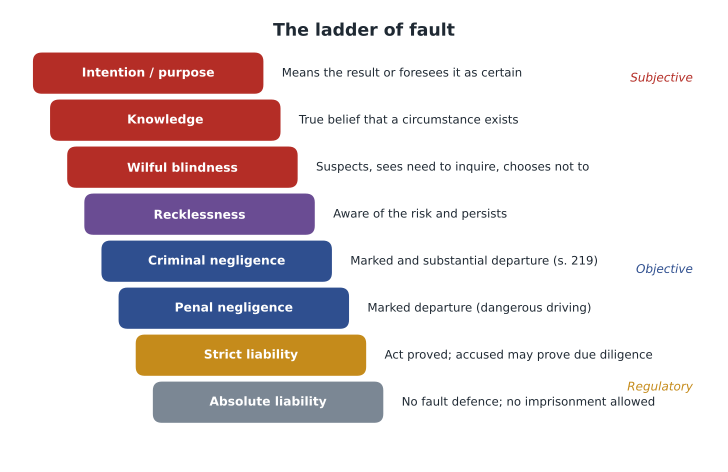
Canadian courts distinguish subjective and objective fault. Subjective fault asks what was actually in the accused's mind: did he intend the consequence, know the circumstance, or foresee the risk? Objective fault asks whether the accused's conduct was a marked departure from what a reasonable person would do in the circumstances, regardless of what the accused actually thought. The distinction is fundamental. Subjective fault is the default for true crimes, and objective fault is the exception, which Parliament must make clear.
Determining the required fault
The first step is always the wording of the offence. Words such as 'intentionally', 'wilfully', 'knowingly', 'with intent to' and 'for the purpose of' signal subjective fault. Where an offence is silent, courts presume subjective fault for true crimes (Sault Ste. Marie; R. v. ADH, 2013 SCC 28). In ADH, the accused gave birth unexpectedly in a store washroom, believed the baby was dead and left it there. She was charged with abandoning a child under section 218. The Court held that section 218 requires subjective fault, because nothing in its text or context displaced the presumption, and upheld her acquittal.
The fault requirement attaches to each element of the actus reus. For assault, the accused must intend to apply force and must know of, be wilfully blind to, or be reckless about the absence of consent. For theft, the accused must intend to take the property, know it belongs to another and act fraudulently and without colour of right. When an offence has a consequence element, the question is what fault attaches to the consequence. For many offences, such as unlawful act manslaughter or assault causing bodily harm, the fault requirement for the consequence is objective foreseeability, a topic for lessons 5 and 6.
Intention and purpose
Intention is the most culpable form of fault. A person intends a consequence when it is his purpose or desire to bring it about. The law also treats a person as intending a consequence that he foresees as certain or substantially certain to result from his conduct, even if it is not his purpose. In R. v. Buzzanga and Durocher (1979), 25 OR (2d) 705 (CA), two Franco-Ontarians circulated a deliberately offensive anti-French pamphlet, intending to provoke a reaction that would help the case for a French-language school. They were charged with wilfully promoting hatred. Justice Martin held that 'wilfully' in that offence meant that the accused must either intend to promote hatred as their purpose, or foresee that promotion of hatred was certain or morally certain to result. Mere recklessness was not enough. A new trial was ordered.
Purpose is a narrower concept. Some offences require that the accused act for a particular purpose, and in those cases foresight of certainty may not suffice. In R. v. Hibbert, [1995] 2 SCR 973, the accused was forced at gunpoint to lure a friend to a place where the friend was shot. He was charged as a party for aiding and abetting under section 21(1)(b), which requires that the accused act 'for the purpose of aiding.' The Court held that purpose in section 21(1)(b) means intention, not desire: an accused who intends to help, even if he does not want the crime to succeed, acts for the purpose of aiding. Duress therefore does not negate the mental element of aiding; it operates as a separate excuse. Hibbert shows that the meaning of 'purpose' depends on the provision.
Motive
Motive is the reason why a person acts, such as greed, jealousy or revenge. It is not an element of most offences. In Lewis v. The Queen, [1979] 2 SCR 821, the accused was charged with murder after a bomb disguised as an electric kettle was sent to the victims. The Court held that motive is not an essential element of any crime, although evidence of motive is always relevant and its absence may be important in assessing guilt. A person who kills for compassionate reasons, as Robert Latimer did when he killed his severely disabled daughter, still intends to kill: R. v. Latimer, 2001 SCC 1. Motive may be relevant to sentencing, to identity and to some defences, and a few offences, such as terrorism offences in section 83.01, require proof of a political, religious or ideological purpose.
Knowledge
Many offences require knowledge of a circumstance: that the goods were stolen, that the substance was a controlled drug, that the complainant was under sixteen. Knowledge means true belief. An accused who honestly believes a circumstance does not exist lacks knowledge, even if the belief is unreasonable, unless the offence imposes an objective standard or Parliament has limited the defence. In R. v. Pappajohn, [1980] 2 SCR 120, the Court held that an honest but mistaken belief in a circumstance negates mens rea; the reasonableness of the belief goes to whether it was honestly held, not to whether it is a defence. Parliament has since limited this principle in sexual assault, as lesson 7 explains.
Wilful blindness
The law does not let accused persons escape liability by deliberately avoiding the truth. Wilful blindness is a substitute for actual knowledge. In R. v. Sansregret, [1985] 1 SCR 570, the accused had broken into his former partner's home and terrified her. She pretended to consent to sex to calm him. He was charged with rape. The Court held that he was wilfully blind to the fact that her apparent consent was given out of fear: he had become aware of the need for inquiry but chose not to inquire because he did not want to know the truth.
In R. v. Briscoe, 2010 SCC 13, Justice Charron described wilful blindness as deliberate ignorance. It is imputed knowledge where the accused's suspicion is aroused to the point where he sees the need for further inquiries but deliberately chooses not to make them. It is distinct from recklessness, which involves knowledge of a danger or risk and persistence in conduct that creates it. Because it rests on a deliberate choice not to know, wilful blindness is a subjective state close to actual knowledge, not a form of negligence. An accused who simply failed to notice what a careful person would have noticed is not wilfully blind. Lesson 8 returns to Briscoe in the context of parties.
Recklessness
Recklessness is the least culpable form of subjective fault. A person is reckless when he is aware that his conduct could bring about the prohibited result or circumstance and persists despite the risk. In Sansregret, Justice McIntyre distinguished recklessness from negligence: recklessness is found in the attitude of one who, aware that there is a danger that his conduct could bring about the result prohibited by the criminal law, nevertheless persists, despite the risk. It is subjective because it requires actual awareness of the risk. Negligence, by contrast, is measured objectively. Courts have treated recklessness as sufficient for many offences that are silent on fault, such as mischief and assault, though not for offences requiring intention or knowledge.
Returning to Calder, if he was aware that shoving Dorey near the curb risked causing him bodily harm and did it anyway, he was at least reckless about bodily harm. If he intended to cause bodily harm, that is more culpable still. For murder, as lesson 6 will show, recklessness about bodily harm is not enough: the Crown must prove that he meant to cause death or meant to cause bodily harm he knew was likely to cause death and was reckless whether death ensued (section 229(a)(ii)).
Transferred intent
Sometimes an accused aims at one person and harms another. Section 229(b) of the Code codifies transferred intent for murder: where a person, meaning to cause death to a human being, or meaning to cause bodily harm he knows is likely to cause death and being reckless whether death ensues, by accident or mistake causes death to another human being, even though he does not mean to cause death or bodily harm to that human being, he commits murder. Outside murder, the common law doctrine transfers intent between victims of the same kind of offence. A punch aimed at one person that lands on a bystander is an assault on the bystander, because the intent to apply force to a person is transferred. Intent is not usually transferred between different kinds of offence: an intent to damage property does not become an intent to injure a person.
Contemporaneity
The mens rea and the actus reus must coincide at some point in time. The principle prevents conviction where a guilty mind arises only after the act is complete, or disappears before it begins. Courts apply it flexibly. In R. v. Cooper, [1993] 1 SCR 146, the accused grabbed the victim by the throat during an argument, blacked out from drinking, and found her dead when he came to. The Court held that the intent required for murder need not persist throughout the entire act of strangulation. It was enough that at some point during the strangling he had the intent to cause bodily harm he knew was likely to cause death, even if he was not aware of the moment of death. A continuing transaction can satisfy contemporaneity, as in Fagan and Miller, discussed in lesson 3.
Mistake of fact
A mistake of fact is not truly a separate defence. It negates the mental element. If an accused honestly believes facts that, if true, would make his conduct innocent, he lacks the knowledge or intention the offence requires. A person who takes a coat from a restaurant coat rack, honestly believing it to be his own, lacks the intent to steal. The mistake need not be reasonable for subjective fault offences (Pappajohn), although an unreasonable belief is less likely to be found honestly held. Where fault is objective, the mistake must be reasonable. And mistake of fact is different from mistake of law, which section 19 of the Code generally excludes, as lesson 11 explains.
The Calder file, again
At the end of class Castellano summarizes. If Calder meant to push Dorey and knew Dorey did not consent, he had the mens rea for assault. If he foresaw a risk of bodily harm and shoved anyway, he was reckless. Whether that is enough for manslaughter depends on the fault for the consequence, which is objective foreseeability of bodily harm that is neither trivial nor transitory, the subject of lessons 5 and 6. And whether it could ever be murder depends on whether he subjectively foresaw that death was likely, which on these facts seems unlikely. 'Fault has degrees,' she says. 'The Code matches each offence to a degree. Your job is to match the facts to the right one.'
Practice problems
Work each problem on paper first, then reveal the answer to check.
An offence makes it a crime to 'wilfully obstruct a peace officer.' What fault does 'wilfully' require?
Show answer
Subjective fault. 'Wilfully' signals intention, which includes acting with the purpose of obstructing or foreseeing that obstruction is certain or substantially certain to result (Buzzanga and Durocher). Depending on the provision, courts have sometimes read 'wilfully' to include recklessness, so the answer turns on statutory context, but it excludes mere negligence.
A courier is paid 2,000 dollars to carry a locked suitcase across the border and is told not to ask what is inside. He suspects drugs but decides not to look. Drugs are found. Does he have knowledge?
Show answer
He is likely wilfully blind. His suspicion was aroused to the point where he saw the need for inquiry, and he deliberately chose not to inquire because he did not want to know (Sansregret, Briscoe). Wilful blindness substitutes for knowledge.
A woman kills her husband, who was terminally ill and in pain, at his request. Does her compassionate motive affect liability for murder?
Show answer
No. Motive is not an element of the offence (Lewis). If she intended to cause death, she has the fault for murder (Latimer). Motive may matter for sentencing, but mandatory life imprisonment applies to murder, and the only route to a different result would be a different charge, a Charter argument or the exercise of prosecutorial or executive discretion.
Summary and key terms
- True crimes carry a presumption of subjective fault (Sault Ste. Marie; ADH, 2013 SCC 28).
- Fault attaches to each element of the actus reus and is determined from the wording of the offence.
- Intention includes purpose and foresight of certainty or substantial certainty (Buzzanga and Durocher); 'purpose' in section 21(1)(b) means intention, not desire (Hibbert).
- Motive is not an element of most offences (Lewis; Latimer).
- Knowledge is true belief; wilful blindness substitutes for knowledge where the accused deliberately avoids inquiry (Sansregret, Briscoe).
- Recklessness is awareness of a risk and persistence despite it, the lowest form of subjective fault.
- Intent transfers between victims (section 229(b)); actus reus and mens rea must coincide at some point (Cooper).
- Mens rea
- The mental or fault element of an offence.
- Subjective fault
- Fault based on what the accused actually intended, knew or foresaw.
- Intention
- Acting with the purpose of bringing about a consequence, or foreseeing it as certain or substantially certain.
- Motive
- The reason why a person acts; generally not an element of an offence.
- Wilful blindness
- Deliberate failure to inquire when suspicion is aroused, treated as knowledge.
- Recklessness
- Awareness that conduct risks a prohibited result or circumstance, and persisting despite the risk.
- Transferred intent
- The rule that intent to harm one person carries over when another person is harmed instead.
Lesson quiz · 5 questions
Score 60% or more to complete this lesson.
Create a free account to save your progress, take quizzes and earn a certificate.