
LAWC-103 · Lesson 6 of 12 · 19 min
Homicide
▶ Video coming soon A video version of this lesson is on the way.
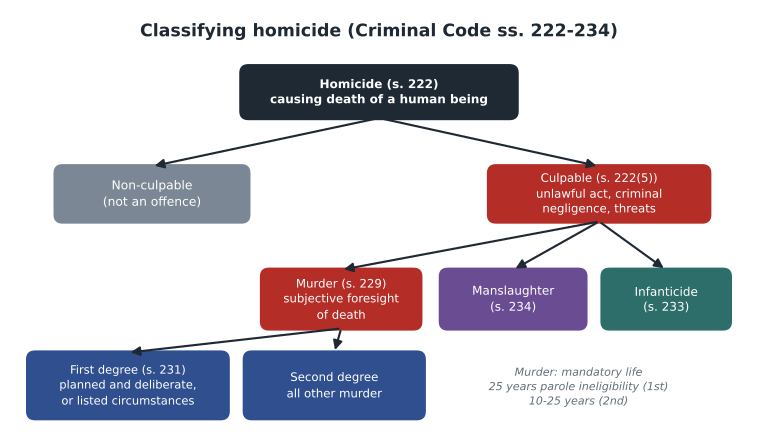
Castellano opens the homicide class by writing section 222(1) on the board: 'A person commits homicide when, directly or indirectly, by any means, he causes the death of a human being.' Below it she writes: not every homicide is a crime. 'A surgeon whose patient dies on the table has committed homicide in this sense,' she says. 'So has a police officer who shoots in lawful self-defence. The Code then sorts homicide into culpable and non-culpable, and culpable homicide into murder, manslaughter and infanticide. The labels decide whether Owen Calder faces life imprisonment with no parole eligibility for ten years, or a sentence a judge can tailor to what he did.'
This lesson examines the structure of homicide in the Criminal Code: causing death, culpable and non-culpable homicide, the forms of murder in section 229, the constitutional minimum fault for murder, first and second degree murder under section 231 including the 2026 amendments, the forms of manslaughter, infanticide and the sentencing consequences. Provocation, which reduces murder to manslaughter, is covered in lesson 11 with the other defences.
Causing the death of a human being
Homicide requires the death of a human being caused by the accused. Section 223 provides that a child becomes a human being when it has completely proceeded, in a living state, from the body of its mother, whether or not it has breathed, has an independent circulation or the navel string is severed. Under section 223(2), a person commits homicide if he causes injury to a child before or during birth as a result of which the child dies after becoming a human being.
Causation follows the principles in lesson 3. The Crown must prove that the accused's conduct was a significant contributing cause of death (Smithers; Nette; Maybin). Sections 222(5) and 224 to 228 address special causation problems: section 224 (death that might have been prevented by proper means), section 225 (treatment of injuries), section 226 (acceleration of death), and section 222(5)(c) and (d) (causing a person to do something that causes death by threats, fear of violence or deception, and wilfully frightening a child or sick person). The old rule in section 227 that death had to occur within a year and a day was repealed in 1999.
Culpable and non-culpable homicide
Section 222(4) provides that culpable homicide is murder, manslaughter or infanticide. Section 222(5) defines culpable homicide as causing the death of a human being by means of an unlawful act, by criminal negligence, by causing that human being by threats, fear of violence or deception to do anything that causes death, or by wilfully frightening a child or sick person. Homicide that is not culpable is not an offence (section 222(3)). A death caused by a lawful act done without criminal negligence, such as a pure accident or justified self-defence, is non-culpable.
Murder: section 229
Section 229 sets out three routes to murder. Under section 229(a)(i), culpable homicide is murder where the person who causes death means to cause death. Under section 229(a)(ii), it is murder where the person means to cause bodily harm that he knows is likely to cause death, and is reckless whether death ensues or not. Under section 229(b), the transferred intent provision, it is murder where a person, meaning to cause death or bodily harm of the (a)(ii) kind to one human being, by accident or mistake causes the death of another. Under section 229(c), it is murder where a person, for an unlawful object, does anything that he knows or ought to know is likely to cause death, and thereby causes death, notwithstanding that he desires to effect his object without causing death or bodily harm.
Section 229(a)(ii) requires subjective foresight of the likelihood of death. In R. v. Cooper, [1993] 1 SCR 146, Justice Cory explained that the accused must intend to cause bodily harm and must subjectively know that the harm is so dangerous that it is likely to result in death. The recklessness element adds little, since a person who knows his conduct is likely to cause death and goes ahead is necessarily reckless as to death. The essential element is that the accused knew death was likely.
The constitutional minimum for murder
The Supreme Court has held that section 7 of the Charter requires subjective foresight of death for a murder conviction, because of the stigma and mandatory life sentence. In R. v. Vaillancourt, [1987] 2 SCR 636, the accused took part in an armed robbery of a pool hall in which his accomplice shot and killed a customer. He was convicted under section 213(d) (later section 230(d)), the constructive murder provision, which made it murder to cause death while committing certain offences if the accused had a weapon. The Court struck down section 213(d), holding that the principles of fundamental justice require at least objective foreseeability of death, and suggesting that subjective foresight was required.
In R. v. Martineau, [1990] 2 SCR 633, the Court confirmed that subjective foresight of death is the constitutional minimum for murder and struck down section 213(a), which made it murder to cause death while committing certain offences by intentionally causing bodily harm. Chief Justice Lamer explained that a conviction for murder carries the most severe stigma and punishment of any crime, and that the punishment must be proportionate to moral blameworthiness. In R. v. Sit, [1991] 3 SCR 124, the Court struck down section 213(c), and the objective branch of section 229(c), the words 'ought to know', is constitutionally inoperative. Section 230 was repealed entirely by SC 2019, c. 25, s. 78.
The surviving part of section 229(c), the unlawful object form, still exists for an accused who subjectively knows that his act is likely to cause death. In R. v. Shand, 2011 ONCA 5, the Ontario Court of Appeal held that section 229(c) requires that the unlawful object be a serious crime requiring proof of subjective fault, distinct from the dangerous act that causes death, and that the accused subjectively foresee death as likely. It upheld the constitutionality of section 229(c) as limited in this way.
First and second degree murder
Section 231 divides murder into first and second degree for sentencing purposes; all murder that is not first degree is second degree (section 231(7)). The classification does not create a separate offence; it is a question of the circumstances of the murder.
Murder is first degree when it is planned and deliberate (section 231(2)). Planned means that the plan was conceived and carefully thought out before it was carried out; deliberate means considered, not impulsive. Murder is also first degree, whether or not planned and deliberate, in several situations: contract killing (section 231(3)); murder of a police officer, correctional officer or similar person acting in the course of duty (section 231(4)); murder committed while committing or attempting certain serious offences, including hijacking, sexual assault, kidnapping, forcible confinement and hostage taking (section 231(5)); murder in the course of criminal harassment (section 231(6)); murder committed for a terrorist activity or for a criminal organization (sections 231(6.01) and (6.1)); and murder while using explosives for a criminal organization (section 231(6.2)).
Section 231(5) has generated important case law. In R. v. Harbottle, [1993] 3 SCR 306, the Court held that the accused must be a substantial cause of death, a higher standard than the general causation test, because of the seriousness of a first degree conviction: the accused's conduct must be an essential, substantial and integral part of the killing. In R. v. Pritchard, 2008 SCC 59, the Court explained that the murder and the underlying offence must form a single transaction. In R. v. Russell, 2001 SCC 53, the victim of the underlying offence need not be the person killed.
The 2026 amendments
In June 2026 Parliament expanded first degree murder in the context of intimate partner violence. An Act to amend the Criminal Code, SC 2026, c. 12, assented to June 17, 2026 and known as Bailey's Law, added section 231(3.1): murder is first degree when the victim is the accused's intimate partner and the death is caused while the accused is engaged in a pattern of coercive or controlling conduct toward the victim. The same Act added section 236(2), requiring a court sentencing a person for manslaughter of an intimate partner in similar circumstances to consider imposing life imprisonment, and section 263.1 dealing with violence against an intimate partner. The Protecting Victims Act, Bill C-16 (royal assent June 18, 2026), moved in the same direction: the government described it as treating murders involving coercive control, hate, sexual violence or exploitation as first degree murder, called femicide when the victim is female, and as creating a separate offence of coercive or controlling conduct toward an intimate partner that comes into force within two years of assent. Because these provisions are new and overlap, practitioners must check the current consolidated text of section 231 on the Justice Laws website and watch for the first appellate decisions interpreting them.
Marchetti points out that section 231(3.1) requires proof of 'a pattern' of coercive or controlling conduct. 'Expect the litigation to be about that word,' Castellano says. 'What counts as a pattern, how much evidence of the relationship is admissible, and how a jury is instructed. That is where the next decade of appeals will be.'
Sentencing for murder
Murder carries a mandatory sentence of life imprisonment (section 235). The differences between first and second degree concern parole eligibility. For first degree murder, the offender is not eligible for parole for 25 years (section 745(a)). For second degree murder, parole ineligibility is at least 10 years and up to 25 years, set by the judge after considering any jury recommendation (sections 745(c), 745.2 and 745.4). Section 745.51, added in 2011, allowed consecutive periods of parole ineligibility for multiple murders. In R. v. Bissonnette, 2022 SCC 23, the Court struck down section 745.51, holding that a sentence of imprisonment for life without a realistic possibility of parole is cruel and unusual punishment contrary to section 12 of the Charter because it denies any possibility of rehabilitation and is degrading in nature. The faint hope clause in section 745.6, which allowed some offenders to apply for earlier parole eligibility, was abolished for offences committed after December 2, 2011.
Manslaughter
Manslaughter is culpable homicide that is not murder or infanticide (section 234). It carries a maximum of life imprisonment and no minimum, except where a firearm is used, which carries a mandatory minimum of four years (section 236(a)). There are three main routes. Unlawful act manslaughter requires an unlawful act that is objectively dangerous, likely to injure another person, plus objective foreseeability of the risk of bodily harm that is neither trivial nor transitory (R. v. Creighton, [1993] 3 SCR 3; R. v. DeSousa, [1992] 2 SCR 944). The unlawful act must itself be an offence that is constitutionally valid, and not an absolute liability offence. Manslaughter by criminal negligence requires a marked and substantial departure from the standard of a reasonable person, as discussed in lesson 5 (R. v. J.F., 2008 SCC 60). And murder may be reduced to manslaughter by provocation (section 232) or by a reasonable doubt about intent, including because of intoxication.
Manslaughter is often the verdict when the Crown cannot prove subjective foresight of death. A jury that has a reasonable doubt about whether the accused meant to cause death or knew death was likely, but is satisfied that the accused committed a dangerous unlawful act causing death, must acquit of murder and convict of manslaughter. Intoxication can raise such a doubt, since murder is a specific intent offence while manslaughter is a general intent offence, as lesson 10 explains.
In R. v. Javanmardi, 2019 SCC 54, a naturopath gave an elderly patient an intravenous injection of nutrients that caused a fatal infection. She was acquitted at trial of criminal negligence causing death and of unlawful act manslaughter; the Quebec Court of Appeal substituted a conviction for manslaughter. The Court held that, for unlawful act manslaughter based on an underlying offence of dangerous conduct, the objective dangerousness of the act must be assessed considering the accused's training and experience, because the context of a licensed activity is part of the circumstances. The Court restored her acquittals.
Infanticide
Section 233 defines infanticide: a female person commits infanticide when, by a wilful act or omission, she causes the death of her newly born child, if at the time she is not fully recovered from the effects of giving birth and by reason of that or of the effect of lactation consequent on the birth her mind is then disturbed. The maximum penalty is five years (section 237). In R. v. Borowiec, 2016 SCC 11, the Court interpreted 'disturbed' broadly as an ordinary word meaning mentally agitated, mentally unstable or mentally discomposed, not requiring a recognized medical condition, and held that the Crown must disprove infanticide beyond a reasonable doubt once there is an air of reality to it. The offence reflects a historical compromise between the severity of murder and the circumstances of new mothers, and remains controversial.
Calder: murder or manslaughter?
Castellano asks the class to classify the Calder homicide. The shove caused death (lesson 3). Calder intended to apply force and knew Dorey did not consent, so the shove was an assault, an unlawful act. A reasonable person would foresee a risk of bodily harm that was neither trivial nor transitory. Unlawful act manslaughter is made out on Creighton. Murder requires that Calder meant to cause death or meant to cause bodily harm he knew was likely to cause death, and nothing suggests that. Daniel Whitecloud asks whether the answer would change if Calder had kicked Dorey in the head repeatedly while he lay on the ground. 'Now you are getting close to section 229(a)(ii),' Castellano says. 'Repeated kicks to the head of a defenceless person can support an inference that the accused knew death was likely. Inference, not presumption. That is for the jury.'
Practice problems
Work each problem on paper first, then reveal the answer to check.
An accused robs a convenience store with a loaded gun to scare the clerk. The gun goes off during a struggle and kills the clerk. The accused says he never meant to fire. What homicide offences are in play?
Show answer
Constructive murder under former section 230 is unconstitutional (Vaillancourt, Martineau) and repealed. Murder under section 229(a) requires intent to kill or to cause bodily harm known to be likely to cause death; section 229(c) requires subjective knowledge that his acts were likely to cause death in pursuit of the unlawful object of robbery (Shand). If the jury has a reasonable doubt on those, unlawful act manslaughter remains: robbery with a loaded gun is a dangerous unlawful act and non-trivial bodily harm was objectively foreseeable (Creighton). Because a firearm was used, a four-year minimum applies to manslaughter.
During a kidnapping, the accused's accomplice holds the victim while the accused shoots him. Is the murder first degree?
Show answer
Under section 231(5), murder committed while committing or attempting forcible confinement or kidnapping is first degree if the accused is a substantial cause of death (Harbottle) and the murder and the confinement are part of a single transaction (Pritchard). The shooter clearly qualifies. The accomplice who held the victim may also be a substantial cause and liable as a party.
Why is a sentence of life without any realistic possibility of parole unconstitutional?
Show answer
In Bissonnette, 2022 SCC 23, the Court held that such a sentence is cruel and unusual under section 12 because it denies any possibility of rehabilitation and is degrading. It struck down section 745.51, which allowed stacked parole ineligibility periods for multiple murders.
Summary and key terms
- Homicide is causing the death of a human being; only culpable homicide (unlawful act, criminal negligence, threats, fear or deception, frightening a child or sick person) is an offence.
- Murder (section 229) requires intent to kill, or intent to cause bodily harm known to be likely to cause death; transferred intent and the subjective unlawful object form also apply.
- Section 7 requires subjective foresight of death for murder (Vaillancourt, Martineau, Sit); section 230 is repealed.
- First degree murder: planned and deliberate, or listed circumstances in section 231, including the 2026 intimate partner provision in section 231(3.1); section 231(5) requires substantial causation (Harbottle).
- Murder carries mandatory life; parole ineligibility is 25 years for first degree and 10 to 25 for second degree; stacked ineligibility is unconstitutional (Bissonnette).
- Manslaughter: unlawful act plus objective foreseeability of non-trivial bodily harm (Creighton), or criminal negligence; infanticide is defined in section 233 (Borowiec).
- Culpable homicide
- Homicide caused by an unlawful act, criminal negligence, threats, fear or deception, or wilfully frightening a child or sick person.
- Murder
- Culpable homicide with the fault in section 229, at minimum subjective foresight of death.
- Planned and deliberate
- A murder that was thought out in advance and considered rather than impulsive, making it first degree.
- Constructive murder
- Former provisions making killings during certain crimes murder without foresight of death; struck down and repealed.
- Unlawful act manslaughter
- Causing death by a dangerous unlawful act where non-trivial bodily harm was objectively foreseeable.
- Infanticide
- The killing of a newly born child by a mother whose mind is disturbed by the effects of birth or lactation (section 233).
- Parole ineligibility
- The period before an offender serving a life sentence may apply for parole.
Lesson quiz · 5 questions
Score 60% or more to complete this lesson.
Create a free account to save your progress, take quizzes and earn a certificate.