
LAWC-103 · Lesson 12 of 12 · 20 min
Capstone: sentencing and a criminal law problem
▶ Video coming soon A video version of this lesson is on the way.
On Thursday, November 19, 2026, Professor Castellano holds her last review class before the December exam. She hands out a two-page problem and says the first half of the class will be on sentencing, because the exam problem ends with a sentencing question. 'Most of you have spent eleven lessons on whether someone is guilty,' she says. 'Most of your clients will plead guilty. What happens next is sentencing, and it is where criminal lawyers spend most of their working lives.'
This lesson has two parts. The first introduces the law of sentencing: the purposes and principles in sections 718 to 718.2, proportionality, the Gladue principles for Indigenous offenders, the main sentencing options, mandatory minimum penalties and the 2026 reforms. The second part works through a full criminal law problem in IRAC form, drawing on every lesson in the course. Sentencing procedure and appeals are covered in more depth in LAWC-211 Criminal Procedure.
The purposes of sentencing: section 718
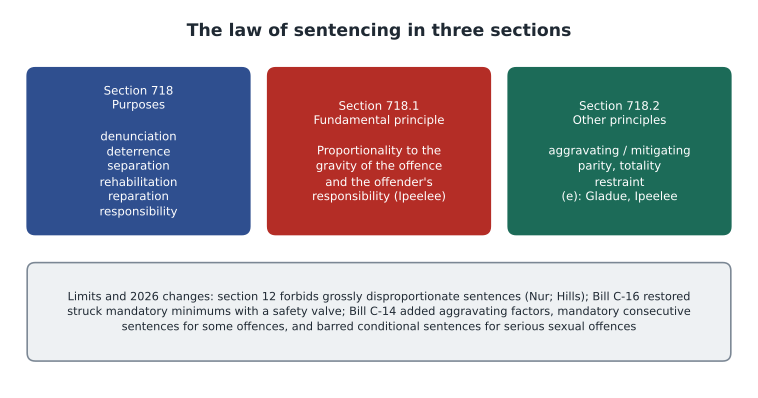
Section 718 provides that the fundamental purpose of sentencing is to protect society and to contribute, along with crime prevention initiatives, to respect for the law and the maintenance of a just, peaceful and safe society by imposing just sanctions that have one or more of the following objectives: to denounce unlawful conduct and the harm done to victims or to the community; to deter the offender and other persons from committing offences; to separate offenders from society, where necessary; to assist in rehabilitating offenders; to provide reparations for harm done to victims or to the community; to promote a sense of responsibility in offenders, and acknowledgment of the harm done to victims or to the community. Sections 718.01 to 718.04 direct courts to give primary consideration to denunciation and deterrence for certain offences, such as offences against children, against peace officers, and involving abuse of vulnerable persons.
The objectives often pull in different directions. Denunciation and deterrence may point to a long prison term, while rehabilitation may point to a community-based sentence. The judge must balance them in light of the offence and the offender. In R. v. Lacasse, 2015 SCC 64, the Court emphasized that sentencing is highly individualized, that trial judges have a broad discretion, and that appellate courts should intervene only where a sentence is demonstrably unfit or the judge made an error in principle that affected the sentence.
Proportionality: section 718.1
Section 718.1 provides the fundamental principle: a sentence must be proportionate to the gravity of the offence and the degree of responsibility of the offender. In R. v. Ipeelee, 2012 SCC 13, Justice LeBel explained that proportionality has two aspects. It ensures that the sentence reflects the seriousness of the offence and so serves denunciation, and it ensures that the sentence does not exceed what is just and appropriate given the moral blameworthiness of the offender, so that it serves a restraining function. Proportionality is the central organizing principle of Canadian sentencing.
Other principles: section 718.2
Section 718.2 sets out further principles. A sentence should be increased or reduced to account for aggravating or mitigating circumstances, and section 718.2(a) lists statutory aggravating factors, including that the offence was motivated by bias, prejudice or hate; that it involved intimate partner abuse; that it involved abuse of a person under eighteen; that it involved abuse of a position of trust or authority; and that it had a significant impact on the victim. Bill C-14, the Bail and Sentencing Reform Act (royal assent June 15, 2026, in force July 15, 2026), added aggravating factors for offences against first responders and public transit workers, organized retail theft, and mischief or theft that damages essential infrastructure.
Section 718.2(b) requires parity: similar sentences for similar offenders committing similar offences in similar circumstances. Section 718.2(c) requires that combined consecutive sentences not be unduly long or harsh, the totality principle. Section 718.2(d) and (e) express restraint: an offender should not be deprived of liberty if less restrictive sanctions may be appropriate, and all available sanctions other than imprisonment that are reasonable in the circumstances and consistent with the harm done should be considered for all offenders, with particular attention to the circumstances of Aboriginal offenders. Bill C-14 also requires consecutive sentences for certain offences, including violent auto theft, break and enter, extortion and arson, and requires judges to consider consecutive sentences for repeat violent offending.
Gladue and Ipeelee
In R. v. Gladue, [1999] 1 SCR 688, the Court held that section 718.2(e) is remedial. It directs sentencing judges to take judicial notice of the systemic and background factors that have contributed to the over-representation of Indigenous people in the criminal justice system, including the legacy of colonialism, residential schools, displacement and poverty, and to consider types of sentencing procedures and sanctions, such as restorative justice, that may be appropriate because of the offender's Indigenous heritage or connection. Gladue reports, prepared by specialized writers, provide this information to the court.
In Ipeelee, the Court reaffirmed Gladue and corrected two errors that had emerged in the lower courts. Gladue does not require the offender to establish a causal link between background factors and the offence; and Gladue principles apply to all offences, including serious ones, although the weight they carry depends on the circumstances. Daniel Whitecloud, who worked in band administration before law school, notes that the over-representation Gladue addressed has grown since 1999. Castellano agrees: 'The Court said so itself in Ipeelee. Section 718.2(e) is a direction to judges, not a cure.'
The sentencing options
Canadian law provides a range of sanctions. An absolute or conditional discharge (section 730) means no conviction is registered; it is available where the offence carries no minimum penalty and a maximum below fourteen years, and the discharge is in the offender's best interests and not contrary to the public interest. A suspended sentence with probation (section 731) suspends the passing of sentence while the offender complies with conditions. A fine (section 734) may be imposed alone or with other sanctions. A conditional sentence of imprisonment (section 742.1), often served at home under strict conditions, is available for sentences of less than two years where there is no mandatory minimum and serving the sentence in the community would not endanger the community. Bill C-14 made conditional sentences unavailable for serious sexual offences, including offences against children. Imprisonment of less than two years is served in a provincial jail; two years or more in a federal penitentiary.
In R. v. Proulx, 2000 SCC 5, the Court explained that a conditional sentence is a punitive sanction that can achieve denunciation and deterrence, and that it should generally include punitive conditions such as house arrest. Probation orders, restitution, weapons prohibitions, DNA orders, driving prohibitions (which Bill C-14 restored for manslaughter and criminal negligence causing bodily harm or death) and sex offender registration orders are common ancillary orders.
Mandatory minimum penalties
Some offences carry mandatory minimum penalties: life imprisonment for murder, four years for certain firearms offences and manslaughter with a firearm, and minimums for some sexual offences against children and impaired driving offences. Section 12 of the Charter protects against cruel and unusual punishment. In R. v. Nur, 2015 SCC 15, the Court struck down three- and five-year mandatory minimums for possession of a loaded prohibited firearm, holding that a mandatory minimum violates section 12 if it is grossly disproportionate either for the offender before the court or in reasonably foreseeable cases. In R. v. Hills, 2023 SCC 2, the Court confirmed the reasonable hypothetical approach and struck down the four-year minimum for intentionally discharging a firearm into or at a house, using the hypothetical of a young person firing an air-powered rifle at a home. In R. v. Hilbach, 2023 SCC 3, decided the same day, it upheld the minimums for robbery with a firearm. In R. v. Bertrand Marchand, 2023 SCC 26, it struck down minimums for child luring.
Parliament has responded in both directions. In 2022, SC 2022, c. 15 repealed mandatory minimums for a number of drug and firearms offences and widened access to conditional sentences. In 2026, the Protecting Victims Act, Bill C-16 (royal assent June 18, 2026), restored the mandatory minimum penalties of imprisonment that courts had struck down, while adding a safety valve: a judge may impose a different sentence of imprisonment in a rare case where the specific mandatory minimum would be grossly disproportionate for the offender before the court. The safety valve is designed to make minimums harder to strike down on the basis of hypothetical offenders, since the judge can depart from the minimum in the real case. How courts apply the new provision, and whether section 12 challenges based on reasonable hypotheticals still succeed, are open questions that the next few years of case law will answer.
Theo Marchetti asks whether the safety valve makes minimums pointless. 'Parliament would say it keeps the minimum as the norm and saves the exception for the truly exceptional case,' Castellano says. 'Defence counsel will say it invites litigation in every case. Watch for the first appeal decisions.'
The problem
Castellano distributes the problem. Late on a Saturday night in Corwin, Jasmine Ortiz and her friend Kevin Nakamura leave a party. Ortiz has had four drinks; Nakamura has had more and taken an unknown pill someone offered him. Outside, Ortiz's former partner, Derek Vale, is waiting in his car. Ortiz has a peace bond against Vale, who has followed her and sent threatening messages for months. Vale gets out of the car, shouts that Ortiz will 'regret this' and walks quickly toward her holding something dark in his hand. Nakamura steps in front of Ortiz and pushes Vale hard in the chest. Vale falls backward, hits his head on the curb and is knocked unconscious. Nakamura, agitated and confused, kicks Vale twice in the ribs as he lies on the ground, shouting incoherently. Ortiz pulls Nakamura away and calls 911. The dark object turns out to be Vale's phone. Vale survives with a fractured skull and broken ribs. Nakamura is charged with aggravated assault (section 268). Ortiz is charged as a party, on the theory that she shouted 'Get him!' just before the push. Advise on liability and, if Nakamura is convicted, on sentence.
Issue 1: the actus reus and causation
Aggravated assault under section 268 requires an assault that wounds, maims, disfigures or endangers the life of the complainant. The push and the kicks were applications of force without consent (section 265). The fractured skull endangered Vale's life, and it was caused by the push: but for the push, Vale would not have fallen, and the push is a significant contributing cause (Smithers, Nette). The broken ribs were caused by the kicks. So the actus reus can be analyzed as two acts: the push, which caused the life-endangering injury, and the kicks, which caused lesser bodily harm. Separating the acts matters because the defences may apply differently to each.
Issue 2: mens rea
Aggravated assault requires the mens rea for assault plus objective foreseeability of the risk of bodily harm (R. v. Godin, [1994] 2 SCR 484). Nakamura intentionally pushed and kicked Vale. A reasonable person would foresee that a hard push to the chest near a curb risks bodily harm. Intoxication does not help on this general intent offence unless it reached the level of automatism. The pill raises that possibility, but Nakamura was apparently aware enough to step in front of Ortiz and push Vale. If he claims extreme intoxication, he must prove it on a balance of probabilities with expert evidence (Daviault; Daley), and the 2022 version of section 33.1 would apply to this violent offence if his consumption of an unknown pill after heavy drinking was a marked departure from the standard of a reasonable person, considering the objective foreseeability of extreme intoxication and harm. Taking an unknown pill from a stranger after drinking may well be found to be such a departure.
Issue 3: self-defence and defence of another
Section 34 protects defence of 'another person.' For the push: the catalyst asks whether Nakamura believed on reasonable grounds that force or a threat of force was being used against Ortiz. Vale's history of threats, the peace bond, his words and his rapid approach holding a dark object support a reasonable belief, even though the object was a phone (Khill: a reasonable mistake suffices). Nakamura's intoxication does not make an unreasonable belief reasonable; the standard is the reasonable sober person in his circumstances. The motive appears defensive. The response, a single hard push, is likely reasonable under section 34(2), considering the nature of the threat, imminence, Vale's history and the proportionality of a push. There is an air of reality, and the Crown must disprove self-defence beyond a reasonable doubt. Nakamura likely has a defence for the push and so for the skull fracture.
For the kicks, the analysis changes. Once Vale was unconscious on the ground, the threat had ended. The catalyst may no longer be satisfied, and kicking an unconscious man is unlikely to be a reasonable response or to have a defensive purpose (section 34(1)(b), (c)). The kicks are probably an assault causing bodily harm (section 267) not covered by self-defence, unless Nakamura's state rose to automatism, in which case section 33.1 issues return.
Issue 4: Ortiz's liability as a party
Ortiz is charged as an abettor under section 21(1)(c). Shouting 'Get him!' could be encouragement. But her liability depends on Nakamura's offence. If the push was justified by self-defence, there is no offence to abet. Section 34 also protects her directly: she believed on reasonable grounds that she was threatened, and encouraging her friend to protect her was itself an act committed for a defensive purpose. For the kicks, which happened after she spoke and which she stopped, the Crown would have to prove she intended to encourage them and knew Nakamura intended to commit them (Briscoe). Pulling him away and calling 911 points the other way. Her liability is weak.
Issue 5: sentence
If Nakamura is acquitted on the push but convicted of assault causing bodily harm for the kicks, the sentencing judge would apply sections 718 to 718.2. Aggravating factors include kicking a defenceless person. Mitigating factors include the provocative and threatening context created by Vale's conduct, Nakamura's apparent lack of a record, his intoxication-related confusion (which may be mitigating if not self-induced recklessness), and any remorse. Proportionality points to a sentence reflecting his reduced moral blameworthiness given the context. A conditional discharge, suspended sentence with probation or conditional sentence might be considered, depending on his background and the injuries. If Nakamura were Indigenous, the judge would also apply Gladue and Ipeelee.
How to write the answer
Castellano ends with advice about method. State each issue as a question. Identify the elements and the burden. Apply the law to the facts one element at a time, and argue both sides where the facts allow. Reach a conclusion on each issue, even if tentative. Separate acts where the analysis differs, as with the push and the kicks. Watch for parties, intoxication and defences in every problem; they are almost always there. And end with sentence if asked. 'Crown, accused, liberty,' she says, pointing to the words she wrote on the first day, still faintly visible on the board. 'You can now explain all three. Good luck in December.'
Practice problems
Work each problem on paper first, then reveal the answer to check.
Identify the strongest argument for the Crown that Nakamura is not protected by self-defence for the push.
Show answer
The Crown could argue that the catalyst fails because a reasonable person would not believe Vale was about to use force from a few words and a dark object, or that the response was unreasonable given other means, such as moving away with Ortiz or calling police (section 34(2)(b)), and that Nakamura's intoxication coloured his judgment. The Crown must persuade the trier of fact beyond a reasonable doubt, and the history of threats and the peace bond make that difficult.
Would the outcome change if Vale had died from the skull fracture?
Show answer
The charge would be manslaughter or possibly murder, but the analysis of the push would be similar: if self-defence applied, Nakamura would be acquitted of any homicide caused by the push. If self-defence failed, unlawful act manslaughter would require an unlawful dangerous act and objective foreseeability of non-trivial bodily harm (Creighton); murder would require subjective foresight of death, unlikely on these facts.
Explain the section 12 test for a mandatory minimum after Nur and Hills, and how the 2026 safety valve affects it.
Show answer
A mandatory minimum violates section 12 if it is grossly disproportionate for the offender before the court or in reasonably foreseeable cases (Nur, Hills). Bill C-16 restored struck-down minimums but allows a judge to impose a different sentence where the minimum would be grossly disproportionate for the actual offender. Supporters argue the valve answers the hypothetical-offender problem; critics expect continued litigation. The case law has yet to settle.
Summary and key terms
- Section 718 sets the purposes of sentencing: denunciation, deterrence, separation, rehabilitation, reparation and responsibility.
- Proportionality to the gravity of the offence and the offender's responsibility is fundamental (section 718.1; Ipeelee).
- Section 718.2 adds aggravating and mitigating factors, parity, totality and restraint, with particular attention to Indigenous offenders (Gladue; Ipeelee).
- Options include discharges, suspended sentences with probation, fines, conditional sentences and imprisonment; Bill C-14 (2026) restricted conditional sentences and added aggravating factors and mandatory consecutive sentences.
- Mandatory minimums violate section 12 if grossly disproportionate for the offender or in reasonable hypotheticals (Nur, Hills); Bill C-16 (2026) restored struck minimums with a safety valve.
- Problem method: separate acts, identify elements and burdens, consider parties, intoxication and defences, argue both sides, conclude, then address sentence.
- Proportionality
- The fundamental sentencing principle that a sentence must fit the gravity of the offence and the offender's responsibility.
- Parity
- The principle that similar offenders committing similar offences in similar circumstances receive similar sentences.
- Totality
- The principle that consecutive sentences must not be unduly long or harsh in combination.
- Gladue principles
- The section 718.2(e) direction to consider systemic and background factors affecting Indigenous offenders and alternatives to imprisonment.
- Conditional sentence
- A sentence of imprisonment of less than two years served in the community under strict conditions.
- Mandatory minimum penalty
- A minimum sentence set by Parliament that the judge must impose, subject to the Charter and, since 2026, a statutory safety valve.
- Discharge
- A sentence under which no conviction is registered, absolute or subject to probation conditions.
Lesson quiz · 5 questions
Score 60% or more to complete this lesson.
Create a free account to save your progress, take quizzes and earn a certificate.