
LAWC-103 · Lesson 7 of 12 · 19 min
Sexual assault and consent
▶ Video coming soon A video version of this lesson is on the way.
Professor Castellano begins the sexual assault class with a warning that is not a disclaimer but a statement of method. 'We will discuss this law as lawyers,' she says. 'That means precise language, respect for the people whose cases these are, and attention to the statute. Several of you will prosecute or defend these cases. Some of you know people who have lived through them. Both facts call for the same thing: getting the law exactly right.' She adds that anyone who needs to step out may do so without explanation.
Sophie Tremblay-Hart asks why sexual assault has its own lesson when it is a form of assault. 'Because Parliament and the Supreme Court have built a body of law around consent that exists nowhere else,' Castellano answers. 'Consent here is defined by statute, the defence of mistaken belief is limited by statute, and the evidence rules are different. If you apply ordinary assault reasoning, you will get the law wrong.'
This lesson covers the offence of sexual assault and its aggravated forms, the actus reus and the meaning of consent, the statutory definition in section 273.1 and the circumstances where no consent is obtained, the mens rea and the defence of honest but mistaken belief in communicated consent, the reasonable steps requirement in section 273.2, and the key Supreme Court cases from Ewanchuk to Kirkpatrick. Evidence rules, such as section 276 on prior sexual history, are introduced briefly and covered in depth in LAWC-203 Evidence.
The offences
Sexual assault is not separately defined in the Code. It is an assault, within the meaning of section 265, committed in circumstances of a sexual nature. Section 265(2) provides that the assault provisions apply to all forms of assault, including sexual assault. Section 271 creates the basic offence, a hybrid offence with a maximum of ten years on indictment, or fourteen years where the complainant is under sixteen. Section 272 creates sexual assault with a weapon, threats to a third party or causing bodily harm, and section 273 creates aggravated sexual assault, where the accused wounds, maims, disfigures or endangers the life of the complainant, with a maximum of life imprisonment. The Protecting Victims Act (Bill C-16, royal assent June 18, 2026) raised the maximum for sexual assault prosecuted summarily from eighteen months to two years less a day.
These offences replaced the old offences of rape and indecent assault in 1983. The reform was deliberate: by treating sexual violence as a form of assault rather than a crime against chastity, Parliament shifted the focus to the violation of the complainant's bodily integrity and sexual autonomy. In R. v. Chase, [1987] 2 SCR 293, the Court held that whether an assault is sexual is determined objectively: viewed in light of all the circumstances, is the sexual or carnal context of the assault visible to a reasonable observer? Relevant factors include the part of the body touched, the nature of the contact, the situation, words and gestures, and any threats. The accused's motive, such as sexual gratification, is relevant but not required.
Consent in the actus reus: Ewanchuk
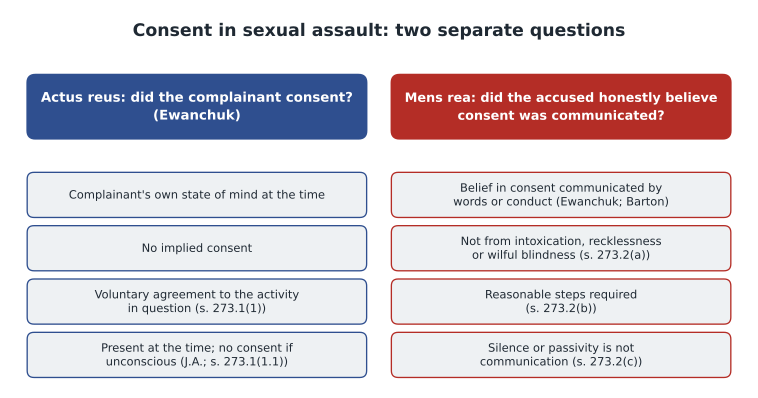
In R. v. Ewanchuk, [1999] 1 SCR 330, the accused invited a seventeen-year-old woman into his trailer for a job interview and engaged in increasingly intimate touching, stopping briefly each time she said no and then resuming. The trial judge acquitted on the basis of 'implied consent', and the Alberta Court of Appeal affirmed. The Supreme Court reversed and entered a conviction. Justice Major, for the majority, held that the absence of consent in the actus reus is determined by reference to the complainant's subjective internal state of mind toward the touching at the time it occurred. The question is simply whether the complainant wanted the touching to occur. There is no defence of implied consent to sexual assault in Canadian law.
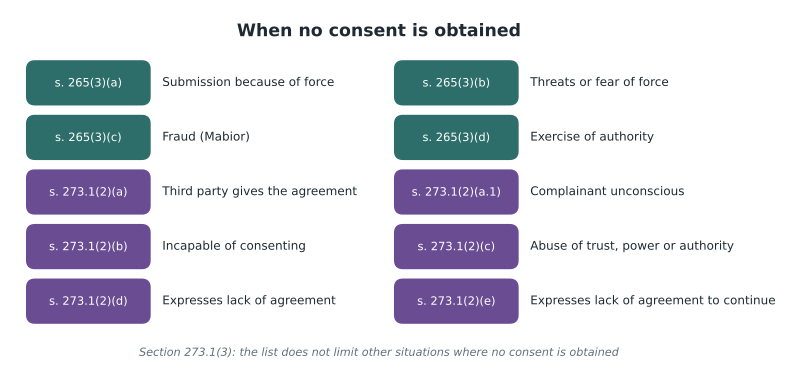
Ewanchuk established that the complainant's evidence that she did not consent, if believed, establishes the absence of consent for the actus reus, subject to the trier of fact's assessment of credibility in light of all the evidence. The complainant's conduct, such as passivity or ambiguous behaviour, is relevant to credibility but cannot substitute for her actual state of mind. Fear need not be reasonable, nor communicated, to vitiate consent: section 265(3)(a) provides that no consent is obtained where the complainant submits or does not resist by reason of the application of force, and section 265(3)(b) adds threats or fear of force.
Justice L'Heureux-Dubé, concurring, wrote a widely cited opinion criticizing the stereotypes reflected in the lower courts' reasoning, including the idea that a woman's failure to resist strongly, her clothing, or her presence in the accused's trailer implied consent. Those stereotypes, sometimes called rape myths, have been repeatedly rejected by the Court.
The statutory definition: section 273.1
Section 273.1(1) defines consent for the purposes of sections 271, 272 and 273 as 'the voluntary agreement of the complainant to engage in the sexual activity in question.' Section 273.1(1.1), added in 2018, provides that consent must be present at the time the sexual activity in question takes place. Section 273.1(1.2) clarifies that the question of whether no consent is obtained under subsection (2) or under section 265(3) is a question of law.
Section 273.1(2) lists circumstances in which no consent is obtained: where the agreement is expressed by the words or conduct of a person other than the complainant; where the complainant is unconscious; where the complainant is incapable of consenting for any other reason; where the accused induces the complainant to engage in the activity by abusing a position of trust, power or authority; where the complainant expresses, by words or conduct, a lack of agreement to engage in the activity; and where the complainant, having consented, expresses by words or conduct a lack of agreement to continue. Section 273.1(3) makes clear that the list does not limit other circumstances in which no consent is obtained.
Consent must be contemporaneous and conscious: R. v. J.A.
In R. v. J.A., 2011 SCC 28, the accused and his partner engaged in consensual erotic asphyxiation; she lost consciousness for a few minutes, during which he performed a further sexual act. She said she had consented in advance. Chief Justice McLachlin, for the majority, held that the Code requires the complainant to provide actual, active consent throughout every phase of the sexual activity. An unconscious person cannot consent, and advance consent to sexual activity that will occur while one is unconscious is not valid consent. The 2018 amendments in sections 273.1(1.1) and 273.1(2)(a.1) codified the result.
Capacity
Consent requires capacity. Section 273.1(2)(b) provides that no consent is obtained where the complainant is incapable of consenting. In R. v. G.F., 2021 SCC 20, the Court explained that capacity to consent requires that the complainant be capable of understanding the physical act, that it is sexual in nature, the specific identity of the partner, and that she has the choice to refuse to participate. Intoxication does not automatically negate capacity, but a complainant who is so intoxicated that she cannot understand these matters cannot consent. In R. v. Hutchinson, 2014 SCC 19, a case about sabotaged condoms, the majority held that the 'sexual activity in question' refers to the specific physical act, its sexual nature and the identity of the partner, and that deception about conditions such as contraception falls to be analyzed under fraud. Kirkpatrick, below, later distinguished Hutchinson for cases where a condom is not worn at all.
Kirkpatrick: condom use and the sexual activity in question
In R. v. Kirkpatrick, 2022 SCC 33, the complainant agreed to sex only if the accused wore a condom. He did not wear one, and she did not know. The question was whether her agreement was consent to 'the sexual activity in question.' A majority of the Court, per Justice Martin, held that when condom use is a condition of the complainant's agreement, sex without a condom is a fundamentally and qualitatively different physical act from sex with a condom. The complainant did not voluntarily agree to the sexual activity that occurred, so there was no consent under section 273.1(1). The Crown does not need to rely on fraud under section 265(3)(c), which in R. v. Mabior, 2012 SCC 47, requires a significant risk of serious bodily harm. Four judges agreed in the result but would have analyzed the case under fraud.
Fraud
Section 265(3)(c) provides that no consent is obtained where the complainant submits or does not resist by reason of fraud. In R. v. Cuerrier, [1998] 2 SCR 371, and Mabior, the Court held that fraud vitiates consent to sexual activity where there is dishonesty, including non-disclosure of HIV status, and deprivation in the form of a significant risk of serious bodily harm. In Mabior, the Court held that there is no realistic possibility of transmission, and so no deprivation, where the accused's viral load was low and a condom was used. Parliament and federal prosecutorial directives have since narrowed prosecutions for HIV non-disclosure, a policy debate the class will revisit in third year.
Mens rea and mistaken belief
The mens rea of sexual assault requires the intention to touch and knowledge of, recklessness as to, or wilful blindness about the complainant's lack of consent. An accused who honestly but mistakenly believed the complainant consented lacks the mens rea. The defence was recognized in R. v. Pappajohn, [1980] 2 SCR 120, which held that the belief need not be reasonable, only honestly held.
After Pappajohn, Parliament limited the defence. Section 273.2 provides that it is not a defence that the accused believed the complainant consented where the belief arose from self-induced intoxication, recklessness or wilful blindness; where it is based on any circumstance in section 265(3) or 273.1(2) in which no consent is obtained; or where the accused did not take reasonable steps, in the circumstances known to the accused at the time, to ascertain that the complainant was consenting. Since 2018, section 273.2(c) also provides that the belief cannot be based on the absence of express or implied communication of consent, such as silence or passivity.
Ewanchuk refined the defence. The belief must be a belief that the complainant communicated consent, by words or conduct. Justice Major called it the defence of honest but mistaken belief in communicated consent. A belief that silence, passivity or ambiguous conduct constitutes consent is a mistake of law, not of fact, and provides no defence. A belief that the complainant's 'no' meant yes is likewise a mistake of law.
In R. v. Barton, 2019 SCC 33, the accused was charged with murder after a woman he had hired for sex died from a wound she suffered during sexual activity in his hotel room. The Court ordered a new trial on manslaughter, finding errors in how the jury was instructed. Justice Moldaver, for the majority, explained the structure of the defence: the accused must believe the complainant communicated consent, by words or conduct, to the specific sexual activity; the belief cannot rest on assumptions, prior sexual history, the complainant's occupation or stereotypes; and the reasonable steps requirement must be assessed against the circumstances known to the accused. The Court emphasized that trial judges must take care to prevent juries from relying on myths and stereotypes, including about Indigenous women and sex workers. The complainant in Barton was Cindy Gladue, a Métis and Cree woman.
The reasonable steps requirement is not a requirement of perfection. The Ontario Court of Appeal upheld section 273.2(b) against a Charter challenge in R. v. Darrach (1998), 38 OR (3d) 1, and the Supreme Court later upheld the section 276 evidence regime in the same case, 2000 SCC 46. In Barton, the Court said that reasonable steps must be taken before the sexual activity, assessed on a quasi-objective standard: what a reasonable person would do in light of the circumstances known to the accused. The more invasive the activity, or the greater the risk, the more steps may be required. Steps based on rape myths or stereotypes are not reasonable.
Evidence rules in brief
Sexual assault trials are governed by special evidence rules. Section 276 bars evidence of the complainant's other sexual activity to support the twin myths that a complainant is more likely to have consented or is less worthy of belief because of that activity; such evidence is admissible for other purposes only after a hearing. The Court upheld section 276 in R. v. Seaboyer, [1991] 2 SCR 577 (striking down an earlier version) and Darrach, and in R. v. J.J., 2022 SCC 28, it upheld the regime extending these rules to records in the accused's possession. Sections 278.1 to 278.98 govern access to the complainant's private records. The Protecting Victims Act lengthened the notice period for applications under these provisions from seven to sixty days and raised the threshold for production of therapeutic records. LAWC-203 Evidence examines these rules.
A note on sentencing
Sexual offences against children are a sentencing priority. In R. v. Friesen, 2020 SCC 9, the Court directed that sentences for sexual offences against children must increase, recognizing the profound harm they cause, and that mid-single-digit penitentiary terms are normal for such offences, with substantially longer terms where aggravating factors are present. The 2026 amendments in Bill C-14 made conditional sentences unavailable for serious sexual offences, and Bill C-16 restored mandatory minimum penalties for child sexual offences, subject to a judicial safety valve, as lesson 12 explains.
Castellano ends with a question for the next class. 'Under Ewanchuk, the actus reus depends on the complainant's state of mind. Under section 273.2, the mens rea depends on what the accused took reasonable steps to find out. Explain to me why the law splits the inquiry that way.' Whitecloud tries an answer: the actus reus protects autonomy, while the mens rea protects against convicting the morally innocent, and section 273.2 decides who counts as morally innocent. 'Close,' she says. 'Write it up.'
Practice problems
Work each problem on paper first, then reveal the answer to check.
A complainant agrees to kissing but freezes and says nothing when the accused begins removing her clothing. He continues. He says he took her silence as agreement. Analyze.
Show answer
Actus reus: consent depends on her subjective state of mind at the time (Ewanchuk); if she did not want the touching, there was no consent, and freezing is not agreement. Mens rea: a belief that silence or passivity means consent is a mistake of law (Ewanchuk) and is excluded by section 273.2(c). He also took no reasonable steps to ascertain consent before escalating (section 273.2(b); Barton). The defence fails.
Partners agree in the morning to sexual activity that night while one is asleep. Is that consent?
Show answer
No. Consent must be present at the time of the activity (section 273.1(1.1)), and no consent is obtained where the complainant is unconscious (section 273.1(2)(a.1)). R. v. J.A. holds that advance consent to sexual activity while unconscious is not valid.
The complainant agreed to sex on condition that the accused wear a condom; he secretly did not. Which route establishes the absence of consent?
Show answer
Under Kirkpatrick, 2022 SCC 33, where condom use is a condition, sex without a condom is a different sexual activity, so there was no voluntary agreement to the activity in question under section 273.1(1). The Crown need not prove fraud and a significant risk of serious bodily harm under Mabior.
Summary and key terms
- Sexual assault is an assault in circumstances of a sexual nature, judged objectively (Chase); sections 271 to 273 create the offences.
- For the actus reus, consent turns on the complainant's subjective state of mind at the time; there is no implied consent (Ewanchuk).
- Section 273.1 defines consent as voluntary agreement to the sexual activity in question, present at the time, and lists situations where no consent is obtained.
- Unconscious persons cannot consent, even in advance (J.A.); capacity requires understanding the act, its sexual nature, the partner's identity and the right to refuse (G.F.).
- Where condom use is a condition, sex without one is not the activity agreed to (Kirkpatrick); fraud requires a significant risk of serious bodily harm (Mabior).
- Mistaken belief must be in communicated consent; section 273.2 bars beliefs from intoxication, recklessness, wilful blindness, silence or passivity, or without reasonable steps (Ewanchuk, Barton, Darrach).
- Consent (sexual assault)
- The voluntary agreement of the complainant to engage in the sexual activity in question, present at the time it occurs.
- Implied consent
- A supposed consent inferred from circumstances; Ewanchuk held it is not a defence to sexual assault.
- Honest but mistaken belief in communicated consent
- The defence that the accused believed the complainant communicated consent by words or conduct, limited by section 273.2.
- Reasonable steps
- Steps a reasonable person would take, in the circumstances known to the accused, to ascertain consent before sexual activity.
- Capacity to consent
- The ability to understand the act, its sexual nature, the partner's identity and that one may refuse.
- Twin myths
- The discredited inferences that a complainant's other sexual activity makes consent more likely or her evidence less credible.
- Sexual activity in question
- The specific physical act, its sexual nature and the partner's identity, and, after Kirkpatrick, condom use where it is a condition of agreement.
Lesson quiz · 5 questions
Score 60% or more to complete this lesson.
Create a free account to save your progress, take quizzes and earn a certificate.