
LAWC-103 · Lesson 11 of 12 · 20 min
Defences
▶ Video coming soon A video version of this lesson is on the way.
For the last substantive class before the capstone, Castellano changes the Calder facts once more. 'This time, Dorey threw the first punch. He is bigger than Calder, he is shouting that he will put Calder in the hospital, and he is reaching into his jacket. Calder shoves him away. Now what?' Theo Marchetti says self-defence. Sophie Tremblay-Hart asks whether it matters that Calder could have walked away. Arjun Mehta wants to know whether it matters if Dorey was only reaching for his phone. 'Good,' Castellano says. 'Those are the three hardest questions in self-defence. And when we finish self-defence, we have necessity, duress, provocation and mistake to cover.'
This lesson covers the justifications and excuses: self-defence under section 34 after the 2012 reform and R. v. Khill; defence of property under section 35; necessity (Perka, Latimer); duress under section 17 and at common law (Ruzic, Ryan); provocation under section 232 as amended in 2015; and mistake of law, including officially induced error. Entrapment and abuse of process, which lead to stays of proceedings rather than acquittals, are covered in LAWC-211.
Justifications and excuses
Canadian law distinguishes justifications and excuses. A justification challenges the wrongfulness of the act: in the circumstances, the act was the right thing to do, or at least a permissible thing. Self-defence is the leading justification. An excuse concedes that the act was wrong but holds that the accused should not be punished because the circumstances made the conduct morally involuntary. Necessity and duress are excuses. In Perka v. The Queen, [1984] 2 SCR 232, Justice Dickson explained that necessity is an excuse resting on a realistic assessment of human weakness, recognizing that a liberal and humane criminal law cannot hold people to the strict obedience of laws in emergency situations where normal human instincts overwhelmingly impel disobedience. The distinction matters because it shapes how the defences are framed and what limits apply.
Self-defence: section 34
Section 34, as replaced by the Citizen's Arrest and Self-defence Act, SC 2012, c. 9, in force March 11, 2013, created a single defence in place of the old patchwork of overlapping provisions. Section 34(1) provides that a person is not guilty of an offence if (a) they believe on reasonable grounds that force is being used against them or another person or that a threat of force is being made against them or another person; (b) the act that constitutes the offence is committed for the purpose of defending or protecting themselves or the other person from that use or threat of force; and (c) the act committed is reasonable in the circumstances.
In R. v. Khill, 2021 SCC 37, the Supreme Court gave the definitive interpretation. Khill was awakened at night by his partner, who saw a man in their truck in the driveway. Khill, a former army reservist, took his shotgun, went outside and, when the man, Jon Styres, turned toward him, shot him twice, believing he had a gun. Styres was unarmed. A jury acquitted Khill of second degree murder. The Supreme Court upheld the Ontario Court of Appeal's order for a new trial because the jury had not been told to consider Khill's role in the incident under section 34(2)(c).
Justice Martin, for the majority, described the three elements as the catalyst, the motive and the response. The catalyst, in section 34(1)(a), asks whether the accused believed on reasonable grounds that force or a threat of force was being used against them or another person. The belief must be honestly held and objectively reasonable. A reasonable but mistaken belief, as where the victim was reaching for a phone, still satisfies the catalyst element. The motive, in section 34(1)(b), is subjective: did the accused act for the purpose of defending or protecting, rather than for vengeance or to settle a score? The response, in section 34(1)(c), asks whether the act was reasonable in the circumstances, considered from the perspective of a reasonable person with relevant characteristics and experiences of the accused.
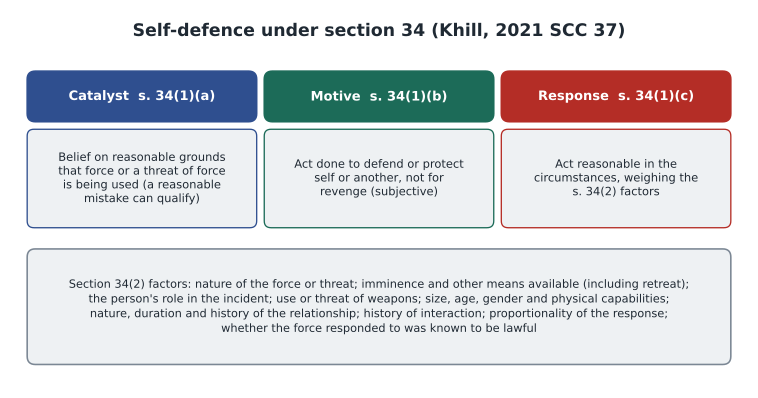
The reasonableness factors in section 34(2)
Section 34(2) lists factors the court must consider in deciding whether the act was reasonable: the nature of the force or threat; the extent to which the use of force was imminent and whether there were other means available to respond to the potential use of force; the person's role in the incident; whether any party used or threatened to use a weapon; the size, age, gender and physical capabilities of the parties; the nature, duration and history of any relationship between the parties, including prior use or threat of force; any history of interaction or communication between the parties; the nature and proportionality of the person's response; and whether the act was committed in response to a use or threat of force that the person knew was lawful.
Khill held that the accused's role in the incident is broad. It includes the accused's conduct throughout the incident, from beginning to end, not just whether the accused was the initial aggressor. Conduct that is provocative, excessive, unlawful or simply unreasonable, and that contributed to the confrontation, may make the final act less reasonable. Khill's decision to leave the safety of his house with a loaded shotgun to confront the man in the truck, rather than calling police, was part of his role and should have been put to the jury.
Retreat and imminence are factors, not rules. The old law suggested that the accused had to retreat if possible and that the threat had to be imminent. Under section 34(2)(b), the availability of other means, including retreat, and the imminence of the threat are only factors. In R. v. Lavallee, [1990] 1 SCR 852, decided under the old provisions, the accused shot her abusive partner in the back of the head as he left the room after threatening to kill her later. The Court held that expert evidence on battered woman syndrome was admissible to help the jury understand why she believed she could not escape and why she perceived the threat as imminent, and that the law does not require a battered woman to wait until her abuser attacks before acting. The current section 34(2)(f) and (f.1) codify the relevance of the relationship and history between the parties.
Applying section 34 to Calder
In Castellano's new facts, Calder believed Dorey was about to use force and possibly reach for a weapon. If the belief was honestly held and reasonable, the catalyst is satisfied, even if Dorey was reaching for his phone. If Calder shoved Dorey to defend himself, the motive is satisfied. The response, a single shove against a larger man who threw the first punch and threatened serious harm, seems reasonable, considering size, the threat and the proportionality of a shove. Tremblay-Hart's point about walking away is relevant under section 34(2)(b), but it does not end the analysis. The Crown would need to disprove self-defence beyond a reasonable doubt once there is an air of reality to it.
Defence of property: section 35
Section 35 provides a defence where a person believes on reasonable grounds that they are in peaceable possession of property and that another person is about to enter, is entering or has entered it without being entitled to, is about to take or damage it, or has done so, and the act is committed for the purpose of preventing or ending the interference, and is reasonable in the circumstances. The defence does not permit the use of force likely to cause death or grievous bodily harm simply to protect property; deadly force would rarely be reasonable unless self-defence is also engaged. The 2012 reform was prompted in part by the case of a Toronto shopkeeper, David Chen, who in 2009 detained a man who had stolen from his store, and was charged but acquitted.
Necessity
Necessity is a common law excuse preserved by section 8(3). In Perka, the accused were drug smugglers whose ship, carrying cannabis from Colombia to Alaska, developed mechanical problems in a storm, and who put into a cove on Vancouver Island to make repairs. Justice Dickson set out three requirements: the accused must have faced a situation of clear and imminent peril, where disaster was imminent or harm unavoidable and near; there must have been no reasonable legal alternative to breaking the law; and the harm inflicted must be proportionate to the harm avoided.
In R. v. Latimer, 2001 SCC 1, the accused killed his twelve-year-old daughter, Tracy, who had severe cerebral palsy, by putting her in the cab of his truck and running exhaust into it, because he believed she faced painful surgery. The Court held that there was no air of reality to necessity. The first two requirements are assessed on a modified objective standard that considers the situation and characteristics of the accused; there was no imminent peril, because the surgery was not an emergency, and there were legal alternatives, such as surgery with pain management or placing Tracy in care. The proportionality requirement is assessed on a purely objective standard, and the Court said it was difficult to imagine a situation where killing a person would be proportionate. Latimer's conviction for second degree murder and the mandatory minimum sentence were upheld.
Duress
Duress exists in two forms. Section 17 provides a statutory defence for a person who commits an offence under compulsion by threats of immediate death or bodily harm from a person present when the offence is committed, if the person believes the threats will be carried out and is not a party to a conspiracy or association subjecting him to compulsion. Section 17 excludes a long list of offences, including murder, attempted murder, sexual assault, robbery, arson and others. The common law defence of duress, preserved by section 8(3), applies to parties to offences, since section 17 applies only to principals (R. v. Paquette, [1977] 2 SCR 189).
In R. v. Ruzic, 2001 SCC 24, the accused imported heroin into Canada from Belgrade after a man threatened to harm her mother in Belgrade if she did not. The threat was not of immediate harm by a person present. The Court held that the immediacy and presence requirements in section 17 violated section 7 because they allowed conviction of persons who acted in a morally involuntary way. Those requirements were struck down, and Ruzic was permitted to rely on the common law defence.
In R. v. Ryan, 2013 SCC 3, the accused tried to hire a hit man to kill her abusive husband. She was charged with counselling murder and raised duress. The Court held that duress was not available, because duress applies only where the accused is compelled by threats to commit an offence against a third party, not where the accused acts against the person making the threats; that is the domain of self-defence. Ryan also restated the elements of duress, which now largely overlap between the statute and the common law: an explicit or implicit threat of death or bodily harm against the accused or a third person; a reasonable belief that the threat would be carried out; no safe avenue of escape, assessed on a modified objective standard; a close temporal connection between the threat and the harm threatened; proportionality between the harm threatened and the harm inflicted; and the accused must not be a party to a conspiracy or criminal association in which they knew threats were likely. The Court stayed proceedings against Ryan because of the unusual circumstances, including the Crown's change of position and the abuse she had suffered.
Provocation: section 232
Provocation is a partial defence to murder only: it reduces murder to manslaughter. As amended by the Zero Tolerance for Barbaric Cultural Practices Act, SC 2015, c. 29, in force July 17, 2015, section 232(2) provides that conduct of the victim that would constitute an indictable offence punishable by five or more years of imprisonment, and that is of such a nature as to be sufficient to deprive an ordinary person of the power of self-control, is provocation if the accused acted on it on the sudden and before there was time for his passion to cool. Before 2015, a 'wrongful act or insult' of the victim could be provocation. The amendment means that insults, infidelity and other lawful conduct can no longer be provocation.
The defence has an objective element and a subjective element. The objective element asks whether the conduct was sufficient to deprive an ordinary person of the power of self-control. In R. v. Tran, 2010 SCC 58, the Court held that the ordinary person has the normal temperament and level of self-control of an ordinary person, and shares relevant characteristics of the accused, such as age and sex, but the standard is informed by contemporary norms and Charter values. In Tran, the accused attacked his estranged wife and her new partner when he found them in bed together; the Court held that a separated spouse's new relationship could not, in law, be provocation. The subjective element asks whether the accused actually acted in response to the provocation, on the sudden and before his passion cooled. In R. v. Cairney, 2013 SCC 55, the Court held that there must be an air of reality to both elements, and that an accused who instigates a confrontation and receives the expected response may not have acted on the sudden.
Mistake of law and officially induced error
Section 19 provides that ignorance of the law by a person who commits an offence is not an excuse for committing that offence. The rule reflects the principle that everyone is presumed to know the law, and the practical concern that a mistake of law defence would reward ignorance and be easy to fabricate. A mistake of fact negates mens rea, as lesson 4 explained; a mistake about whether conduct is legal does not.
There are limited exceptions. Some offences make knowledge of a legal status an element, such as acting without colour of right in theft. And the common law recognizes officially induced error. In R. v. Jorgensen, [1995] 4 SCR 55, Chief Justice Lamer, concurring, set out its elements, which the Court adopted in Lévis (City) v. Tétreault, 2006 SCC 12: an error of law or of mixed law and fact; the accused considered the legal consequences of the act; advice was obtained from an appropriate official; the advice was reasonable; the advice was erroneous; and the accused relied on it. The defence results in a stay of proceedings rather than an acquittal.
The structure of defence analysis
Castellano ends with a checklist. First, is there an air of reality to the defence on the totality of the evidence (Cinous)? Second, who bears the burden? For self-defence, necessity, duress and provocation, the accused bears only an evidential burden, and the Crown must disprove the defence beyond a reasonable doubt. For mental disorder and automatism, the accused must prove the defence on a balance of probabilities. Third, what are the elements, and which are subjective, objective or modified objective? Fourth, what is the result: acquittal, conviction for a lesser offence, NCR or a stay? 'Defences are where the facts matter most,' she says. 'On Thursday we put it all together.'
Practice problems
Work each problem on paper first, then reveal the answer to check.
Mira, who has been abused by her partner for years, hits him with a lamp while he is sleeping after he told her he would kill her in the morning. Analyze self-defence.
Show answer
Catalyst: did she believe on reasonable grounds that force or a threat of force was being used, considering the history of the relationship (section 34(2)(f), (f.1); Lavallee)? A threat to kill in the morning can satisfy this. Motive: did she act to protect herself? Response: was the act reasonable, considering imminence, other means such as leaving or calling police, the history of abuse and proportionality? Imminence and retreat are only factors (section 34(2)(b)). The Crown must disprove the defence beyond a reasonable doubt once there is an air of reality.
Max, a gang member, is told by his gang leader that he will be beaten unless he delivers a package of drugs. Can he rely on duress?
Show answer
Probably not. Duress is unavailable to a person who is a party to a conspiracy or criminal association and knew that threats or compulsion were likely (section 17; Ryan). By joining the gang, he likely accepted that risk. He would also have to show no safe avenue of escape, such as going to police.
An accused kills his wife after she tells him she is leaving him for another man. He says he lost control. Is provocation available?
Show answer
No. Since 2015, provocation requires conduct of the victim that would be an indictable offence punishable by five years or more (section 232(2)). Telling someone you are leaving is lawful. Even before 2015, Tran held that a spouse's lawful decision to leave or enter a new relationship could not be provocation in law.
Summary and key terms
- Justifications (self-defence) deny wrongfulness; excuses (necessity, duress) recognize moral involuntariness (Perka).
- Section 34: catalyst (reasonable belief in force or threat), motive (defensive purpose) and response (reasonable in the circumstances) (Khill, 2021 SCC 37); role in the incident is broad; retreat and imminence are factors.
- Section 35 protects peaceable possession of property with reasonable force.
- Necessity requires imminent peril, no reasonable legal alternative and proportionality (Perka, Latimer).
- Duress: section 17 for principals (immediacy and presence struck down in Ruzic); common law for parties; elements restated in Ryan; not available against the threatener.
- Provocation reduces murder to manslaughter; since 2015 it requires victim conduct amounting to a serious indictable offence (section 232; Tran; Cairney).
- Ignorance of the law is no excuse (section 19), except officially induced error, which leads to a stay (Jorgensen; Lévis v. Tétreault).
- Justification
- A defence that the act was right or permissible in the circumstances, such as self-defence.
- Excuse
- A defence that the act was wrong but the accused should not be punished because it was morally involuntary, such as duress or necessity.
- Catalyst, motive and response
- The three elements of self-defence under section 34(1) as described in Khill.
- Modified objective standard
- A reasonableness test that takes account of the accused's situation and relevant characteristics.
- Duress
- An excuse for committing an offence under threats of death or bodily harm with no safe avenue of escape.
- Provocation
- A partial defence reducing murder to manslaughter where the victim's serious criminal conduct caused a sudden loss of self-control.
- Officially induced error
- A defence, leading to a stay, for reasonable reliance on erroneous legal advice from an appropriate official.
Lesson quiz · 5 questions
Score 60% or more to complete this lesson.
Create a free account to save your progress, take quizzes and earn a certificate.