
LAWC-102 · Lesson 9 of 12 · 18 min
Good faith in contractual performance
▶ Video coming soon A video version of this lesson is on the way.
Professor Varga puts a question on the screen before anyone has sat down: 'Is it a breach of contract to lie to your contracting partner about something the contract does not mention?' For most of the twentieth century, he explains, a Canadian common-law court would probably have said no, so long as you did what the contract required. 'Then, in 2014, the Supreme Court changed the conversation.' Sophie Tremblay-Hart notes that the Civil Code of Québec has required good faith in every contract since 1994. 'Exactly,' says Varga. 'The common law took a while to catch up, and it has done so in its own, narrower way.'
This lesson examines the organizing principle of good faith in Canadian common law contract law and the specific duties that flow from it: the duty of honest performance, the duty to exercise contractual discretion in good faith, and related obligations. It also looks at what good faith does not require.
Before Bhasin
Traditional common law resisted a general doctrine of good faith. Parties were free to pursue their own interests, and courts feared that a vague duty would let judges rewrite bargains. But good faith appeared in many specific doctrines: implied terms requiring cooperation, the duty of insurers and insureds to act with utmost good faith, the employer's obligation to act in good faith in the manner of dismissal (Wallace v. United Grain Growers Ltd., [1997] 3 SCR 701, later reframed in Honda Canada Inc. v. Keays, 2008 SCC 39), and limits on the exercise of discretion in some contracts. Courts also recognized implied obligations of good faith in tendering, after M.J.B. Enterprises. The picture was piecemeal and unpredictable.
Bhasin v. Hrynew
In Bhasin v. Hrynew, 2014 SCC 71, Harish Bhasin was an enrolment director selling education savings plans for Can-Am, an Alberta company. His dealer agreement renewed automatically every three years unless either party gave six months' notice of non-renewal. Another enrolment director, Larry Hrynew, wanted to take over Bhasin's agency. When the Alberta Securities Commission required Can-Am to appoint an officer to audit its enrolment directors for compliance, Can-Am appointed Hrynew, Bhasin's competitor, to review Bhasin's confidential records. Can-Am misled Bhasin about its plans, including a restructuring in which Bhasin's agents would move to Hrynew's agency, and equivocated when he asked whether the merger was a done deal. When Bhasin refused to let Hrynew audit his records, Can-Am gave notice of non-renewal. Bhasin lost the value of his business, and many of his agents went to work for Hrynew.
Justice Cromwell, for a unanimous Court, made two incremental steps.
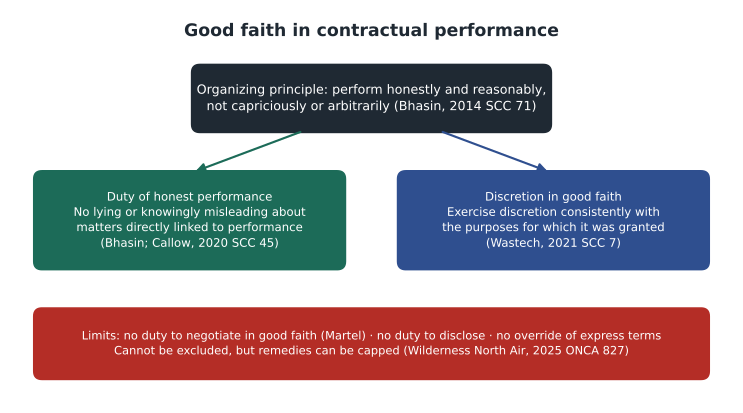
- First, good faith contractual performance is a general organizing principle of the common law of contract. It underpins and informs more specific doctrines and can be used to develop them. The principle is that parties generally must perform their contractual duties honestly and reasonably and not capriciously or arbitrarily. It does not impose a duty of loyalty or of disclosure, or require a party to put the interests of the other ahead of its own.
- Second, the Court recognized a new common law duty that applies to all contracts as a manifestation of the organizing principle: the duty of honest performance. Parties must not lie or otherwise knowingly mislead each other about matters directly linked to the performance of the contract. The duty is not an implied term; it operates as a general doctrine of contract law that parties cannot exclude, although they may relax its requirements in some ways, provided they respect its minimum core.
Can-Am breached the duty by misleading Bhasin about its plans and the effect of the audit. The Court assessed damages on the expectation basis: what Bhasin would have been in had Can-Am performed honestly. Had Can-Am been honest, Bhasin could have taken steps to protect his business, so damages reflected the value of his business at the time of non-renewal. Hrynew was not liable, because the duty of honest performance runs between contracting parties.
C.M. Callow Inc. v. Zollinger
In C.M. Callow Inc. v. Zollinger, 2020 SCC 45, ten condominium corporations had a two-year winter maintenance contract with Callow, which they could terminate on ten days' notice. In the spring of the first year, they decided to terminate but did not tell Callow. Over the summer, their representatives made statements that led Callow to believe the contract would continue, and Callow performed some extra work for free in the hope of renewal. In September the condominiums gave notice. By then it was too late for Callow to bid on other winter contracts.
Justice Kasirer, for the majority, held that the condominiums breached the duty of honest performance by knowingly misleading Callow about the termination clause's exercise. The duty applied even though the termination right was unrestricted: a party must exercise even an unconditional right honestly. Active deception does not require an outright lie. Half-truths, omissions and even silence can be part of a course of conduct that knowingly misleads, depending on the circumstances. The duty is still not a duty to disclose; the condominiums could have kept silent about their plans. What they could not do was create and maintain a false impression through their words and conduct.
On remedy, the majority held that damages are expectation damages, putting Callow in the position it would have been in had the condominiums been honest. If they had told the truth, Callow could have bid on other contracts, so damages reflected the opportunity lost. A concurring judgment would have analyzed the case through the law of civil fraud, and a dissent found no active deception on the facts.
Wastech: discretion exercised in good faith
In Wastech Services Ltd. v. Greater Vancouver Sewerage and Drainage District, 2021 SCC 7, the Court addressed a second duty: the duty to exercise contractual discretion in good faith. Wastech transported municipal waste under a long-term contract that allowed Metro Vancouver to allocate waste among three disposal facilities. Wastech was paid more for hauling to the most distant site. The contract set a target operating ratio for Wastech's profits but did not guarantee it. In 2011 Metro sent more waste to a nearer facility, which cut Wastech's revenue, and Wastech claimed a breach of good faith. An arbitrator agreed, but the courts set the award aside.
Justice Kasirer, for the majority, held that where a contract gives one party a discretionary power, the duty to exercise discretion in good faith requires that it be exercised reasonably, meaning in a manner connected to the purposes for which the discretion was granted. The purposes are identified by interpreting the contract as a whole, using the principles in Sattva. The duty applies to all contracts, regardless of the parties' intentions, but its content is shaped by the contract. Within the range of choices consistent with those purposes, a party may act in its own interest.
On the facts, the discretion to allocate waste was given so that Metro could achieve efficiency and keep costs down. Metro's allocation served those purposes, even though it hurt Wastech, so there was no breach. The contract did not guarantee Wastech its target ratio, and the Court would not use good faith to give Wastech a guarantee it had not bargained for. Justices Brown and Rowe, joined by Justice Côté, agreed with the result but disagreed with parts of the majority's analysis.
Good faith in employment
Employment contracts are a fertile ground for good faith. In Matthews v. Ocean Nutrition Canada Ltd., 2020 SCC 26, a senior chemist was constructively dismissed shortly before the company was sold. His long-term incentive plan said payment required that he be a full-time employee at the time of the sale, and purported to exclude any claim for damages after termination 'with or without cause'. The Court held that the clause did not clearly remove his right to damages for the bonus he would have received during the reasonable notice period, so he recovered it. The Court noted that the organizing principle of good faith informs the employer's conduct in dismissal, but did not need to decide whether there had been a separate breach of good faith, because the damages were already covered.
Good faith and the Crown
Contracts between the Crown and Indigenous peoples add a public law dimension. In Quebec (Attorney General) v. Pekuakamiulnuatsh Takuhikan, 2024 SCC 39, Quebec and Canada had funded an Indigenous police force in the community of Mashteuiatsh under successive tripartite agreements. Funding was inadequate, and the band council absorbed deficits. The majority, in reasons by Justice Kasirer, held that Quebec's refusal to renegotiate its contribution when the agreements were renewed breached both the duty of good faith under article 1375 of the Civil Code of Québec and the honour of the Crown, which applies to the performance of agreements made with Indigenous peoples in pursuit of reconciliation. The Court upheld an award equal to Quebec's share of the accumulated deficits as a remedy for the breach of the honour of the Crown. Although decided under Quebec law, the honour of the Crown analysis applies across Canada.
Limits on good faith
Good faith in Canadian common law has clear limits.
- There is no general duty to negotiate in good faith. Parties to negotiations may walk away for any reason, and in Martel Building Ltd. v. Canada, 2000 SCC 60, the Court refused to recognize a tort duty of care in the conduct of commercial negotiations. Parties can agree to negotiate in good faith, and courts may enforce such an agreement if its terms are sufficiently certain.
- There is no general duty to disclose. Callow confirms that silence alone is not dishonest performance, though it can contribute to active deception.
- Good faith does not override express terms. It does not let a court rewrite the allocation of risk or impose obligations inconsistent with the contract.
- Parties cannot exclude the duty of honest performance, but they can limit the remedies for breaching it, as the Ontario Court of Appeal held in Wilderness North Air v. Hydro One Remote Communities, 2025 ONCA 827, discussed in Lesson 6.
Other specific duties may still develop under the organizing principle. Courts have discussed a duty of cooperation, implied obligations not to undermine the other party's performance, and good faith in the exercise of termination rights. Bhasin described the organizing principle as a standard that informs doctrine, not a free-standing source of new obligations.
Damages for breach of good faith
Because the good faith duties are contractual, damages are assessed on the ordinary contractual basis: the innocent party is put in the position it would have been in had the duty been performed. For the duty of honest performance, that means the position if the defendant had not lied, not the position if the contract had continued. That is why Bhasin received the value of his business at non-renewal, and Callow the value of the opportunity it lost. For the discretion duty, damages reflect what would have happened had the discretion been exercised reasonably, which may simply be a different reasonable choice.
Back to the question
Varga returns to the opening question. Lying to your contracting partner about a matter directly linked to the contract's performance is now a breach of contract in every common-law province, even if the contract says nothing about it and even if you have an unrestricted right to terminate. Keeping your plans to yourself is not. 'The line,' he tells the class, 'is between staying quiet and creating a false impression. Most of my clients who got in trouble did not stay quiet.'
| Case | Duty | Holding |
|---|---|---|
| Bhasin v. Hrynew, 2014 SCC 71 | Organizing principle; honest performance | Parties must not lie or knowingly mislead about matters directly linked to performance |
| C.M. Callow v. Zollinger, 2020 SCC 45 | Honest performance | Applies to unrestricted termination rights; active deception can include half-truths and silence |
| Wastech v. Greater Vancouver Sewerage, 2021 SCC 7 | Discretion in good faith | Discretion must be exercised reasonably, consistent with the purposes for which it was granted |
| Matthews v. Ocean Nutrition, 2020 SCC 26 | Employment; incentive plan | Clause did not clearly exclude damages for bonus during reasonable notice |
| Quebec (AG) v. Pekuakamiulnuatsh Takuhikan, 2024 SCC 39 | Civil law good faith; honour of the Crown | Refusal to renegotiate funding breached good faith and the honour of the Crown |
| Martel Building v. Canada, 2000 SCC 60 | Negotiations | No tort duty of care in conducting commercial negotiations |
Common mistakes
MistakeBhasin created a general duty to act in the other party's best interests.
InsteadIt recognized an organizing principle and a specific duty of honest performance. There is no duty of loyalty or disclosure.
MistakeIf a contract gives an unrestricted right to terminate, good faith is irrelevant.
InsteadCallow held that even an unrestricted right must be exercised honestly; a party may not knowingly mislead about it.
MistakeGood faith in discretion means the party must exercise its discretion to benefit the other party.
InsteadWastech requires only that discretion be exercised consistently with the purposes for which it was granted; a party may act in its own interest within that range.
MistakeParties can contract out of the duty of honest performance.
InsteadThey cannot exclude it, though they may limit the remedy (Wilderness North Air) and adjust its requirements while respecting its minimum core.
Practice problems
Work each problem on paper first, then reveal the answer to check.
Lakeshore has a three-year exclusive distribution deal with a retailer, terminable on 60 days' notice. Lakeshore decides in March to terminate in September but tells the retailer in June, when asked, that 'we're excited about next year together'. The retailer turns down a competing line. What claim does the retailer have?
Show answer
Breach of the duty of honest performance under Bhasin and Callow: Lakeshore knowingly misled the retailer about the exercise of its termination right. Damages put the retailer where it would have been had Lakeshore been honest, likely the value of the competing opportunity it lost, not profits for the rest of the three years.
A supply contract lets Lakeshore set quarterly order quantities 'in its discretion'. Lakeshore cuts orders sharply after finding a cheaper supplier. Is this a breach of good faith?
Show answer
It depends on the purposes for which the discretion was granted (Wastech). If it was granted to let Lakeshore match production to demand, cutting orders to switch suppliers may be outside those purposes, especially if the contract implies the supplier is the main source. If the contract contemplated Lakeshore seeking better prices, there may be no breach.
Why did Bhasin hold that Hrynew was not personally liable for breach of the duty of honest performance?
Show answer
The duty arises from the contract and applies between contracting parties; Hrynew was not a party to Bhasin's agreement with Can-Am.
Summary and key terms
- Good faith contractual performance is an organizing principle of Canadian common law contract law (Bhasin).
- The duty of honest performance forbids lying or knowingly misleading about matters directly linked to performance; it applies to every contract and cannot be excluded.
- Callow extends the duty to unrestricted termination rights and holds that half-truths and silence can be part of active deception, without creating a duty to disclose.
- Wastech requires contractual discretion to be exercised consistently with the purposes for which it was granted.
- Good faith does not create duties to negotiate, disclose or act against one's own interests, and does not override express terms.
- Damages for breach of good faith duties are expectation damages measured by what would have happened had the duty been performed.
- Organizing principle
- A general standard that underpins and informs more specific doctrines, such as good faith contractual performance.
- Duty of honest performance
- The duty not to lie or knowingly mislead a contracting partner about matters directly linked to the contract's performance.
- Active deception
- A course of conduct, including half-truths or silence in context, that knowingly creates a false impression.
- Contractual discretion
- A power under a contract allowing one party to make choices affecting the other party's interests.
- Honour of the Crown
- A constitutional principle requiring the Crown to act honourably in its dealings with Indigenous peoples, including in performing agreements with them.
Lesson quiz · 5 questions
Score 60% or more to complete this lesson.
Create a free account to save your progress, take quizzes and earn a certificate.